
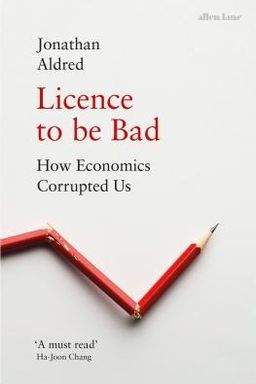
Licence to be Bad cover

Licence to be Bad

by Jonathan Aldred

In ''Licence to be Bad'', Jonathan Aldred explores how a few influential economic theories have altered our perceptions of morality and ethics over the past 50 years. By dissecting concepts like game theory and free-rider thinking, Aldred challenges the supposed objectivity of economics and highlights the social and environmental consequences of prioritizing economic efficiency.

How Economic Ideas Rewired Modern Life

If you want to understand why governments now talk like businesses, why citizens are called consumers, and why markets are treated as moral arbiters, you need to trace how economic ideas captured political and cultural imagination. This book argues that over the past seventy years, abstract economic theories migrated from seminar rooms into boardrooms, parliaments, and everyday speech. They promised rigor and clarity, but often smuggled in moral and political judgments disguised as technical reasoning.

The story begins with postwar anxieties about state power and central planning. Friedrich Hayek’s Mont Pèlerin project seeded a global network of thinkers who reframed freedom as economic rather than political liberty. Through think tanks, donors, and media outreach, those ideas redefined what counted as ‘reasonable policy.’ The default assumption became that markets deliver freedom, while governments must justify any intervention. This intellectual revolution—popularly called neoliberalism—was not a conspiracy but a deliberate long game to reshape the moral weather.

From ideas to institutions

Policy rarely changes through logic alone. Wealthy donors like Antony Fisher converted Hayek’s philosophy into organizational power: creating the Institute of Economic Affairs in Britain, the Atlas Network abroad, and the intellectual foundations later drawn on by Thatcher, Reagan, and countless technocrats. Milton Friedman’s claim that a firm’s only duty is to maximize profit spread through classrooms and boardrooms, legitimizing what would once have looked antisocial—aggressive deregulation, cost-cutting at the expense of safety, and short-term shareholder focus. When elites changed their intellectual reference points, institutions followed.

The seductions of models and numbers

The mid‑century also witnessed the mathematization of social reasoning. Game theory, decision theory, and welfare economics offered what seemed like a disinterested, scientific map of human motives. John von Neumann and John Nash turned behavior into payoff matrices and equilibria. Ken Arrow translated voting into logic and proved that no perfectly rational collective decision rule exists. These findings captivated policymakers and military strategists alike, suggesting that behavior could be quantified and optimized. Yet, as the book warns, the attraction of mathematical authority often obscured the fragile assumptions beneath: hyper‑rational agents, perfect information, and shared reasoning rarely describe real humans or real democracies.

When elegant ideas mislead reality

The Coase theorem, for instance, began as a thought experiment showing that if transaction costs were zero, private bargaining could solve social harms efficiently. But when Chicago disciples reinterpreted it as a literal instruction—deregulate and let markets fix themselves—they ignored Coase’s core point that real negotiations are costly and require law and institutions. Arrow’s impossibility theorem similarly became a conservative slogan against democratic rationality, fueling arguments to replace politics with markets. Once mathematical parables escaped their technical contexts, they became moral weapons.

The moral economy of incentives

Later, late‑century policy imported behavioral and incentive concepts. The belief that “you get what you reward” inspired corporate reforms, school bonuses, and ‘nudges’ meant to steer without coercion. Yet incentives are never neutral: they communicate distrust, crowd out intrinsic motives, and reshape identities. Experiments from daycare fines in Haifa to paid blood donation in England show how monetary rewards can erode civic or moral engagement. Similarly, behavioral nudges may work statistically but raise ethical questions when they covertly manipulate default choices without deliberation or consent.

Becker, numbers, and the reach of the economic lens

Gary Becker’s project expanded economic logic into family, crime, and discrimination. His framework treated all behavior as rational maximization of ‘utility,’ flattening moral and cultural distinctions. Combined with attempts to price human life (Thomas Schelling’s ‘value of statistical life’) and numerical risk models in finance or climate economics, the culture of quantification produced both power and blindness. It justified auctioning kidneys, assigning probabilities to unknowable events, and treating future extinction as a discounted cash flow. Numbers whispered certainty where uncertainty and ethics belonged.

Politics, inequality, and the call for humility

By the 1980s, the intellectual tide converged into policy: tax cuts for the richest, performance pay, privatization, and weakened labor institutions. Inequality soared, defended by a meritocratic myth that the rich were simply more ‘productive.’ The book connects this shift directly to the long march of economic ideas from Mont Pèlerin to Wall Street. It concludes that reclaiming balance requires humility: economists must acknowledge their discipline’s ethical foundations, disclose conflicts, and treat models as guides, not gospel. Economics should serve democratic judgment, not replace it.

In short, the book shows how ideas about markets, rationality, and incentives became governing metaphors for human life—and why recovering moral and political judgment is essential if we wish to build economies that serve people, not the reverse.


How Market Faith Was Built

Hayek foresaw that changing policy required first changing belief. After World War II he and colleagues at the 1947 Mont Pèlerin conference launched a moral campaign for markets. They saw collectivism as a new serfdom and built institutions to shift the culture itself. When Antony Fisher founded the Institute of Economic Affairs and later the Atlas Network, he turned moral philosophy into an infrastructure of persuasion—media briefings, policy memos, donor coalitions. The goal was not immediate power but slow conversion: make market logic the background common sense of modern life.

Think tanks as cultural engineers

Think tanks like IEA in Britain or Cato in the US blurred boundaries between academia and lobbying. Funded by wealthy patrons, they coached journalists and trained politicians. Their success is visible when phrases such as 'government inefficiency' or 'personal responsibility' sound descriptive rather than ideological. That linguistic normalization gave political leaders—Thatcher, Reagan, Pinochet’s advisers—tools to justify wide privatization and deregulation. (You might compare this to Antonio Gramsci’s idea of cultural hegemony: whoever sets the terms of debate wins before arguments begin.)

The moral turning point

Milton Friedman’s 1970 essay in The New York Times declared that business’s only social responsibility is profit. It captured a new moral order: profit became virtue, and social concern became distraction. Over time, firms adopted that creed as ethical permission for greed. When corporate scandals from Enron to Volkswagen erupted, they revealed how a moral language built to defend freedom had metastasized into a permission structure for deceit and external harm.

The long shadow

This intellectual infrastructure endures. International networks like Atlas or Heritage still circulate one-page doctrines for emerging leaders. Their power lies not in conspiracy but in persistence: decades of essays, grants, and friendships that turned free-market dogma into civic reflex. Understanding that lineage helps you see how 'the economy' became not a domain of choice but the arbiter of all choices.


When Models Became Masters

Game theory, decision science, and welfare economics promised to make social behavior computable. John von Neumann’s wartime abstraction of human conflict gave administrators a seductive toolkit: represent any strategic situation as a game, find its equilibrium, and infer rational policy. RAND analysts even modeled nuclear deterrence using these games. Yet these frameworks, appealing in their precision, imported severe simplifications — agents with perfect foresight, symmetric reasoning, and fixed payoffs. When exported to politics or everyday life, that precision became illusion.

Equilibrium and its human gaps

John Nash’s equilibrium concept — each player choosing optimally given others’ choices — underpins much economic theory. It defines stability, not predictability. In real markets or diplomatic crises, players misread one another, lack shared beliefs, and face multiple equilibria. Reinhard Selten’s refinements and backward induction made theory neater but less human. Laboratory experiments confirm it: real people rarely reason like ideal strategists.

The limits of metaphor

When Schelling applied game theory to nuclear brinkmanship, the metaphor of 'chicken' made deterrence seem calculable. But beyond such extremes, translating moral or civic decisions into payoffs can mislead. If you assume everyone maximizes self-interest, you risk teaching distrust as rational. Whole policies—from Cold War containment to corporate compensation—borrowed the rhetoric of games, often ignoring context or empathy that defies formal optimization.

The constructive uses

Despite critique, game theory’s applied offspring—like well-designed auctions or mechanism design—achieved enormous successes. The 1994 U.S. spectrum auctions raised billions efficiently. The book’s lesson isn’t to reject formality but to remain aware of its boundaries: use models as microscopes, not as constitutions. Complexity and moral choice require institutions, not equations.


Law, Bargaining, and the Myth of the Perfect Market

Ronald Coase offered a thought experiment to show the importance of transaction costs—search, negotiation, enforcement. If those costs vanished, private parties could reach efficient agreements no matter who owned the rights. But Chicago colleagues misread it literally, treating the 'Coase theorem' as proof that government should withdraw. Coase spent decades protesting this misuse. His insight, properly understood, is that real markets always involve frictions—and law, norms, and institutions exist to manage them.

Transaction costs everywhere

Imagine organizing trades among thousands of pollution emitters or spectrum users with perfect information and zero friction—impossible. Yet policymakers embraced Coasean optimism: carbon markets, license auctions, and privatizations of public goods. Each revealed design failures once human complexity entered. The 1983 Illinois job-voucher scheme failed because embarrassment and administrative delays—'soft costs'—overwhelmed textbook incentives.

The enduring lesson

Coase’s true question—who should bear harm when harms are reciprocal—invites moral and institutional judgement, not technocratic retreat. Markets never operate in a vacuum; property and contracts depend on governance. Forgetting that reality converts economic elegance into political naïveté.


Democracy, Choice, and the Arrow Paradox

Ken Arrow’s Impossibility Theorem revealed that no voting rule can translate all individual preferences into a perfectly consistent collective order. That result was mathematically profound but widely misinterpreted. Many read it as proof that democracy cannot yield rational outcomes. Hayekian market advocates seized it to argue that markets, not votes, best aggregate preferences. Arrow himself objected: his theorem highlights trade‑offs, not hopelessness.

The misused moral

Turning a logical paradox into political cynicism transformed public philosophy. If collective rationality is impossible, then politics appears futile, and authority shifts toward technocracy or price signals. That inference underpins decades of governance by markets and central banks insulated from democracy. Yet Arrow’s followers—Amartya Sen among them—showed that relaxing assumptions or embedding debate in institutions restores workable choice. Real democracies, with constitutions and deliberation, escape abstract impossibility through design and civic virtue.

A broader warning

Treating mathematical axioms as fate blinds societies to institutional creativity. Arrow’s deeper message aligns with the book’s ethic: social problems are not puzzles for optimal algorithms but domains where judgment, participation, and ethics decide what counts as 'rational.'


Morality and the Market: Incentives, Nudges, and Human Meaning

The modern world treats incentives and nudges as clean, technical tools. Offer bonuses, set fines, tweak default options—behavior adjusts. But this view ignores how people interpret signals. Incentives express power and moral expectation: they can affirm dignity or insult it. Experiments from the Haifa daycare (where fines for lateness increased lateness) to blood donation studies (where payment discouraged donors) show that money can crowd out civic motivation.

Identity and message

Paying someone to act kindly or responsibly transforms the meaning of the act. In Wolfenschiessen, Swiss villagers refused cash to host a nuclear waste site—they didn’t want to look bribed. When massive compensation was later offered, acceptance came at enormous cost and resentment. Moral framing and communal identity, not money alone, govern cooperation. Likewise, professional pride—of nurses, custodians, teachers—falters when replaced by mechanistic pay metrics.

The rise and limits of Nudge

Behavioral economics arose as a corrective to perfect rationality. Kahneman and Tversky showed that framing shapes choice. Thaler and Sunstein’s Nudge program applied this insight by designing intelligent defaults. Automatic pension enrollment or cafeteria layouts helped many act in their long-term interest. Yet nudging skirts democratic legitimacy when it operates invisibly. Who defines the desired outcome? Transparent nudges that people can endorse work better and respect autonomy.

Designing with respect

Effective policy blends incentives with moral narrative. Combine quantitative levers with public dialogue—like coupling a plastic‑bag tax with environmental campaigns. Treat people as citizens shaping norms, not lab subjects adjusting to stimuli. The book’s creed: incentives are moral tools, and every price tag tells a story about trust and value.


The Expansion and Limits of Economic Reason

Gary Becker’s 'economic imperialism' extended market-style reasoning into love, learning, and crime. In treating every action as utility maximization, Becker claimed neutrality: economics can analyze anything. But this universality flattened meaning. Discrimination became simply a 'taste'; care became 'human capital investment.' When markets price bodies or citizenship, moral discomfort reveals the theory’s limits.

The price of life

Thomas Schelling’s effort to value a statistical life aimed for pragmatic policy—how much should we spend to reduce fatal risks? Yet it also exposed ethical blind spots: anonymity, coercion, inequality. A single monetary metric cannot capture voluntary versus involuntary danger or the moral weight of identifiable victims. (The same tension surfaces in cost-benefit analyses of climate disaster; discounting future lives treats equality as arithmetic.)

Markets reveal but also distort value

The book insists that prices measure willingness to pay, not worthiness. When wealth disparities are vast, market signals reflect power, not fairness. Thus, auctioning immigration rights or university slots may be efficient but ethically grotesque. You cannot outsource justice to prices. Economic reasoning illuminates trade-offs, but moral reasoning decides which trades are permissible.


The Certainty Trap: Numbers, Risk, and Ignorance

Quantification gives comfort—but also delusion. When probabilities replace judgment in domains of deep uncertainty, numbers can hide ignorance behind decimals. Ellsberg’s paradox shows how people avoid bets with unknown odds, contradicting the axioms of rational choice. Yet economists built models assuming such precision, turning subjective guesses into 'scientific' probabilities. The danger: mathematical elegance masquerading as knowledge.

Models that collapse under stress

Financial crises dramatized this peril. Banks modeled 'normally' distributed risk, making fifty-sigma crashes seem impossible. When they occurred—from LTCM’s failure to Lehman’s collapse—the models denied their own possibility. Mandelbrot and Taleb remind you that fat tails and black swans are normal in complex systems. When Goldman Sachs’s CFO claimed to see a '25-standard-deviation event,' he admitted not anomaly but model failure.

Ethics in uncertainty

Policy models also hide value judgments. Climate economics compresses planetary catastrophe into GDP loss percentages, while discount rates diminish the moral standing of future generations. The book urges honesty: these are ethical choices, not technical necessities.

What to do instead

Treat numbers as navigation aids, not autopilots. Rely on scenario planning, precautionary principles, and resilience design rather than spurious precision. Wisdom begins when you ask whether a risk is measurable or merely imaginable—and act respectfully toward the latter.


Ideas, Inequality, and Power

Economic ideas don’t just describe wealth—they distribute it. The late twentieth century’s inequality surge owes much to intellectual revolutions. Mont Pèlerin’s descendants at Chicago supplied the logic for deregulation and tax cuts; corporate theorists justified skyrocketing CEO pay as 'talent markets.’ Financial liberalization rewarded rent-seekers who shaped rules in their favor. The economic case for these shifts drew strength from theories that appeared objective but carried political DNA.

Myth and measurement

Meritocracy became the moral mask for inequality: those at the top earn what they’re 'worth.' Yet empirical work—like the Great Gatsby Curve—shows that high inequality suppresses mobility. Luck, networks, and institutional design determine fates as much as productivity. When voters internalize the ideology that success equals merit, redistribution looks unjust, and plutocracy becomes self-reinforcing.

Changing direction

The book’s policy takeaway is pragmatic: tax progressivity, anti‑rent‑seeking reform, and cultural counter‑narratives that re‑moralize equality. None require rejecting markets; they require remembering that markets are human tools embedded in law and ethics. Left untended, their logic drifts toward hierarchy, not liberty.


Reclaiming Economics for Humanity

After cataloguing the triumphs and distortions of economic thinking, the final message is simple: economics must rediscover humility. Pretending to be an apolitical science blinds practitioners to their moral influence. The 2008 crisis, austerity errors, and unacknowledged industry ties revealed a profession too insulated and too proud. The cure is intellectual pluralism and ethical transparency.

Building integrity

Economists should disclose conflicts, open their models’ ethical assumptions, and cultivate professional norms on par with medicine or law. A renewed pedagogy would reunite theory with history and moral philosophy, training future economists as interpreters of complex human systems, not technicians for ready-made formulas.

A democratic role

The discipline’s dignity, as Keynes once hoped, lies in service: economists as humble, competent plumbers of collective life. Citizens should likewise learn to interrogate economic claims, asking whose values and whose risks they express. Restoring trust in economics means rebalancing expertise with accountability, and reuniting moral reasoning with measurement. That, the book concludes, is how societies once again make markets for people—not people for markets.

Dig Deeper

Get personalized prompts to apply these lessons to your life and deepen your understanding.

Go Deeper

Get the Full Experience

Download Insight Books for AI-powered reflections, quizzes, and more.