
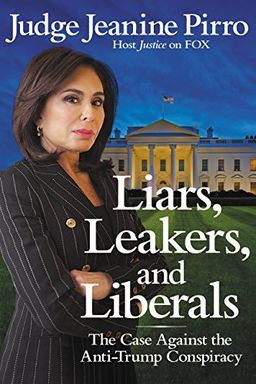
Liars, Leakers, and Liberals cover

Liars, Leakers, and Liberals

by Judge Jeanine Pirro

Liars, Leakers, and Liberals by Judge Jeanine Pirro exposes the forces opposing President Trump, from biased media to political insiders. The book defends Trump''s policies and character while critiquing the conspiracies against him, offering readers a perspective on the political and media landscape.

Liars, Leakers, and Liberals: Jeanine Pirro's Case Against the Deep State

Have you ever felt like the news doesn’t tell the whole story—that what we see and hear every day is being filtered through an invisible force? In Liars, Leakers, and Liberals, Judge Jeanine Pirro argues that this “invisible force” is not a conspiracy theory but a deliberate, organized effort by entrenched elites she calls the Deep State. She contends that Washington insiders, establishment politicians, the intelligence community, and their allies in the media are colluding to undermine the presidency of Donald J. Trump and subvert the will of the American people.

Pirro draws upon her decades of experience as a prosecutor, judge, and political commentator to claim that America is facing not just political division but an internal revolt led by what she calls the “Liars, Leakers, and Liberals.” Her main argument is that President Trump’s election in 2016 unleashed a primal fear among establishment figures accustomed to power—not Democrats versus Republicans, but insiders versus outsiders, the Swamp Party versus the American People’s Party.

A Nation Under Siege by Its Own Institutions

Pirro begins with a depiction of a media landscape and political culture that she says have declared war on Donald Trump from the moment he descended the escalator at Trump Tower. She recounts how the media ridiculed his announcement speech, exaggerated his missteps, and ignored what she views as his successes—tax reform, military revival, energy independence, and record-low unemployment. Pirro places this media animosity alongside a supposed “conspiracy” within federal agencies, led by figures such as James Comey, John Brennan, James Clapper, and former President Obama, arguing that a network of unelected bureaucrats weaponized intelligence gathering and law enforcement against a sitting president.

At the core of her thesis is the belief that democratic norms are being inverted—investigators fabricating crimes, journalists spreading propaganda, and politicians pursuing personal power under the guise of justice. Pirro sees these as symptoms of moral decay and political opportunism, not incompetence. For her, truth is being sacrificed in the name of ideology, creating a climate of hatred where ordinary Americans are demonized for loving their country or supporting its president.

The Forgotten Americans and the Rise of Trump

Before explaining the characters she labels “liars” and “leakers,” Pirro situates Trump’s rise within America’s social and economic discontents. She portrays him as the needed insurgent after years of what she describes as weak leadership under Barack Obama—characterized by rampant illegal immigration, trade imbalance, cultural division, and perceived hostility toward Christianity and free enterprise. In this narrative, Trump’s election is less a political accident than a populist rebellion, fulfilling the framers’ vision of citizen leadership over entrenched aristocracy (similar in theme to Victor Davis Hanson’s The Case for Trump).

To Pirro, Trump represents the mirror opposite of the corrupt political class: blunt where they are polished, patriotic where they are cynical, and results-driven where they are bureaucratic. The backlash, in her view, was inevitable. It came from a mesh of political operatives, intelligence elites, and cultural influencers who could not stomach losing power. She argues that this establishment illegally spied on the Trump campaign using the Steele Dossier, twisted the Mueller investigation into a witch hunt, and orchestrated media hysteria to delegitimize every policy achievement.

Liars, Leakers, and Liberals Defined

Pirro’s title categorizes the forces resisting Trump. “Liars” are the politicians and journalists spreading false narratives; “Leakers” are the bureaucrats and intelligence officers who secretly furnished classified information to harm the administration; and “Liberals” are the ideological activists, Hollywood icons, and media figures whom she believes prioritize globalism and identity politics over patriotism. Her tone is unapologetically prosecutorial—a courtroom argument pitched to the jury of public opinion.

For instance, she scrutinizes James Comey’s “sanctimony” and his decision to leak internal memos in order to trigger the appointment of Robert Mueller. She condemns Hillary Clinton as “the high priestess of the Deep State,” Sen. John McCain as a RINO who abetted the opposition, and figures like Brennan, Rice, and Clapper as masterminds of an illegal campaign of unmasking and surveillance. Throughout, Pirro contrasts these elites with “the forgotten men and women of America”—working-class citizens who, she asserts, voted for Trump because they were tired of being lied to, taxed unfairly, and dismissed as ignorant deplorables.

A Call to Arms for Patriots

Rather than a detached political analysis, Pirro’s tone is that of an exhortation. She warns that if citizens fail to recognize these “liars, leakers, and liberals” for what they are, America risks losing its founding principles of freedom, faith, and self-governance. The book culminates with a call for vigilance and civic engagement—imploring readers to support Trump’s agenda, reject media manipulation, and preserve the nation’s constitutional order.

Through its polemic style, Liars, Leakers, and Liberals taps into the anger and alienation many Americans felt during the political upheavals of the late 2010s. Whether or not one agrees with Pirro’s conclusions, her book captures a defining struggle of contemporary America: between those defending established power and those seeking to upend it. Her rallying cry is simple but forceful—truth and loyalty to America must prevail over deception, corruption, and elitism.


The Media’s War on Trump

Pirro dedicates early chapters to what she calls the “Fake News Machine,” a sprawling network of liberal journalists and entertainment figures waging psychological warfare on the Trump presidency. She recounts stories such as CNN’s retracted reports linking Trump officials to WikiLeaks, ABC’s false claim that Michael Flynn had colluded before the election, and Paul Krugman’s infamous prediction that the stock market would “never recover” from Trump’s election. Each incident, Pirro claims, demonstrates deliberate deception designed to create chaos and delegitimize Trump’s victory.

From Bias to Hostility

According to Pirro, the traditional liberal bias of the press mutated into open hostility after 2016. Figures such as Jim Acosta became symbols of arrogance, accusing Trump’s supporters of lacking intelligence. The “honeymoon period” that usually accompanies new presidents never arrived. She cites the 2018 White House Correspondents’ Dinner, where comedian Michelle Wolf crudely insulted Sarah Huckabee Sanders, as evidence of how civility collapsed under ideological rage. The result, she argues, is that mainstream outlets have abandoned journalism for activism, using anonymous sources to print unfounded stories rather than verifiable facts.

The Industry of Outrage

Pirro compares the modern media ecosystem to an outrage economy where disdain for Trump fuels profits. The “Trump bump,” she notes, rescued collapsing newspapers like the New York Times and Washington Post, which gained subscribers by promising constant resistance coverage. CNN, led by Jeff Zucker—the same executive who once made Trump a TV star on The Apprentice—profited from wall-to-wall anti-Trump framing. In Pirro’s view, this hypocritical commerce of contempt betrays the media’s original mission to inform citizens. (Her critique parallels that in Sharyl Attkisson’s The Smear, which deconstructs media manipulation as a form of political warfare.)

Rewriting Trump’s History

In a section called “The Donald and the Press,” Pirro recalls the days when the same media that demonized Trump now celebrated him as a glamorous builder and philanthropist. She recounts his rescue of New York’s Wollman Rink and his generous acts toward employees, claiming this earlier affection evaporated only when he defied the establishment. The “Media’s 2016 About-Face,” she writes, reveals their hypocrisy: they once sought his celebrity to sell magazines but turned on him when he threatened their political allies.

For Pirro, this transformation from bias to sabotage represents an existential threat to democracy. When reporters become political operatives and fact-checking becomes selective censorship, she argues, public trust collapses and demagogues flourish on both sides. Her recommendation is unapologetically activist: confront the narrative, seek primary sources, and treat truth as a civic duty rather than a media product.


Hollywood Hypocrisy and Liberal Elitism

If the media spread lies, Pirro argues, Hollywood amplified them through moral hypocrisy. She devotes an entire section to “Lying, Liberal Hollywood Hypocrites,” portraying movie stars and entertainers as self-righteous elites who preach virtue while tolerating abuse and corruption within their own ranks. Her main example is the exposure of producer Harvey Weinstein’s sexual crimes, which she describes as the ultimate irony—a liberal establishment that professed feminist ideals yet enabled predators for decades.

The Weinstein–Clinton Connection

Pirro recounts how Weinstein donated over $1.5 million to Democratic candidates, particularly the Clintons and Obama. When the scandal broke, Hillary Clinton waited five days to express shock—a delay Pirro calls “political cowardice.” The author draws parallels between Weinstein’s crimes and Bill Clinton’s alleged misconduct, accusing liberal feminists of betraying their principles by protecting their political allies. For Pirro, Hollywood and Washington are two wings of the same self-serving elite circle, more interested in retaining influence than defending justice.

Celebrity Rage and Double Standards

Pirro lambastes actors such as Robert De Niro, Sean Penn, Madonna, and Kathy Griffin for what she sees as violent rhetoric against Trump. She argues that when celebrities threaten to “punch the president” or fantasize about assassination, it normalizes extremism among their followers while eroding respect for democratic institutions. Yet, these same voices were silent, she says, when Barack Obama conducted drone strikes or when Bill Clinton’s scandals surfaced. This selective outrage, in Pirro’s view, is proof that moral posturing, not conviction, drives Hollywood activism.

The Cultural Cost of Hypocrisy

Beyond individuals, Pirro claims Hollywood itself has become a “brainwashing machine.” Scriptwriters insert anti-conservative messages into entertainment—from superhero shows mocking Trump supporters to sitcoms equating faith or patriotism with ignorance. She condemns the cancellation of Tim Allen’s Last Man Standing as evidence that cultural dissent from the left’s orthodoxy is punished. For Pirro, Hollywood’s downfall—declining movie attendance, poor ratings, and loss of trust—is poetic justice for abandoning real art in favor of political propaganda.

Her broader argument mirrors sociologist Charles Murray’s theme in Coming Apart: that America’s cultural elite live in an isolated bubble detached from the moral values of ordinary citizens. In Pirro’s telling, the entertainment world’s collapse is not only about artistry or politics—it’s a moral reckoning for a class that lost touch with humility and truth.


RINOs and the Collapse of Party Loyalty

Moving beyond liberal opponents, Pirro turns her ire toward the Republican establishment. She coins them “RINOs”—Republicans in Name Only—accusing leaders like Paul Ryan and Mitch McConnell of betraying both the president and his voters. For Pirro, the GOP’s internal sabotage was just as dangerous as Democratic resistance because it hollowed out Trump’s legislative momentum and protected the bureaucracy she calls the Swamp.

Betrayals in Budget and Border

Pirro dissects episodes like the 2018 omnibus spending bill, which funded Planned Parenthood and sanctuary cities but underfunded Trump’s border wall. She portrays this as moral treason: Republicans campaigning on border security yet surrendering to liberal pressure once in Washington. To her, this proves they serve donors over constituents and crave establishment approval over national sovereignty.

Deep State Dependence

The author argues RINOs protected the bureaucratic apparatus—agencies like the FBI and DOJ—hoping to preserve their own access to power. By refusing to expose Obama-era abuses such as the FISA surveillance or Mueller’s overreach, Pirro says they effectively enabled a “soft coup.” She singles out McCain’s role in circulating the Steele dossier as a betrayal of party unity and compares Trump’s defiance of convention to Reagan’s rebellion against GOP elites in the 1980s.

Ultimately, Pirro reframes Trump’s movement as not Republican but revolutionary. In her view, the traditional two-party system has been replaced by two opposing forces: career politicians defending their empire versus citizens defending their country. It’s the populist-versus-globalist fault line that continues to define American political identity today.


Sanctuary Cities and the Rule of Law

Pirro’s legal background surfaces most powerfully in her attack on sanctuary cities—jurisdictions that limit cooperation with federal immigration enforcement. She humanizes the debate through the murder of Kate Steinle, a California woman killed by an illegal immigrant with multiple deportations. This tragedy, she argues, exposes liberal officials who place ideology above public safety.

The Federal-State Conflict

According to Pirro, sanctuary laws represent a constitutional crisis. Cities and states defying federal immigration statutes distort the balance of power established by the Constitution’s Supremacy Clause. Politicians like California’s governor and mayors of Los Angeles, Chicago, and Oakland—whom Pirro labels “lawless liberals”—aid criminal aliens at the expense of citizens. She recounts Oakland Mayor Libby Schaaf’s tweet warning residents of impending ICE raids, an act Pirro calls “treasonous” for endangering federal officers and the public.

Law Enforcement and Betrayal

Pirro appeals directly to police officers, urging them to uphold their oath over political directives. She warns, “if this is a tough one for you, hang up the badge,” reinforcing her belief that moral courage—not politics—must guide policing. Using the case of an undocumented murderer in her own jurisdiction, she contends that sanctuary policies embolden predators and silence victims, including immigrant communities themselves. What liberals call compassion, she argues, is systemic negligence that breeds crime and insecurity.

Her solution is uncompromising: withhold federal funding from sanctuary cities, finish the border wall, and enforce existing laws equally. For Pirro, immigration is not just about demographics—it’s a litmus test of whether America still believes in the rule of law.


Deep State Players and the Coup Within

The heart of Pirro’s exposé is a cast of officials she portrays as conspirators within federal intelligence and law enforcement—the “rogues’ gallery” orchestrating the anti-Trump campaign. She devotes chapters to John Brennan, Susan Rice, James Clapper, James Comey, and Barack Obama, outlining how each allegedly abused authority to surveil, leak, or manipulate investigations to protect Hillary Clinton and frame Donald Trump.

From Spying to Unmasking

Pirro’s indictment begins with Brennan, whom she calls “Pond Scum Brennan,” for politicizing the CIA through the Steele dossier, while Rice is accused of unmasking private American citizens in intelligence reports. Clapper, she says, lied to Congress when denying surveillance of Americans. Together these officials, under Obama, allegedly weaponized FISA courts to justify spying on Trump’s associates. Pirro views this as an unprecedented violation of constitutional rights—a scandal bigger than Watergate.

Obama and Hillary as Architects

Far from passive observers, Pirro names Obama and Clinton as key architects of the Deep State. She recounts the Uranium One deal as proof of pay-to-play corruption, where U.S. uranium reserves were sold to Russia amid millions in donations to the Clinton Foundation. She also frames Obama’s post-election executive orders expanding intelligence sharing as a cover for data leaks that fueled the Russia-collusion narrative. Pirro concludes that the former president’s “shadow government” continued to operate after leaving office, steering the resistance through loyalists embedded in bureaucracies.

Her portrait of this network echoes themes in Mark Levin’s Unfreedom of the Press and Gregg Jarrett’s The Russia Hoax: that unelected officials have usurped the powers of elected ones. For Pirro, the only remedy is accountability—criminal prosecution, exposure, and public courage to confront bureaucratic corruption.


The Witch Hunt and Its Consequences

When Pirro labels the Mueller investigation a “witch hunt,” she isn’t speaking metaphorically. She compares it to historical persecution, where accusation replaced evidence and hysteria replaced law. Through this lens, Special Counsel Robert Mueller’s probe into alleged Russian interference is portrayed as a political vendetta—“a coup by process.”

The Manufactured Scandal

Pirro reconstructs the events from the Steele dossier to the appointment of Mueller by Rod Rosenstein after Jeff Sessions’ recusal. Each step, she insists, depended on deceit: a discredited dossier funded by Democrats, an FBI eager to conceal Hillary Clinton’s email crimes, and an attorney general intimidated into paralysis. She spotlights figures like Peter Strzok and Lisa Page, whose “insurance policy” texts she cites as proof of intent to undermine an elected president. Cases against Michael Flynn, Paul Manafort, and others are depicted as coercive tactics—intended not for justice but for headlines.

The Real Collusion

Ironically, Pirro contends, the only proven collusion with Russia came from Democrats: the Clinton Foundation’s donations, the DNC’s payments to Fusion GPS, and Obama’s uranium concessions. By contrast, the indictments of low-level operatives and Russian trolls revealed no American wrongdoing. She mocks the idea that social-media memes changed an election’s outcome, contrasting media obsession with these trivialities against silence about intelligence leaks or FBI bias.

Pirro’s final verdict is uncompromising: the Deep State’s witch hunt damaged the nation’s faith in justice more than any foreign meddling could. Restoring trust, she argues, requires purging the bureaucracy and reaffirming the Constitution’s original idea that power flows from the people, not from unelected agencies.


The Real Trump Presidency and Its Achievements

After chapters of indictment, Pirro pivots to defense—describing the “real Trump presidency” obscured by media noise. She paints a portrait of efficiency, patriotism, and compassion. Through economic expansion, tax reform, judicial appointments, border enforcement, and foreign diplomacy, she portrays Trump as the restorer of American strength and optimism.

Economic Renaissance

Pirro credits the 2017 tax reform and deregulation with creating millions of jobs and record-low minority unemployment. She parallels Trump’s approach to Reaganomics—freeing enterprise from bureaucratic strangulation—and contrasts it with Obama-era stagnation. The result, she claims, is not trickle-down but “get-up-and-work capitalism.”

Foreign Policy and Peace Through Strength

From defeating ISIS to brokering historic talks with North Korea, Pirro hails Trump’s willingness to confront enemies and strengthen allies. Recognizing Jerusalem as Israel’s capital and demanding NATO members pay their share, she argues, signaled a return to moral clarity. She credits advisers like General John Kelly and Jared Kushner for restoring discipline and focus amid chaos manufactured by leaks.

The People Behind the President

Pirro devotes special warmth to Melania, Ivanka, and Trump’s children, positioning them as embodiments of loyalty and traditional values. In contrast to media caricatures, she portrays them as devoted, hardworking, and family-oriented. Ivanka’s work on child tax credits and women’s entrepreneurship symbolizes, for Pirro, the compassionate conservative vision ignored by critics.

Ultimately, her narrative concludes with optimism: that despite sabotage from liars, leakers, and liberals, Trump’s presidency rekindled America’s founding spirit. Whether or not readers share Pirro’s faith in Trump, her closing appeal—defend truth, cherish freedom, and never bow to elites—sums up the populist conviction driving the book from start to finish.

Dig Deeper

Get personalized prompts to apply these lessons to your life and deepen your understanding.

Go Deeper

Get the Full Experience

Download Insight Books for AI-powered reflections, quizzes, and more.