
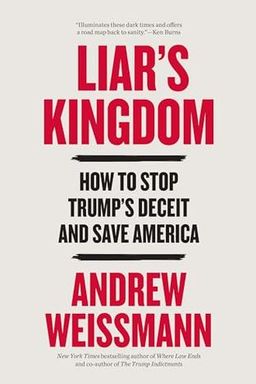
Liar's Kingdom cover

Liar's Kingdom

by Andrew Weissmann

The author of “Where Law Ends” argues that a flaw in America’s legal system allows for deceit in our politics.

Indictments, Evidence, and Democratic Guardrails

How do you judge historic prosecutions without getting lost in partisanship? This book argues you do it by reading the indictments themselves—DC (January 6), Georgia (Fulton County RICO), Florida (Mar‑a‑Lago documents), and New York (hush‑money business records)—and by pairing that primary text with disciplined annotations that explain prosecutorial choices, evidentiary posture, and strategic tradeoffs. The editors frame the volume as a working guide: you engage the charging language directly, consult notes that decode why certain facts matter, and track how each case advances or risks core rule‑of‑law norms. The result is a hybrid resource that gives you both raw material and a legal roadmap.

What the book is trying to show

Across four prosecutions, you see a consistent analytic lens: do the charges reflect statutes routinely enforced against nonpolitical defendants, and is the evidence standard, transparent, and corroborated? The authors contend three cases—DC, Georgia, and Florida—fit that mold; the New York case sits in more novel legal terrain because falsifying business records becomes a felony only if linked to another crime (raising questions about predicate theories that courts will test). You learn to separate political noise from prosecutorial normalcy by asking whether similar conduct typically draws similar charges.

How the four cases fit together

The DC indictment charges conspiracies to defraud the United States and to obstruct an official proceeding, plus obstruction and a civil‑rights conspiracy, all tied to the January 6 certification. Georgia uses state RICO to stitch together pressure on officials, fake elector schemes, and the Coffee County voting‑system access into a single enterprise. Florida centers on willful retention of national defense information and obstruction, built on boxes, subpoenas, and surveillance. New York tells a ledger‑driven story: reimbursements to Michael Cohen recorded as legal fees to conceal election‑related hush payments. Each case emphasizes different evidentiary media—memos and testimony in DC; overt acts and flipped defendants in Georgia; photos, videos, and texts in Florida; and invoices, vouchers, and checks in New York.

Trump’s pattern as causal context

The book threads a larger through‑line: Donald Trump’s public brand of transgression—promotional falsehoods, politics of grievance, and norm erosion—creates the conditions in which alleged crimes can occur. Episodes like birtherism, the Access Hollywood tape, firing James Comey, pressuring state officials, and the post‑election tactics culminating in January 6 illustrate how public lies precede coercive moves. You don’t equate transgression with illegality automatically; instead, you see how repeated norm‑breaking widens the Overton window, making more extreme steps thinkable and, when institutions resist, legally perilous.

A legitimacy test from abroad

International comparisons—France (Sarkozy, Chirac), Israel (Olmert), South Korea (Park, Lee), Brazil (Lula), and others—show that democracies can prosecute ex‑leaders without sliding into authoritarian “show trials.” The book gives you a checklist: beware manufactured evidence, idiosyncratic charges no one else faces, and selective enforcement designed to sideline rivals. Applied to the U.S. cases, the authors argue the evidence and charging patterns in DC, Georgia, and Florida look conventional; New York is the outlier because its felony theory hinges on linking falsified records to other crimes (a live legal debate rather than proof of politicization). (Note: U.S. selective‑prosecution doctrine also requires proof of invidious purpose.)

Why annotations matter to you

The annotations illuminate prosecutorial strategy and likely trial fights. You see why Special Counsel Jack Smith kept the DC case “lean and mean” with one defendant to accelerate trial, while Fani Willis used Georgia’s RICO to capture a networked campaign with many actors—expecting pleas and cooperation (as with Sidney Powell, Kenneth Chesebro, Jenna Ellis, and Scott Hall). You also learn how evidentiary rulings—like whether violence from January 6 comes in at the DC trial—or privilege disputes (e.g., attorney‑client or executive privilege) can reshape what juries hear.

A reader’s toolkit

The book arms you with practical questions: Does the statute match the facts? Do nonpolitical defendants face similar charges? What cooperating witnesses corroborate documents, emails, videos, or ledgers? How do venue, timing, and severance decisions affect trial sequence? And crucially, how do prosecutors prove knowledge and intent—especially in DC, where evidence that aides, DOJ officials, and courts rejected fraud claims goes to Trump’s state of mind?

Key framing insight

By pairing primary documents with expert annotations, you can judge not only what was charged but why those charges likely rise or fall—grounding your conclusions in law and evidence rather than headlines.

In short, you learn to read four very different cases as tests of both legal accountability and democratic guardrails. The book neither inflates nor minimizes the stakes: if the evidence is standard and the charges routine, accountability strengthens institutions; if charges become idiosyncratic or evidence thin, legitimacy erodes. Your task, with this guide, is to track the facts, the statutes, and the strategies—case by case, motion by motion—so you can evaluate history in real time. (For comparison, think of how Watergate reporting plus court documents allowed citizens to follow law through procedure; this book offers a similar scaffolding for the Trump era.)


Reading Indictments Like A Prosecutor

The book trains you to treat indictments as maps, not mysteries. You start with the statutes, then tie them to facts prosecutors can actually prove with documents, testimony, and digital traces. Annotations point you to why certain choices were made: Jack Smith’s single‑defendant DC case to streamline timing; Fani Willis’s broad RICO to capture network behavior; and Alvin Bragg’s paper‑trail theory in Manhattan to convert a political scandal into a falsified‑records narrative. You don’t guess intent; you infer it from emails, recorded calls, memos, ledgers, and surveillance video.

Follow the evidence types

Each case leans on different proof. DC relies on memos (Chesebro, Eastman), witness testimony (e.g., Mike Pence, Rusty Bowers), and the January 6 Committee’s record to show knowledge of falsity and a coordinated plan to disrupt certification. Georgia aggregates overt acts—pressure on officials, Coffee County data access, fake electors—and flips defendants to corroborate the enterprise. Florida uses time‑stamped surveillance, texts, photos of boxes in unusual places (a bathroom, storage room), and subpoena responses to show retention and obstruction. New York uses invoices, vouchers, checks, and internal emails to show intentional misclassification of reimbursements as legal fees.

Ask the legitimacy questions

You apply a simple rubric: Are these standard statutes? Are similarly situated defendants typically charged? Is the evidence transparent and cross‑checked? The book argues yes in DC (conspiracy and obstruction used widely in January 6 cases), yes in Florida (willful retention and obstruction are classic DOJ fare), and yes in Georgia (state RICO and election‑interference statutes have organizational‑crime analogues). New York is debated because the felony upgrade relies on linking falsified records to other crimes—an approach with state precedent but less settled terrain for a former president. (Note: Debate over predicate crimes doesn’t make a case a show trial; it marks a novel theory courts may accept or limit.)

Track timing, venue, and severance

Strategy lives in calendars and courtrooms. The editors list key dates—indictments through 2023 and trial targets in 2024—so you can watch judges juggle overlaps. Severance fights in Georgia (e.g., Chesebro and Powell’s speedy‑trial demands) demonstrate how RICO cases splinter into waves, often yielding pleas that strengthen the remaining prosecutions. Removal attempts to federal court (e.g., Mark Meadows) signal defense bids to change juror pools and immunities. Venue differences—DC’s January 6 docket, Florida’s national‑security procedures, Manhattan’s white‑collar bench—shape motion practice and evidentiary rulings.

Understand cooperation dynamics

Plea leverage is the engine of complex cases. Georgia shows it vividly: Scott Hall, Sidney Powell, Kenneth Chesebro, and Jenna Ellis pleaded and agreed to cooperate, supplying detail on logistics (Coffee County), strategic memos (fake electors), and public messaging. Florida features cooperating insiders and IT witnesses (e.g., testimony about surveillance footage deletion requests). Cooperation turns documents into narratives a jury can follow—who did what, when, and why—and it locks in testimony before trial uncertainty sets in.

Watch the elements that matter most

Two elements dominate: knowledge and obstruction. In DC and Georgia, prosecutors must show Trump knew the fraud claims were false or indifferent to their truth and nevertheless pushed schemes to overturn results. They stack evidence of repeated briefings and court losses to infer knowledge. In Florida and New York, obstruction and falsification amplify underlying conduct—moving boxes ahead of searches, pressing staff to delete surveillance, or disguising reimbursements as legal fees to hide campaign‑related hush payments. Obstruction often proves consciousness of guilt even if jurors debate the underlying offense.

Use the show‑trial checklist

The international comparison gives you a practical screen: if the evidence is routine and the charges are commonly brought, the case sits in legitimate territory. If evidence is contrived, statutes are idiosyncratic, or enforcement is oddly selective, alarms should sound. Apply that to U.S. cases and you’ll see why the book calls three indictments straightforward and one novel—but still rooted in familiar white‑collar logic.

Practical takeaway

Treat each indictment as a checklist of elements. Tie each element to named exhibits, witnesses, and timelines. Then ask whether strategy (severance, venue, plea) helps or hurts the government’s ability to show those links clearly before a jury.

When you read like a prosecutor, you move beyond vibes to verifiability. The book’s annotations keep you focused on what jurors will actually see, what judges are likely to admit, and how standard prosecutorial playbooks—built on documents, cooperators, and corroboration—carry these cases forward. (In the spirit of classic trial guides like Irving Younger’s on evidence, this book’s method shows you how proof, not punditry, wins or loses cases.)


Transgression To Legal Exposure

The authors argue that Donald Trump’s public persona—built on transgression—doesn’t merely color these prosecutions; it structures them. You see three recurring elements: promotional falsehoods (inflating success and sowing doubt about institutions), grievance politics (stoking resentments that justify extraordinary measures), and norm erosion (testing and breaking guardrails). This pattern stretches from birtherism to the Access Hollywood tape, from firing FBI Director James Comey to the 2020 post‑election pressure campaign. It is not itself criminal, but it creates the conditions in which alleged crimes can germinate.

From rhetoric to action

Public falsehoods often act as prelude to coercion. After the 2020 election, the indictment narratives say Trump escalated: pressuring state officials (Georgia’s Brad Raffensperger call to “find” 11,780 votes), organizing fake electors in multiple states, and urging the Department of Justice to validate unfounded claims. The DC case alleges a plan to manufacture a dispute to obstruct certification; Georgia alleges a RICO enterprise linking pressure, forged documents, and computer access; Florida describes retention and concealment of classified materials; and New York details false ledger entries to mask election‑related hush payments. The unifying thread is action choreographed after rhetorical groundwork.

The Overton window widens

The pattern normalizes once‑unthinkable moves, making loyalists more willing to sign certificates as fake electors or to breach local voting systems in Coffee County. By the time institutional checks push back—federal courts rejecting suits, DOJ officials disputing fraud claims, Pence refusing to halt certification—the conduct has already crossed into legal risk. Prosecutors then marshal the very records produced by that norm‑breaking—recorded calls, emails, memos, and texts—to prove intent.

Not all transgression equals crime

The book is careful: it doesn’t say every norm breach is illegal. It shows how certain breaches become crimes when paired with acts defined in statutes—false statements, forged documents, obstruction, computer trespass, or willful retention of national defense information. For example, pressuring public officers becomes solicitation to violate oaths in Georgia; creating alternate elector slates becomes forgery and filing false documents; moving boxes and seeking to delete surveillance transforms possession of papers into obstruction in Florida.

A pattern prosecutors can narrate

Narrative coherence matters to juries. Prosecutors in DC and Georgia lean on contemporaneous warnings—advisers, DOJ leaders, and courts saying fraud claims lacked merit—to argue Trump knew the claims were false. They connect public statements to private planning: Chesebro’s and Eastman’s memoranda, Giuliani’s presentations to Georgia legislators, and the logistics of Coffee County data acquisition. In Florida, photos and time‑stamped videos narrate a cover‑up; in Manhattan, a tidy ledger story walks jurors through invoices, vouchers, and checks.

Why this lens helps you

Seeing the pattern doesn’t decide guilt; it clarifies causation. You can evaluate whether rhetoric drifted into coordinated acts that statutes prohibit, and whether prosecutors have the corroboration to prove it. The lens also explains the divergent charging strategies: DC’s narrow case to spotlight the core scheme; Georgia’s broad RICO to show an enterprise; Florida’s document‑and‑obstruction focus; and New York’s accounting narrative. (Note: This echoes scholarship on “strategic norm violation” in populist movements; the book translates that theory into indictment‑ready facts.)

Bottom line

If you map words to deeds—and deeds to statutes—you can track how a brand of political transgression turns into legal exposure once institutions demand proof, records pile up, and actions take shape in emails, memos, and recordings.

For you as a reader and voter, this perspective offers a grounded way to interpret the news. Instead of reacting to each filing as an isolated shock, you can see a causal arc: narrative construction, operationalization, institutional pushback, and legal accountability. That arc, the book argues, is the story beneath the headlines and the connective tissue across all four indictments.


The January 6 Federal Case

The DC indictment is a focused attempt to hold a political leader accountable for an alleged plan to subvert the 2020 election certification. It charges four offenses: conspiracy to defraud the United States (18 U.S.C. § 371), conspiracy to obstruct an official proceeding (§ 1512(k)), obstruction and attempted obstruction of an official proceeding (§ 1512(c)(2)), and conspiracy against rights (§ 241). The case tells a step‑by‑step story: spread claims of decisive fraud known to be false, deploy fake electors to create the veneer of dispute, enlist DOJ to amplify doubt, and pressure Vice President Mike Pence to reject legitimate electoral votes on January 6.

Who and what the proof looks like

Six unindicted co‑conspirators (widely reported as Rudy Giuliani, John Eastman, Sidney Powell, Jeffrey Clark, Kenneth Chesebro, and Boris Epshteyn) populate the narrative, but only Trump is charged—by design, to streamline the case. The proof is documentary and testimonial: Chesebro and Eastman memos, emails coordinating alternate electors in seven states, testimony from officials like Arizona’s Rusty Bowers, and grand‑jury evidence from Mike Pence about conversations and pressure. The January 6 Committee’s public record supplies additional timelines and statements that the special counsel has woven into the grand‑jury materials.

Why no insurrection charge?

The special counsel avoids seditious conspiracy or insurrection counts, which would invite years of threshold litigation. Instead, he chooses obstruction and fraud‑based conspiracies that track what the documents and witnesses directly show: a plan to manufacture a dispute and interrupt the certification. This reflects a prosecutorial calculus: higher‑drama charges risk procedural delay that could push a verdict beyond electoral timelines; narrower counts still capture the alleged wrongdoing with a cleaner evidentiary path.

The intent problem and how prosecutors solve it

Intent is the fulcrum. Prosecutors must show Trump knew the fraud claims were baseless or was willfully blind. The indictment lays out repeated briefings from DOJ leaders and campaign advisers that debunked specific allegations, plus court losses across contested states. Each rebuff reinforces the knowledge inference. When combined with planning documents for fake electors and the pressure campaign on Pence, the government argues intent to obstruct, not merely to litigate disputed results.

Pence’s testimony and the constitutional theater

Compelling testimony from a sitting vice president’s former office is extraordinary. Pence’s account goes to the heart of the pressure to reject electoral votes. The case also addresses fringe constitutional theories—like the notion that the vice president can unilaterally discard electors—through contemporaneous memos and expert pushback. By charging conspiracy against rights (§ 241), prosecutors frame disenfranchisement of millions as a civil‑rights violation, anchoring the criminality not only in process but in the voters’ rights at stake.

Trial posture and evidentiary fights

Expect disputes over what violence evidence from January 6 a jury may hear, how to handle co‑conspirator statements, and whether certain legal‑advice communications fall under crime‑fraud exceptions. The single‑defendant posture limits severance issues and speeds trial but concentrates proof burden on Trump’s knowledge and direction. The annotated indictment flags these pinch points so you can anticipate pretrial motions that decide what story the jury ultimately hears.

What conviction would mean

A verdict would validate obstruction‑and‑fraud theories as apt tools to police attempts to subvert electoral certification, without relying on insurrection law. An acquittal, conversely, would signal that proving knowledge and corrupt intent at the apex of power is the steepest hill in public‑corruption cases.

For you, the DC case models how prosecutors can build a democracy‑protection narrative with conventional statutes and paper‑heavy proof. It sets the legal template for accountability while testing how jurors evaluate intent amid unprecedented political context. (Note: This approach mirrors how many Jan. 6 rioter cases used § 1512(c)(2) to reach conduct that disrupted certification; the novelty here is applying the same spine to a president.)


Georgia’s RICO Engine

Georgia’s Fulton County case is a different animal: it charges a sprawling enterprise under the state’s RICO statute, alleging a coordinated effort to overturn the 2020 result in Georgia through pressure, forged documents, and computer intrusions. Nineteen defendants were initially charged, including Donald Trump, Rudy Giuliani, John Eastman, Mark Meadows, Sidney Powell, Kenneth Chesebro, and Jenna Ellis. The indictment casts a mosaic: legislative presentations, the creation and transmission of forged elector certificates, the Coffee County voting‑system operation, and harassment of election workers Ruby Freeman and Shaye Moss.

How RICO frames the story

RICO lets prosecutors treat related acts—some not crimes by themselves—as overt steps advancing a shared purpose. Calls, travel, emails, and logistics become connective tissue that proves a pattern of racketeering activity. In Georgia, the alleged objective was to alter the lawful outcome by pressuring officials, creating fake elector paperwork, and breaching election infrastructure. Under RICO, each participant can be liable for acts of co‑conspirators committed in furtherance of the enterprise, even if they didn’t personally execute each step.

Fake electors as a physical mechanism

Counts 8–16 detail the fake electors: individuals signed certificates titled “CERTIFICATE OF THE VOTES OF THE 2020 ELECTORS FROM GEORGIA,” falsely representing themselves as duly elected electors. These were mailed to the Archivist, the President of the Senate, state officials, and even federal courts. The secrecy around the plan—assurances that documents would be used only if litigation succeeded, despite internal plans to use them regardless—bolsters intent. Chesebro’s memoranda, central exhibits in both federal and state narratives, map out the recruitment and signing tactics; his October 2023 plea adds cooperative weight.

Coffee County: logistics meet data

The Coffee County episodes show on‑the‑ground action: Cathleen Latham arranging airport pickups (Act 142), Scott Hall flying to Douglas Municipal Airport (Act 143), and Sidney Powell’s engagement of SullivanStrickler LLC to access Dominion machines. Acts 146–153 allege computer theft, trespass, and invasion of privacy—copying system data to a vendor server, downloading it later, and forwarding it to outside lawyers (Act 155). These technical threads—flight logs, texts, server records—turn abstract conspiracy into tangible acts with timestamps and custodians.

Human impact and public harm

By naming the smear and threats against Ruby Freeman and Shaye Moss, the indictment personalizes harm. It’s not only about forged papers and server downloads; it’s about how a campaign to delegitimize election workers created real‑world danger. That narrative helps jurors connect procedural crimes to civic damage—an important rhetorical and legal move in RICO storytelling.

Plea leverage and procedural churn

RICO invites cooperation. Scott Hall, Sidney Powell, Kenneth Chesebro, and Jenna Ellis pleaded guilty and agreed to cooperate, providing detail the state can deploy against remaining defendants. Speedy‑trial demands triggered early evidentiary skirmishes; severance rulings shaped who was tried together. Removal attempts by figures like Mark Meadows sought federal forums and potential immunities but also previewed defense themes. The complexity makes trial management hard but also multiplies pressure points for flipped testimony.

State‑law consequences

A distinctive feature: state convictions are beyond a president’s federal pardon power. That constitutional boundary makes the Georgia case uniquely consequential in any future clemency calculus. It also underscores how federal and state systems can operate in parallel, each addressing different slices of alleged conduct.

Takeaway

Georgia uses RICO to render visible a networked effort: forged documents, pressure calls, and a county‑level data operation fused into one enterprise. Its strength is breadth and corroboration; its risk is complexity and logistics. The early pleas suggest prosecutors have already converted that breadth into narrative focus.

For you, Georgia demonstrates how a state can adapt organized‑crime tools to election‑interference facts. It clarifies why seemingly minor acts—airport pickups, server downloads, notarizations—become central when woven into a coordinated push to rewrite certified results. (Comparable to how federal RICO stitched together businesses, couriers, and accountants in mob cases; here the “enterprise” is a political‑legal operation aimed at elector outcomes.)


Secrets, Ledgers, And Legitimacy

Two remaining prosecutions showcase classic white‑collar and national‑security playbooks—and they anchor the book’s legitimacy analysis. In Florida, the superseding indictment narrates willful retention of national defense information (18 U.S.C. § 793(e)) plus obstruction and false statements: a grand‑jury subpoena, alleged box‑moving by Walt Nauta, pressure on IT staff to delete surveillance (involving Carlos De Oliveira), and a search that recovered more classified documents. In New York, Alvin Bragg alleges 34 counts of falsifying business records tied to reimbursements for Michael Cohen’s $130,000 payment to Stormy Daniels, recorded as legal fees to conceal campaign‑related hush money.

Florida: a two‑track case—papers and cover‑up

The Florida narrative is chronological and evidence‑heavy: NARA demands, a partial return with 197 classified documents in January 2022, a grand‑jury subpoena, a false certification of a “diligent search,” and the August 2022 search recovering additional classified materials. Photos of boxes in a bathroom or storage room and time‑stamped surveillance underwrite obstruction counts (conspiracy to obstruct justice § 1512(k), alteration of records, false statements § 1001). Even absent the underlying retention, the alleged deletion push is its own crime. Together, the paper trail plus attempted concealment create independent liability prongs. (Note: Classified‑evidence handling under CIPA complicates trial logistics, but the charging logic mirrors prior DOJ cases.)

New York: turning politics into accounting

Manhattan’s case is narrower but concrete. AMI’s “catch‑and‑kill” purchases (Dino Sajudin for $30,000; Karen McDougal for $150,000) established a pattern of suppressing damaging stories in 2015–2016. Cohen then paid Daniels via Essential Consultants LLC. In 2017, the Trump Organization reimbursed Cohen through 12 $35,000 checks, recorded as legal retainers. Those invoices, vouchers, and checks—documented line by line—are the corpus of the 34 counts. The felony upgrade hinges on intent to conceal another crime (e.g., campaign‑finance or tax offenses), a theory Bragg grounds in state precedent but that remains the most novel piece across the four cases.

International yardstick for legitimacy

Comparative cases—France, Israel, South Korea, Brazil, Taiwan—show that prosecuting ex‑leaders is normal when evidence is standard and statutes are ordinary. The book’s show‑trial checklist cautions against manufactured proof, idiosyncratic crimes, or selective targeting designed to knock out rivals. Against that yardstick, Florida fits classic national‑security and obstruction patterns; DC and Georgia match routine conspiracy and RICO frameworks already applied to other January 6 and election‑interference actors. New York, while rooted in common business‑records enforcement, is the outlier due to its predicate‑crime linkage.

What to watch procedurally

Expect CIPA battles in Florida over how to present classified content without compromising sources and methods; those fights affect timing as much as admissibility. In New York, jury understanding of motive—why mislabel reimbursements—will matter, along with limiting instructions about the predicate‑crime theory. Across both, credibility of insiders (e.g., Nauta, De Oliveira, Cohen) and the corroboration of their statements with documents or video will be decisive. Paper and pixels, not punditry, will carry the day.

Synthesis

Florida and New York illustrate the book’s method: align statutes with abundant, familiar evidence streams—surveillance, emails, ledgers—and then evaluate novelty. One case is routine but sensitive (classified materials plus obstruction); the other is routine in evidence but novel in felony theory. Both demonstrate how legal systems translate political scandals into chargeable, documentary stories.

For you, the lesson is to follow the receipts—literally. When prosecutors can show boxes moved on camera or checks logged in a ledger, the legal narrative writes itself. When theories stretch law into new configurations, scrutinize predicate logic and comparators rather than dismissing the case as “political” by default. That disciplined approach—central to the book’s annotations—helps you separate robust accountability from risky experimentation. (Think of this as the white‑collar twin to the DC and Georgia conspiracy spines.)

Dig Deeper

Get personalized prompts to apply these lessons to your life and deepen your understanding.

Go Deeper

Get the Full Experience

Download Insight Books for AI-powered reflections, quizzes, and more.