
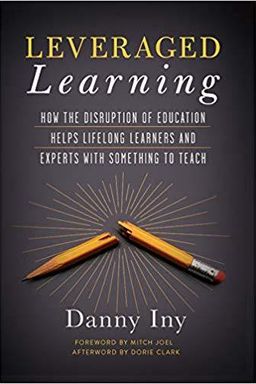
Leveraged Learning cover

Leveraged Learning

by Danny Iny

Leveraged Learning delivers a transformative six-step process for creating impactful educational experiences. Drawing from cutting-edge advances, it empowers learners to excel in any area, blending knowledge with critical skills. Discover how to thrive in a rapidly changing world with innovative learning techniques.

Leveraged Learning: Transforming Education for the Modern Age

How do you stay relevant in a world where technology and knowledge change faster than your phone’s operating system? That’s the question Danny Iny poses in Leveraged Learning, a thorough exploration of how education must evolve to serve both learners and teachers in our rapidly accelerating world. Iny argues that traditional education—the centuries-old model of lectures, degrees, and institutional prestige—has broken down. It no longer guarantees success, preparation, or return on investment. Instead, education must become responsive, lifelong, and focused on outcomes, not signals.

The Broken Promise of Modern Education

For most of modern history, education was society’s golden ticket. A college degree signaled competence and opened doors to stable, high-paying jobs. But Iny reveals that this “signal” has decayed. What once represented true expertise and discipline now mostly reflects debt and conformity. With 40% of adults holding degrees, the diploma that once stood out has become commonplace. Employers now rank education last among hiring criteria, preferring work ethic and problem-solving instead of credentials. Meanwhile, tuition costs have skyrocketed—growing twice as fast as inflation. The result is a generation burdened by over $1.4 trillion in student debt yet underprepared for meaningful work.

The Age of Acceleration and Irrelevance

The deeper issue, Iny explains, lies in the mismatch between education’s slow, hierarchical model and a world defined by automation, artificial intelligence, and constant change. Jobs are disappearing as algorithms replace routine tasks. What remains are roles requiring creativity, fortitude, and emotional intelligence—traits no standardized test can measure. Iny draws on thinkers such as Thomas Friedman (Thank You for Being Late) and Joseph E. Aoun (Robot-Proof), showing that universities teach “knowing what,” but success now demands “knowing how.” The half-life of knowledge has shrunk to mere years; anything learned today may be obsolete by graduation.

A Landscape Shaped by Four Transitions

Iny maps the seismic transitions reshaping how we learn: from real-time classrooms to semi-synchronous digital experiences; from “just-in-case” learning (stockpiling degrees) to “just-in-time” education (learning exactly what is needed when needed); from information transfer to transformation; and from mandatory participation to volitional learning. These shifts redefine not only how education is consumed but who provides it. Universities once had a monopoly, but now online platforms, independent experts, and lifelong learners occupy the stage. Iny’s insight mirrors Jeff Cobb’s Leading the Learning Revolution: learning is now a lifelong, dynamic economy rather than a static, institutional process.

The Economics of Disruption

The second half of the book examines the economics driving this transformation. Iny uses analogies from the industrial world—Henry Ford versus William Durant, Amazon versus traditional publishers—to show that innovation rarely comes from incumbents. Like Ford, disruptive educators emerge outside academia, unencumbered by bureaucracy and legacy costs. Universities, burdened by outdated structures such as tenure, accreditation, and bloated facilities, can’t pivot fast enough. Instead, learning will either consolidate—with a few world-class providers offering scalable foundational education—or fragment—through the rise of niche experts and independent instructors serving specialized learners. In this new ecosystem, expertise and adaptability trump institutional prestige.

Human Learning That Works

Having examined the failures of today’s system, Iny turns toward solutions. “Education that works,” he insists, must combine three dimensions: knowledge (acquiring essential skills efficiently), insight (developing critical and creative thinking), and fortitude (the emotional resilience to persist through challenge). These become the building blocks of “Leveraged Learning”—a model that supports lifelong learners while empowering educators to design transformative, outcome-driven experiences. Iny applies neuroscience, psychology, and systems thinking to show how memory, motivation, and mindset shape success more than mere information transfer.

The Mission: Reclaiming Learning for the Future

Ultimately, Leveraged Learning is both a diagnosis and a design guide. Education, Iny declares, is humanity’s most powerful engine of progress—yet it’s running on fumes. The book challenges you, whether you’re a lifelong learner, educator, or business leader, to rethink what learning means. Instead of chasing degrees, we must pursue mastery, adaptability, and connection. Instead of measuring success in test scores, we must measure transformation. Reading this book leaves you realizing that the future of learning isn’t about institutions; it’s about individuals empowered to leverage knowledge for impact. In other words, it’s about becoming indispensable in a world that never stops changing.


The Crisis of Modern Education

Danny Iny begins his argument with an uncomfortable truth: the entire educational system is failing to deliver on its promise. College is no longer a reliable path to success, and the signals it once sent to employers are distorted and diluted. The diploma has lost meaning in a world flooded with degrees and is often outweighed by crippling student debt. This chapter traces how the signal of education—once a mark of intelligence and discipline—has turned into mere smoke.

The Power and Decay of Educational Signals

Iny explains that humans rely on signals—shortcuts that help us decide whom to trust, what to buy, and where to invest. A degree used to be one such reliable shortcut, implying expertise and commitment. But when nearly half the population holds college degrees, this signal loses power. Employers now see a sea of sameness: applicants with identical credentials but minimal practical skill. Academic inflation means people pursue even more degrees to stand out, perpetuating an endless cycle of diminishing returns.

The Erosion of Substance

Meanwhile, universities have drifted from their core mission—imparting useful skills. The lecture format, unchanged for centuries, remains dominant despite research proving it’s one of the least effective teaching methods. Accreditation processes are slow and bureaucratic, making curriculum updates nearly impossible. Tenure further insulates professors from accountability. Iny cites studies from Richard Arum and Josipa Roksa’s Academically Adrift, showing that 45% of college students exhibit no measurable improvement in critical thinking after four years. Employers confirm the gap: surveys rank education as the least important hiring factor, with work ethic, communication, and problem-solving far ahead.

The Economic Bubble

At the same time, costs have exploded. Tuition has increased at twice the rate of inflation for over three decades. The average American graduate leaves school owing thirty thousand dollars, with real repayment often exceeding forty-five thousand. Add lost income during those years, and costs climb toward six figures even before considering underemployment. Ryan Craig’s research in College Disrupted suggests that by the next decade, tuition could surpass $130,000 per year. As Peter Thiel warned, higher education may be the nation’s last sacred bubble—one that’s already deflating, evidenced by declining enrollment rates.

Who Survives When the Bubble Bursts

Elite universities with massive endowments, global reputations, and alumni networks will endure. Vocational and community colleges will likely survive through low costs and practical focus. But mid-tier institutions—those charging Ivy League prices without Ivy League outcomes—face collapse. Forbes columnist Todd Hixon called higher education “ground zero for disruption,” listing structural flaws such as redundant curricula, poor employability focus, and lavish campus spending. The impending shakeout will force institutions to merge or vanish, while adult learners and online educators rise in their place. The baton is passing from universities to innovators who craft education that actually delivers value.

The implication for you is stark: relying on conventional education is no longer enough. Instead, you must cultivate a mindset of independent learning. The future favors those who leverage knowledge rather than accumulate credentials.


Learning in the Age of Automation

Iny places modern education against the backdrop of unprecedented technological acceleration—the Age of Automation. Robots, artificial intelligence, sensors, and machine learning are reshaping industries faster than universities can update syllabi. He draws inspiration from Aldous Huxley’s Brave New World and Thomas Friedman’s Thank You for Being Late to illustrate how our imaginations lag behind reality. Just as Huxley couldn’t foresee elevator buttons, educators today fail to imagine the true implications of automation on work and learning.

The Four Directions of Job Disruption

Jobs are being pulled in four directions. First, up: existing work demands more complex knowledge and interdisciplinary thinking. Second, apart: skilled and unskilled tasks within roles separate, sometimes splitting jobs into parts handled by humans and machines. Third, out: outsourcing and automation replace manual or routine cognitive labor. And fourth, down: entire job categories become obsolete. Oxford University’s landmark study suggests nearly half of all current jobs could disappear within two decades. McKinsey estimates automation could save trillions in labor costs but will devastate middle-tier professions.

From “Bullshit Jobs” to Meaningful Work

Dutch historian Rutger Bregman calls many modern professions “bullshit jobs”—tasks that add little value beyond bureaucracy. Automation will sweep these away, leaving space for more meaningful human roles. What survives belongs to the domains of complexity and creativity—the zones where computers fail. Dave Snowden’s Cynefin framework helps explain this: machines dominate the obvious and complicated domains, while humans excel in the complex and chaotic. Our future depends on skills machines can’t replicate—thinking critically, solving novel problems, and connecting empathetically with others.

The New Education Imperative

To thrive, we must teach what automation cannot. That means developing human capacities: curiosity, emotional intelligence, and creative resilience. Joseph Aoun calls this the “robot-proof” curriculum—education that forms creators, not workers. Employers already agree. Surveys show they value critical thinking and teamwork over technical know-how. Peter Cappelli of Wharton found that the top hiring concerns aren’t skills, but attitudes—punctuality, motivation, and self-management. These soft skills represent human leverage, the advantage that automation can’t replace.

The takeaway is clear: in a world where knowledge changes daily, your success depends less on what you know and more on how quickly you can learn, adapt, and collaborate. Lifelong learning isn’t optional—it’s survival.


The Four Transitions Redefining Learning

Education today stands at a crossroads. Iny identifies four tectonic transitions reshaping the learning landscape: the move from real-time to semi-synchronous learning, from just-in-case to just-in-time education, from information to transformation, and from mandatory to volitional participation. Each shift overturns centuries of assumptions about how people learn and what learning should achieve.

From Real-Time to Semi-Synchronous

Historically, learning meant showing up—at set times, in set places. Today, digital tools make learning increasingly flexible. Videos, online communities, and asynchronous lessons allow students to learn on their own schedules. Iny compares this to the culinary idea of mise en place: chefs prepare ingredients ahead so meals can be cooked quickly. Likewise, semi-synchronous learning prepares resources in advance, balancing immediacy with convenience. The result is education tailored to pace and preference, accessible anywhere, anytime.

From Just-in-Case to Just-in-Time

Old education taught mountains of content “just in case” you might one day need it. Modern learners, empowered by Google, YouTube, and MOOCs, prefer to learn “just in time”—acquiring specific skills exactly when required. Harvard’s Lawrence Summers predicts that anything you learn will be obsolete within a decade, emphasizing agility over accumulation. This shift demands shorter, focused modules and lifelong updates rather than one long academic binge.

From Information to Transformation

Information alone no longer holds value in a world of instant answers. The new gold lies in transformation—learning experiences that change behavior. Iny separates “learning about” (knowledge) from “learning to” (skill), urging educators to design experiential courses, internships, and real-world projects that provoke growth. Transformation demands engagement, feedback, and personalization—traits missing from traditional lectures but natural in well-built online programs.

From Mandatory to Volitional

Perhaps the most radical shift is that learning has become voluntary. Students now choose how, where, and whether to engage. Massive open online courses (MOOCs) offer total freedom—but freedom comes with responsibility. Completion rates hover below 15%. Iny refutes the myth of shrinking attention spans; people binge-watch Netflix for hours, proving attention follows interest. The problem isn’t distraction—it’s design. Education must entice learners through accountability, storytelling, and relevance so they choose learning over entertainment.

Together, these transitions redefine education from a rigid system to a dynamic ecosystem of choice, accessibility, and transformation. For you, that means learning becomes truly personal—a lifelong, self-directed journey rather than a one-time event.


The Economics of a New Educational Era

Iny explores why true educational transformation rarely begins within universities themselves. Drawing analogies from industry giants like Ford, Tesla, Amazon, and Netflix, he demonstrates that incumbents often fail when change arrives. Innovation usually comes from outsiders unburdened by tradition. Higher education’s incumbents—universities—are trapped by bureaucracy, legacy costs, and obsolete incentives.

Why Incumbents Fail

Universities suffer from what Nassim Taleb calls “the turkey problem”: everything looks fine until the day of reckoning. Their success has bred complacency. Tenure rewards research over teaching, accreditation slows change, and massive physical campuses consume budgets that could fund innovation. Only 21 cents of every tuition dollar goes to instruction; the rest supports administration and lavish amenities. As Upton Sinclair once noted, “It is difficult to get a man to understand something, when his salary depends upon not understanding it.” The same holds true for higher education.

Consolidation and Fragmentation

Iny foresees two simultaneous trends: consolidation and fragmentation. The mass portions of education—foundational subjects like math, science, and communication—will consolidate under a few global providers. Think MOOCs by Harvard, Stanford, or Coursera offering courses to millions. Meanwhile, specialized professional or creative learning will fragment, delivered by niche experts and small providers. This “long tail” mirrors Chris Anderson’s online market economics—the hits dominate the head, while countless niche offerings populate the tail.

Who Will Provide Education?

Three types of players will thrive: elite universities leveraging scale and brand; staffing firms offering “last-mile” training tailored to employment needs; and independent upstarts designing targeted courses. Iny highlights Ryan Craig’s venture capital group University Ventures investing in such disruptors. Ultimately, expertise—not institutions—will drive value. The classrooms of the future will be led by practitioners, entrepreneurs, and coaches, not professors trapped in outdated hierarchies.

Understanding this economic shift helps you see opportunity: learning and teaching are no longer confined to academia. If you have expertise, you can create impact—and income—by becoming part of this new decentralized educational frontier.


Mastering Human Learning: Knowledge, Insight, and Fortitude

Iny’s framework for “education that works” rests on three pillars: knowledge, insight, and fortitude. These elements transform learning from passive absorption into active mastery. Each drives a distinct kind of growth—cognitive, creative, and emotional—together forming the foundation of leveraged learning.

Knowledge: Making Learning Stick

Knowledge is the base layer. Iny draws on neuroscience research from authors like Benedict Carey (How We Learn) and K. Anders Ericsson (Peak), emphasizing deliberate practice and spaced repetition. You learn best by building “scaffolding”—connecting new ideas to existing understanding. Memory thrives on relevance and repetition, not passive listening. This means practical exercises, real feedback loops, and multi-sensory experiences that encode learning. “Learning,” Iny notes, “is not a spectator sport.”

Insight: Thinking Critically and Creatively

Beyond knowledge lies insight—the ability to connect ideas, question assumptions, and create new understanding. Iny combines critical thinking with creativity, borrowing frameworks from Joseph Aoun, Keith Sawyer, and Elkhonon Goldberg. Insight emerges when learners evaluate claims, weigh decisions, explore problems, and generate creative solutions. Minerva Schools’ curriculum exemplifies this, training students in seven structured steps of reasoning and creation. Creativity, he explains, is a process, not a lightning bolt—an ongoing zigzag between asking, learning, playing, and making.

Fortitude: The Hidden Ingredient

The third pillar—fortitude—addresses motivation and mindset. Many learners fail not because of intelligence but because they quit. Iny applies Martin Seligman’s research on resilience (“the three Ps of pessimism”) and Angela Duckworth’s concept of grit to show that persistence is teachable. Fortitude grows through adversity supported by structure, mindfulness, and growth mindset. Educators must help learners anticipate obstacles, practice mental contrasting (“WOOP”: Wish, Outcome, Obstacle, Plan), and transform failure into learning fuel. Success depends less on IQ and more on endurance through challenge.

Together, these three dimensions turn learning into transformation. When you cultivate knowledge, insight, and fortitude, you become more than informed—you become adaptable, creative, and resilient. That’s the essence of leveraged learning.


Designing Courses That Transform

Iny shifts from theory to application, laying out how educators can design transformative courses. Drawing from design thinking (IDEO’s David Kelley) and educational psychology (Bloom’s mastery learning), he presents a structured approach to creating learning experiences that deliver results.

Design Thinking Applied to Education

The LAUNCH framework—Look, Ask, Understand, Navigate, Create, Highlight—guides course creators to research needs, build prototypes, and iterate. Like designers, educators must empathize with learners and test continuously. “Real artists ship,” Iny quotes Steve Jobs: perfection isn’t static; improvement happens through feedback loops. This “beta mentality” encourages educators to release courses early, learn from students, and refine until transformation occurs.

Momentum and Friction

Learning, Iny says, resembles motion. Students begin with momentum but face friction—confusion, distraction, or emotional resistance. Educators must identify and remove these barriers. Jonathan Haidt’s “Rider, Elephant, Path” model explains three forms of friction: interaction (environmental obstacles), cognitive (mental load), and emotional (fear or self-doubt). Successful courses reduce all three. Clear instructions ease interaction friction; strong scaffolding prevents cognitive overload; and supportive communities help overcome emotional hurdles.

Iterate Toward Excellence

Every course evolves through iteration—test, refine, repeat. Bill Gates argued that the best investment in education is teacher feedback systems. Iny agrees: iterate ruthlessly until the learning experience flows smoothly and learners succeed. Great courses aren’t born; they’re built in beta.

For creators and educators, this mindset transforms teaching into a craft of continuous improvement—a living system designed for change, much like the very learners it serves.


The Six Layers of Leveraged Learning

To operationalize his model, Iny describes six interconnected layers that compose every great educational experience: content, success behaviors, delivery, user experience, accountability, and support. Together, they form the architecture of leveraged learning.

1. Content

Content starts with outcomes. Educators must ask: what should students still know, do, or value years later? Backward design (Marjorie Vai and Kristen Sosulski) ensures lessons align with measurable goals. Trim excess material mercilessly—teach only what directly advances transformation.

2. Success Behaviors

Students often fail due to behavior, not comprehension. Encourage reflection, effort awareness, and time management. Iny recommends Peter Gollwitzer’s “implementation intentions”—preloaded habits like: “When I face resistance, I’ll study for ten minutes anyway.” These behavioral scripts double success rates.

3. Delivery

Effective delivery blends active participation and formative feedback. Learning demands doing, discussing, and applying—not passive reading. Activities such as simulations, projects, and critiques embed knowledge deeply.

4. User Experience

User experience must match context. Online learning should embrace flexibility, not mimic classrooms. Iny contrasts intentional learning (structured time) with interstitial learning (quick bursts via mobile). Courses succeed when design matches how students actually learn.

5. Accountability

Accountability counters procrastination and hyperbolic discounting—the tendency to favor short-term comfort over long-term goals. Community, deadlines, and visible progress keep learners engaged. Even simple cues, like a missed deadline icon, can drive completion.

6. Support

Finally, support differentiates great education from good. Bloom’s research found one-on-one tutoring doubled achievement compared to lecture formats. While full tutoring isn’t scalable, smart use of peer review, adaptive learning, and coaching approaches achieves similar results. Ryan Craig calls this blend “the killer app of online education.”

Each layer builds on the next, creating a system where content drives behavior, behavior fosters engagement, and engagement yields transformation. From knowledge to insight to fortitude, these layers make education deeply human—and truly effective.


Education That Works: A Call to Action

Iny closes his book with a powerful call to action for learners, educators, and business leaders alike. Education, he insists, is humanity’s greatest engine of progress, but only if we reclaim it from its broken institutions. The future belongs to those who take responsibility for their own learning and help others do the same.

For Learners

Your mission is lifelong mastery, not degrees. Invest in learning that gives real skills and impact. Skip overpriced universities unless they offer unique credibility or vocation. Choose apprenticeships, boot camps, and online programs with measurable outcomes. Treat learning as an ongoing habit—something to practice regularly, like exercise.

For Educators

Empower transformation, not compliance. Stay actively involved in your field, refine your craft, and build experiences that combine knowledge, insight, and fortitude. Innovate boldly—if institutions stifle change, go independent. The education market welcomes ethical entrepreneurs who teach with impact and integrity.

For Businesses

Shift from hiring credentials to hiring capability. Google and Ernst & Young already dropped degree requirements, using skill assessments instead. Build cultures of learning within your teams; invest in ongoing education and feedback systems. Companies that learn collectively will outlast competitors.

The Golden Ticket

“The gap between the world we live in and the world we wish for,” writes Iny, “is bridged by education.” Leveraged Learning reimagines that bridge—flexible, lifelong, and human-centered. Whether you’re learning for yourself or leading others, the message is the same: progress begins with how you learn. The future of education is already here; it’s just waiting for you to build it.

Dig Deeper

Get personalized prompts to apply these lessons to your life and deepen your understanding.

Go Deeper

Get the Full Experience

Download Insight Books for AI-powered reflections, quizzes, and more.