
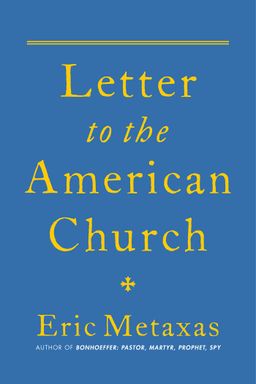
Letter to the American Church cover

Letter to the American Church

by Eric Metaxas

Eric Metaxas’s ''Letter to the American Church'' serves as a powerful call-to-action for Christians to engage politically and socially. By examining historical precedents, Metaxas urges believers to transform passive faith into active participation, challenging them to influence the nation''s future while staying true to their spiritual convictions.

A Call for Courage: The Church’s Moment of Reckoning

Have you ever wondered what happens when people of faith remain silent while evil marches forward? In Letter to the American Church, Eric Metaxas poses that agonizing question to every believer in America. He argues that just as the German Church of the 1930s failed to resist Adolf Hitler, the American Church today stands at a similar crossroads. The book is not a gentle critique—it’s a trumpet blast admonishing Christians to wake up, speak, and act before their silence becomes complicity.

Metaxas contends that the American Church’s retreat from cultural engagement is nothing short of catastrophic. By avoiding “politics” in the name of staying pure or focusing solely on evangelism, believers have surrendered the public square to forces hostile to God and human dignity. These forces—rooted in Marxist and atheistic ideologies he identifies under names like Critical Race Theory and radical gender politics—are, in his view, today’s equivalent of the spiritual darkness that once gripped Nazi Germany. Yet many Christians call withdrawal “winsome,” confusing cowardice for humility.

The Parallel with Bonhoeffer’s Germany

Metaxas’s argument draws heavily from his earlier work on Dietrich Bonhoeffer, the German pastor who resisted the Nazi regime and wrote The Cost of Discipleship. Bonhoeffer’s warnings to his peers—especially his sermon on Reformation Sunday in 1932—serve as the mirror through which Metaxas views America’s plight. In Bonhoeffer’s day, most church leaders thought it “unseemly” or “political” to resist. Their theological hair-splitting and obsession with safety led millions to death. Bonhoeffer pleaded with them: “Unless you repent, God will remove your lampstand.” Metaxas warns that if the American Church does not repent from its silence, history will judge it with the same horror that we reserve for the German Church.

The Stakes for America and the Modern Church

Metaxas reminds readers that America’s moral and spiritual roots have blessed not only its citizens but the entire globe. He invokes Tocqueville’s observation that America’s liberty worked precisely because its churches encouraged virtue rather than shrinking from politics. That symbiosis between faith and freedom set America apart. But now, as Christianity retreats from the public sphere, liberty itself begins to crumble. The Church’s silence, he says, is enabling an “anti-God globalist ideology” to rise—one aimed at dismantling national sovereignty, the family, and even objective truth.

To Metaxas, this is not hyperbole. He points out recent moments when political leaders deemed churches “nonessential” during lockdowns, when pastors accepted that designation instead of defying it, and when many gave moral sanction to cultural movements that contradict biblical teaching. Each instance, he argues, echoes Germany’s “spiral of silence”—the sociological process where the failure of some to speak emboldens others’ silence until an entire culture cannot speak at all.

Why This Matters Now

Metaxas’s premise is stark but hopeful: God has granted America—and its Church—an extraordinary role as a beacon of liberty under His authority. That calling is not a nationalistic boast but a sacred responsibility. If believers shrink back now, he believes the resulting judgment will not only devastate America but echo around the world. The author therefore appeals to individual conscience, reminding readers that “silence in the face of evil is itself evil.” His message is urgent, revolutionary, and personal. This book is both a theological manifesto and a moral summons—to be the Church that acts, speaks, and shines in dark times, even if the price is high. In making this plea, Metaxas aims to do what Bonhoeffer once did: awaken Christians before history closes the window of repentance forever.


What Is the Church, Really?

When you think of “church,” what comes to mind—a weekly service, a building, or a belief system? Metaxas insists that such definitions have become dangerously inadequate. The Church, he writes, is not a passive institution; it’s the living Body of Christ meant to shape the world. Yet the modern American Church has shrunk back into private piety, apologizing for its visibility. This retreat, once justified by embarrassment over being 'too political' in the 1980s and 90s, now functions as spiritual abdication.

Faith as Public Engagement

Metaxas cites Bonhoeffer, Wilberforce, and Colson as examples of believers who acted boldly in public life because they knew God’s truth applied everywhere—from the pulpit to parliament. He draws on theologian Abraham Kuyper’s famous declaration: “There is not one square inch of creation over which Christ does not cry, ‘Mine!’” This means the Church cannot compartmentalize its witness. Whether speaking on marriage, life, or justice, faith is public by nature. Christian retreat helps secularism impose what Metaxas and Richard John Neuhaus call “the naked public square”—a space stripped of divine perspective, where atheism masquerades as political neutrality.

The Cost of Silence

From the “Johnson Amendment” banning political speech in churches to cultural pressures that mock moral convictions, Metaxas argues that secularism has successfully coaxed pastors into surrendering their voices. He reminds readers that colonial preachers once denounced tyranny from their pulpits, inspiring freedom itself. By contrast, today’s pastors fear losing tax benefits or popularity. For the author, this fear equals spiritual paralysis—the same paralysis that infected German pastors under Nazi propaganda. Some in America even adopt a new religious vocabulary, saying they avoid politics “for the sake of the Gospel.” But Metaxas calls this a destructive illusion: real gospel witness never excludes standing for truth in public life.

Living Faith Fearlessly

Ultimately, what makes the Church the Church is courageous obedience. When Christian leaders counsel silence, they are “singing more loudly” to drown out the cries of those suffering injustice—whether unborn children, persecuted believers abroad, or citizens under ideological tyranny. Metaxas invites readers to heed Bonhoeffer’s example and William Wilberforce’s conviction: biblical faith must permeate every sphere. To be silent, even out of politeness or fear of being misunderstood, is to betray both God’s truth and human freedom. The Church will either embody Christ in history—or be remembered, like the German Church, as one that merely played at religion while darkness grew unchecked.


Prophets, Silence, and Seeing the Future

Can the Church learn from its past to foresee its future? In this section, Metaxas explores the prophetic calling of Christians. Just as Bonhoeffer foresaw where Hitler’s ideology would lead, believers today must discern what current trends portend. The tragedy of the German Church, he explains, was not its ignorance but its refusal to act on what it already suspected. Knowing evil was rising, many assumed things would never get 'that bad.'

Seeing the Future Through God’s Eyes

Every Christian, Metaxas argues, is meant to participate in God’s prophetic vision—not necessarily by predicting events, but by recognizing moral direction. He points to Bonhoeffer’s November 1932 sermon, which warned his congregation that celebrating Reformation Day without repentance was hypocrisy. Those words—'Unless you repent, I will remove your lampstand'—would prove devastatingly accurate. Two years later, the same church stood in ruins under Allied bombs. To Metaxas, that ruin was history’s visual parable of divine judgment.

Seeing With Courage

Prophetic vision demands courage. Bonhoeffer recognized that leaders under authoritarian regimes must adapt to changing evil; to ignore shifts in the spiritual landscape is to drift into irrelevance. Metaxas compares this blindness to American leaders who apply outdated strategies—avoiding difficult topics as though circumstances were still safe. By refusing to acknowledge cultural transformations brought by new ideologies, they repeat the German Church’s fatal error: clinging to 'business as usual.' Modern comfort, he warns, can anesthetize conscience just as effectively as fear.

God Still Sends Prophets

Because God operates outside time, Metaxas writes, He calls prophets in every generation to warn His people. Whether Bonhoeffer in 1933 or pastors today confronting moral relativism, prophecy is meant not to scare but to awaken. Those who dismiss warnings as exaggeration may be committing the same mistake as those who thought Hitler was a temporary sideshow. Seeing the future correctly requires humility, yet acting upon it requires repentance. For readers, this means watching not the news but history through biblical lenses—understanding that neutrality toward evil is never neutral and that God’s people are accountable to the light they have been shown.


The Spiral of Silence and the Cost of Cowardice

One of Metaxas’s most haunting ideas comes from Elisabeth Noelle-Neumann’s sociological theory: the “spiral of silence.” It describes how fear of social isolation prevents individuals from speaking truth until no one speaks at all. In the German Church’s case, silence allowed Hitler’s ideology to thrive; in ours, it lets lies about identity, freedom, and morality flourish unchecked. Metaxas extends Noelle-Neumann’s insight to illustrate how cowardice multiplies through communities, producing cultural paralysis.

How Silence Becomes Evil

The spiral works like this: when people hesitate to voice conviction, the perceived social cost of speaking increases. Others then grow more fearful, continuing the pattern until truth vanishes from conversation entirely. Metaxas calls this dynamic “spiritual entropy.” It is not passive; it actively empowers wickedness. When pastors refuse to address abortion or gender ideology, the lie that these issues are merely political becomes cultural dogma. He reminds readers that Bonhoeffer warned: “Silence in the face of evil is itself evil. Not to speak is to speak. Not to act is to act.”

Breaking the Spiral

Yet courage also spreads contagiously. Just as silence breeds more silence, one voice of truth lowers the cost for others. Metaxas urges Christians to recognize that each act of integrity—public or private—reduces fear’s grip. The price of speaking may be real: friends lost, reputations damaged, income sacrificed. But he asks readers to measure that price against the immeasurable cost of cultural decay. He quotes Bonhoeffer and Colson, insisting that freedom to speak truth is a hallmark of faith itself. If the Church forfeits it willingly, America ceases to exist as a truly free nation.

Faith as Courage

Metaxas contrasts cowardice with biblical faith. To fear death, disapproval, or loss more than you fear disobeying God is, he argues, practical atheism. Courage is faith made visible. Each generation must decide whether it trusts God enough to risk comfort for truth. The spiral of silence isn’t inevitable—it unravels the moment someone speaks. In that moment, you're reminded that history never changes course by majority consensus; it changes when even one person dares to tell the truth out loud.


Faith, Grace, and Cheap Religion

Metaxas devotes several chapters to dissecting theological errors that have neutered Christian witness. He begins where Bonhoeffer began: the corruption of “faith” and “grace” into cheap imitations. Martin Luther rediscovered salvation by faith alone—a breakthrough that freed believers from earning redemption. Yet over centuries, that doctrine thinned until faith became mere intellectual assent and grace became indulgence for sin. Bonhoeffer called this distortion 'cheap grace'; Metaxas calls it the root of the Church’s paralysis.

Faith That Acts

True faith, he explains, is dynamic trust expressed through obedience. Citing James 2:14–26, he notes that “faith apart from works is dead.” Believing in Christ means unmistakably acting on belief: defending life, freedom, and truth. Metaxas parallels Bonhoeffer’s teaching that cheap grace justifies cultural laziness—Christians sin freely, assuming grace will cover their cowardice. Instead of risking reputations for righteousness, they attend Sunday services to reassure themselves that God approves their passivity. This spiritual consumerism mirrors the German Church’s conformism, where religion became decorum instead of devotion.

Repentance Over Religion

To show what real grace looks like, Metaxas revisits the Genesis story of Adam and Eve sewing fig leaves after their sin—an image representing humanity’s attempt to hide guilt through self-effort. God Himself kills animals to clothe them, revealing that blood must be shed for true covering. In the same way, pretending faith without obedience is a fig leaf. Only when believers trust God entirely—repenting, risking, acting—do they receive genuine grace. Cheap grace, by contrast, offends divine love because it trivializes Christ’s sacrifice.

Loving God Wholeheartedly

Metaxas draws on Jesus’s command to love God with all one’s heart, soul, and mind. This, he says, replaces hollow belief with relational passion. Faith that does not move mountains, heal, or confront lies is faith that does not exist. He echoes Bonhoeffer’s rebuke of the bourgeois Church: Christianity had been reduced to an hour on Sunday, leaving the other six days to the world. To live “religious Christianity” instead of fearless discipleship is to deny grace’s power. Authentic faith, Metaxas concludes, is a fiery love that manifests in unmistakable courage—love that fights for the truth regardless of consequences.


The Idol of Evangelism

One of the boldest claims Metaxas makes is that evangelism itself has become an idol. In some churches, reaching unbelievers is used as an excuse not to speak hard truths about justice, morality, or politics. This error, he argues, mirrors the German pastors who said they must “only preach the Gospel” instead of denouncing persecution. But a truncated Gospel that neglects righteousness is not the Gospel at all.

A Misunderstood Gospel

Metaxas contrasts fashionable 'seeker-sensitive' approaches—focused on comfort—with Jesus’s uncompromising method. Christ called out hypocrisy, overturned tables, and told worshippers they were children of the devil. His harsh love revealed that truth and salvation are inseparable. Trying to make Christianity palatable by trimming its moral edges betrays the very heart of evangelism. If salvation means transformation, then silence on sin prevents transformation entirely. Bonhoeffer’s line, “Only he who cries out for the Jews may sing Gregorian chants,” summarizes the point: worship without costly love is empty.

Evangelism Versus Obedience

Metaxas recounts stories of pastors who claim neutrality to avoid being 'cancelled.' Their logic is simple: silence preserves the platform that allows them to preach. But he asks, what Gospel remains when its messenger abandons truth to keep preaching opportunities? Bonhoeffer condemned this same logic among ministers under Nazism; they conflated prudence with obedience. Love demands speaking truth, not hiding behind strategy.

Real Evangelism in Action

Citing William Wilberforce’s crusade against slavery and Billy Graham’s opposition to communism, Metaxas reminds readers that evangelists have always fought societal evil when guided by faith. God uses public courage to draw hearts, not silence. The idol of evangelism—concern more for appearances than obedience—must be smashed. True evangelism grows directly out of loving God enough to defend His truth publicly. Anything less resembles the churches that sang louder, thinking praise would drown out the cries of those being led to destruction.


Faith Applied: Religionless Christianity and Modern Courage

In his conclusion, Metaxas revisits Bonhoeffer’s haunting idea of “religionless Christianity.” Though often misused by secular theologians after Bonhoeffer’s death, the phrase meant a faith stripped of pious formalism—a Christianity lived out courageously in the real world. For Metaxas, it’s the antidote to today’s timid religiosity. He insists that genuine discipleship will always seem wild, unpredictable, and deeply uncomfortable. God’s grace was never intended to make us safe; it was meant to make us dangerous to lies.

Freedom and Responsibility

Metaxas echoes Galatians 5:1: “For freedom Christ has set us free.” That freedom carries the burden of leadership. Believers must take personal accountability—pastors cannot outsource courage. Every Christian is called to push against false walls, whether social, political, or spiritual. He illustrates this final challenge through Ronald Reagan’s 1987 speech at the Brandenburg Gate. When Reagan defied advisers and thundered, “Mr. Gorbachev, tear down this wall!” the world shifted. Those words, Metaxas writes, tore through decades of fear. Their prophetic courage collapsed an empire built on falsehoods.

Living with Wild Obedience

Like Bonhoeffer, Wilberforce, and Reagan, Metaxas calls for Christians to risk misunderstanding, rejection, and loss. Playing it safe—burying your talent rather than investing it—is spiritual treason. Safety disguises unbelief. Faith always involves holy risk, and freedom always comes with the charge to act. The American Church must therefore rise from its comfort, speak truth into darkness, and reclaim its prophetic voice.

Your Call in History

Metaxas closes by turning to the reader directly: “This is the hour for which you were born.” God places each generation at specific junctures requiring courage. If believers reclaim authentic, 'religionless' Christianity—faith in action—revival and renewal may yet come. But if fear prevails, America’s lampstand may be removed just as Germany’s was. The final message is piercingly clear: the Church’s destiny hinges on whether you will stand now. The time for polite faith has ended; the season for living faith has begun.

Dig Deeper

Get personalized prompts to apply these lessons to your life and deepen your understanding.

Go Deeper

Get the Full Experience

Download Insight Books for AI-powered reflections, quizzes, and more.