
Idea 1
Making Feedback Your Superpower
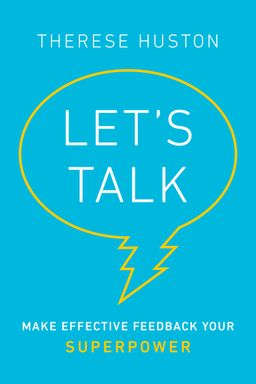
When was the last time you gave someone feedback that truly changed them? If the thought alone makes you anxious, you’re not alone. In Let's Talk: Make Effective Feedback Your Superpower, cognitive psychologist Dr. Therese Huston redefines how we think about feedback. She argues that the key to successful feedback isn’t mastering the art of telling people what to do—it’s learning how to create conversations people can actually hear. Feedback that works, she contends, isn’t a one-way critique; it’s a two-way exchange that builds trust, fuels growth, and motivates sustained excellence.
Huston’s central claim is both reassuring and revolutionary: anyone—introverts, avoiders, even conflict-phobes—can learn to give powerful feedback if they shift from performance judge to collaborative coach. The goal isn’t to become perfect at feedback, but to make it a natural and ongoing process that energizes both people involved. While classic management advice emphasizes candor and critique, Huston shows that genuine connection and psychological safety are just as critical. This balance, she insists, turns feedback from a dreaded ritual into a leadership superpower.
Why Feedback Feels So Hard
Despite living in an era flooded with online reviews and metrics, personal feedback is still agonizing for most managers. Huston reveals that 37 percent of managers feel uncomfortable giving critical feedback—and more than 20 percent avoid it altogether. We’re trained from childhood to stay silent unless we have something nice to say, yet our professional roles demand the opposite. Even worse, many organizations have replaced annual reviews with “continuous feedback,” increasing the pressure without offering tools to do it well. The result is a paradox: we’re expected to give more feedback than ever, but we suffer more stress and confusion when we do.
By grounding her approach in psychology and neuroscience, Huston normalizes this discomfort. Giving feedback triggers the same physiological stress response as receiving it—anxiety, hesitation, and mental load. Yet, she assures readers, feedback can become freeing when we reframe it from “telling hard truths” to “supporting someone’s growth.” Her message echoes Kim Scott’s Radical Candor but softens its directness with empathy and evidence from cognitive science.
The Three Conversations We Must Master
Huston introduces a powerful framework that immediately demystifies feedback: every conversation fits into one of three types—appreciation, coaching, or evaluation. Each fulfills a different human need. Appreciation recognizes effort and value (“I see you”); coaching helps someone grow (“Here’s how we can improve together”); and evaluation sets expectations (“Here’s where you stand”). The problem? Most managers blur these categories. We give a messy mix of praise and judgment that leaves employees confused, demoralized, or defensive.
By separating these forms, you increase clarity and connection. A conversation that starts with, “I’d like to have a coaching talk” feels safer than a vague “Can we talk?” Managers learn to match their message to the need—using appreciation for motivation, coaching for development, and evaluation for progress tracking. This triple framework runs through the book and becomes the foundation for every later practice.
From Scripts to Real Conversations
The heart of Huston’s book lies in moving feedback beyond “scripts” into authentic conversations. She dismantles the false comfort of canned lines (“Have you considered...?”) and focuses instead on presence. People don’t remember your phrasing, she argues—they remember how you made them feel. That emotional imprint determines whether they see you as a partner or an adversary. Drawing on Maya Angelou’s insight—“People will forget what you said and did, but never how you made them feel”—Huston explains how even painful feedback can feel supportive when it’s rooted in visible good intention.
Chapters like “Side with the Person, Not the Problem” and “Say Your Good Intentions Out Loud” demonstrate this shift in practice: feedback is effective when others sense you’re genuinely rooting for them. When Terri’s mentor told her bluntly, “You can’t write, but I want you to be happy,” it cut deep but inspired transformation. That phrase—I want you to be happy—became the key that unlocked change. This exemplifies Huston’s “superpower tip”: your helpful intentions only help if the other person hears them.
Why Feedback Must Be a Dialogue
At its core, the book contends that effective feedback mirrors a healthy conversation: both people talk, and both people listen. Huston’s research shows that what employees crave most isn’t relentless positivity—it’s being heard. In surveys she conducted, workers said they would have felt far better about discouraging feedback if only their managers had listened, discussed next steps collaboratively, or acknowledged their efforts. When feedback is a monologue, morale plummets; when it’s a dialogue, engagement rises.
This insight shapes everything from body language to timing. To make feedback land, you create psychological safety through listening, empathy, and follow‑up. Huston draws from experts like Amy Edmondson (The Fearless Organization) and Guy Itzchakov’s research on listening: when people feel heard, they become more open, more balanced, and more willing to change.
Feedback as Fairness—Not Favoritism
A ruling theme in Huston’s work is fairness. Feedback, she warns, is riddled with unconscious bias—gendered, racial, and hierarchical. Women and people of color often receive vaguer feedback or comments on personality rather than performance. To correct these patterns, Huston equips readers with evidence‑based tools for identifying bias (“protective hesitation,” “vague praise,” “tone policing”) and making fairness a daily practice. This isn’t just ethics—it’s performance strategy. When feedback is fair, the entire team performs better.
Why This Matters
In a world where employee engagement is sinking and trust in leadership is fragile, Huston’s work feels urgent. Feedback isn’t just communication; it’s the oxygen of learning organizations. By combining psychology, neuroscience, and storytelling, Let’s Talk transforms a dreaded managerial duty into a creative act of leadership. You’ll learn how to speak with care, listen with intent, and make feedback work for everyone—especially you. Whether you’re managing one person or an entire organization, this book will teach you to turn awkward moments into transformative ones, making feedback your greatest everyday superpower.