
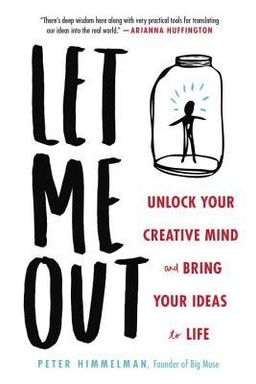
Let Me Out cover

Let Me Out

by Peter Himmelman

Let Me Out by Peter Himmelman empowers readers to overcome creative barriers and fears through practical techniques. By embracing creativity, confronting inner critics, and nurturing supportive relationships, it guides individuals to transform ideas into reality and sustain motivation for future challenges.

Unleashing Creativity by Silencing Fear

Do you ever feel like your biggest ideas—with all their promise and potential—get trapped inside you? In Let Me Out, musician and creative coach Peter Himmelman argues that the real obstacle preventing most people from living creatively isn’t lack of talent or opportunity—it’s fear. Specifically, it’s a self-protective, overly cautious inner voice he calls Marv—short for “Majorly Afraid of Revealing Vulnerability.”

Himmelman explains that Marv evolved from our primal instincts to avoid danger and rejection. The same brain that once helped us survive saber-toothed predators now resists emotional exposure, risk, and change. When we dream of launching a new business, learning an instrument, or confessing love, Marv whispers, “Don’t embarrass yourself.” His mission is safety, but at the cost of creativity and growth.

The Big Muse and the Creative Journey

After years as a professional musician, Himmelman realized the tools of songwriting—structure, rhythm, action, and reflection—offered a powerful metaphor for life itself. When the music industry’s collapse forced him to reinvent himself at age fifty-two, he founded Big Muse, a program designed to help others turn creative dreams into tangible results. The book distills these techniques into a step-by-step framework, from confronting the inner critic to building momentum, forming supportive communities, and sustaining long-term creativity.

Through relatable stories—his own and others’—Himmelman shows how creativity is not a mystical gift but a process that can be learned and practiced. Examples like his cousin Jeff, a talented pianist paralyzed by self-doubt, or entrepreneur Scott Eirinberg, who turned a spark of inspiration into the successful “Land of Nod” brand, illustrate how recognizing and quieting fear can unlock action.

Specific, Present, and True

At the heart of Himmelman’s creative philosophy are three guiding principles: Specific, Present, and True. Every goal or dream must be broken into concrete steps (specific), acted on immediately (present), and aligned with genuine desire rather than outside expectations (true). This triad helps bypass fear and indecision. For example, instead of aspiring vaguely to “be more creative,” you might decide to spend fifteen minutes writing lyrics at 8:30 a.m., today.

This approach connects deeply with cognitive psychology’s concept of “adaptive steps,” small achievable actions that rewire the brain’s pessimism loop. Himmelman integrates scientific insights from thinkers like Aaron Beck and Mihaly Csikszentmihalyi (who coined “flow”). He links such research to his own art-driven exercises, from writing “Why You” statements to exploring “Elephant Ropes”—self-limiting childhood memories that still influence adult behavior.

From Fear to Flow

The book’s ultimate aim is transformation—from paralysis to presence. Himmelman contends that freedom emerges when we stop wrestling with Marv and start understanding him. The goal isn’t to destroy fear, but to give it a “furlough” so our creative minds can breathe. This gentle approach echoes mindfulness practices, emphasizing awareness without judgment.

Throughout Let Me Out, Himmelman offers Brain Bottle Openers (BBOs)—structured exercises to unlock mental bottlenecks. These range from writing gratitude texts (“Smartphone Letter”) to performing mental reframings (“Acknowledgment Is Knowledge”). Each BBO has clear psychological reasoning and a real-world purpose: reconnecting imagination with action.

Why It Matters

In an age dominated by distraction and self-doubt, Let Me Out insists that creativity is a vital human need, not a luxury. Whether you want to write a novel or repair a relationship, Himmelman’s lessons help you reclaim agency. He blends science, art, humor, and personal confession to reveal how progress begins in small, sincere actions. The cumulative message is empowering: you can live more creatively not by erasing fear, but by redirecting it toward meaningful, specific, and honest expression.

By the end, what begins as a guide to creative productivity becomes something deeper—a meditation on courage, empathy, and the art of being fully alive. Himmelman’s invitation is deceptively simple but powerful: stop planning and start doing; stop hiding behind safety and show the world what’s inside you. That’s how you finally let yourself out.


Meet Marv: The Inner Critic Revealed

At the core of Himmelman’s philosophy is identifying and understanding Marv—the inner critic who masquerades as protector but functions as saboteur. Marv’s voice is the anxious chatter that asks, “Who are you to try this?” or “What if you fail?” Himmelman personifies Marv to make the intangible tangible, giving us a way to dialog with self-doubt rather than drown in it.

Marv’s Origins

Marv arises from evolutionary biology. The human brain evolved to react instantly to threats—a rustle in the bushes, a dangerous shadow. But while predators disappeared, our amygdala stayed busy, perceiving emotional risks (like criticism or rejection) as mortal danger. Thus, the fear that once saved us now freezes us when we need creativity most. Himmelman illuminates this through stories of artists haunted by imagined failure, proving that even professionals aren’t immune.

The Left and Right Brain Tug-of-War

Himmelman references Roger Sperry’s research on divided hemispheres: the left brain’s logical, analytical focus clashes with the right brain’s intuitive, associative imagination. When you brainstorm new ideas, the analytic mind screams caution—Marv’s cue to intervene. The trick is not silencing logic but balancing it. By keeping dreams Specific, Present, and True, you reassure Marv that action is safe, transforming him from a roadblock into an ally.

Turning Criticism into Fuel

Himmelman shares an anecdote from his early career. When he timidly presented a song to a mentor, the man ejected the cassette and hurled it like a football into a fireplace. The experience burned itself into his psyche—proof that creative ambition often meets cruelty. Yet the real takeaway, he later learned, was that criticism hurts only when you’ve given Marv the microphone. Once you differentiate external critique from internal sabotage, you can finish imperfect work and grow stronger.

Marv, in the end, is not your enemy but your overzealous guardian. When you learn to thank him—then politely send him on vacation—you reclaim your creative agency. This reframing aligns with modern cognitive-behavioral therapy: you can’t stop negative thoughts from arriving, but you can decide how to respond to them.


Breaking the Elephant Ropes of the Past

We are all tethered to invisible ropes—old experiences that convinced us we’re inadequate, strange, or unworthy. Himmelman calls these Elephant Ropes, after circus elephants trained to stop resisting tiny restraints because they failed to break chains as calves. Similarly, many adults remain bound by outdated self-beliefs.

The Subtle Power of Shame

Himmelman shares a childhood memory: after a garage “rock concert” where he joyfully performed for neighborhood kids, a girl called him “immature.” Instantly, his confidence collapsed—and for decades, that moment defined his boundaries. He calls this a classic Marv takeover: a single external judgment solidifies into lifelong inhibition. By revisiting these formative wounds with compassion, he encourages readers to reclaim their childlike vitality.

Expansion vs. Contraction

Instead of labeling experiences as success or failure, Himmelman reframes them as expansion (learning, growth, creativity) or contraction (fear, self-protection). This dynamic model removes judgment and invites curiosity. When you recognize contraction as a signal rather than a verdict, you can consciously choose expansion—taking another small risk despite fear.

From Judgment to Observation

Drawing on Zen thought, Himmelman reminds us we are not our job titles or failures. We are observers, capable of awareness beyond labels. The Elephant Rope exercise—recalling a limiting memory and describing it vividly—helps disentangle fear from identity. Once you see the rope, you can step over it. This shift from analysis to awareness mirrors mindfulness psychology and offers a clear doorway back to creative freedom.


Turning Fear into Motion

Fear thrives on stagnation; action dissolves it. Himmelman’s solution is deceptively simple: take one specific, present, and true step right now. When we delay, Marv spins complex rationalizations. He illustrates this through relatable stories of paralysis, from his friend Jeff Victor—an accomplished pianist who couldn’t schedule a simple hometown concert—to designer Andy Cruz, too nervous to call a potential client.

The Deflators and Fear’s Storytelling

Himmelman dramatizes fear as a team of “Deflators” producing cinematic sabotages in your mind. Each time you approach a dream, they craft persuasive narratives of disaster. By becoming conscious of these inner movies, you weaken their hold. This technique aligns with narrative therapy, which teaches that rewriting the story changes the outcome.

Tiny Steps, Big Leaps

Jeff’s path to his dream concert began when Himmelman asked him to take a five-minute action—simply find his old setlist. That microscopic step reactivated confidence and led, eventually, to a joyous real performance. Momentum, once started, creates its own courage. “The lever you can pull anytime,” Himmelman writes, isn’t motivation—it’s motion itself.

Each small act quiets Marv by proving survival. As psychologist Albert Bandura noted in his research on self-efficacy, mastery builds through incremental successes, not grand victories. The moment you pick up the phone, pencil, or instrument, the illusion of fear begins to crumble.


Rediscovering Kid-Thinking

Adults plan, analyze, and delay. Children play, explore, and experiment. Himmelman urges you to reclaim that uninhibited state he calls Kid-Thinking—a mindset of joyful immersion without judgment. D.W. Winnicott described play as the “intersection of dream and reality.” For Himmelman, that’s the essence of creativity: risking messiness to make meaning.

Learning from Karate and Curiosity

He compares creativity to martial arts. Most karate students fail not from lack of skill, but from fear of getting hit. Similarly, most creators stall because they dread failure’s sting. Mastery begins the moment you accept imperfection as part of practice. Like true black belts, creative experts have been “hit” countless times and survived. Courage, not perfection, keeps them flexible.

Exercises to Break Functional Fixation

In one playful Brain Bottle Opener, Himmelman asks readers to find multiple uses for an ordinary cup or to turn random scribbles into recognizable images. These exercises train you to see beyond “functional fixedness”—a cognitive bias that limits creativity. The more absurd your ideas, the more your brain rewires for innovation. (Cognitive psychologist Anthony McCaffrey’s research supports this, showing new solutions arise when you reinterpret an object’s purpose.)

Kid-Thinking doesn’t demand reverting to childhood; it means remembering that exploration itself is play. When you approach projects with wonder rather than worry, you unlock spontaneous insight and flow—the “Milky Way Moment” Himmelman celebrates.


The Milky Way Moment and the Joy of Doing

What does joy feel like in the creative process? For Himmelman, it’s the Milky Way Moment—that blissful, immersive state when time dissolves and effort becomes pleasure. He compares it to tasting the richest candy bar imaginable after years of chewing on dry grass. The metaphor captures both the sweetness of doing and the emptiness of endless hesitation.

From Anxiety to Action

His prototypical example is Andrea, a young realtor who dreams of writing a blog. Instead of overthinking, she sets a timer and starts typing within minutes. That simple act turns anxiety into motion—and within an hour, she experiences flow. She hasn’t “succeeded” yet, but she’s alive with purpose. The creative reward, he insists, comes not from results but from engagement.

Love Fuels Creativity

Himmelman relates a poignant story of writing a song for his dying father. The vulnerability and honesty of the gesture opened emotional floodgates—and ironically, became the work that launched his professional career. The lesson is profound: heartfelt connection, not ambition, is the most sustainable motivator. (Psychologist Barbara Fredrickson’s studies on love and positivity echo this insight: enduring joy stems from meaningful connection, not achievement.)

If you feel stuck, the way forward isn’t to strategize or compare—it’s to begin. The Milky Way isn’t out there; it’s the glow that arises inside you when thought becomes action.


Sustaining Momentum and Navigating Change

Even after initial bursts of inspiration, reality tests resolve. Himmelman devotes several chapters to sustaining creativity through uncertainty. Change, he writes, isn’t a disruption—it’s the lifeblood of creativity. When we resist it, we stagnate.

The Backache of Change

He recounts losing his job as a television composer, a blow that initially felt catastrophic. Yet by reframing the event—seeing his own blind spots, taking “Acknowledgment Is Knowledge” responsibility for his part—he discovered new empathy and direction. Change, like a sore back, signals growth and realignment. Accepting discomfort allows us to reinvent ourselves continually.

Letting Go and Reconnection

The subsequent “Logjam” exercise teaches how to release outdated dreams or grudges through a “Letting Go Letter.” Writing down what no longer serves you—relationships, habits, self-concepts—acts as creative dynamite, freeing mental energy. Himmelman also prescribes moments of sensory awareness and volunteer experiences to reawaken empathy, reminding you that inspiration grows through reconnection with others.

His formula for resilience blends artistry with psychology: accept responsibility, forgive yourself, and make space for renewal. Creativity, he argues, isn’t linear progress—it’s cyclical healing.


Community, Connection, and the Posse Principle

Creativity may begin in solitude, but it thrives in connection. Himmelman’s concept of the posse emphasizes surrounding yourself with allies who reflect your courage back to you. A posse can be one person or ten; what matters is mutual accountability and belief.

Debbie Gold’s Puzzle Breakthrough

Debbie, a former rock tour manager, reinvented herself by turning vintage record covers into bestselling jigsaw puzzles. Her success, she insists, came from confiding early ideas in musician friends like Bob Weir of the Grateful Dead. Their encouragement sustained her through legal tangles and self-doubt. A supportive network turns isolation into incubation.

Avoiding External Deflators

Not everyone deserves to hear your early dreams. Himmelman warns of “External Deflators”—well-meaning critics who kill fragile ideas with skepticism. Share your embryonic projects only with those who understand creative processes. Protecting the tender phase of an idea is a form of self-care.

By cultivating a growth-minded posse and avoiding destructive voices, you transform fear into loyalty and humility into strength. Creativity, Himmelman concludes, is contagious when shared with the right tribe.


Music as Metaphor: Structure Gives Freedom

Himmelman ends where he began—with music. The discipline of songwriting becomes a metaphor for any creative pursuit. Songs demand form—meter, rhyme, rhythm—but within that structure lies infinite emotional space. Similarly, life’s constraints (job, family, time) can fuel rather than hinder creative expression if approached with intention.

Immersive vs. Outcome Motivation

He distinguishes between immersive motivation (creating for the joy of it) and outcome motivation (creating for praise or reward). Studies like Daniel Pink’s Candle Problem reinforce this point: extrinsic rewards narrow focus and stifle innovation. True creativity flourishes when effort becomes its own reward.

Writing Your Song

Himmelman’s final Brain Bottle Opener—writing a personal “dream song”—blends structure with emotion. By writing three verses describing your envisioned future in vivid sensory terms, you fuse logic and imagination. Even non-musicians can experience the cathartic clarity of shaping chaos into melody.

Through this creative ritual, the abstract becomes tangible, the invisible becomes heard. In Himmelman’s view, that’s what it means to truly “let yourself out.”

Dig Deeper

Get personalized prompts to apply these lessons to your life and deepen your understanding.

Go Deeper

Get the Full Experience

Download Insight Books for AI-powered reflections, quizzes, and more.