
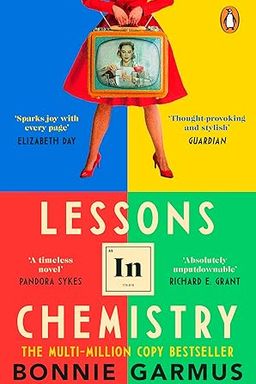
Lessons in Chemistry cover

Lessons in Chemistry

by Bonnie Garmus

In Lessons in Chemistry, Elizabeth Zott is a brilliant scientist navigating 1950s gender biases. Her unexpected rise as a TV cooking show host challenges societal norms, inspiring women to embrace change and pursue their ambitions. This compelling novel explores themes of resilience, solidarity, and the transformative power of science and self-belief.

Chemistry, Identity, and Social Change

At its core, Lessons in Chemistry by Bonnie Garmus asks how a brilliant woman can remake her world when her genius collides with sexism, grief, and the constraints of mid‑century America. You experience this question through Elizabeth Zott—a chemist whose life spans the laboratory, the kitchen, the television studio, and the moral battleground of public opinion. Garmus turns science into metaphor and activism into daily practice, arguing that intellectual honesty and courage can transform even hostile institutions.

The scientific life turned domestic

Elizabeth’s journey begins in research, driven by rigor and curiosity, but bureaucracy and sexism force her out. Denied credit for her discoveries and punished for pregnancy, she converts her kitchen into a lab, proving that discipline and inquiry can survive outside official structures. She later uses a TV show, Supper at Six, to teach chemistry disguised as recipes—a powerful act of democratizing knowledge. You see science escape the ivory tower and enter homes, reframing ordinary acts like cooking or cleaning as sites of learning and empowerment.

Grief as catalyst

The death of Calvin Evans, her partner and intellectual equal, catalyzes reinvention. His presence—scientist, rower, orphan, and moral compass—shapes much of the novel’s emotional orbit. When Calvin dies suddenly, Elizabeth transforms pain into productivity. Her grief becomes proof of resilience, showing how loss can generate new systems rather than end the story. Calvin’s notebooks, stolen and later recovered, symbolize a reclamation of intellectual heritage from patriarchal institutions.

Resistance in daily form

The book’s feminism is pragmatic. Elizabeth uses lunchbox notes for her daughter like miniature manifestos: “Play sports at recess but do not automatically let the boys win.” These are micro‑lessons against ambient sexism. She resists every attempt to shrink her into stereotype—whether Hastings’ dismissal or KCTV’s insistence on glamour. You learn that resistance need not occur in protest marches alone; it can live in household pedagogy and televised subtext.

Public visibility and private cost

Public acclaim rarely equals respect. The same audience that cheers Elizabeth calls her “Luscious Lizzie.” The press reframes brilliance as personality, and success as scandal. This tension—the woman adored but trivialized—illustrates Garmus’s critique of celebrity culture and gendered representation. (Note: Garmus’s realism here echoes Virginia Woolf’s concern that women are confined by surface image rather than substance.) The novel teaches that authenticity has a price, and that sometimes integrity must coexist with public misunderstanding.

Science as moral language

The deeper theme is epistemological: chemistry is not just Elizabeth’s profession but her worldview. She believes every social phenomenon—sexism, grief, conformity—can be analyzed through reaction and balance. The kitchen becomes her bench, reactions her metaphors. By turning molecular logic into social critique, Garmus shows how scientific methods can expose cultural fallacies. The law of conservation of mass becomes a moral symmetry: nothing is lost, only transformed.

Resilience through community

Elizabeth’s survival depends on allies: Harriet Sloane, her neighbor who models quiet empathy; Walter Pine, who evolves from producer to protector; Reverend Wakely, who reconciles religion and reason; and Six‑Thirty, her dog who embodies non‑verbal loyalty. This group demonstrates how care circulates beyond blood. They enact an alternative social chemistry—bonds that stabilize when formal systems fail.

Transformation and legacy

By the end, Elizabeth leaves television, backed by Avery Parker’s foundation, to rebuild a lab and return to science. That act of recommitment concludes not in fame but autonomy: she uses public influence to change institutional governance, oust exploitative directors, and reframe research as shared work. You come away understanding the book’s core claim—change, like chemistry, begins with agitation. Stir the solution, apply heat, and even the most rigid compound can rearrange.


Sexism and Institutional Betrayal

From UCLA’s physics labs to Hastings Research Institute, Elizabeth navigates structures designed to exclude her. Garmus details how everyday misogyny scales into career death: resource gatekeeping, rumor mills, and punitive bureaucracy. When Dr. Meyers assaults her and she defends herself, the institution ostracizes her, proving how privilege protects perpetrators. Later, Donatti and Frask at Hastings enforce compliance by firing her for pregnancy, citing “standards.” You see how the system itself acts as antagonist.

Administrative indifference and coded control

The bureaucrats cloak their prejudice in procedure. Supplies become tools of exclusion, gossip replaces peer review, and written policies serve reputation rather than ethics. (Note: This pattern mirrors real mid‑century scientific culture, documented in biographies of Rosalind Franklin.) By showing sexism as an institutional algorithm, Garmus shifts blame from individuals to systems—a critical insight you can apply to modern workplace inequities.

Turning exile into innovation

Denied a lab, Elizabeth builds one herself. She mixes equipment with cookware, charges colleagues for consultancy, and repurposes grief into survival. This resistance through creation transforms humiliation into independence. The book insists that exclusion can generate alternative spaces—kitchens, side rooms, public platforms—where knowledge circulates despite authority.


Calvin Evans and the Chemistry of Love

Calvin Evans is not simply Elizabeth’s counterpart; he is a study in how genius and isolation interreact. His brilliance results in early acclaim, but his emotional damage—abandonment and superstition—creates internal instability. He fears love, believing he’s jinxed, yet his relationship with Elizabeth becomes transformative: they collaborate naked over experiments, fuse affection with method, and produce mutual growth. Their home represents radical partnership, merging intellect and intimacy.

The grudge mechanism

Calvin’s life reveals how resentment shapes scientific identity. His bitterness toward institutions mirrors Elizabeth’s later rebellion. Garmus uses him to explore how talent without healing breeds defensiveness. He views affection as experiment, fearing repeat catastrophe. When he dies accidentally—police car, leash, timing—you feel how randomness dismantles mastery. (Parenthetical note: Like Mary Shelley's tragic scientists, Calvin demonstrates how intellect cannot neutralize emotion.)

Legacy transfer

His death leaves notebooks, clues, and an emotional residue that fuels Elizabeth’s trajectory. Later, Avery Parker’s revelation as Calvin’s biological mother reframes lineage and class: philanthropy and secrecy intersect with science. You see grief convert into lineage‑repair, suggesting that honesty about origins can heal generational divides. For you, Calvin’s story teaches that unprocessed guilt delays discovery; only transparency permits progress.


Rowing, Discipline, and Recovery

Rowing operates throughout as both literal sport and metaphor for synchronization. Calvin’s Cambridge years and Elizabeth’s later training make physical endurance parallel intellectual rigor. The discipline of oars—the synchronized slide, the shared pain—represents solidarity among misfits. When Elizabeth joins the men’s eight, she challenges gendered exclusion and reclaims a space historically coded male.

Technique and metaphor

The sport’s technical detail—catch, drive, recovery—mirrors the novel’s structural rhythm. “Go slow to go fast,” the coach says, summarizing the logic of patience under pressure. Rowing demands alignment of breath and thought, and its physicality teaches cooperation. (Note: Garmus borrows rowing imagery to link movement and resilience, echoing how Wallace Stevens tied walking to thinking.)

Pain as ritual and release

For both Calvin and Elizabeth, rowing converts emotional pain into controllable strain. The boat becomes their therapy, grief metabolized through muscle memory. When they flip repeatedly, Elizabeth insists on continuing despite fear, proving that equilibrium—scientific or emotional—requires persistence through imbalance. Rowing thus becomes Garmus’s symbol for collective motion toward recovery.


Supper at Six and the Politics of Television

Supper at Six translates laboratory precision into mass pedagogy. Designed as light entertainment for the Afternoon Depression Zone, the show combines domesticity with rigor. Producers demand charm; Elizabeth delivers chemistry. Each episode becomes a miniature class: spinach casserole as lesson in oxalic acid, pot pie as protein coagulation, potato eyes as toxic glycoalkaloids. Viewers unknowingly learn molecular reasoning alongside dinner prep.

Performing under constraint

Elizabeth’s refusal to comply—to giggle, flirt, or fake ignorance—creates tension with sponsors and executives. Phil Lebensmal enforces sexism through wardrobe and script, culminating in a coercive assault that exposes TV’s predatory underside. Still, she turns televised chemistry into civic education. Her enduring line, “Children, set the table. Your mother needs a moment to herself,” doubles as feminist manifesto: authority reclaimed through domestic command.

Public learning through practical acts

Garmus uses the show to argue that science belongs in everyday life. Television becomes social laboratory—mass experiments in knowledge and empathy. You also see how honesty invites backlash: her on‑air atheism triggers outrage, bomb threats, and syndication. Yet she endures, proving that authenticity, even under threat, can alter public norms of education and gender authority.


Public Exposure and Media Amplification

Madeline’s kindergarten family tree project and Life magazine’s coverage of it capture how personal truth becomes commodified. The tree lists unjustly scrutinized details—illegitimacy, historical icons—and provokes school outrage. When reporters repeat it, privacy collapses into spectacle. The family endures the paradox of fame: their honesty weaponized as scandal. Harriet’s diplomacy contrasts Elizabeth’s defiance, outlining two strategies for surviving visibility—prudence or principle.

Visibility as vulnerability

You learn how media appetite distorts meaning. A child’s assignment becomes moral trial; sponsors dictate narrative; headlines frame scientists through sexuality. Garmus critiques early celebrity logic that continues today—data turned gossip, truth turned clickbait. The novel asks: does exposure advance justice, or simply multiply misunderstanding?

Reclaiming voice

Elizabeth ultimately uses speech as shield. Through precise communication—writing, teaching, arguing—she counteracts distortion. The act of defending truth publicly becomes science’s human extension: the experiment of persuasion under uncontrolled conditions.


Six-Thirty and the Ethics of Care

Six‑Thirty, the rescued dog, embodies care as moral intelligence. Once failed at bomb detection, he becomes emotional stabilizer and guardian. His vocabulary expands into hundreds of words, making him witness to love and danger. When Calvin dies, Six‑Thirty’s grief mirrors human mourning—lying at graves, saving lives, reading moods. He turns loyalty into ethical action, diving at threats and retrieving safety.

Cross‑species empathy

Through him, Garmus suggests that morality transcends species boundaries. Six‑Thirty restores balance when humans falter, protecting community. His persistence makes care visible, offering an alternative model of emotional labor where instinct replaces discourse. (Note: The dog’s perspective recalls Jack London’s sentient witnesses—beings that reflect human ethics through behavior.)

Care as connective tissue

Practically, Six‑Thirty bridges isolation by fetching Madeline, alerting danger, and attracting social support. His presence rebuilds communal ties around Elizabeth’s household, showing that survival depends on shared vigilance. The dog’s heroism, documented in local papers, turns care into civic virtue.


Philanthropy, Power, and Redemption

Avery Parker’s late arrival transforms private tragedy into institutional reckoning. As Calvin’s mother and founder of the Parker Foundation, she brings financial and moral leverage. Her admission that wealth once concealed shame reframes charity as accountability. By acquiring Hastings and deposing Donatti, she enables reform—proof that reparative philanthropy can restore justice.

The acorn connection

Mad’s acorn labeled “Fairy Godmother” becomes prophecy fulfilled: Parker’s philanthropy rooted in guilt. Through this, Garmus critiques the culture of hidden benevolence—donors who preserve reputations while silencing those they intend to help. Parker’s transparency becomes catharsis for both herself and Elizabeth, showing that honesty about complicity leads to institutional healing.

Restorative outcomes

Parker and Wilson finance the rebuilding of Elizabeth’s lab, shifting control from exploiters to visionaries. Money becomes moral reagent: not neutral, but transformative when mixed with truth. This episode reminds you that systems change only when resources and ethics react together.


Recommitment to Science and Self

Elizabeth’s final act—leaving television to return to laboratory work—serves as fulfillment of the novel’s title. She demonstrates that lessons in chemistry are also lessons in autonomy. On her farewell broadcast, she declares “Chemistry is change,” redefining transformation as a personal and professional law. Faithful viewers witness a scientist reclaim authority from entertainment industry constraints.

Allies and networks

Her return is collectively supported: Walter negotiates contracts to secure rights; Parker funds the new Hastings; Harriet and Wakely provide moral steadiness. Together they form a structure of reclamation—proof that solidarity reconfigures failure into momentum. (Note: this echoes the collaborative spirit found in novels like The Signature of All Things by Elizabeth Gilbert.)

Lesson of persistence

The book concludes with chemistry as philosophy: through agitation, reactions begin. Elizabeth’s recommitment closes the cycle—science regains dignity, and society absorbs its own critique. You leave understanding that transformation, whether molecular or social, requires courage to alter states without assurance of applause.

Dig Deeper

Get personalized prompts to apply these lessons to your life and deepen your understanding.

Go Deeper

Get the Full Experience

Download Insight Books for AI-powered reflections, quizzes, and more.