
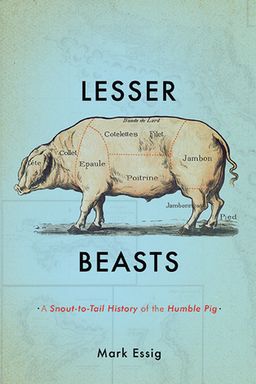
Lesser Beasts cover

Lesser Beasts

by Mark Essig

Lesser Beasts by Mark Essig explores the pig''s enduring relationship with humanity, from ancient civilizations to modern farming. This fascinating history reveals pigs as crucial companions in human development, exposing cultural, ethical, and environmental issues that challenge our current farming practices.

Humans and Pigs: A Shared Evolutionary Story

Humans and Pigs: A Shared Evolutionary Story

Why did pigs become humanity’s most paradoxical partner—beloved and reviled, sacred and profane? Across biology, culture, and economy, pigs mirror us more closely than any other livestock. Their journey from forest omnivore to factory-confined commodity reflects how humans shape—and are shaped by—our food systems. The book argues that understanding the pig’s story unlocks key lessons about adaptation, civilization, and the costs of technological progress.

Biological and cognitive parallels

You begin with anatomy and mindset. Pigs share our omnivorous teeth, flexible digestive systems, and remarkably similar sensory intelligence. Their snouts act like hands, packed with tactile nerves for foraging and exploration—a “fifth limb” that mirrors the human hand’s dexterity. Because pigs, like humans, do not waste metabolic energy on giant fermentation guts, they can afford large brains. This “expensive-tissue” balance helps explain their curiosity, problem-solving, and emotional range. (Temple Grandin notes pigs can learn mirror recognition and delay gratification—traits once reserved for primates.)

Self-domestication and ecological opportunism

Domestication did not start with capture but coexistence. At neolithic sites like Hallan Cemi and Cayönü Tepesi, wild boars moved into human settlements to scavenge waste and grain. Over centuries, repeated interaction selected for smaller brains, docile behavior, and shortened snouts—classic juvenile traits. Pigs essentially domesticated themselves through proximity, evolving alongside humanity’s sedentary turn. Unlike shepherded animals, they joined village life, recycling refuse, fertilizing soils, and serving as living waste management systems.

Religion, taboo, and identity

Once close companions, pigs later became religious boundary markers. Leviticus classifies them as unclean for failing to chew cud—a symbolic division between vegetarians and scavengers. In Jewish and Islamic law, this prohibition defined communal identity; in Christianity, its reversal became a statement of inclusiveness. Abstention became political: in Maccabean resistance stories, refusing pork meant resisting imperial assimilation. These dietary boundaries encode ecological anxieties—omnivory, filth, and disease—as moral concerns.

Economic rise and cultural ambivalence

From Rome’s pork empire to today’s confinement barns, pigs recurrently thrive where human systems can feed them and suffer where they offend our sensibilities. Romans industrialized pork with urban sty breeds and curing innovations; medieval Europe reinvented forest pannage. In each era, pigs translated landscape and culture into fat and muscle, adapting faster than almost any species we managed. Yet each transformation carried moral baggage—dirt, greed, gluttony—that mirrored social tensions between wealth, labor, and cleanliness.

From local resource to global commodity

After Columbus, pigs crossed oceans as empire’s traveling commissary—feeding conquistadores and invading ecosystems. The same flexibility that made pigs imperial assets makes them modern ecological liabilities. Industrial agriculture amplified that pattern: pigs now consume vast quantities of grain and soy, their waste rivaling human output, their antibiotic use breeding resistant bacteria. When China industrialized pork in the 1990s, it replayed centuries of Western intensification in two decades—compressing environmental, welfare, and ethical dilemmas into one global story.

Core lesson

The pig’s evolution stands as a mirror to our own civilization: opportunistic, intelligent, and adaptive, yet driven by appetites that carry ecological and ethical consequences.

Through this lens, the book traces how biological kinship turned into industrial dependence. It asks you to reckon with how a creature so similar to us became a barometer of humanity’s relationship to nature, morality, and technology—and whether we can learn from the pig’s adaptability before our own becomes unsustainable.


From Forest Omnivore to Village Partner

From Forest Omnivore to Village Partner

The story begins long before agriculture. Evolution split the ungulates into ruminant grazers and omnivorous suids. While horses and deer specialized for grass, pigs retained full-mouth versatility and forest mobility—traits that let them eat what humans ate. Those shared appetites explain why pigs shadowed us into settlements, not as prey but participants.

Hallan Cemi and Cayönü: self-domestication theory

At Hallan Cemi (11,000 years ago), archaeologists uncovered pig remains mostly from young males—evidence of early human culling practices within villages. Centuries later at Cayönü Tepesi, bones show morphological changes—shorter snouts and smaller teeth—marking domestication. These shifts reveal pigs adopted human spaces first, and only afterward did people begin to consciously manage them. This “commensal pathway” resembles dogs’ evolution from wolves scavenging at camps but unfolds through entire communities, not specialist herders.

Cultural duality

Living beside humans made pigs both useful and unsettling. Their role as garbage recyclers blurred purity boundaries, foreshadowing Near Eastern taboos. In China, however, proximity turned positive: pigs became vital converters of leftover grain into fat and fertilizer. Across Eurasia, ecological opportunity yielded multiple independent domestications—a pattern of spontaneous partnership wherever humans settled and stored food. (This repeats the general lesson from Jared Diamond’s domestication models: species that exploit human niches often evolve toward cohabitation.)

Key takeaway

Domestication can be an emergent process—driven not by capture but by cooperation and adaptation to human-created habitats.

Seeing pigs as evolutionary opportunists reframes human history: they adapted to us as we built the world around them, setting the stage for every ecological and moral contradiction that followed.


Faith, Class, and the Politics of Purity

Faith, Class, and the Politics of Purity

Religious rules about pigs blend ecology, theology, and social order. When Leviticus bans pork for failing to chew cud, it creates a symbolic opposition between clean grazers and dirty scavengers. This code expressed both spiritual purity and practical anxiety about disease transmission from omnivores living close to human waste.

Taboos as identity tools

In the Hellenistic era, defiance of forced pig sacrifice became resistance to cultural domination. Eleazer in the Maccabees refuses pork under torture, transforming dietary observance into a badge of faith. Islam inherited the prohibition, spreading it across continents; Christianity inverted it—using pork acceptance to signify openness and inclusion. Food choices became spiritual border walls that defined who belonged to which moral world.

Class and cleanliness

Beyond religion, pork also reflected class divides. Urban poor raised pigs as living trash processors; elites ate ruminants raised on taxed estates. In medieval and modern times, status and hygiene shaped taste. When sanitation improved, pork lost its symbolism of peasant practicality and gained reputation as coarse or unhealthy. Those shifts proved that disgust and holiness share roots in social hierarchy.

Insight

Every taboo does social work: it regulates boundaries, not just behaviors. The pig’s spiritual and class stigma remains a coded reflection of ecology and power.

In short, religion and status converged on the same symbol—the pig—turning an efficient scavenger into a contested moral figure across centuries.


Pigs and the Making of Empires

Pigs and the Making of Empires

From Rome’s banquet halls to conquistadores’ camps, pigs built empires as much as legions did. Their portability, fecundity, and omnivory made them political tools—feedstock for expansion and symbols of abundance.

Rome’s pork machine

Roman agriculture industrialized pig farming, distinguishing grain-fed sty pigs for urban citizens and forest pigs for rural areas. Emperors funded pork doles, and curing techniques pioneered prosciutto traditions in Parma and Iberia. Salting transformed meat into imperial infrastructure—transportable calories linking provinces to Rome.

Collapse and medieval adaptation

After Rome fell, forest pigs replaced urban breeds as grain supplies disappeared. Medieval Europe practiced “pannage”—seasonal mast feeding—turning woodlands into economic units measured by swine capacity. Monasteries refined curing, peasants preserved lard economies, and nobles hunted boar for sport. Pigs underwrote resilience amid fragmentation.

Columbian Exchange and conquest

Columbus and later conquistadores unleashed pigs onto the Americas. Rapid multiplication turned islands into living larders, while ecological disruption destroyed native crops and habitats. Cortés and De Soto treated herds as mobile commissaries; feral descendants became invasive species. Thus pigs helped fuel conquest and reshape ecosystems simultaneously.

Paradox

Every empire both fed itself and poisoned its landscapes with the same animal—pigs as both sustenance and contagion of civilization.

Empires rise and fall, but the pig remains their emblem: adaptable, exploitive, indispensable—a living technology for human expansion.


Industrialization and the Birth of Porkopolis

Industrialization and the Birth of Porkopolis

Nineteenth-century America transformed pigs into industrial products. Corn-belt abundance made hogs efficient calorie converters, and Midwest packers made cities like Cincinnati and Chicago synonymous with mechanized slaughter. Here, modern capitalism took shape on a killing floor.

Corn and breeding innovation

The corn-hog symbiosis defined agricultural economics: an acre of corn yielded more meat calories when fed to hogs than when eaten directly. English and Chinese genetic lines created compact, fast-fattening breeds such as the Poland China, optimized for grain-fed efficiency. Walking droves to slaughterhouses demanded animals with straight legs and stamina—selection by logistics as much as biology.

Packinghouses and by-product economies

Cincinnati’s nickname “Porkopolis” captures the industrial spirit. Overhead rails moved carcasses past stationary workers—the disassembly line that inspired Henry Ford’s car factories. Packing giants like Armour and Swift monetized every fragment: lard became soap and lubricant; blood made dyes and albumen; bristles became brushes. Profit lay less in chops than chemistry of waste. This logic birthed modern integrated manufacturing.

Public reform and perception

Upton Sinclair’s The Jungle exposed unsanitary conditions and exploited labor, triggering the Meat Inspection Act of 1906. The scandal shifted public discourse from worker welfare to consumer safety—a moral inversion where disgust became reform’s driver. It also revealed how industrial food mirrored industrial ethics: efficiency above empathy.

Conceptual takeaway

The industrial pig was the prototype for mass production—where living systems are disassembled into price-per-pound units of progress.

Once a village partner, the pig became a model for mechanization itself, changing how humans valued life, labor, and cleanliness.


Confinement, Health, and the Modern Pig

Confinement, Health, and the Modern Pig

Twentieth-century agribusiness perfected control. Through feed science, genetic engineering, and confinement architecture, pigs were redesigned into lean, efficient, white-meat machines—products optimized for visual appeal and economic yield, not flavor or welfare.

Feed and pharmaceuticals

Corn-soy rations maximize growth; vitamins and antibiotics turn metabolic chemistry into industrial output. By the 1990s, U.S. livestock consumed tens of millions of antibiotic pounds annually, promoting fast growth but fostering drug resistance. Denmark’s later ban demonstrated that high productivity could coexist with restraint—an international benchmark for reform.

Architecture of confinement

Slatted floors, automated feeders, and gestation crates restructured pig life cycles. A sow’s pregnancy became data points in controlled environments; natural behaviors—nesting, rooting, socializing—disappeared. The result was meat visually paler and chemically leaner, marketed as “the other white meat.” But physiology betrayed marketing: stress-prone genetics produced pale, soft, exudative flesh, flavorless yet profitable. Efficiency narrowed experience for both pigs and people.

Public health and pollution

Manure lagoons the size of lakes, air rich with ammonia, and antibiotic resistance link cheap pork to environmental crisis. The 1995 North Carolina spill released 25 million gallons of waste, killing fish downstream—a microcosm of the hidden costs beneath affordable meat. Subsidies keep retail prices low while taxpayers absorb cleanup and healthcare burdens.

Lesson

Cost efficiency can conceal collective expense; every cheap chop masks ecological debt and ethical deficit.

In the modern era, pig farming exemplifies humanity’s bargain with technology: abundant protein bought with confinement, pollution, and fragility.


Ethics, Reform, and Global Futures

Ethics, Reform, and Global Futures

As pigs became thoughtless units of industrial output, awareness of their intelligence reignited moral debate. Experiments by Stolba and Wood-Gush proved pigs’ creativity and social structure; confinement science proved our disregard. Ethical awakening now challenges the economic norms that made confinement profitable.

Regulation and market reform

The European Union banned gestation crates following veterinary reports; North American corporations—Burger King, Costco, Smithfield—began voluntary phaseouts under consumer pressure. The movement reflects a shift from government control to corporate conscience, driven by visibility in global media campaigns. Yet, even with reforms, niche humane producers constitute under one percent of supply—proving the tension between moral intention and price sensitivity.

Virtuous carnivores and culinary resistance

Artisanal networks such as Niman Ranch trace welfare-conscious pork supply chains, pairing outdoor rearing with whole-animal utilization. Chefs like Craig Deihl promote transparency and taste grounded in ethics—a culinary counterpoint to industrial anonymity. These movements demonstrate that reform often begins through palate rather than politics.

Globalization and ecological symmetry

Meanwhile, China’s industrial modernization repeats Western patterns at continental scale. In two decades, family pig farmers dwindled from 95% to 25%. Soy imports, genetic uniformity, and waste concentration replicate North American dilemmas globally. The purchase of Smithfield Foods by Chinese conglomerate Shuanghui symbolizes this feedback loop—capital flowing back to where industrial methods are newly adopted.

Final reflection

Saving the pig—ecologically and ethically—means rethinking the systems that made it our economic twin. The animal’s welfare now mirrors the planet’s health.

The closing chapters ask a moral question disguised as an agricultural one: Can humanity treat its closest food mirror humanely—and by doing so, treat itself sustainably?

Dig Deeper

Get personalized prompts to apply these lessons to your life and deepen your understanding.

Go Deeper

Get the Full Experience

Download Insight Books for AI-powered reflections, quizzes, and more.