
Idea 1
Leonardo da Vinci: The Unified Mind of Art and Science
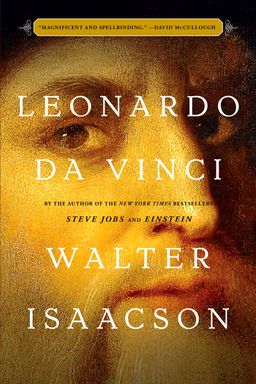
What happens when an artist refuses to separate art from science, or imagination from measurement? In his monumental biography Leonardo da Vinci, Walter Isaacson paints a portrait of a man whose curiosity stitched together anatomy, painting, hydraulics, optics, and geometry into one continuous inquiry. His guiding principle was that everything connects: the muscles of a face mirror the motion of water, the curl of hair repeats the eddy of a stream, and proportion binds architecture to the human body.
Isaacson’s Leonardo is less a divine genius than an empirical mind—an amateur scientist guided by artistic sensitivity and by experience rather than dogma. The book’s argument is that creativity flourishes when observation, curiosity, and experiment cross disciplinary borders. Through notebooks, paintings, and machines, Leonardo demonstrates that drawing can be a form of thinking, and that science can be driven by beauty.
The Convergence of Art, Science, and Engineering
Leonardo’s lifelong refusal to segment disciplines is the thread running through all his work. He paints with the precision of a physicist and designs engines with an artist’s sense of harmony. His early apprenticeship in Verrocchio’s studio exposed him to metalwork, painting, and stage design simultaneously—a curriculum in integration. Later, his service in Milan under Ludovico Sforza turned these skills into pageants, hydraulic systems, and monuments. In each case, the same intellect observed, measured, and expressed nature, whether through paint or pulleys.
Leonardo’s self-promotion letter to Ludovico is revealing: he lists military and civil engineering feats—bridges, canals, siege designs—then adds, almost casually, “Likewise in painting, I can do everything possible.” That phrase captures his sense of unity. For him, painting was a science of perception, as rigorous as mechanics or anatomy. Every project—whether the Vitruvian Man, the Mona Lisa, or the Sforza horse—serves as an experiment in how matter moves, light scatters, and feeling is embodied.
The Notebooks: A Laboratory of the Mind
Leonardo’s notebooks are where this unity becomes visible. Written in mirror script to prevent smudging and arranged without hierarchy, they show a storm of observation: anatomy mingles with botany, hydraulics with human gesture, geometry with humor. His “to-do lists” (“measure Milan,” “describe the tongue of the woodpecker”) reveal both method and play—proof that curiosity was his true discipline. Each page operates as a portable lab where drawing turns fleeting perception into data and pattern.
After his death, his papers were scattered into codices—Arundel, Atlanticus, and Leicester—but even in fragments they reveal a coherent mental model: the interplay between observation and experiment. He builds glass tanks to trace eddies, wax hearts to visualize vortices, and mechanical wings to model birds. The Codex Leicester, later owned by Bill Gates, crystallizes his geological and hydrodynamic insight—how rivers carve valleys and why the sky appears blue—proof of his relentless empiricism centuries ahead of formal science.
A Discipline of Observation and Experiment
Isaacson shows that Leonardo’s greatness doesn’t rest on divine intuition but on his process: he observes, tests, records, revises. He measures river flow with cork floats, dissects cadavers to map muscles, and studies optics to refine chiaroscuro. Long before formal scientific methodology, he embodies its spirit. In this sense, Leonardo’s “science of painting” is not metaphorical: it depends on experiment, on “experience the mistress of all things.”
He pairs empirical restraint with imaginative might. You see it in his flying-machine sketches, where he translates bird anatomy into mechanics, building gliders and screws years before aviation. His models often failed in practice, yet his method—conceptual modeling through images—predicted how modern engineers work with CAD or visualization software. The lesson: precision and wonder can coexist.
Humanity, Identity, and the Psychology of Making
Leonardo’s illegitimacy freed him from the rigid career path of his notary father and allowed early entry into artistic apprenticeship. His outsider status—illegitimate, left-handed, often avoidant of formal Latin education—nurtured his independence. Sexual nonconformity and emotional intimacy with pupils such as Salai gave his art a fluid androgyny that Isaacson links to his fascination with ambiguity: the smile that flickers, the gender that blends, the gesture that hovers between sacred and sensual.
Isaacson reads this as psychological fuel rather than gossip. Leonardo’s private life—his careful household, his affection for apprentices, his isolation—is part of how curiosity persisted. His notebooks oscillate between exuberant observation and melancholic reflection (“as I thought I was learning to live, I learned how to die”), showing that a restless mind often coexists with vulnerability. Genius, in Isaacson’s account, emerges not despite but through complexity.
Legacy: A Mind Ahead of Time
By the time Leonardo dies in France in 1519 under the protection of King Francis I, he has designed urban utopias, dissected human hearts, and painted works that redefine perception. Yet few of his ideas are published; his notebooks sleep for centuries. This paradox—boundless vision, limited transmission—forms the book’s central melancholy. His experiments on fluid vortices anticipate modern cardiac and fluid dynamics; his geology rejects biblical flood theory empirically; his art fuses sensory precision with metaphysical resonance. But history almost lost it all because he wrote, not printed.
The Core Lesson
To live like Leonardo is to cultivate curiosity without borders. Keep a notebook, test every assumption, and blend observation with imagination. Creativity does not arise from specialization alone but from synthesis—the courageous mixing of disciplines, the willingness to see art in science and meaning in metrics.
Isaacson ultimately reframes genius as a teachable stance: curiosity sustained by discipline, play sustained by rigor, and wonder bound to evidence. Leonardo da Vinci remains the archetype of the whole mind—a pattern-seeker in paint and ink who reminds you that the boundaries between art, science, and life are illusions worth dismantling.