
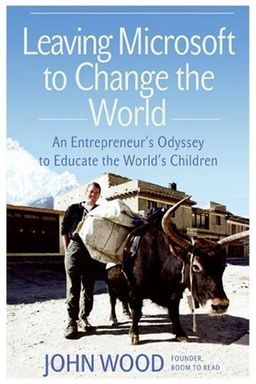
Leaving Microsoft to Change the World cover

Leaving Microsoft to Change the World

by John Wood

Leaving Microsoft to Change the World chronicles John Wood''s inspiring transition from a top Microsoft executive to the founder of Room to Read. Driven by a desire to combat global illiteracy, Wood''s story reveals the transformative power of education and the impact one individual can have on the world.

From Corporate Success to Global Education Revolution

What would happen if you walked away from everything—your wealth, your status, your secure job—to dedicate your life to helping others? In Leaving Microsoft to Change the World, John Wood poses and answers this very question. This is not another tale about corporate burnout; it’s the story of how one man transformed his career, and ultimately millions of lives, by applying business acumen to global education inequality.

Wood’s journey begins high in the Himalayas, where a simple encounter with a Nepali headmaster—who lamented that his school had no books—sparked a new mission. That conversation planted the seed for what would become Room to Read, a global nonprofit built on the idea that world change starts with educated children. The book chronicles how Wood replaced the corporate ladder of Microsoft with the unpredictable, passionate climb of social entrepreneurship.

The Spark in Nepal

The story opens with Wood’s trek through Nepal in 1998—a journey meant to escape Microsoft’s relentless pace. But instead of unplugging, he reconnected with meaning. At a mountain school, he discovered classrooms full of eager students but barely any learning materials. When the headmaster said, “Perhaps, sir, you will someday come back with books,” Wood’s life purpose shifted from selling software to delivering education. This was his epiphany: knowledge, not code, would be the most transformative product he could ever distribute.

On returning to Sydney, Wood’s brainchild—eventually called Room to Read—took shape. The contrast with his old life was striking: instead of quarterly software releases, he measured success by delivered libraries and smiling students. His Microsoft experience didn’t disappear, though; it became his greatest asset. He understood scaling, efficiency, and metrics—and he applied those principles to humanitarian work. The Dalai Lama’s teaching that happiness comes from helping others became his compass.

From Microsoft’s Metrics to Measurable Hope

Wood’s career in Beijing and Sydney had immersed him in a world obsessed with results and growth. In leaving it behind, he didn’t abandon that drive—he redirected it. Instead of tracking software licenses, he tracked how many schools, libraries, and scholarships Room to Read could fund. His motto became: measure your impact, not your intentions. This approach, inspired by Microsoft’s data-driven culture, became the bedrock of Room to Read’s credibility in the philanthropic world.

By building partnerships with local communities, leveraging networks of volunteers, and treating donors like shareholders in humanity, Wood revolutionized how NGOs could operate. He replaced dependency with participation through “challenge grants”—villages donating land, labor, or materials alongside Western funding. This coinvestment model ensured sustainability and pride, echoing his mantra: people take care of what they help build. (In his words: “nobody washes a rental car.”)

Scaling Compassion: Business Principles for the Social Sector

In the traditional charity world, enthusiasm often outweighed efficiency. Wood brought a Silicon Valley playbook: think big, move fast, and measure success meticulously. He defined clear performance metrics, formed an international volunteer network, and reinvested in people much like venture capital firms back their founders. Mentored by veteran investor Bill Draper, he merged two worlds—the precision of business strategy and the purpose of philanthropy—creating what he called “the Microsoft of nonprofits.”

Through chapters filled with airport encounters, cross-continental fundraisers, and partnerships from Nepal to Vietnam and Cambodia, Wood demonstrates how one person’s vision can ignite a global movement. His story mirrors the spirit of other innovators who left business for impact (like Muhammad Yunus of Grameen Bank). Yet where Yunus lent capital, Wood lent opportunity—through books, schools, and access, especially for girls.

Why This Story Matters

At its heart, this book is about transformation—individual and institutional. It challenges you to consider what the “lottery of life” has granted and how you can redistribute your luck. Education, Wood argues, is humanity’s highest yield investment. One girl’s scholarship can uplift generations, economies, and communities. You learn that building schools is more than construction—it’s constructing hope at scale.

Through humor, humility, and business rigor, John Wood shows that altruism doesn’t need to be inefficient, and ambition is not the enemy of compassion. His central lesson: world change doesn’t require billionaires—it requires networks of ordinary people united by extraordinary purpose. Leaving Microsoft to Change the World is both a memoir and a manual for doing good better: an invitation to bring your skills, not just your sympathy, to the world’s classroom.


A Trek That Changed Everything

John Wood’s journey into philanthropy began not in a boardroom but on the dusty trails of Nepal. After years in Microsoft’s whirlwind of meetings and milestones, he booked a three-week hiking trip along the Annapurna Circuit to disconnect. What he found was connection—a profound encounter with poverty, education, and gratitude that forever changed his trajectory.

The Boy and the Empty Library

In a village called Bahundanda, Wood met Pasupathi, a local education officer who invited him to visit a school. Inside, 450 students shared a classroom devoid of books. When Wood asked to see the library, the headmaster gestured to an empty room. A single glass cabinet held a battered romance novel, an outdated atlas, and a decade-old Lonely Planet Guide to Mongolia—their entire collection. The headmaster’s request, “Perhaps, sir, you will someday come back with books,” struck Wood like a life directive. That night, under candlelight, he made a promise in his journal to return.

From Promises to Packages

Back in Sydney, Wood’s first email—a humble plea for children’s books—went viral. Friends, colleagues, and complete strangers rallied, sending thousands of titles to his parents’ home in Colorado. His father, Woody, jokingly urged him to “get home soon” when their garage overflowed with 3,000 books. Together, father and son shipped the first batch to Nepal and personally delivered them by donkey caravan up Himalayan hills. Their trek became known as “Woody and John’s Excellent Adventure,” marking the birth of a global movement.

In Bahundanda, children swarmed the new library—their first colorful picture books opening portals to worlds they’d never imagined. Their joy convinced Wood that this mission was not charity but opportunity. His corporate career suddenly felt narrow compared to the vast horizon of impact he had glimpsed in the mountains.

The Moment of Decision

The turning point came in a Kathmandu monastery, where Wood meditated on his divided life. Surrounded by chanting monks and flickering candles, he realized his problem wasn’t overwork—it was purposelessness. “Did my job really matter?” he asked himself. The answer echoed with clarity: helping children read carried far more meaning than selling software. “I might have life after Microsoft,” he concluded. By the time he returned to Beijing, he knew his mission had shifted.

The decision to leave wasn’t painless. His partner Sophie, friends, and boss struggled to comprehend why a rising executive would trade certainty for risk. Yet Wood recognized that fulfillment often demands walking away from the comfortable and toward the consequential. (As Viktor Frankl suggests in Man’s Search for Meaning, purpose—more than pleasure—anchors the human spirit.)

In the end, one promise in a mountain school reshaped his life. The boy in Nepal and the empty library were no longer distant memories—they were marching orders. The path to global change, Wood discovered, begins with a single, unfinished story and a willingness to write the next chapter yourself.


Building Room to Read

Room to Read began as “Books for Nepal,” a small and scrappy project fueled by one man’s conviction that education could bridge inequality. But Wood’s ambition, paired with business rigor, transformed it into one of the world’s largest literacy nonprofits—spanning Nepal, Vietnam, Cambodia, India, and beyond. The organization became a blueprint for how to scale social impact without losing its soul.

The Business of Doing Good

Wood applied the same frameworks that made Microsoft a global powerhouse: vision statements, goal tracking, and relentless accountability. Every donation was tied to tangible results—number of schools built, libraries opened, and girls educated. “Talking about what we’ve done is better than what we plan to do,” he insisted. His Excel sheets became modern ledgers of hope, each cell representing a child’s education, not a sales projection.

Crucially, Wood avoided the inefficiency that often plagues NGOs. Inspired by Bill Draper and Robin Donohoe of the Draper Richards Foundation, he pitched philanthropy like venture capital: fund early-stage innovation, demand progress metrics, and invest in people. Draper saw in Wood a classic entrepreneur—only his market was the developing world, and his product was literacy.

The Coinvestment Model

Unlike traditional aid that gives handouts, Room to Read pioneered a challenge grant model. Local communities contributed land, labor, or materials—whatever they could afford—to supplement donor funds. This made every project a partnership, not paternalism. As Wood quipped, “Nobody washes a rental car.” When villagers built their own schools, pride replaced dependency. Women carried 50-kilo bags of cement up mountain trails; parents petitioned factories for bricks. The result was ownership—and sustainability. In one Nepali village, 183 families pooled together tiny contributions to cofund their school, proving that dignity scales alongside donations.

A Global Network of Volunteers

Wood’s model was contagious. He didn’t rely on billionaires but on networks of “super-empowered individuals”—professionals who used their careers to fuel causes. From Chicago to Hong Kong, volunteer “chapters” hosted cocktail fundraisers that doubled as global citizenship lessons. These chapters became his modern army of philanthropists, united by shared purpose and minimal overhead. By 2005, Room to Read had more than 1,000 volunteers operating like franchises of hope.

Each partnership, from Scholastic’s million-book donation to Goldman Sachs alumni funding Everest schools, accelerated the mission: to give every child the room to read and the reason to dream. Within a decade, Wood’s organization had built over 2,300 libraries and educated thousands of girls—proving that with business strategy and boundless heart, compassion can scale globally.


Educating Girls as a Catalyst for Change

If access to education is a universal need, access for girls is an urgent revolution. In much of the developing world, girls remain at home to cook, care for siblings, or are forced into early marriage. Wood’s Room to Grow scholarship program confronted this inequality head-on, empowering girls through long-term educational support, mentorship, and community advocacy.

The Power of One Girl’s Education

Wood often quoted Usha, a Nepali activist who said, “When you educate a boy, you educate just the boy. But when you educate a girl, you educate the whole family.” This belief shaped Room to Grow’s DNA. Scholarships covered school fees, uniforms, supplies, and even bicycles for travel. Each girl was paired with a female mentor, reinforcing confidence and resilience. For $250 a year—a fraction of Western tuition—a life could change direction forever.

Stories that Define Impact

In Delhi, Anita, a 15-year-old whose parents arranged her early marriage, fought tearfully to continue school. When Room to Read’s local committee realized her determination, they found funding for her tuition and tutor. Anita not only returned to class but became a role model for her younger sister. In Nepal, Shilpi and Nebedita helped orphaned Sujina stay in school after her father’s death, proving that local women were the backbone of lasting change. These girls became not beneficiaries but beacons—each one illuminating the path for future generations.

Wood rejected the notion that girl’s education was just a “women’s issue.” He insisted that men had to champion it too, drawing from his own upbringing by three strong women—his mother, grandmother, and sister—who taught him to read and believe in himself. “Can only women care about girls?” he challenged audiences. “Didn’t civil rights advance because everyone fought for equality?”

Why Girl’s Education Matters for the World

Educating girls is not charity—it’s smart economics. Studies show that literate women have smaller, healthier families, reduce poverty, and increase GDP growth. The United Nations cites it as the single most powerful lever for development. Wood’s pitch to donors framed this elegantly: an emotional and rational investment with exponential returns. (In Half the Sky, Nicholas Kristof makes a similar case—both agree empowerment begins with education.)

By 2006, over 2,000 girls were on long-term scholarships thanks to donors and local champions like Tina Sciabica, the Chicago lawyer who led fundraisers that financed hundreds more. The movement outgrew its founder—it belonged to every girl whose pencil drew a better future.


Applying Business Principles to Nonprofits

Transitioning from Microsoft to nonprofit leadership meant more than changing titles. It meant rewriting the rules of charity. Wood consciously modeled Room to Read after lessons learned from Bill Gates and Steve Ballmer—two mentors who ran Microsoft with relentless focus on metrics and accountability. He called his approach the “Microsoft of nonprofits.”

Results Are the Real Mission Statement

While many NGOs measured intentions, Wood measured outcomes. Each Room to Read email ended with a “results ticker”—schools built, libraries opened, girls on scholarship. This transparency created built-in accountability. Donors could literally see their impact grow with every update. He believed philanthropy should embrace data, not distance. “If United Airlines can print on every napkin that they’re number one in on-time performance,” he said, “why can’t we do the same for education?”

People Over Programs

Wood applied corporate hiring discipline to the nonprofit world. He sought passionate, enterprising employees who “knew their numbers” and treated donors as partners, not patrons. When he met with potential hires, he tested for initiative and heart, not résumé padding. This mirrored Steve Ballmer’s management ethos: attack problems, not people. The result was a culture of challenge and candor—where data replaced ego and the mission trumped hierarchy.

Loyalty and Leadership

Wood also borrowed from Microsoft’s human philosophy—Ballmer’s loyalty to his team. At Room to Read, that meant investing in employee welfare (healthcare, dental, retirement matching) even as overhead stayed below 10%. He believed inspired people outperform underpaid ones. Laughter, purpose, and results coexisted. His mantra: “We only hire those who can’t imagine doing anything else.”

In merging business acumen with human compassion, Wood redefined what effective charity looks like. He proved that efficiency and empathy are not opposites—they’re partners. Under his leadership, Room to Read wasn’t just helping children read; it was teaching the nonprofit world how to perform.


The Transformative Network Effect

John Wood envisioned philanthropy not as a solo act but as a network—what he called the Andrew Carnegie of the 21st century: a global web of “concerned citizens.” This idea revolutionized Room to Read’s growth and democratized global giving. Instead of one billionaire funding libraries, thousands of professionals, families, and students became philanthropists in their own right.

From Local Sparks to Global Chapters

The first nodes of this network appeared in cities like Chicago, New York, and San Francisco. Volunteers held small parties, inviting friends to “build a school or two.” Nancy’s sushi-and-sake fundraiser in New York raised $20,000 in a weekend; others followed her lead, turning social energy into social good. Each chapter acted like a startup, competing playfully for fundraising records—London’s $100,000 haul ignited rivalries from Hong Kong to Chicago. These grassroots chapters became Wood’s Silicon Valley of compassion.

International Momentum

Within a few years, Room to Read expanded far beyond its American base: volunteers in London, Vancouver, Singapore, and even Mount Everest’s base camp raised funds for schools. In one inspiring moment, climber Alison Levine used her women’s Everest expedition to sponsor two Nepali schools, convincing Swiss mountaineer Bruno Rodi at base camp to endow two more.

This contagion of giving proved Wood’s belief in “mass participation philanthropy.” As he observed, there aren’t enough billionaires to fix the world—but there are millions who can give time and talent. Each volunteer was a node amplifying impact exponentially; Wood simply connected the dots.

The Network as Resilience

Even setbacks turned into triumphs. After a failed Boston event yielded “more awareness than cash,” Wood persisted, refining his strategy for mobilizing high-energy professionals. This adaptive network later became crucial after crises like the 2004 tsunami, when global supporters raised emergency school-rebuilding funds within weeks.

In the end, Room to Read’s network embodied a larger truth: collective small actions can rival elite philanthropy. Wood replaced the myth of the lone hero with a global chorus—every voice adding power to literacy’s song.


Crisis, Resilience, and the Power of Action

Wood’s ability to act quickly was tested after two global crises: the 9/11 attacks and the 2004 Asian tsunami. In both, his philosophy—do something, don’t overanalyze—turned tragedy into mobilized compassion. These events proved that courage and community could triumph over fear and paralysis.

After 9/11: Building Peace Through Education

In the shadow of September 11, donors feared recession and xenophobia. Yet Room to Read’s message—that education, not vengeance, was the antidote to extremism—resonated. At a fundraiser in Chicago, lawyer Ben Shapiro argued passionately that neglected education had fueled the rise of madrassas in Afghanistan. A single event funded two new schools, symbolizing light over darkness. This was philanthropy as response, not retreat.

The Tsunami: Turning Disaster into Renewal

The 2004 Indian Ocean tsunami obliterated schools across Sri Lanka and Indonesia. Within days, Wood mobilized CNN appearances and turned viewer empathy into action. His small San Francisco team fielded hundreds of calls as donations poured in worldwide. Volunteers like journalist Suba Sivakumaran flew to Sri Lanka to launch Room to Read’s new branch within weeks. By year’s end, they had rebuilt 22 schools and opened dozens more libraries.

In one village, a family named Chintha and Shantha led reconstruction of a preschool that doubled as a library, feeding workers daily and teaching their children to volunteer. When four-year-old Kavith carried bricks to help build his own classroom, he embodied Wood’s belief: compassion isn’t abstract—it’s learned through doing.

Each disaster reaffirmed Wood’s core insight: humanity’s best response to tragedy is progress. As he told his team, quoting Apollo 13: “This will be our finest hour.” Whether rebuilding after waves or war, Room to Read’s story became one of resilience in motion—proof that optimism, when organized, can heal the world.


A Million Books and a Lifelong Mission

By 2005, Room to Read reached a symbolic milestone: its millionth book delivered. For Wood, this number wasn’t about scale—it was about stories. Each book carried the dreams of children, parents, and donors who believed that literacy could transform the human experience. The celebration in Nepal was both homecoming and prophecy.

The Millionth Library

On a trip back to Kathmandu, Wood was greeted like family by Dinesh Shrestha, his original partner from the Lions Club days. Together they attended the simultaneous opening of 123 new libraries across Nepal—each funded by local partnerships and global supporters. Students showered them with marigolds, singing and dancing in joy. It was a vivid manifestation of Wood’s dream: the “Microsoft of nonprofits” had achieved exponential impact without losing its human heart.

Each school, from the Simle campus built by villagers to city programs in Kathmandu, demonstrated sustainability. Communities were now initiating their own expansions without external funding—proof that empowerment had replaced dependence. The millionth book was both celebration and challenge: how many more classrooms still waited empty?

A Legacy Beyond Numbers

When asked how he kept his pace, Wood replied simply: “Every time I doubt, I visit the schools.” The smiles of children learning to type or read reminded him why he had left Microsoft’s glass offices for Himalayan dirt paths. His story closes not with triumph but continuity—a vow to devote his “most productive decades” to universal education. “Do not wish to be anything but what you are,” he quotes St. Francis de Sales, “and try to be that perfectly.”

Wood’s life illustrates that purpose is not found—it’s built, brick by brick, book by book. The engineer who once sold software now programs opportunity. His story invites you to consider: which mountain of meaning are you ready to climb?

Dig Deeper

Get personalized prompts to apply these lessons to your life and deepen your understanding.

Go Deeper

Get the Full Experience

Download Insight Books for AI-powered reflections, quizzes, and more.