
Idea 1
Learning at Speed: Turning Agility into Advantage
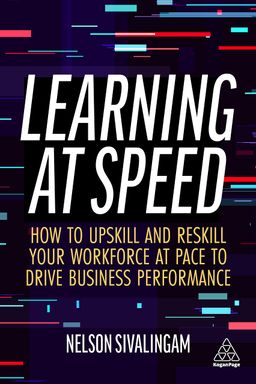
How can your team stay ahead in a world that seems to be learning faster than you are? In Learning at Speed, Nelson Sivalingam argues that the only true competitive advantage today is the speed of learning. He contends that businesses and individuals no longer win because they have the biggest budgets or the best products — they win because they can learn, adapt, and apply new insights faster than anyone else. The book presents a playbook for how to make learning your organization’s “moat,” leveraging principles from the startup world to deliver continuous performance improvement at pace.
Sivalingam shows that learning has become a strategic differentiator in an age where disruption is constant and legacy advantages — such as brand, capital, or scale — are fleeting. What sets successful organizations apart, he says, is not what they know, but how fast they can unlearn, relearn, and apply. To that end, his concept of Lean Learning adapts lessons from the Lean Startup and Agile frameworks to transform stale Learning & Development (L&D) functions into engines of measurable business impact. Just as startups test minimum viable products to validate assumptions and iterate quickly, smart learners and organizations must test “minimum valuable learning.”
Why Speed Outpaces Size
The context of today’s exponential change — from digital transformation to automation to global crises like the pandemic — has obliterated the predictability that most organizations were built for. Sivalingam illustrates this by comparing winners and losers during the pandemic: while giants like Arcadia Group collapsed under outdated models, agile players like ASOS quadrupled profits and even acquired Arcadia’s brands. The lesson? You can’t outlast disruption, but you can outlearn it.
Companies once had decades to respond to market shifts. Now, technology cycles, customer preferences, and business models change in months, not years. The average Fortune 500 company's lifespan has shrunk from 65 years to 15. In this landscape, speed of learning — not size or market share — is the survival metric. This urgency underpins the book’s mission: teaching you how to embed fast learning cycles into your culture, processes, and management systems before the next wave of change hits.
Learning from Startups: Fail Fast to Succeed Sooner
Why startups? Because they’re wired to learn faster than anyone else. With limited resources and little certainty, startup founders iterate to find what works through quick tests, real customer feedback, and relentless adaptation. Sivalingam draws on this ethos of agility and experimentation to reinvent corporate learning. The same principles that drive Airbnb, Uber, and Slack — testing hypotheses, removing waste, and pivoting fast — can and should fuel employee learning and reskilling. He even names this approach “Lean Learning” to echo the core Lean Startup idea: eliminate anything that doesn’t add measurable value.
Under Lean Learning, L&D professionals stop being course creators or compliance enforcers and become performance enablers. Instead of guessing what employees need and building massive programs that take months, they prototype quick, testable learning experiences aligned to business goals. Feedback fuels improvement, which drives more rapid iteration — the same way successful products evolve through continuous user testing.
From Compliance to Performance
One of the book’s central revelations is that most corporate learning resembles a failing startup: full of wasted investments, poor understanding of customer needs, and slow feedback loops. Sivalingam outlines three types of existing learning cultures — compliance-driven, process-driven, and skills-driven — and shows why none are fast or effective enough. The future, he argues, is performance-driven learning — learning that focuses on observable impact rather than activity metrics. In this model, knowledge isn’t an end in itself; it’s a function of improving the variables that matter most to the business.
The shift requires asking new questions: “What problems are we solving?” and “How do we know this learning improves outcomes?” — rather than “How many people completed the course?” These questions push L&D closer to the startup mindset: love the problem, not the solution. (This parallels thinking from Eric Ries’s The Lean Startup, which emphasizes problem-validation over premature scaling.)
What This Book Delivers
Sivalingam builds his argument through three major parts. Part I, “On Your Mark,” explains where traditional L&D goes wrong and redefines learning as a function of lean, iterative performance improvement. Part II, “Get Set,” provides the playbook — tools like the Learning Canvas for strategic design, the Learning Ecosystem for scalable impact, and principles for personalizing learning in the flow of work. Part III, “Go,” puts it all into motion through experiments: designing Minimum Valuable Learning, achieving “Learning-Challenge Fit,” and running “Lean Learning sprints.”
Throughout, Sivalingam weaves vivid stories — such as Microsoft’s transformation under Satya Nadella’s growth mindset, NPR’s agile sprint to reinvent programming, and Google’s peer-to-peer learning culture — to demonstrate that learning agility isn’t abstract. It’s operational, measurable, and replicable. He closes with a rallying cry: learning at speed isn’t optional. It’s your organization’s only way to keep winning in a world that never slows down.
“Change is inevitable, but learning at speed is intentional.” — Nelson Sivalingam