
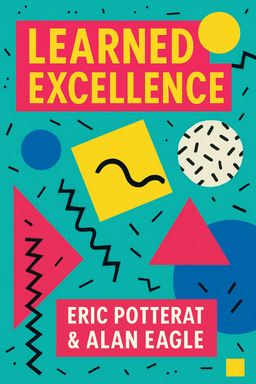
Learned Excellence cover

Learned Excellence

by Eric Potterat & Alan Eagle

Learned Excellence is your guide to achieving peak performance through five essential mental disciplines. Leveraging insights from top athletes, military leaders, and executives, this book offers strategic principles for mastering personal and professional success.

Learning Excellence: Mastering the Mental Game of Performance

When was the last time your mind sabotaged your best effort? Maybe you walked into a presentation, interview, or exam confident and well prepared—only to freeze, doubt yourself, or lose focus. In Learned Excellence, clinical and performance psychologist Dr. Eric Potterat, with writer Alan Eagle, argues that the secret to sustainable high performance has less to do with talent or intelligence than with what happens in your head. Excellence, they contend, isn’t innate—it’s learned. Like updating the software on your phone, you can upgrade your mental operating system to perform better under pressure.

Drawing on decades of work with Navy SEALs, professional athletes, elite executives, and first responders, Potterat outlines a comprehensive framework called Learned Excellence: a set of practical mental disciplines that enable anyone—from boardrooms to classrooms—to perform their best when it matters most. His central metaphor is simple: humans, like phones, come equipped with powerful hardware (our bodies, natural abilities, intelligence). But without the right software (mindset, focus, and emotional control), the system underperforms. We train our bodies endlessly, he says, but we neglect the realm 'above the neck and between the ears.' That’s where true excellence lives.

The Software of Performance

The book introduces five mental disciplines that serve as the “core components” of the excellence operating system: Values and Goals, Mindset, Process, Adversity Tolerance, and Balance/Recovery. Each chapter breaks down these mental muscles into actionable routines using stories from top performers—like Olympic gold medalist Nathan Chen, Miami Heat coach Erik Spoelstra, and cliff diver David Colturi. The point is clear: these individuals weren’t born calm, focused, and confident. They’ve trained their minds the same way they train their bodies.

In the opening chapter, Potterat writes, “We are all performers.” Whether you lead SEAL missions, argue cases in court, teach, or parent, you face moments that require peak performance under pressure. The difference between good and great often comes down to mental preparation: controlling your thoughts, emotions, and reactions before and during stressful moments.

From Navy SEALs to Everyday Life

The credibility of Learned Excellence comes from Potterat’s unusual career pathway—from clinical psychologist treating trauma to performance psychologist training warriors, Olympians, and executives. His experience running mental programs for Navy SEALs and designing Red Bull’s high-performance 'Performing Under Pressure' camps makes him a front-line authority. The book’s narrative walks readers through his evolution: learning how elite military operators manage extreme stress, seeing athletes apply psychological techniques to enhance precision, and witnessing how business and civic leaders use these same methods to make critical decisions calmly.

One of his lessons from the SEALs is profound: under pressure, people don’t rise to the occasion—they fall to the level of their training. The mental toughness exercises he taught commandos, from controlled breathing to visualization, apply equally to anyone wanting to thrive amid everyday challenges. He learned that calm, confidence, and clarity aren’t innate—they’re the result of intentional practice.

Why This Framework Matters

Potterat frames the five pillars of Learned Excellence as essential to countering our modern epidemic of distraction, stress, and self-doubt. We live, he argues, in a world of performance anxiety—where people care more about reputation (how they’re seen) than identity (who they truly are). This constant mental noise drains focus and joy. The solution is to train the mind: articulate your values, set meaningful goals, adopt a growth mindset, follow repeatable processes, and balance performance with recovery.

Much like psychologists Carol Dweck (Mindset) and Angela Duckworth (Grit), Potterat believes that excellence is a decision you make daily. But unlike those models, his approach is holistic and operational. He doesn’t just describe traits of high performers—he provides protocols. You’ll learn to write a personal credo that anchors you in your core values, use 4x4x4 breathing to calm your nervous system, craft pre-performance routines, design time management strategies for peak focus, and build habits that align effort with purpose.

Training for Life’s Crucible

Throughout the book, vivid stories bring theory to life. We see figure skater Nathan Chen redeem his Olympic failure by rediscovering joy in performance; pilot Anthony Oshinuga avert disaster midair through mental rehearsal; and Red Bull athletes learning resilience by facing their fears—like performing stand-up comedy or encountering a trained grizzly bear. These anecdotes underline Potterat’s belief that stress is not the enemy. Handled correctly, stress is the stimulus that strengthens the mind, building “mental immunity” much like exercise strengthens the body.

Ultimately, Learned Excellence argues that performing at your best is about learning to train the mind as deliberately as you train the body. Whether you’re a parent, athlete, leader, or student, your goal isn’t perfection—it’s progression. You can’t eliminate pressure, but you can use it. As the author reminds us through his years coaching SEALs and CEOs alike: the difference between good and great isn’t talent—it’s training the software that runs your life.


Values and Goals: Anchoring Identity Before Performance

Potterat begins with the foundation of all mental performance work: knowing who you are and why you perform. He calls this process developing a personal credo—a short statement of ten words that define your identity and values. Most of us, he notes, act out of reputation (what others think) instead of identity (what we truly believe). That shift, from reputation to identity, changes everything about how you perform.

From Reputation to Identity

Consider David Colturi, a Red Bull cliff diver who flung himself from heights of 90 feet into open water. Despite his bravery, Colturi often obsessed over others’ opinions—judges, sponsors, fans. After a freak accident that nearly killed him, he redefined his values around discipline, courage, and purpose. He stopped performing for reputation and started diving from identity. His recovery marked a mental rebirth, allowing him to return to elite competition calmer and more present.

Potterat guides readers through reflective exercises like journaling what energizes them, asking loved ones which traits they see, and distilling those insights into core “identity markers.” Examples include loyalty, curiosity, humility, or grit. Your personal credo becomes a moral compass for decision-making and focus. As one client told him, “I stopped reacting to what others expected and started responding to who I am.”

Setting Goals That Mean Something

Once values anchor identity, goals give direction. Potterat advocates writing specific goals across six life pillars: career, relationships, health, spirituality, hobbies, and legacy. He emphasizes the importance of making them SMART—specific, measurable, achievable, relevant, and time-bound—and intrinsic rather than extrinsic. Instead of “lose ten pounds so people think I look better,” make it “develop daily energy to play with my kids.”

Soccer legend Carli Lloyd embodies this process. As a child, she filled notebooks with detailed goals—from moves she wanted to master to countries she’d visit. Even after World Cup glory, she continues the habit, setting process goals (mastering a technique) alongside outcome goals (winning titles). As Potterat notes, writing them down and sharing them with others dramatically increases accountability and success.

Finding Your Engine

Drawing inspiration from Yankee legend Yogi Berra, Potterat reminds us that every performer needs an engine—a core motivation that drives them. For some it’s winning; for others, service, curiosity, or family. The key is alignment: when what drives you matches what you value, performance becomes sustainable. When there’s misalignment—say you chase money but value connection—excellence feels hollow.

He suggests revisiting your hardest life experiences to uncover these engines. How did you manage past adversity? What patterns emerge in your responses? As in therapy, awareness precedes growth. By understanding how you perform under stress and why you do it, you build the psychological architecture for learned excellence.

“When you stay true to your identity, reputation takes care of itself.” —Eric Potterat

When you clarify your credo and engine, your focus shifts from appearances to authenticity. You stop performing for applause and start performing for purpose. That shift—supported by intention, goals, and self-awareness—is the foundation upon which every other discipline in Learned Excellence is built.


Mindset: Choosing the Lens That Shapes Reality

If values are your inner compass, mindset is the lens through which you navigate the world. Potterat explains that while most people inherit a default mindset—shaped by upbringing, experience, and environment—top performers choose theirs. They intentionally cultivate beliefs that help them grow, handle setbacks, and thrive under pressure.

Mindset as Choice

A powerful illustration comes from Katy Stanfill, a former Navy helicopter pilot who nearly lost faith in herself after making a midair error. The moment could have defined her career, but Katy reframed it as a learning opportunity. Asking herself, “What is there to learn from this?” transformed failure into growth and fear into focus. That question became her lifelong mantra—a real-world expression of Carol Dweck’s “growth mindset.”

Potterat contrasts growth with fixed mindsets: the first sees abilities as developable through effort and feedback, while the latter views them as static traits. Research consistently shows that growth-oriented individuals outperform fixed-mindset peers because they remain resilient and curious even when outcomes go awry.

Staying in the Circle

To operationalize mindset, Potterat offers one memorable phrase: stay in the circle. The circle contains the only three things you can control—your attitude, effort, and behavior. Everything else—judges, weather, colleagues, outcomes—belongs outside. Focusing inside the circle helps channel energy to what matters most while ignoring distractions.

Athletes like the Miami Heat’s Erik Spoelstra turn this concept into team culture. His players sign contracts affirming effort and growth, reminding themselves that sacrifice and process—not outcome—drive championships. Similarly, firefighter and world champion Dave Wurtzel overcame self-doubt by replacing negative self-talk (“I’ll fall again”) with positive affirmations (“I’ve run this before; I can do it”). His transformation shows that confidence can be constructed through deliberate self-talk practice, not inherited.

Practicing Failure and Transition

Practicing mindset isn’t about constant positivity; it’s about resilient realism. Potterat encourages readers to purposely step outside their comfort zone—to fail in low-stakes settings—to build emotional endurance. Former SEAL Marcus Luttrell calls this “finding stress before it finds you.” Likewise, Cirque du Soleil’s Ben Potvin describes creative failure as “a candy store” that sparks innovation. Failure, in other words, is training.

Finally, Potterat introduces the art of shifting mindsets across roles. A SEAL’s mindset in combat doesn’t work at the dinner table; a CEO’s intensity in meetings can backfire at home. Learning transition rituals—like brushing your teeth and reminding yourself “I’m not at work anymore”—helps reset your mental context. The goal is mental flexibility: being the right version of yourself for the right environment.

Choosing, practicing, and adjusting your mindset turns aspiration into competence. When you focus on controllables, speak to yourself like a coach, and welcome challenges, you begin programming the mental software of excellence. As Potterat summarizes: “Mindset is how you set your mind to face every situation.”


Process: Trusting the Steps Over the Outcome

Many performers obsess over results—scores, promotions, wins—but Potterat insists that outcomes are the residue of process. Top performers design reproducible systems for preparation, feedback, and time management—and then trust them, even when results lag. The mantra is simple: focus on the steps, and the score takes care of itself.

Consistency Beats Perfection

Consider MLB pitcher Rich Hill. Early in his career, Hill fixated on winning games; later, he realized success came from perfecting each pitch—controlling his training intensity, routines, and mindset between throws. “You don’t have to be perfect,” he says. “You just have to attack your process aggressively.” His shift mirrors Potterat’s larger theme: progress over perfection.

Time, Potterat notes, is the currency of process. Everyone, from you to Beyoncé, gets twenty-four hours—but only the disciplined turn time into mastery. He teaches readers to color-code their calendars (red = sacred commitments, yellow = flexible, green = movable) and eliminate “white space,” those uncaptured hours that leak productivity. Meticulous scheduling isn’t rigidity—it’s freedom from chaos.

Filtering Signal from Noise

Potterat warns against reacting to random feedback—what he calls the barista problem. He tells of a famous athlete who let a coffee shop worker’s unsolicited advice derail his practice. The lesson: trust your vetted sources. Build a network of coaches, mentors, and peers who are loyal, honest, knowledgeable, and challenging. Solicit evidence-based feedback only from them, ignore the rest, and approach change incrementally—one variable at a time. This creates steady evolution rather than emotional overreaction.

Recovering from Failure through Reflection

Potterat’s client Mike Dowdy, a professional wakeboarder, exemplifies process faith. When he tried to fix every problem after a poor performance, his inconsistency worsened. Once he committed to his structured training—tracking goals weekly, reviewing objectively, and resisting impulsive changes—he became 2016 World Champion. Potterat now keeps Dowdy’s board mounted above his desk as a symbol: excellence comes from trusting process over panic.

When you build systems for preparation, feedback, and iteration, you inoculate yourself against outcome anxiety. You can’t control winning or luck, but you can control your calendar, your attention, and your deliberate practice. As Potterat writes, “Follow the process, and the outcomes will follow you.”


Adversity Tolerance: Mastering the Mind Under Pressure

Every top performer eventually faces chaos—the mission gone sideways, the competition mistake, the microphone glitch. Potterat calls this moment the proving ground of excellence. His field-tested antidote is adversity tolerance: the ability to manage your body’s fight, flight, or freeze response and channel stress into clarity.

Stress as Training Fuel

At Red Bull’s Performing Under Pressure camps, Potterat and scientist Andy Walshe used stress inoculation techniques—throwing elite athletes into unfamiliar challenges like improvisational comedy or even facing a trained grizzly bear. By confronting controlled fear, participants learned that stress isn’t the enemy—it’s data. Like building muscle, small doses of stress strengthen the body’s response systems.

Scientifically, Potterat explains the HPA axis—the biological chain reaction that floods your bloodstream with cortisol and adrenaline when danger looms. The goal isn’t to stop the system; it’s to regulate it through mental drills that reset focus and restore executive function.

The Big Tools: From Visualization to Breathing

Potterat teaches ten core practices for adversity tolerance. The most celebrated is visualization: mentally rehearsing events vividly using all five senses so the brain feels like it’s “been there before.” Hall of Fame receiver Lynn Swann visualized every spin and catch before games; figure skater Nathan Chen used visualization and gratitude before his Olympic comeback skate. Other tools include 4x4x4x4 breathing (slow inhale and exhale to calm the nervous system), goal segmentation (breaking big tasks into smaller steps), and black-boxing (temporarily setting aside mistakes to stay mission-focused).

From Panic to Poise

Stories illustrate every tactic: Oregon prosecutor Deena Ryerson resetting herself mid-trial through deep breathing after blanking in front of a jury; professional pilot Anthony Oshinuga landing safely through automatic contingency training after smoke filled his cockpit. The point, Potterat says, is to teach your nervous system that control resides within you. Breathe. Segment. Reset. Continue.

Instead of fearing stress, embrace it as evidence that you care. As former SEAL Pete Naschak puts it, “Don’t get rid of the nerves—use them. They tell you this matters.” Acting on that insight transforms panic into performance.


Balance and Recovery: Sustaining Excellence Through Rest

Performance isn’t sustainable without recovery. Potterat discovered early—especially among Navy SEALs—that burnout masquerades as toughness. High achievers overtrain, overanalyze, and overwork until their relationships and health collapse. His prescription: treat recovery and balance as disciplines, not luxuries.

The Six Pillars of Balance

Potterat outlines six life pillars—work, relationships, health, spirituality, hobbies, and legacy—that support long-term well-being. If you overinvest in one, the structure wobbles. He cites insurance executive Steve Idoux, whose drive for perfection made him short-tempered and exhausted. By focusing on family dinners, exercise, and team trust instead of late-night emails, he regained both composure and effectiveness.

Letting Balls Drop (and Picking Them Back Up)

Oregon prosecutor Deena Ryerson captures a universal truth: “You can have it all, but not all at once.” Potterat encourages readers to accept that some pillars will temporarily weaken—especially during life sprints like child rearing or major projects—but awareness and scheduling make rebalancing possible. Color-code your calendar not just by urgency but by category: if health and relationships have too few blocks, adjust your week accordingly.

The Science and Art of Recovery

Recovery techniques range from simple to sophisticated. Sleep, Potterat insists, is the ultimate performance enhancer—optimized through habits like tart cherry juice (a natural melatonin source) and screen-free evenings. Nature walks, meditation, yoga, float tanks, and gratitude rituals also replenish focus and enhance creativity. NBA coach Erik Spoelstra practices daily workouts and team gratitude circles, reminding his players to remember what—and who—they’re grateful for.

Former CIA executive Patty Brandmaier offers a surprising recovery strategy: she took a part-time job at Williams Sonoma to reconnect with joy and learning after career burnout. That dose of variety reignited her leadership energy. Potterat’s point: recovery isn’t passive rest—it’s active restoration that renews meaning, not just energy.

Balance, he concludes, is the long game of excellence. Sleep, stillness, laughter, and love aren’t distractions from greatness—they’re its foundation. As one SEAL told him, “If you want to last, you have to breathe between battles.”


Practicing Excellence: Turning Habits into Identity

The final section of Learned Excellence turns ideas into life design. Excellence, Potterat reminds us, isn’t an act but a habit powered by daily repetition. “We are what we repeatedly do,” he quotes historian Will Durant. The challenge is consistency: applying the five disciplines until they rewire how you think and act.

Start Small, Build Momentum

Potterat suggests beginning with manageable steps—crafting a 30-, 90-, or 180-day plan to implement credos, goals, controllable habits, and feedback loops. Pick one skill—say, 4x4x4 breathing—and practice until it’s automatic. Then add the next. Like Carli Lloyd’s endless lists or a SEAL’s daily drills, mastery emerges through micro improvements compounded over time.

Spreading Excellence to Others

Potterat also explores how leaders and parents can teach excellence. In teams, modeling self-awareness and constructive feedback fosters psychological safety. Leaders can run “after-action reviews”—short debriefs asking, “One thing that went well? One thing to improve?” This cultivates shared growth rather than blame. For parents, the method is patience: let children take risks, fail safely, and debrief the lessons. Fellow SEAL Pete Naschak’s mother called this rule “try it and see.” It built resilience long before Navy training did.

Excellence, Potterat insists, belongs to everyone—not just Olympians or CEOs. Regardless of title, we all perform daily in relationships, work, and self-mastery. By practicing intention, reflection, and recovery, you create a system that turns effort into identity. You stop chasing moments of greatness and start living them.

“Don’t wait for excellence to appear—practice it until it can’t disappear.”

By the final chapter, Potterat’s message feels both practical and profound: training your mind is the ultimate form of self-respect. Learn your identity, cultivate your mindset, trust your process, embrace adversity, and rest deliberately. Excellence isn’t reserved for the elite—it’s a learned, repeatable way of showing up fully human and fully prepared.

Dig Deeper

Get personalized prompts to apply these lessons to your life and deepen your understanding.

Go Deeper

Get the Full Experience

Download Insight Books for AI-powered reflections, quizzes, and more.