
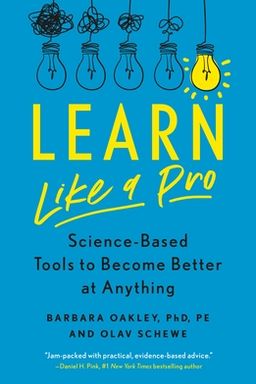
Learn Like a Pro cover

Learn Like a Pro

by Barbara Oakley and Olav Schewe

Learn Like a Pro by Barbara Oakley and Olav Schewe reveals powerful, science-based strategies to transform your learning habits. Discover techniques to enhance focus, improve memory, and solve complex problems with ease, all while increasing your confidence and productivity. Whether you''re a student or lifelong learner, this book offers invaluable tools to become better at anything.

Learning How to Learn Anything Better

Have you ever stared at your notes for hours, only to draw a blank the next day? In Learn Like a Pro, Dr. Barbara Oakley and Olav Schewe argue that most people fail at learning not because they lack intelligence, but because they never learned how to learn. The book blends insights from neuroscience, cognitive psychology, and educational research to show that effective learning is a skill—one that anyone can master with the right strategies.

Oakley and Schewe contend that learning isn’t about innate ability or endless hours of hard work. It’s about understanding the brain’s natural systems—how focus, memory, motivation, and self-discipline interact—and using practical techniques to align your study habits with how your mind actually learns. They call this approach “pro learning,” and it’s as relevant for mastering calculus as it is for picking up cooking, coding, or karate.

The Core of Pro Learning

At the heart of the book is a powerful premise: learning is trainable. Whether you’ve convinced yourself that “I’m bad at math” or “languages just don’t stick,” those limitations are usually illusions created by poor learning strategies. Both authors are living proof. Olav Schewe went from an average high school student to top of his class at Oxford by changing how he studied. Barbara Oakley once flunked math in high school, but by retraining her brain’s learning processes, she became a professor of engineering. Their stories embody a hopeful truth—you can always rewire your brain to learn better.

This transformation starts with recognizing that the brain operates in distinct modes and systems. The book explores how the focused mode (when you’re concentrating on solving problems or studying intensely) interacts with the diffuse mode (when you’re relaxed, daydreaming, or walking). True learning happens through alternating between these modes. You focus to grasp a concept, step away to let your brain process, and then return with fresh insight. This cycle helps build neural connections that move information from short-term to long-term memory.

The Science Behind Smart Study

The authors dive into the neuroscience of learning, explaining how neurons connect through synapses and grow stronger with use—similar to muscles. Active learning methods like self-testing and teaching someone else build thicker, stronger neural connections, whereas passive learning (like rereading or highlighting text) merely gives the illusion of knowledge. They draw on research showing that active recall, spacing, and interleaving (mixing different topics or problem types) drastically improve both recall and comprehension.

You also learn why lifestyle factors matter. Exercise boosts learning by increasing brain-derived neurotrophic factor (BDNF), a molecule that helps neurons grow. Sleep solidifies what you’ve learned by allowing neurons to bind together. Even diet and caffeine can subtly improve attention and memory, though the authors warn against quick fixes or overreliance on stimulants.

Overcoming Mental Barriers

Another key theme is the psychology of focus and motivation. The authors explain why procrastination causes literal “pain in the brain,” triggering the same discomfort center activated by physical pain. But the good news is that this mental resistance fades after about 20 minutes of effort. That insight forms the basis of techniques like the Pomodoro Method—short bursts of focused work followed by rewarding breaks, a system proven to reduce procrastination and increase concentration.

They also dismantle the myth of self-discipline as superhuman willpower. Instead, disciplined learners build systems to make good choices easy: removing distractions, planning in advance, and turning productive behaviors into habits. A student who prepares their workspace the night before removes the temptation to delay. It’s not about having more willpower—it’s about needing less of it.

From Knowledge to Intuition

One of the book’s most fascinating sections explains how repetition and pattern recognition lead to expertise. There are two learning systems: the declarative system for explicit, step-by-step knowledge, and the procedural system for automatic intuition. You start by consciously learning the steps, but through internalization and practice, you transition to fluid, instinctive performance—just like driving a car or speaking a language fluently. By combining intentional practice with spaced repetition and interleaving, you can develop this kind of “fast thinking” expertise in any field.

Building Motivation and Meaning

The final pieces of the pro learning puzzle deal with motivation and metacognition. Motivation, they argue, isn’t just about wanting to succeed—it’s about understanding why a task matters to you. Framing learning in terms of personal goals or long-term purpose activates dopamine-driven motivation. Metacognition, or “thinking about your thinking,” helps you direct your learning efforts strategically. By regularly stepping back to ask “Is my method working?” or “What should I adjust?”, you turn learning into a deliberate process rather than a blind routine.

Through humor, stories, and evidence, Oakley and Schewe make learning feel accessible and human. They remind us that every learner—from struggling student to seasoned professional—can apply science-backed strategies to unlock new levels of growth. The book isn’t a promise of instant genius but a manual for progress: learn smarter, not harder. By mastering your brain’s natural learning systems, you transform effort into achievement and frustration into lifelong curiosity.


Mastering Focus and Productivity

The first major skill the authors teach is focus—how to beat distraction, overcome procrastination, and create conditions for deep work. They open with the Pomodoro Technique, a deceptively simple but powerful method created by Francesco Cirillo in the 1980s. You set a timer for 25 minutes of total focus, take a 5-minute break, and repeat. Each cycle is called a 'Pomodoro' (Italian for tomato, named after Cirillo’s kitchen timer). This system aligns perfectly with how your brain’s attention and reward systems operate.

How Focus Beats Procrastination

When you even think about an unpleasant task, a region of the brain called the insular cortex lights up, producing a feeling of discomfort or pain. That’s why procrastination feels necessary—it’s avoidance of pain. But when you push through and start, that discomfort dissipates after about 20 minutes. The Pomodoro method helps you cross this psychological barrier by reducing intimidating tasks into short sprints of effort, making it easier to get started.

Distraction-Free Environments

Distraction, Oakley and Schewe note, is the modern learner’s worst enemy. Just having your phone nearby—even face down—consumes a portion of your cognitive attention. They reference research from Rutgers Business School showing that using a phone for breaks actually prevents the brain from recharging effectively. To focus like a pro, put your phone out of sight and out of reach. Disable notifications and use website blockers like Freedom or SelfControl if you’re prone to online wandering. Victor Hugo, the 19th-century novelist, reportedly locked himself naked in his study to avoid distractions—proof that even before social media, writers had to outsmart temptation.

The Myth of Multitasking

Multitasking, often seen as a badge of productivity, actually reduces efficiency by up to 40%. Every time you switch tasks, your brain leaves an “attention residue,” a remnant of prior focus that clouds your next task. The result: lower quality work and more errors. However, occasional task-switching can promote creativity because it prevents mental fixation. The trick is to know when to switch—when you’re genuinely stuck, not when you’re simply bored or distracted.

Focus deeply for short periods, then reward yourself with full rest—this rhythm turns discipline into habit rather than strain.

For optimal performance, studies show that top workers operate in cycles of 50–60 minutes of deep work followed by 15–20 minutes of deliberate rest. During breaks, avoid mentally taxing activities like scrolling your phone. Instead, take a walk, stretch, or simply relax—this allows the brain’s diffuse mode to consolidate learning. If you’re working long hours, structure your day around these focus-rest rhythms to maintain energy and keep frustration low.

Ultimately, the art of focus isn’t about grinding endlessly—it’s about cultivating patterns that protect attention. By blending structure (Pomodoros), environment (distraction-free zones), and reward (breaks), you can transform even tedious studying into manageable, satisfying progress.


Unlocking the Diffuse Mode: The Power of Taking Breaks

In their second key lesson, Oakley and Schewe explore a counterintuitive truth: sometimes, the best way to solve a problem is to stop thinking about it. Your brain operates in two modes—the focused mode and the diffuse mode. The focused mode is narrow, intense, and perfect for tackling familiar problems. The diffuse mode is relaxed and open, ideal for seeing new connections and creative breakthroughs. Alternating between them is the secret sauce of deep understanding.

A Brain Like a Maze

Imagine your brain as a maze. In focused mode, you’re walking the established pathways—solving familiar math problems, writing structured sentences, or recalling a known formula. In diffuse mode, your thoughts become drones flying above the maze, spotting routes that aren’t visible from the ground. This shift enables insights that brute force focus can never produce. When you’re stuck, that’s your brain’s way of saying: time to let the drones fly.

Real-Life Applications

The book offers tangible examples. Olav tells a story about getting his drone literally stuck in a tree. After failing repeatedly to free it, he walked away. Hours later, his diffuse mode delivered a solution: attach a fishing line to an arrow and shoot it over the branch. The same logic applies to mental blocks—step away, do something mildly engaging (like washing dishes or walking), and your unconscious will often hand you the answer later.

The Hard Start Technique

One particularly clever strategy born from diffuse thinking is the Hard Start Technique. When faced with an exam or homework set, begin with the hardest question first. Work on it briefly, then switch to easier tasks. While you’re focusing on something else, your diffuse mode works behind the scenes on the tough problem. When you return, fresh insights often appear. This approach prevents you from getting stuck in frustration and maximizes background learning time. (Similar strategies appear in Carol Dweck’s concept of 'productive struggle.')

Whether you’re writing an essay or debugging code, pro learners know that downtime isn’t laziness—it’s biology. The diffuse mode is your brain’s second gear for creativity. Taking breaks, sleeping, or even studying in a lightly noisy coffee shop can help stir new connections. As the authors put it: true productivity means learning when to focus and when to let go.


Building Strong Memory Connections

Every time you learn something new, your brain forms physical connections between neurons called synapses. Oakley and Schewe explain that mastering a skill or subject isn’t about memorizing faster—it’s about strengthening these connections through active engagement, spacing, and varied use.

Active Versus Passive Learning

Most students mistake busywork for learning—rereading, highlighting, or listening passively feels productive but does little for memory formation. Active learning, in contrast, demands that you interact with the material: reciting key ideas, solving problems without looking, or teaching someone else. This effort signals the brain to grow new dendritic spines—the 'fingers' of neurons that reach to connect with others—creating durable memory networks. (This echoes research from John Dunlosky and Peter Brown’s Make It Stick.)

Retrieval Practice and Spacing

The most evidence-backed method for deep learning is retrieval practice—testing yourself to recall information from memory. This process is both an active exercise and a diagnostic tool, showing you what you truly know. Combine this with spaced repetition—reviewing material at intervals just before you forget it—and you massively improve long-term retention. Apps like Anki or Quizlet are practical tools built around these principles.

Interleaving and Elaboration

To move from shallow familiarity to deep understanding, Oakley and Schewe recommend interleaving (mixing topics) and elaboration (explaining ideas in your own words). Interleaving forces your brain to recognize differences and patterns, while elaboration integrates new ideas with old knowledge. For example, if you’re learning about artists, don’t study all of Picasso’s works before moving to Monet; alternate them to sharpen your pattern recognition.

Exercise, Diet, and Sleep

Learning doesn’t happen in isolation. Physical exercise increases the release of BDNF, a protein that acts like fertilizer for your brain by stimulating neuron growth. Adequate sleep literally binds new memories overnight—neurons form lasting synaptic bridges while you rest. Caffeine and moderate glucose intake can aid focus, but the authors emphasize that natural routines—nutritious foods, movement, and rest—are far more sustainable than any pill or gimmick.

In short, learning deeply means engaging actively, spacing intelligently, connecting broadly, and supporting your brain’s biology. You’re not just storing information—you’re building a cognitive architecture.


Using Working Memory Wisely

Your working memory is like an octopus with only four arms—capable of juggling just a few things at once. Overload it, and learning collapses. Oakley and Schewe emphasize that the key to mastering complex ideas is to manage this limited capacity while linking working memory with your almost unlimited long-term memory.

Chunking and Simplifying

A major technique for managing cognitive load is chunking—grouping information into meaningful units. Just as you memorize a phone number in parts, you can bundle facts, formulas, or phrases into conceptual clusters. Over time, these 'chunks' become single items your working memory can handle easily.

Note-Taking Strategies

To capture learning efficiently, the authors introduce powerful note-taking methods: split notes and concept maps. In split notes (inspired by the Cornell Method), you write main ideas on the right side and summary cues on the left. Later, cover the right-hand side to test your recall. Concept maps, on the other hand, visualize relationships through branches and arrows—ideal for big-picture subjects like biology or management. Reviewing notes the same day cements them into long-term memory. Research shows top medical students nearly always review notes within 24 hours of class.

Managing Overload

Cognitive overload happens when you cram too much into your attentional octopus. The antidote is simplification: focus on essentials, use plain terms instead of jargon, and externalize details. Write lists or formulas on paper instead of keeping them in your head. Tools like Evernote or OneNote can expand your 'mental desktop,' freeing up your limited working memory for deeper reasoning.

When you manage working memory strategically—by chunking, note-taking, and externalizing mental clutter—you transform the way you think. Each small improvement frees up capacity for creative and critical insights.


Mastering the Art of Memorization

In an age when you can Google anything, Oakley and Schewe argue that memorization isn’t outdated—it’s liberating. Knowing key facts frees up mental space for complex reasoning. Their examples from world memory champions prove that with the right tools, anyone can drastically improve recall.

Why Memorization Still Matters

Memorization strengthens your ability to think critically. For instance, comparing revolutions in history requires recalling core details—not just looking them up. Similarly, understanding physics means knowing key formulas by heart. These stored facts speed up your problem-solving by feeding your procedural intuition (much like how chess masters rely on internalized positions).

Memory Techniques

The authors showcase verbal and visual mnemonics—from acronyms (e.g., RICE for “Rest, Ice, Compression, Elevation”) to crazy sentences (“My Very Elderly Mother Just Served Us Noodles” for the planets). But the standout strategy is the Memory Palace: associating vivid mental images with physical locations. World record holder Alex Mullen used this ancient Greek method to memorize an entire deck of cards in 19 seconds. The wilder your imagery—the boar in your bedroom symbolizing boron—the stronger the memory.

Metaphors and Meaning

Beyond tricks, the authors emphasize metaphors as memory tools. A metaphor connects the unknown with the known—thinking of the heart as a pump, for example. This reuses neural pathways from familiar concepts to encode new ones, a process known as “neural reuse.” (This idea echoes George Lakoff’s linguistic theories and Daniel Kahneman’s model of associative thought.)

In essence, mnemonic devices don’t just decorate memory—they engineer it. By pairing meaning with images and structure, you build fast-access libraries of knowledge ready for instant recall.


Developing Intuition Through Procedural Learning

Moving from slow, deliberate reasoning to fast, intuitive prowess requires tapping your brain’s procedural learning system. Oakley and Schewe show that mastery arises when this deeper system—responsible for automatic skills—works alongside your conscious, declarative system.

From Steps to Flow

In the beginning, learning feels clumsy because the declarative system dominates: you consciously recall instructions step by step. Through practice, your procedural system gradually absorbs these patterns until performance feels effortless. Musicians, athletes, and polyglots all rely on this transition. For instance, serving a tennis ball or speaking in another language becomes fluid once procedural memory internalizes the motion or phrase.

Internalization and Interleaving

To build procedural intuition, the authors recommend internalizing problems—working them repeatedly from memory without peeking at solutions—and interleaving problem types. This combination trains your brain to recognize patterns automatically. Math students, for example, should alternate geometry, algebra, and statistics problems rather than batch them, simulating real-world problem variety.

Language and Habit Formation

The same principle applies to languages. Classroom drills mostly build declarative understanding (knowing grammar rules). True fluency, however, emerges through immersive, procedural learning—speaking with native speakers, making mistakes, and correcting in real time. Gesturing while learning new words—miming “drink” or “write”—further strengthens neural connections by linking sound, motion, and meaning.

Procedural learning transforms competence into instinct. It’s the engine behind 'thinking fast'—the kind of mastery where analysis gives way to intuitive performance, a hallmark of genuine expertise.


Willpower Without Struggle: Redesigning Self-Discipline

Oakley and Schewe reject the myth that success depends on iron willpower. Instead, they show how to build systems that make disciplined action nearly effortless—just as Theodore Roosevelt did by turning exercise, study, and reading into consistent habits rather than heroic acts of restraint.

Designing for Ease

Set up your environment to make the right choice the easy choice. Pack your gym bag the night before, or leave your study materials ready at your desk. By removing friction, you eliminate the need for daily motivation. Pair this with eliminating temptations: put your phone in another room, block distracting websites, or schedule work sessions away from the kitchen if snacks lure you in.

Rewiring Habits

Habits form through repetition until actions run on 'autopilot.' The authors suggest identifying the trigger of a bad habit and changing your response. For instance, if stress makes you scroll social media, replace the cue-response pattern: when stressed, take a short walk or start a Pomodoro. Habits typically take around two months to solidify, so persistence pays off.

Planning Ahead

Psychologist Peter Gollwitzer’s research on 'implementation intentions' confirms that detailed planning—deciding when, where, and how to act—increases success rates dramatically. Students who planned study times and obstacle responses completed 50–60% more work than those who relied on vague intention. Visualize challenges (like a friend inviting you out) and rehearse your calm refusal in advance.

Self-discipline, then, is less about raw restraint and more about strategic structure. Remove friction, form positive habits, and plan for setbacks—and control becomes automatic.


Creating Motivation That Lasts

Motivation, according to Oakley and Schewe, hinges not on how much you want success but on how much effort you’re willing to invest. Dopamine—the brain’s motivation chemical—is released when you anticipate rewards, not just when you achieve them. By engineering your mindset and environment, you can trigger that dopamine dynamically.

Find the Value

As demonstrated in the story of Tom Sawyer and his fence-painting trick, motivation depends on perceived value. Reframing chores as challenges or privileges tricks the brain into engagement. Make study sessions feel valuable by connecting them to personal rewards or long-term goals—such as future career freedom or mastery of an admired skill. Writing down the 'why' behind your task primes your mental turbocharger.

Building Mastery and SMART Goals

Humans thrive when they feel capable but challenged. Aim for tasks that are 'doable with effort'—just outside your comfort zone. Set SMART goals (Specific, Measurable, Ambitious, Realistic, Time-limited) to give structure to that challenge. Long-term goals provide direction, milestone goals track progress, and process goals define daily actions. Mental contrasting—visualizing both success and the cost of inaction—adds emotional fuel.

Working with Others

Study buddies and collaborative groups amplify motivation through accountability and “motivation contagion.” Surround yourself with learners who care. Their ambition, energy, and curiosity can elevate your own (a concept aligned with Daniel Coyle’s The Talent Code). Learning becomes a social act—less pressure, more shared progress.

Ultimately, motivation is self-created. By connecting value, mastery, goals, and community, you transform learning from obligation into purpose-driven action.


Becoming a Pro Learner Through Metacognition

In the book’s conclusion, Oakley and Schewe introduce the ultimate meta-skill: metacognition—thinking about your own thinking. It’s what separates amateurs from pros. Metacognitive learners don’t just study; they plan, monitor, and adapt. They constantly ask: 'Is my method working?' and adjust accordingly.

The Four Steps of Self-Regulated Learning

  • 1. Understand the task: Clarify the goal. What’s expected? How will you be evaluated?
  • 2. Set goals and plan: Break tasks into manageable parts. Choose techniques (retrieval practice, interleaving, Pomodoro) that fit.
  • 3. Learn: Engage actively. Use active recall, testing, and strategic breaks.
  • 4. Monitor and adjust: Reflect often—if you’re not improving, change your method. Iterate continuously.

Why Reflection Matters

Without reflection, learners repeat ineffective habits—like talent show contestants who can’t hear their own weaknesses. Metacognition helps you seek honest feedback and view failure as data, not defeat. Studies show that students trained in self-regulated learning jump from average (50th percentile) to well above average (75th percentile). It’s the skill that multiplies all other skills.

To learn like a pro, you must become your own coach—observing, experimenting, and refining. Once you practice this cycle, every challenge becomes a feedback loop for growth. Learning, after all, isn’t what happens to you—it’s what you do to your brain.

Dig Deeper

Get personalized prompts to apply these lessons to your life and deepen your understanding.

Go Deeper

Get the Full Experience

Download Insight Books for AI-powered reflections, quizzes, and more.