
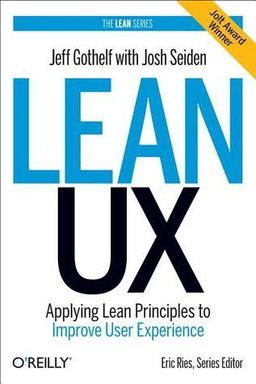
Lean UX cover

Lean UX

by Jeff Gothelf

Lean UX guides you through applying lean principles to design, enhancing collaboration and efficiency. Learn to integrate feedback and iteratively improve your processes, resulting in innovative products that delight customers and drive business success.

Designing Better Products Faster Through Lean UX

How do you design great products in a world that moves faster than your design cycles? Jeff Gothelf’s Lean UX: Applying Lean Principles to Improve User Experience argues that user experience design must evolve to match the rapid pace of modern Agile development. Rather than polishing deliverables and creating perfect specs, designers should focus on fast experimentation, collaboration, and validated learning. The book contends that the best design doesn’t come from solitary genius or pixel-perfect wireframes—it comes from teams learning together through a continuous loop of building, measuring, and learning.

Gothelf, alongside editor Josh Seiden, merges three major movements—Lean Startup, Agile Development, and Design Thinking—to propose a radical shift: stop designing for documentation and start designing for outcomes. Instead of measuring success by the number of deliverables or features, measure it by the impact those features have on user behavior and business goals. It’s a practical guide for any designer, developer, or product manager ready to abandon the fantasy of “Phase II” projects and embrace the messy, iterative reality of modern software creation.

The Problem with Traditional Design

Traditional design methods borrowed from the industrial age assume that manufacturers must know precisely what to build before production begins. In software’s early days, this mindset made sense—producing physical CD-ROMs or floppy disks meant high distribution costs. But the Internet changed everything. Today, teams can release new versions instantly. Yet, many organizations still cling to exhaustive documentation, extensive specs, and perfectionist up-front design. The result? Products that take too long to reach users and fail to adapt quickly to real feedback.

Gothelf calls this model outdated and dangerous. In a world of continuous deployment and high user expectations, rigid processes make teams slow, unresponsive, and stuck in silos. Lean UX seeks to replace this rigidity with flexibility, turning design into a learning process instead of a manufacturing pipeline.

The Three Foundations of Lean UX

Gothelf builds Lean UX on three key foundations:

  • Design Thinking: A collaborative, human-centered approach to solving problems through iteration and empathy. Everyone—not just designers—can apply design thinking to understand users and generate solutions.
  • Agile Development: Short, iterative development cycles where working software matters more than heavy documentation. Agile brings designers and developers together as one team focused on user value, not personal output.
  • Lean Startup: Eric Ries’s now-famous “Build–Measure–Learn” feedback loop, applied to design. Each feature is a hypothesis to test, not an assumption to execute. The goal is to learn quickly and cheaply whether a product solves a real problem.

From Deliverables to Shared Understanding

Lean UX’s central promise is to free teams from bureaucracy. Gothelf insists that value lies not in the documents designers produce, but in the team’s shared understanding of the user and the product. Designers evolve from lone experts into facilitators, creating alignment among developers, product managers, and stakeholders. Through collaborative sketching, design studios, and usability sessions, everyone contributes ideas and learns together.

“Documents don’t solve customer problems—good products do.”

This mindset shift—to collaboration, experimentation, and continuous learning—is the book’s beating heart. It’s not “less UX,” but better UX faster. The benefit isn’t only speed; it’s deeper understanding and better team morale. By integrating continuous feedback loops, Lean UX helps teams measure what actually works for users, not what looks impressive in a presentation deck.

Why It Matters Now

Gothelf’s message aligns with a broader transformation in tech culture. Just as manufacturing had to embrace lean principles in the 20th century, knowledge work and digital design must do the same in the 21st. Eric Ries, who wrote the foreword, notes that most companies fail not from lack of intelligence but from the systems they use to build. In a market that demands speed, adaptability, and user delight, Lean UX offers a path forward: one where learning replaces guessing, and collaboration replaces silos.

By the end of the book, you will learn how to reframe your design process as hypotheses to test, how to involve everyone in creating and validating design ideas, how to run continuous experiments, and how to embed UX seamlessly in Agile environments. In short, Lean UX empowers you to build products users love—through fast, focused learning rather than endless documentation.


Principles That Drive Lean UX

If Lean UX has a soul, it lies in its principles. These are more than just guidelines—they are values that redefine what effective design looks like in a fast-moving, data-driven world. Gothelf distills twelve principles that act as both a compass and a cultural manifesto for teams adopting Lean UX.

Cross-Functional Collaboration

The days of “throwing designs over the wall” are over. Lean UX thrives on cross-functional teams where developers, product managers, marketers, and QA staff all contribute from day one. When everyone builds the product together, silos collapse and communication accelerates. Shared ownership ensures everyone understands why something is being built—not just what needs to be done.

Focus on Outcomes, Not Output

Rather than tracking progress through features shipped or pixels pushed, lean teams measure success by outcomes—the business and behavior changes they produce. Did we increase conversions? Improve retention? Reduce friction? These are the KPIs that really matter. (This aligns closely with John Doerr’s Objectives and Key Results framework, which also ties work to measurable impact.)

Small, Dedicated, Co-Located Teams

Gothelf recommends teams small enough to share two pizzas, echoing Jeff Bezos’s famous rule. Fewer than ten people, dedicated to a single project and ideally in one location, create the intimacy and speed that large bureaucratic groups lack. When teams work side-by-side, they communicate spontaneously rather than through long email threads and reports.

Experimentation and Permission to Fail

Innovation happens when teams can fail safely. Lean UX invites teams to treat design like a science lab: form hypotheses, run experiments, and accept that most will fail. Gothelf illustrates this through Derek Sivers’ story of a pottery class—students told to make as many pots as possible created better results than those aiming for one perfect pot. Frequent failure breeds expertise.

Remove Waste and Work in Small Batches

Borrowing from lean manufacturing, teams should eliminate any activity that doesn’t produce learning or user value. That includes unnecessary deliverables, heavy documentation, and endless debates. The smaller the batch of work, the faster the team can learn. Build one small test, get real feedback, and refine—don’t design the entire system up front.

Shared Understanding and Continuous Discovery

The most valuable product of a team isn’t a design document; it’s shared understanding. When everyone participates in research and sees user feedback firsthand, design decisions no longer need pages of explanation. “Get Out of the Building” (GOOB), a concept popularized by Steve Blank, encourages teams to talk to users regularly and continuously test ideas in the wild rather than behind office walls.

These principles create a system where designers shift from artists to facilitators, teams measure success based on learning, and work becomes a continuous conversation with users. The result is leaner, smarter, and more human design.


Framing Work Around Hypotheses

In traditional organizations, projects begin with requirements and end with deliverables. Lean UX replaces that rigid model with hypotheses and outcomes. Instead of pretending to know all answers upfront, teams begin with educated guesses and let experiments reveal what’s true. The key tool for this is the hypothesis statement.

From Assumptions to Hypotheses

Every project starts with assumptions—beliefs about what users need, how they’ll behave, or what business goals matter. Gothelf’s advice: say them out loud. Gather stakeholders from every discipline, including customer support or sales, and list what each person believes. Then prioritize the riskiest and least-understood assumptions. Those become the first hypotheses to test.

The Hypothesis Format

“We believe that [doing this/building this feature] for [this audience] will achieve [this outcome]. We will know this is true when we see [this feedback or metric].”

This concise formula forces clarity: who it’s for, what you’ll build, what result you expect, and how you’ll measure success. It shifts design discussions from aesthetics to intent, turning debates into data-driven experiments. (In Eric Ries’s The Lean Startup, this parallels the “Build–Measure–Learn” loop.)

Creating Proto-Personas and Outcomes

Instead of months-long persona research, Lean UX uses proto-personas—quick sketches of target users created collaboratively. These are starting points, updated as the team learns more. The same process applies to outcomes: pick concrete, measurable goals tied to user behavior, such as “increase replies from job seekers to recruiters by 20%.” The Ladders example in the book demonstrates this approach in action: by redefining their problem around outcomes, their team found clarity and focus.

Framing work as hypotheses empowers you to stay curious. Instead of defending designs, your job becomes to test ideas, measure impact, and continually evolve. It changes the team’s mindset from “proving we’re right” to “discovering what’s true.”


Collaborative Design as a Team Sport

Gothelf’s central message to designers is simple but challenging: stop working alone. Collaboration isn’t a distraction—it’s the new design superpower. By turning design into a team activity, Lean UX breaks the myth of the lone creative genius and replaces it with shared responsibility for outcomes.

Why Collaboration Matters

In fast-moving organizations, waiting for handoffs wastes time and destroys context. When developers, product managers, and QA specialists sketch together, they not only understand design decisions better but also preempt feasibility issues. At TheLadders, Gothelf recalls sketching dashboards with a developer in real time—the collaboration halved implementation time and boosted ownership across the team.

Design Studio Method

The Design Studio exercise is Lean UX’s flagship collaboration technique. Teams tackle a design challenge together: each member sketches six quick concepts (a “6-up”), explains their ideas, receives critique, and refines the strongest version. Finally, the group converges on a shared concept. The process values quantity over perfection, building trust and creativity across roles. As comedian Amy Poehler—whom Gothelf quotes—puts it, surrounding yourself with people who challenge and inspire you “will change your life.”

Tools for Collaboration

Gothelf highlights digital tools like Google Docs, Skype, and wikis for distributed teams. GE’s UX Center of Excellence built a living pattern library (the Industrial Internet Design System) that standardized design components across thousands of developers. Style guides like this reduce waste, preserve coherence, and free designers to focus on deeper user problems instead of repeatable layouts.

Collaboration redefines what it means to be a designer. Instead of guarding your vision, you facilitate creative problem solving. You become the glue that holds conversations, feedback, and design intent together. The reward? Faster learning, better cohesion, and products shaped by collective insight, not individual ego.


Testing Through MVPs and Experiments

Every design is a hypothesis waiting for validation. The way to test it? Build a Minimum Viable Product (MVP). In Lean UX, MVPs minimize waste by allowing teams to test ideas early before committing heavy resources. They can be as simple as a paper prototype or a coded live feature.

Two Kinds of MVPs

Gothelf distinguishes between two types of MVPs: those built for learning and those built for value delivery. A learning MVP helps you understand whether a problem or feature matters to users (like a newsletter signup form to test interest). A value MVP, by contrast, actually delivers functionality in a limited form to see if users engage with it meaningfully.

Prototype Early, Prototype Cheap

Lean UX embraces a range of prototypes: paper sketches, clickable wireframes (in Balsamiq or Figma), mid-fidelity mockups, or even coded prototypes connected to real data. The rule is simple: build the smallest thing you can to learn the most. At a startup Gothelf describes, an entire business model was validated with a simple iPad prototype at a conference—it took just eight days to design, build, and test.

Non-Prototype MVPs

You don’t always need to build interfaces. Gothelf showcases creative examples of non-prototype MVPs: sending an email to gauge interest, buying Google Ads to test messaging, creating a landing page with a “Sign up” button, or inserting a “button to nowhere” in an existing app to measure clicks. Startup founder Cheryl Yeoh validated her app CityPockets by manually entering user coupons into a database before investing in back-end code—a technique known as a “Concierge MVP.”

Whatever form they take, MVPs emphasize doing, not debating. They shift your mindset from perfection to progress, teaching you that speed and iteration beat guessing every time.


Continuous Research and Feedback Loops

What happens after you launch an MVP? That’s where the real design work begins. Lean UX turns research from a rare event into a weekly ritual. Instead of saving testing for the end, Gothelf urges teams to integrate user feedback into every sprint. His mantra: test everything, all the time.

Collaborative Discovery in the Field

Gothelf insists that the entire team—not just researchers—get out of the building and talk to customers. A PayPal team he coached sent designers and developers to shopping malls with prototypes. They returned with pages of notes and immediate clarity on which ideas were viable. By letting developers talk to real users, the team built empathy and shared understanding in a single day.

“Three Users Every Thursday”

To make research sustainable, Gothelf highlights Meetup.com’s practice of testing continuously: three users every Thursday. No fancy usability lab required—just a desk, webcam, and GoToMeeting for remote observation. The entire team watches sessions live, reacts immediately, and discusses patterns afterward. With over 600 tests a year, Meetup achieved innovation at a fraction of the cost of traditional studies.

Analyzing and Acting on Findings

After each research session, teams debrief immediately and look for patterns across feedback. Outliers are “parked” for later. This approach keeps learning continuous and cumulative. Gothelf warns against overanalyzing conflicting data—patterns over time matter more than any single comment. At TheLadders, weekly sessions revealed how job seekers’ attitudes toward SMS messaging evolved over years, allowing the company to adapt in sync with changing behavior.

Continuous discovery doesn’t just validate features; it transforms culture. When users’ voices become part of every week, teams build products that fit real people, not abstract personas in PowerPoint decks.


Integrating Lean UX and Agile

Many teams already work in Agile but struggle to fit design into sprints. Lean UX bridges that gap. Instead of treating design as a separate phase, Gothelf embeds it into Agile’s rhythm—stand-ups, retrospectives, and iteration planning meetings. The outcome: designers, developers, and product owners finally work on the same things at the same time.

From Staggered Sprints to True Integration

Early “Staggered Sprint” models placed design one sprint ahead of development. While this helped designers plan, it recreated waterfall silos and wasted effort on unvalidated work. The Lean UX alternative is continuous collaboration: design, dev, and research all happening in overlapping cycles. Everyone participates in iteration planning, ensuring no story moves ahead without design input.

Team Participation and Shared Rituals

Gothelf emphasizes all-hands participation in Agile rituals. At TheLadders, neglecting stand-ups left designers isolated from time estimates and sprint priorities. Once they joined, scheduling and backlog management became smoother—and designers gained early visibility into technical constraints. This proactive collaboration also keeps creativity alive within fast delivery cycles.

Lean UX in Scrum Practice

In Scrum teams, each theme kicks off with collaborative sketching and hypothesis sessions, followed by two-week sprints of building and testing. Weekly user sessions validate hypotheses mid-sprint, keeping the backlog aligned with real learning. This rhythm allows rapid discovery and consistent communication—proof that UX doesn’t slow Agile down; it fuels it.

When Lean UX meets Agile, the organization stops treating design as decoration and starts treating it as a learning engine. The result isn’t just faster delivery—it’s smarter teams empowered to adapt after every sprint.


Shifting Organizational Culture

Adopting Lean UX is as much about culture as process. Gothelf dedicates his final chapter to the organizational shifts required to make it stick. It’s not enough for one team to be agile; the entire company must value collaboration, learning, and outcomes over hierarchy, roles, and documents.

From Outputs to Outcomes

Managers love feature roadmaps because they create a false sense of control. Lean UX replaces those roadmaps with outcome-based goals—like reducing churn or increasing engagement—letting teams experiment freely to find the best path. Leadership’s job is to define goals, not mandate features. This demands trust, transparency, and a tolerance for ambiguity.

New Roles for Designers and Managers

Designers become facilitators rather than heroes, guiding discussions instead of dictating solutions. Managers evolve from gatekeepers to coaches, clearing obstacles and encouraging experimentation. (Marty Cagan’s Inspired echoes this shift, urging product leaders to empower teams instead of micromanaging them.)

Restructuring Teams and Space

Small, cross-functional teams—“two-pizza teams”—should sit together in open workspaces to encourage spontaneous collaboration. Physical co-location builds the kind of trust that Slack messages can’t. When separation is unavoidable, video calls and periodic face-to-face meetings keep the connection alive.

Changing Agency and Vendor Relationships

Agencies and third-party vendors often resist Lean UX because they sell deliverables. Gothelf challenges this: move toward time-and-materials or outcome-based contracts that reward learning, not documentation. Collaboration with clients should be a continuous process, not a handoff.

Embracing UX Debt and Speed

Just as engineers track technical debt, designers must track UX debt—the backlog of experience improvements deferred during fast iterations. Addressing it deliberately maintains usability without sacrificing speed. The goal, Gothelf reminds us, is “speed first, aesthetics second.” Get something usable in front of users and improve from there.

Ultimately, Lean UX thrives where leaders value learning over certainty. Culture change starts small—one experiment, one shared success, one open team conversation at a time—but over time, it transforms how entire organizations innovate, communicate, and deliver value.

Dig Deeper

Get personalized prompts to apply these lessons to your life and deepen your understanding.

Go Deeper

Get the Full Experience

Download Insight Books for AI-powered reflections, quizzes, and more.