
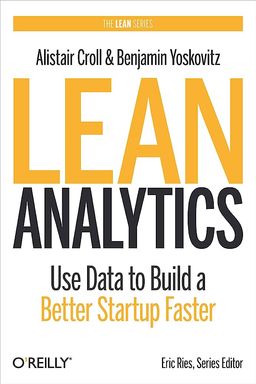
Lean Analytics cover

Lean Analytics

by Alistair Croll and Benjamin Yoskovitz

Lean Analytics offers entrepreneurs a data-driven path to building better start-ups faster. By focusing on effective metrics and strategic insights, this book guides you through essential growth stages, ensuring your venture aligns with market demands and thrives sustainably.

Building Better Startups Through Lean Analytics

What if you could know, with high confidence, whether your startup idea was worth pursuing—without wasting years or your life savings on the wrong thing? In Lean Analytics: Use Data to Build a Better Startup Faster, Alistair Croll and Benjamin Yoskovitz argue that you can. Their central message is that data-driven learning is the antidote to entrepreneurial self-delusion. Startups don’t fail because founders aren’t passionate or hardworking—they fail because they persistently chase unverified assumptions. The cure is measuring the right things, at the right time, and using those insights to learn and pivot rapidly.

Croll and Yoskovitz build on the foundations of the Lean Startup movement popularized by Eric Ries and Steve Blank. While Lean Startup teaches you how to run experiments and validate hypotheses, Lean Analytics teaches you what to measure and why those measurements matter. The book introduces an adaptable framework for identifying your One Metric That Matters (OMTM)—the single data point you should focus on at any given stage of your startup’s growth. It also helps you identify your business model and determine your stage of development so you can focus your efforts wisely.

Why Lean Analytics Matters

The authors open with a blunt truth: founders lie to themselves. Entrepreneurs are natural optimists—a trait essential for surviving uncertainty—but unchecked optimism can be fatal. Data, properly framed and interpreted, acts as a necessary counterweight. It helps you discern what’s actually working from what merely feels good. This means abandoning vanity metrics like total downloads or pageviews in favor of actionable, comparative indicators like conversion rates, churn, or retention. These are the “truth metrics” that guide you toward product/market fit and sustainable growth.

From Hypotheses to Feedback Loops

Startups operate under extreme uncertainty. You begin with a series of assumptions—about your customers, their problems, and your solution. Lean Analytics insists that you transform those assumptions into testable hypotheses and measure your progress against them. The “Build-Measure-Learn” feedback loop from Lean Startup becomes more rigorous here: Croll and Yoskovitz supply the tools for deciding what to measure and how to know when you’re succeeding.

You’ll learn how to recognize which data matters at each step: during discovery (qualitative interviews and empathy metrics), prototyping (stickiness and retention), growth (virality and monetization), and scaling (efficiency and replication). This staged approach helps you reduce risk methodically, one dimension at a time, instead of trying to optimize everything at once.

Six Business Models and Five Stages of Growth

A standout feature of Lean Analytics is its comprehensive taxonomy of startup types and stages. The book identifies six common business models—E-commerce, SaaS, Free Mobile Apps, Media Sites, User-Generated Content, and Two-Sided Marketplaces—each with unique “lines in the sand,” or benchmark metrics. Then, it lays out five stages of startup evolution: Empathy, Stickiness, Virality, Revenue, and Scale. By blending these two frameworks, you can pinpoint the specific metrics that define your success right now.

For instance, if you’re building a SaaS product in the “Stickiness” stage, your OMTM might be churn rate or active users. If you’re running an e-commerce site in the “Revenue” stage, focus shifts toward lifetime value and customer acquisition cost.

The Focus Imperative

The authors repeat one idea tirelessly: focus kills chaos. Founders, they warn, are magpies—distracted by shiny ideas, new features, and endless data points. The OMTM principle enforces focus by forcing you to choose one measurable goal that determines whether you’re making real progress. Everything else becomes secondary until you cross that “line in the sand.” Once you meet your goal, you identify a new OMTM appropriate to your next stage of growth.

From Gut Instinct to Data-Informed Decisions

Importantly, the authors caution that being “data-driven” doesn’t mean surrendering your instincts. It means being data-informed—using information as feedback, not as a dictator. They remind you that analytics should never replace creativity or customer empathy. Instead, it disciplines intuition so your hunches become hypotheses and your passion becomes measurable progress. Examples like Orbitz adjusting hotel listings for Mac users or Dropbox optimizing freemium conversions illustrate how nuanced data use can create outsized impact.

Ultimately, Lean Analytics calls for an alliance between vision and evidence. Successful founders learn when to trust their gut—and when to demand proof. With the right metrics guiding each phase, you can stop gambling and start learning your way to success.


Facing the Startup Delusion

Croll and Yoskovitz begin with a stark observation: entrepreneurs are natural liars—especially to themselves. In the early chapters, particularly “We’re All Liars,” they explore how passion blinds founders to reality. You’re wired to believe your idea is great, but unchecked confidence leads you to ignore signals that your product doesn’t fit the market. Lean Analytics confronts this tendency head-on by making data your compass.

The Reality Distortion Field

Entrepreneurs need a bit of delusion. After all, you’re building something that doesn’t yet exist, convincing people to join you on faith. But when belief turns into self-deception, it becomes dangerous. Croll compares this to Steve Jobs’s infamous “reality distortion field”—in moderation it inspires, but unchecked it isolates you from truth. Analytics pierces this illusion by providing evidence that either supports or invalidates your assumptions.

The Yin and Yang of Data and Intuition

The authors emphasize balance: instinct fuels creativity; data fuels correction. You need both. For example, gut feeling might tell you a feature will engage users, but only data—say, a cohort retention curve or A/B test—can confirm it. Ignoring data is reckless, but relying on it too blindly stifles insight. Instead, treat analytics as your truth serum. It helps you see beyond your bias, validating your story in the marketplace rather than in your head.

(This theme echoes Daniel Kahneman’s ideas in Thinking, Fast and Slow: system 1—instinctual thinking—needs system 2—analytical reasoning—to balance its optimism.)

Vanity Metrics vs. Learning Metrics

Perhaps the most practical lesson from this chapter is avoiding vanity metrics—numbers that make you feel good but don’t guide action. Pageviews or registered users sound impressive, but they don’t tell you if anyone values your product. Real learning happens when you measure metrics you can influence directly, such as activation rate, churn, or lifetime value. These are actionable metrics, because they drive decisions.

Core Insight

Startups don’t run on inspiration alone—they run on validated learning. Every vanity metric postpones failure instead of preventing it.


Choosing Metrics That Matter

In “How to Keep Score,” the authors dig deeply into what makes a good metric. They argue that meaningful metrics share three qualities: they’re comparative, understandable, and actionable. Numbers matter only when they tell a story—when you can compare them across time or groups, when everyone understands them, and when they lead to change.

The Anatomy of a Good Metric

Good metrics are ratios or rates because they show relationships. For example, conversion rate (visitors who buy) and churn rate (customers who leave) reveal direction and health. Unlike raw totals, ratios are easier to act on because they highlight proportional change rather than absolute growth. If your conversion rate drops but traffic doubles, your raw numbers might still look good—yet the trend hides trouble.

The authors also emphasize segmentation: breaking data into cohorts or user groups helps you understand behavior differences. Are new users more likely to churn than old ones? Are paid users more engaged than free ones? These distinctions let you target improvements precisely.

Qualitative vs. Quantitative Data

Not all valuable learning is numerical. Croll and Yoskovitz remind you that qualitative insights—customer interviews, open feedback, behavioral observation—are crucial in early stages when numbers are scarce. Quantitative metrics scale later as you gather more users. The art lies in combining both: listen early, measure later. This hybrid approach transforms vague signals into testable hypotheses.

They also caution against correlation without causation. Just because two variables move together doesn’t mean one causes the other. A famous case from the book: Orbitz discovered Mac users booked pricier hotels, but only careful analysis confirmed that device type was predictive enough to personalize offers without alienating customers.

Ultimately, metrics must be lenses, not mirrors—they should reveal, not flatter. The founders’ job is to interpret them in context and act decisively.


Deciding What to Work On

Before metrics can guide you, you need something worth measuring. In “Deciding What to Do with Your Life,” the authors explore how to choose an idea that aligns with both market demand and personal motivation. Startups only succeed when the founders care deeply about the problem they’re solving—and when that problem matters enough to customers to pay for a solution.

Using the Lean Canvas

Croll and Yoskovitz advocate for the Lean Canvas, Ash Maurya’s one-page replacement for a traditional business plan. It captures your hypotheses about customers, problems, solutions, channels, and revenue. This keeps you lean, preventing wasted time on formal plans that collapse at first contact with reality. The Lean Canvas makes your assumptions visible, so you can use analytics to verify them.

The Three Circles of Fulfillment

Bud Caddell’s framework, which the authors highlight, helps you align personal purpose with opportunity. The ideal venture lies at the intersection of three questions: What are you good at? What do you love to do? and What can you make money doing? This ensures your entrepreneurial journey is sustainable—financially and emotionally. Without this fit, data may help you optimize a business that you no longer care about.

From Hypothesis to Validation

Once you’ve articulated your idea, the real work begins: testing assumptions. Metrics become experiments that falsify or confirm your hypotheses. For instance, if you believe users will pay for convenience, test variations of pricing and speed to measure behavior directly. Analytics is not a replacement for vision—it’s the method for aligning that vision with reality.


The Discipline of One Metric That Matters

The “One Metric That Matters” (OMTM) is the beating heart of Lean Analytics. Croll and Yoskovitz argue that startups fail not because they lack data, but because they drown in it. Success requires ruthless focus on a single, strategic measure until that measure improves enough to move to the next stage.

Why One Metric?

Founders suffer from data ADD. They juggle vanity metrics, dashboards, and conflicting KPIs, hoping one will point to success. The OMTM principle imposes discipline: you pick one metric that defines progress right now. That metric must be specific, time-bound, and tightly linked to your current goal. For example, a SaaS startup in early retention might focus entirely on monthly active users, while later it might shift to customer lifetime value.

The OMTM evolves. Once you hit your target “line in the sand,” you select a new metric appropriate for the next challenge. This sequential focus prevents premature optimization and clarifies team priorities.

Examples of OMTM in Action

Moz, the SEO software company, achieved better growth when it limited itself to a handful of clear KPIs. Solare, a startup featured in the book, disciplined its team around a few measurable customer behaviors that signaled real adoption. These cases show that focus doesn’t slow you down—it accelerates learning by converting chaos into clarity.

Key Lesson

At any given moment, your company has only one most important question. The OMTM tells you whether you’re getting the answer.


Recognizing Your Business Model

Before choosing metrics, you must know what kind of business you’re in. Chapter 7, “What Business Are You In?”, emphasizes that how you make and collect money determines what to measure. Startups fall into six archetypes, each with its own success signals.

The Six Models

  • E-commerce: Selling goods/services online—measure conversion rate, cart size, and acquisition cost.
  • SaaS: Subscription service—monitor churn, upsell rate, and monthly recurring revenue.
  • Free Mobile App: Prioritize retention, in-app purchases, and cost per install.
  • Media Site: Focus on ad inventory, sessions per visitor, and click-through rates.
  • User-Generated Content: Measure engagement and contribution ratios between creators and lurkers.
  • Two-Sided Marketplace: Balance supply and demand growth, ensuring healthy transaction rates.

Each model has its quirks. For example, SaaS products are low-cost but rely on retention, while marketplaces must win trust on both sides (like eBay or Airbnb). Recognizing your model aligns your analytics with your real risks—e.g., churn for SaaS, liquidity for marketplaces, engagement for UGC platforms.


Understanding Startup Stages

Startups don’t grow linearly—they evolve through five distinct stages: Empathy, Stickiness, Virality, Revenue, and Scale. Each stage asks a unique question, and only when you’ve answered it should you move on. This staged thinking prevents founders from expanding prematurely.

Stage 1: Empathy

Here, you’re not selling—you’re listening. You run interviews to validate whether the problem you’re solving actually matters. Early metrics are qualitative: number of customer conversations, clarity of pain points, and the consistency of patterns across interviews. You’re searching for “a problem worth solving.”

Stage 2: Stickiness

Once you’ve built an MVP, you test retention: do users come back? This involves measuring daily or monthly active users, reactivation rates, and feature engagement. Segmenting by cohort helps see if newer users behave better, signaling improvement. Stickiness precedes growth; otherwise, marketing only churns more users through a leaky bucket.

Stage 3: Virality

Now you pursue organic growth. Measure your viral coefficient—the number of new users each existing user recruits—and the time it takes for that spread. However, the authors warn against chasing virality before retention. As they put it, “If your users don’t stick, your viral loop just leaks.”

Stage 4: Revenue

When engagement and growth are healthy, focus shifts to monetization. You now test pricing, upsells, and customer acquisition cost versus lifetime value. The goal: prove your business can sustain itself, not just attract attention.

Stage 5: Scale

Finally, scaling means replicating success at a larger level—entering new markets, automating systems, and optimizing efficiencies. Here you track margins, system uptime, and unit economics. Scale isn’t about growth for growth’s sake—it’s about repeatable, predictable operation.


Drawing Lines in the Sand

Knowing what to measure is powerful—but without benchmarks, numbers lack meaning. Lean Analytics introduces the idea of lines in the sand: pre-defined targets for what “good enough” looks like. These benchmarks prevent endless tinkering and tell you when to move on to the next problem.

Why Baselines Matter

Startup founders constantly ask, “Are we doing well enough?” The truth: there’s rarely a universal standard. But rough baselines—like 2–5% conversion rates for SaaS trials or 17 minutes average daily use for social networks—offer sanity checks. They help you distinguish between underperformance and optimization plateau.

The Dangers of Over-Optimization

Beyond a certain point, trying to squeeze marginal gains wastes time. The book encourages founders to recognize diminishing returns: when improvements flatten, that’s a sign to move on. As Croll says, “Don’t move the line to your ability—move your ability to the line.” The goal is progress, not perfection.


Lean Analytics Beyond Startups

Data-driven learning isn’t just for startups. In later chapters, Croll and Yoskovitz explore how enterprises and intrapreneurs can use Lean Analytics to innovate inside large organizations. Whether you’re testing internal projects or building new products, the same logic applies: form hypotheses, measure progress, and iterate rapidly.

Intrapreneurship and the Skunk Works Model

Using the example of Lockheed Martin’s “Skunk Works,” the authors describe how autonomous teams inside corporations can act like startups—working fast, testing ideas, and avoiding bureaucracy. To succeed, they need authority proportionate to their responsibility and leaders who shield them from corporate inertia.

Translating Lean into Enterprise Terms

Corporate innovators must adapt Lean principles to slower processes and legacy systems. Their metrics focus more on integration costs, support demands, or user adoption within existing channels. Still, the underlying process is identical: start with empathy, test for stickiness, demonstrate virality or internal buy-in, and prove ROI.

Ultimately, Lean Analytics isn’t just a startup methodology—it’s a mindset. Whether you’re in a startup, a university lab, or a Fortune 500 company, the challenge remains the same: turning unknowns into knowns through evidence, iteration, and courage.

Dig Deeper

Get personalized prompts to apply these lessons to your life and deepen your understanding.

Go Deeper

Get the Full Experience

Download Insight Books for AI-powered reflections, quizzes, and more.