
Idea 1
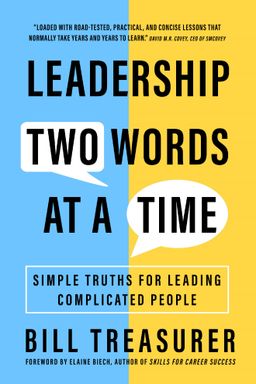
Leadership Two Words at a Time: Turning Complexity into Clarity
How can you lead complicated people in an increasingly chaotic world without losing your own sanity? In Leadership Two Words at a Time, Bill Treasurer argues that leadership doesn’t have to be overwhelming if you anchor yourself in small, memorable truths. Every lesson worth mastering about leadership, he suggests, can be boiled down to two words—simple, actionable phrases that capture the heart of what effective leaders actually do.
Treasurer’s premise grew out of decades of coaching executives, managers, and new leaders across industries. He found that when leaders distilled their insights from coaching sessions into short, memorable phrases, they were more likely to act on them. Keeping things “two words at a time,” he discovered, turned abstract advice into daily habits. These phrases became verbal compasses that helped leaders stay centered amid chaos. The book, then, is both a practical playbook for new leaders and a wake-up call for experienced ones who have drifted away from their foundational values.
Why Simplicity Matters in Complex Times
The world of leadership, Treasurer notes, has never been more complex. Leaders today must navigate hybrid workforces, heightened social tensions, and cross-generational expectations. Yet most leadership books target top executives instead of the first-time supervisor or project manager who’s just trying to get through a chaotic week. That gap inspired Treasurer to create something different—a field guide for “mere mortals” who need wisdom they can use right now. He distills leadership development into three human responsibilities: leading yourself, leading people, and leading work. Master those three, and you’ll master leadership itself.
He insists that the best leaders don’t start with grand visions—they start with self-awareness and discipline. You can’t lead others if you can’t first lead yourself. But self-management alone isn’t enough. Leadership is a relational art, requiring trust, humility, and inclusion. Finally, good leadership means getting work done ethically and effectively—translating values into results. These three arenas—self, people, and work—form the structural backbone of the book.
The Threefold Journey: Self, People, and Work
Part I, “Leading Yourself,” includes phrases such as Know Thyself, Model Principles, Gain Control, Practice Humility, and Cultivate Composure. Each chapter pushes you to strip away illusions about leadership as command-and-control. Instead, Treasurer teaches that self-awareness, integrity, and composure create a ripple effect: when you know yourself, you draw the best from others. His stories—ranging from a construction foreman to a corporate vice president—show how qualities like spiritual grounding and humility prevent the leadership disease of hubris.
Part II, “Leading People,” shifts outward to your relationships. You learn that trust must come first (“Trust First”), workplaces thrive on psychological safety (“Create Safety”), people grow through investment (“Nurture Talent”), and fairness depends on inclusion (“Promote Inclusion”). These chapters humanize management by turning empathy into a performance advantage. Through tales like the safety director who role-modeled vulnerability to ignite a cultural transformation, Treasurer reminds us that courageous openness—sharing pain, not just plans—is what unites teams.
Part III, “Leading Work,” takes the mission further. Here, Treasurer encourages leaders to fall in love with business itself (Love Business), master execution (Get Results), apply disciplined management (Master Management), and learn to build partnerships upward (Lead Up). Leadership, he insists, is not about rank—it’s about responsibility. And much of that responsibility involves “making others successful,” whether they’re your direct reports or your boss.
Leadership as a Courage Practice
Courage, a theme woven through Treasurer’s entire career, forms the moral engine of the book. Drawing on his earlier work Courage Goes to Work, he defines leadership as courage in motion: the willingness to face discomfort, raise standards, and serve others with humility even when it’s hard. Courage manifests differently at each stage—self-leadership requires self-honesty, people leadership demands vulnerability, and leading work takes accountability. Each chapter ends with “Think Now” and “Act Now” steps, anchoring reflection with tangible action—because you can’t think yourself into better leadership; you can only act yourself into it.
In crafting these two-word principles, Treasurer makes leadership both accessible and demanding. You can’t hide behind theory. “Practice Humility” is not an abstract ideal—it’s a behavioral challenge. His conversational tone, full of humor (“don’t brown-nose,” “tough noogies”), keeps lessons from feeling preachy, while stories of real leaders ground the wisdom in authentic experience.
Why This Book Matters Now
Modern workplaces face what Treasurer calls “the plight of new leaders”—people promoted for their technical skill but unprepared for the human complexity of leadership. When 83% of organizations say developing leaders is critical but only 5% actually do it, most first-time leaders are on their own. This book offers their missing playbook. It teaches that leadership is joyfully hard: difficult but deeply rewarding when you approach it as service, not status. In a world obsessed with hacks and quick wins, Treasurer’s “two words” method brings us back to the fundamentals of integrity, composure, discipline, and courageous service—simple, not easy, but profoundly transformative.
Core Message
Leadership isn’t about grand gestures—it’s about consistent choices grounded in character. Take it two words at a time, and leadership becomes a daily practice rather than an intimidating ideal.