
Idea 1
Leading When Leadership Is Dangerous
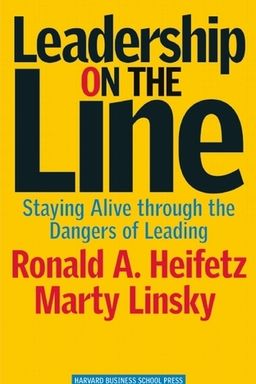
How do you lead change when doing so might get you attacked, sidelined, or burned out? In Leadership on the Line, Ronald Heifetz and Marty Linsky argue that real leadership—what they call adaptive leadership—is inherently dangerous because it asks people to face loss. True leadership disrupts habits, challenges loyalties, and dismantles comforting routines. It is not about issuing orders or inspiring slogans; it’s about mobilizing people to take responsibility for what matters most, even when it hurts.
Heifetz and Linsky contend that leadership is not defined by position or authority but by the capacity to mobilize adaptive work—the courageous process of helping people evolve to meet new challenges. Yet they acknowledge a paradox: leading necessary change often provokes fierce resistance, especially from those who stand to lose the most. The authors therefore focus on a practical question: How can you lead change and still stay alive—professionally, politically, and personally?
Why Leadership Hurts
Leadership becomes perilous precisely because progress requires loss. When leaders challenge deeply held norms and values, they become targets. The book opens with the story of Maggie Brooke, a Native American elder who fought alcoholism in her community. Following the example of another woman, Lois, she called Alcoholics Anonymous meetings for years even when no one came. She was mocked and isolated before her vision finally took root and began to change lives. Likewise, former Israeli Prime Minister Yitzhak Rabin was assassinated for pushing peace efforts that forced Israelis to face painful territorial compromises. Both illustrate the book’s central claim: leadership provokes backlash because people don’t resist change, they resist loss.
Adaptive vs. Technical Problems
The authors draw a pivotal distinction between technical and adaptive challenges. Technical problems are solvable with existing expertise and procedures—like repairing a car or administering a standard policy. Adaptive challenges, however, demand new learning and changed values. They cannot be “fixed” by authority alone. As the authors put it, “adaptive work requires learning, not applying existing know-how.” Many leadership failures occur when people treat adaptive challenges as if they were technical ones, offering swift, superficial fixes instead of engaging people to confront hard questions. (This parallels John Kotter’s notion in Leading Change that transformation fails when leaders aim to manage rather than mobilize.)
For example, Ecuador’s president Jamil Mahuad mistook his country’s collapsing economy in 2000 as purely a technical challenge requiring financial tweaks. By focusing on policy rather than people’s anxiety and sense of betrayal, he eroded public trust and was ousted from office. His failure shows how even great vision is doomed if it ignores the adaptive dimension—the losses and emotions people must navigate to change.
Leading Without the Myth of the Hero
Heifetz and Linsky reject the “heroic” model of leadership that promises salvation from above. Heroism feeds ego and dependency, leaving organizations unfit to adapt on their own. Real change, they say, resembles evolution more than revolution—it builds on cultural DNA while fostering renewal from within. The authors recount President Juan Manuel Santos’s long, patient negotiation for peace with Colombia’s FARC guerillas. Rather than promising instant transformation, Santos led through incremental adaptation—building alliances, orchestrating conflict, and accepting losses. His example underscores the book’s pragmatic optimism: you can lead dangerous change and survive, if you pace it wisely and keep connected to people’s tolerance for discomfort.
A Blueprint for Survival and Meaning
The book offers a blueprint for leading while staying alive: get above the fray (“on the balcony”), act politically, orchestrate conflict, give the work back to the people, and hold steady amid resistance. Later chapters address self-awareness—managing one’s hungers for control, affirmation, or intimacy—and anchoring oneself through reflection, confidants, and purpose. The authors weave political leadership with deeply personal insight, linking the external risks of public challenge with the internal work of self-discipline and renewal. The final message is spiritual as well as strategic: leadership derives its power from love—the commitment to help people grow—and the courage to keep your heart open even when it breaks.
In short, Leadership on the Line reframes leadership not as authority or charisma but as adaptive service. It’s about mobilizing people to do hard, meaningful work—without sacrificing your soul in the process. This is not just survival; it’s staying human while leading dangerous change.