
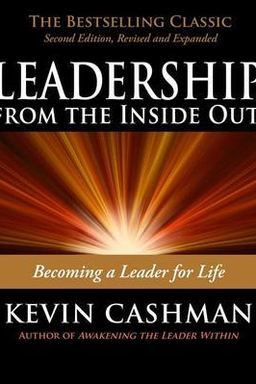
Leadership from the Inside Out cover

Leadership from the Inside Out

by Kevin Cashman

Leadership from the Inside Out challenges the conventional metrics of success, encouraging leaders to cultivate authenticity, resilience, and purpose. Through engaging stories and insights, this book inspires leaders to grow personally, serve others, and create meaningful change, transforming both their lives and organizations.

Leading from the Inside Out

How can you lead with authenticity in an increasingly complex, fast-changing world? In Leadership from the Inside Out, Kevin Cashman argues that true leadership does not begin with strategy, authority, or position—it begins within. Leadership, he writes, is courageous, authentic influence that creates enduring value. It is less a role than an expression of identity: who you are determines how you lead. To sustain performance and inspire others, you must cultivate inner mastery, clarity of purpose, connection to values, and the courage to act from them.

Across the book’s many chapters, Cashman moves you through an integrated model of leadership growth—Personal, Interpersonal, Change, Resilience, Being, Coaching, and Purpose masteries—each one connecting inner awareness to outer impact. His research partnership with Korn Ferry and references to leaders like Steve Reinemund of PepsiCo, Paul Polman of Unilever, Daniel Vasella of Novartis, and David MacLennan of Cargill ground the philosophy in corporate life, showing that self-awareness and authenticity correlate with financial performance as well as human flourishing.

Leadership as Identity, Not Technique

Cashman reframes leadership as an identity journey. The traditional, outside-in model—where you acquire skills to influence others—often yields imitation rather than transformation. The inside-out model starts with becoming aware of your values, motives, and purpose, then aligning behavior with that awareness. From inner alignment flows presence, credibility, and sustainable influence. This “inside-out loop” requires courage to be authentic and discipline to integrate purpose into every decision. You learn that presence, not technique, is the true vehicle of influence. (This perspective recalls Daniel Goleman’s work on emotional intelligence and Jim Collins’s description of Level 5 humility-driven leaders.)

Cashman threads research evidence through this view: Korn Ferry’s David Zes and Dana Landis found that self-aware leaders deliver stronger organizational results. Thus, reflection and feedback loops are not luxuries but strategic imperatives. Companies that develop only surface competencies risk breeding actors, not authentic leaders.

From Personal Mastery to Organizational Value

Each leadership aspect builds on the foundation of personal growth. You begin with Personal Mastery: uncovering “shadow beliefs” that unconsciously drive defensive or perfectionist behaviors, and shifting from coping to character. You explore authenticity not as static honesty but as the alignment between your current awareness and your potential self. This leads naturally into Interpersonal Mastery: learning to balance personal power (the “I”) with relational power (the “We”). Effective leaders assert perspective without diminishing others, an equilibrium Cashman captures in the metaphor of an “opener”—someone who both voices truth and invites collaboration.

From there, the focus extends to Change Mastery and Resilience. In unpredictable conditions, Learning Agility—not IQ—is the predictor of success. You must switch from control to adaptability, from problem-fixation to opportunity-framing. The resilient leader manages not time but energy: physical, emotional, mental, and spiritual. Stories of Arianna Huffington’s health collapse and recovery, or Brian Cornell limiting meeting length for energy efficiency, illustrate that vitality sustains leadership far longer than constant motion.

Being, Purpose, and the Power of Story

Underneath action lies Being Mastery—the cultivation of presence. Through meditation, mindfulness, time in nature, and daily reflection, you access a state of “restful alertness” where stress subsides and intuition surfaces. Neuroscience supports this: Richard Davidson’s research shows meditation decreases amygdala reactivity and increases executive brain function. Cashman’s own experience on retreat with Maharishi Mahesh Yogi illustrates how deep rest fuels creativity and calm decision-making. As he notes, “With no silence there is no reflection; with no reflection, no vision; and with no vision, no leadership.”

From that inner quiet, Purpose Mastery emerges: clarifying your “Big Why.” You discover purpose at the intersection of core talents and core values, as seen in David Lubetzky creating KIND Snacks from a family story of compassion, or Brian McNamara leading GSK Consumer Health by “infusing life in people.” Purpose transforms performance into contribution—it is the guiding compass through complexity. Complementing it is Story Mastery, the ability to communicate purpose through narratives that inspire others. Cashman cites neuroscience experiments by Paul Zak linking storytelling to empathy and cooperation: story activates both heart and mind. Leaders like Liam Condon at Bayer made corporate purpose vivid by sharing personal career arcs instead of slogans.

Character and Coaching as Multipliers

Character, Cashman insists, is leadership’s ultimate multiplier. Without it, skills collapse into manipulation. Terry Bacon’s research confirms that character amplifies or erodes every other power source. Toro’s decision to retrofit safety roll bars at its own expense exemplifies purpose-driven ethics turning integrity into brand trust. Likewise, Cargill’s David MacLennan models authenticity through humility, transparency, and service. Public courage—leaders speaking out on issues consistent with mission—is framed not as activism but as moral coherence.

Finally, Coaching Mastery operationalizes all others: awareness, commitment, and practice. Just as athletes like Kobe Bryant refine skills through repetition, leaders sustain change through repeated, embodied acts. Transformational coaching, in Cashman’s model, shifts not only behavior but identity. Organizations such as Novartis and Paul Van Oyen’s Etex have leveraged coaching cultures to turn leadership growth into cultural transformation.

The book closes with integration: leadership mastery is not separate programs but a holistic way of living and leading. When you practice reflection (Being), energy renewal (Resilience), and purposeful coaching (Coaching) daily, you embody inside-out leadership. This process is lifelong—an evolution from role to soul—through which you align who you are with the value you create in the world.


Personal Mastery and Authentic Influence

Personal Mastery is where inside-out leadership begins. It asks you to understand your inner landscape—beliefs, motives, strengths, fears—and to bring them into alignment so your outer actions reflect your true self. Cashman defines authenticity as the continuous integration of your evolving awareness with transparent behavior. You're authentic to who you are now but inauthentic to who you could become unless you grow intentionally. True growth means surfacing the unconscious patterns—or 'shadow beliefs'—that quietly shape behavior.

Exposing Shadow Beliefs

Shadow beliefs often take the form of internal warnings: “I must control outcomes to stay safe,” or “If I’m not perfect, I’ll lose respect.” They served a purpose once but restrict leadership maturity. Through feedback, reflection, and coaching, you can surface them and replace them with conscious principles grounded in courage. For example, Edward, an accomplished executive, believed success could vanish overnight—creating anxiety and overcontrol. When he faced this belief, he learned to delegate and trust, increasing both results and engagement.

Character versus Coping

Cashman contrasts two energy sources: Character, drawn from purpose and service, and Coping, driven by fear and control. Character expands possibilities and connection; Coping contracts them. Tracy, a high performer, managed through control until team morale fell. Coaching helped her shift to trust-based leadership, revitalizing her unit. When you act from Character, you magnetize trust and creativity. From Coping, you might achieve but without renewal or followership.

Tools for Growth

Personal Mastery practices include journaling values, asking, “Do I lead from character or coping when challenged?”, inviting feedback about blind spots, and seeking coaching to accelerate change. Neuroscience research (Rock & Schwartz) supports this discipline: sustained self-reflection creates new neural pathways that make awareness habitual. Over time, you stop reacting from defenses and begin choosing from clarity. This is inner leadership in action—a conscious redirection of attention from fear to purpose.

Leadership takeaway

Authenticity is not static honesty but conscious evolution—the courage to own your patterns, rewrite them, and act from your deeper purpose instead of your defenses.

Personal Mastery transforms self-awareness into authentic influence. When you integrate your whole self—strengths, limits, and life experiences—you begin to lead naturally rather than perform leadership. This inner alignment is both the seed and the standard for every other mastery to come.


Building Trust and Relational Mastery

If Personal Mastery shapes who you are, Interpersonal Mastery defines how you connect. Cashman describes leadership as a balance between I power (self-expression and conviction) and We power (collaboration and openness). Both streams must flow together. Results without relationship create burnout; relationship without results breeds complacency. The key is learning when to assert and when to include—a rhythm of authentic dialogue and mutual trust.

720° Development

To build relational mastery, you need feedback that reaches both inside and out. Cashman suggests 720° development—combining 360° external feedback with inner reflection and assessment of personality, motives, and values. This dual feedback prevents denial and turns insights into change. One executive, misunderstood as aloof, discovered through this approach how his self-reliance created distance. With coaching, he learned to name emotions and invite collaboration, rebuilding credibility.

Inclusion and Candid Conflict

True inclusion, Cashman notes citing Andrés Tapia, is not assimilation but activation of difference. “Diversity is the mix; inclusion is making the mix work.” Constructive conflict—challenging ideas while respecting people—creates stronger decisions. The 'Ten, Bob' story illustrates what happens when teams withhold truth to protect authority: innovation and integrity die. Trust grows only when candor becomes habit.

Everyday Practices

  • Open meetings with inquiry: ask, “What perspectives haven’t we heard yet?”
  • Notice when you overuse the 'I'—replace monologue with dialogue.
  • Address conflict quickly; silence breeds mistrust.

Interpersonal Mastery transforms leadership from heroic to collective. When you blend authenticity with empathy and draw strength from inclusion, you create teams resilient enough to thrive under uncertainty and diverse enough to innovate under pressure.


Purpose and the Power of Story

Purpose gives leadership direction; story gives it life. Cashman invites you to discover your Core Purpose—the intersection of your natural talents and your values shaped by experience—and to communicate it through authentic narratives. Organizations led by purpose, like Unilever under Paul Polman, balance profit with service. Individuals like David Lubetzky of KIND Snacks turn family values of kindness into powerful business models. Purpose fuels performance because it aligns decisions, engages hearts, and sustains motivation when conditions fluctuate.

Finding Your Core Purpose

To unearth your purpose, trace moments of peak energy and contribution. What activities make you lose track of time? Which values have guided your toughest decisions? These clues reveal a pattern—your life’s compass. Cashman’s exercises help connect past experiences to current vocation. For instance, Brian McNamara articulated his purpose as 'infusing life in people,' a lens through which he shapes strategy and culture alike. Purpose emerges from service, not mere ambition.

Story as the Voice of Purpose

Once you clarify purpose, you must express it through story. Neuroscientist Paul Zak discovered that character-driven stories release oxytocin, enhancing empathy and cooperation—literally uniting hearts and minds. A CEO who read corporate values as bullet points lost the audience; another who told a story for each value lit up the room. Liam Condon’s storytelling around 'Science for a Better Life' at Bayer made purpose contagious. Your stories need not be heroic—vulnerability and struggle make them believable and inspiring.

Pitfalls and Practices

Stories fail when they aggrandize the teller, exclude audiences, or distort truth. The antidote is authenticity plus relevance. Collect real stories from your life and organization. Practice telling them aloud, match them to current challenges, and keep emotion visible. Purpose without story is abstract; story without purpose is noise. Together they form the moral narrative of your leadership.

Core lesson

Purpose tells you what to live for; story shows others why it matters. When the two align, you generate inspiration rather than compliance.

Through Purpose and Story Mastery, Cashman turns leadership communication into moral architecture—a way to align people not through control but through shared meaning and belief.


Character, Ethics, and Sustainable Impact

Character anchors leadership power. Without it, intelligence and charisma become liabilities. Cashman frames character as your core energy source—the invisible quality that multiplies or cancels every other leadership strength. Research by Terry Bacon confirms this: if followers doubt your integrity, no amount of competence restores influence. Authentic leaders act from values even when costly; this moral courage builds trust and longevity.

Ethics in Action

Toro’s decision to retrofit old mowers with roll bars at company expense embodies moral leadership—sacrificing short-term profit for long-term trust. Similarly, when leaders like Steve Reinemund of PepsiCo honored integrity over advantage (returning competitor documents), they modeled values-in-motion. Character-led actions shape cultures where people believe doing good is inseparable from doing well.

Public Courage

In the current era, character includes public responsibility. Jeffrey Immelt of GE once said CEOs are 'cowards' if they don’t stand up for issues aligned with mission. Taking a public stance rooted in purpose unites internal and external identity. Character converts ethics from compliance to conscience—leadership as stewardship rather than status.

Living Your Ethical Compass

  • Clarify nonnegotiable values; revisit them before big decisions.
  • Share failure stories (as Cargill’s David MacLennan does) to normalize humility and learning.
  • Reward ethical choices publicly—make virtue visible.

Enduring truth

Character-driven leadership builds the only legacy that lasts—trust. It transforms ethics from policy to practice and turns profit into positive impact.

When you ground all strategic decisions in ethical clarity, you not only build sustainable organizations—you also free yourself from the inner conflicts that erode vitality and presence.


Learning Agility and Leading Change

In a turbulent world, adaptability is power. Cashman’s concept of Change Mastery relies on Learning Agility—the ability to learn in one context and apply insights in another. It predicts long-term potential better than IQ because it measures not what you know, but how you grow. You must learn faster than the environment changes.

Dimensions of Agility

Korn Ferry’s model identifies five facets: Mental, People, Change, Results Agility, and Self-awareness. The last—knowing your patterns—is the keystone of all others. Cashman underscores that leaders stumble less from ignorance than from rigidity. Glenn, a brilliant technical executive, lost his job due to low People Agility; only through failure did he become flexible enough to reinvent himself. Jim, an 'old school' achiever, improved dramatically after coaching unlocked congruence between his values and actions.

Seven Shifts of Change

Change Mastery involves seven mental shifts: Problem → Opportunity, Short-Term → Long-Term, Circumstance → Purpose, Control → Agility, Self → Service, Expertise → Listening, and Doubt → Trust. Each reframing turns resistance into momentum. As Peter Senge said, “People don’t resist change; they resist being changed.” Through purpose, you transform imposed change into chosen growth.

Designing Lasting Change

Drawing from neuroscience (Rock & Schwartz), Cashman outlines four imperatives: focus attention on the new, make vision conversational, allow reflection, and reinforce constantly. These behaviors align brain plasticity with organizational learning. Successful change integrates external action with internal meaning—attention, conversation, internalization, and repetition.

Practical takeaway

Change succeeds when you combine agile learning with purpose-driven framing—helping people see change not as threat but as the next expression of shared mission.

To lead change well, become the 'CEO of Change' in your domain. Build agility through small experiments, practice the seven shifts, and design environments that sustain focus and reflection. Adaptation then becomes your competitive advantage, not your stressor.


Energy, Resilience, and Renewal

Resilience Mastery helps you sustain leadership energy over time. You cannot extend time, but you can renew energy across four domains: physical, mental, emotional, and spiritual. Cashman reframes 'work-life balance' as 'energy leadership'—leading with vitality rather than depletion. Drawing on Tony Schwartz and Catherine McCarthy, he asserts that managing energy yields higher performance than managing hours.

Four Domains of Energy

Physically, renew through sleep, nutrition, and movement (as Arianna Huffington learned after collapsing from exhaustion). Mentally, alternate concentration and recovery to maintain clarity. Emotionally, cultivate optimism and meaningful relationships. Spiritually, connect work with purpose to direct energy meaningfully. Leaders like Brian Cornell at Target schedule shorter meetings to conserve cognitive energy; Toro’s Ken Melrose reinforces creativity through a 'freedom-to-fail' culture that avoids burnout.

Recognizing Energy States

Cashman provides two self-checklists: Ten Signs of Lack (nervous energy, fatigue, irritability, strained relationships) and Ten Signs of Mastery (smooth energy, joy, focus, connection). Observing these cues early helps you prevent collapse. Charlotte, who rebuilt her life through small steps—exercise, nature, visualization—illustrates that resilience compounds incrementally.

Principles for Renewal

  • Lead on-purpose, not on autopilot.
  • Take true rest—digital fasts, reflection, humor.
  • Invest in well-being as a performance strategy.

Energy insight

Vitality is not luxury—it’s leverage. The more intentionally you renew, the more presence you bring to others and the longer your impact endures.

Resilience Mastery ensures sustainability: when you lead from energy rather than exhaustion, you model a culture of performance grounded in humanity.


Presence, Being, and Reflective Practice

At the foundation of inside-out leadership lies Being Mastery—the discipline of cultivating presence and inner stillness beneath action. Cashman’s insight is simple: leadership clarity emerges from inner quiet. Without silence, there is no reflection; without reflection, no vision; without vision, no leadership. Being Mastery is not retreat from the world but expansion of awareness within it.

What Being Looks Like

Through meditation, mindfulness, time in nature, or prayer, you access a state of 'restful alertness' where creativity and calm coexist. Cashman’s months-long meditation retreat with Maharishi Mahesh Yogi revealed this paradox: when the mind slows, insight accelerates. Leaders like Laura, who gained a breakthrough walking in a park, confirm that stillness breeds solutions.

Neuroscience Validation

Studies by Richard Davidson and David Rock show meditation decreases amygdala activation and improves prefrontal function—the brain’s decision-making center. Even brief mindfulness programs improve attention and emotional regulation. These findings quantify why presence outperforms pressure. (Daniel Goleman calls this 'the neural basis of emotional intelligence.')

Simple Practices

  • Practice short breathing pauses before difficult conversations.
  • Spend time daily in nature or silence to reconnect clarity.
  • Reflect: “What am I noticing right now without judgment?”

Being Mastery complements action with awareness. It enables you to observe experience without drowning in it—leading with calm alertness. When you cultivate this inner presence, others feel safer and more inspired around you. From that space, transformative decisions arise naturally rather than through force.

Leadership reflection

Presence is not a soft skill—it’s the master skill that integrates all others. From silence flows insight; from insight, influence.

Being Mastery transforms constant doing into conscious being, enabling you to lead from clarity, compassion, and inner strength—the invisible core of authentic leadership.


Coaching and Integration for Lasting Change

The final stage of inside-out leadership is integration—embedding learning through practice and coaching. Coaching is the bridge between potential and performance. Cashman defines transformational coaching as developing Awareness, Commitment, and Practice. Awareness reveals patterns, Commitment ignites motivation, and Practice locks new behaviors into habit through repetition and feedback.

Three Steps of Transformation

First, awareness: hold up a mirror using 360° feedback or reflection. Then, commitment: visualize both the positive gains and losses tied to change to generate emotional investment. Finally, practice: design daily behaviors that embody the shift. Research by Zenger and Folkman shows that most learning value (over 50%) occurs during follow-up, not during the workshop—proof that repetition rewires the brain.

Coaching in Action

Cashman describes several coaching modes: Expert (skills), Pattern (behavioral), Transformative (identity), and Integrative (linking self to system). In practice, curiosity beats prescription. Novartis used this model to grow internal leaders and reduce external hires. Paul Van Oyen of Etex created 'go-beyond' journeys where leaders spend a day together outside routine, deepening awareness and connection.

Integrating the Masteries

All masteries—Personal, Interpersonal, Change, Resilience, Being, Purpose—come together through coaching. Integration means transforming individual reflection into collective culture. Cashman urges you to begin with a few daily rituals: morning reflection (Being), energy renewal breaks (Resilience), storytelling moments (Purpose). Over time these compound into systemic change.

Final insight

Leadership growth is not linear—it’s integrative. Awareness without practice dies as insight; practice without awareness becomes routine. Coaching ensures both coevolve.

By embodying coaching for yourself and others, you turn inside-out leadership from a philosophy into a living system—a culture of reflection, adaptation, and authenticity that scales across an organization.

Dig Deeper

Get personalized prompts to apply these lessons to your life and deepen your understanding.

Go Deeper

Get the Full Experience

Download Insight Books for AI-powered reflections, quizzes, and more.