
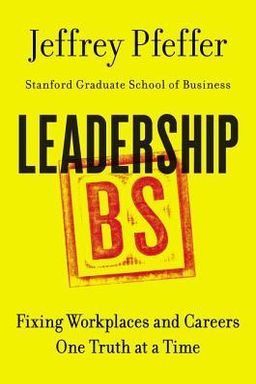
Leadership BS cover

Leadership BS

by Jeffrey Pfeffer

Leadership BS reveals the gritty truth behind the corporate facade, challenging the rosy narratives of leadership success. Jeffrey Pfeffer exposes the harsh strategies-deception, self-promotion, and manipulation-employed by top executives to maintain power and influence in business.

The Leadership Illusion: Why Feel-Good Advice Fails and Reality Hurts

Why do so many leadership books promise transformation, yet workplaces remain filled with stressed employees and disillusioned managers? In Leadership BS, Stanford professor Jeffrey Pfeffer poses this hard question and answers it unflinchingly: the leadership industry—composed of books, TED talks, corporate trainings, and inspirational gurus—has largely failed. Pfeffer contends that decades of well-meaning advice have created a world of feel-good myths rather than improving actual leadership practices. Instead of producing kinder or more effective leaders, the industry sells moral prescriptions that few people follow and that contradict how power, incentives, and human psychology actually work.

Pfeffer’s central claim is provocative: leaders rise not because they are honest, authentic, or selfless, but often because they are the opposite—politically shrewd, self-promoting, strategically deceptive, and ruthlessly self-interested. By studying real evidence rather than inspirational anecdotes, Pfeffer argues that we need to confront leadership as it truly operates in organizations, not as we hope it could be. He insists that until we understand the social systems and incentives that produce bad behavior, the endless calls for authenticity and humility will keep failing.

The Failure of the Leadership Industry

Pfeffer opens with damning statistics: billions spent each year on leadership training but declining employee trust, rising disengagement, and high CEO churn. Surveys show fewer than half of workers are satisfied with their jobs, and trust in leaders around the world hovers below 20 percent. In short, there’s a massive gap between what leadership programs preach and what workplaces actually experience. Pfeffer calls this gap “leadership BS” —the comforting, moralistic narratives that sound uplifting yet fail to produce change.

Drawing a parallel to early quack medicine, he likens today’s leadership “gurus” to 19th‑century snake oil salesmen who sold cures with big promises and no scientific proof. Just as Abraham Flexner’s 1910 reform turned American medicine into an evidence-based discipline, Pfeffer calls for a similar revolution in leadership: one anchored in data, realism, and behavioral science rather than stories and slogans.

Human Nature and the Truth of Power

The heart of Pfeffer’s argument lies in human behavior. People act in self-interest, respond to incentives, and adapt to social hierarchies. Organizations reward results, not virtues. Therefore, leaders who rise tend to be assertive, politically savvy, and sometimes manipulative—traits often condemned by the very industry that studies leadership. This is not an endorsement of deceit or toxicity but an acknowledgment that the path to power often runs counter to the ideals of honesty and modesty that leadership literature promotes.

Pfeffer insists that to fix leadership, you must first recognize these underlying truths. Telling people they “should” be humble or authentic without addressing the systems that punish such behavior is like telling doctors to cure disease by positive thinking. Reality—not moral exhortation—must be the starting point.

From Myths to Measurable Reality

Pfeffer challenges the “romance of leadership”—our near-religious obsession with heroic individuals. We love stories of visionary CEOs, servant leaders, or authentic icons like George Washington who “couldn’t tell a lie.” But these tales, often embellished or false, distort reality. For instance, even the cherry tree story itself was a fabrication invented to sell books. Pfeffer shows how organizations and cultures prefer these moral fables because they comfort us, offering a sense of fairness and moral order even when data say otherwise.

Instead, Pfeffer wants leaders and students to adopt evidence-based thinking: measure real workplace outcomes like retention, trust, and engagement; observe leader behaviors empirically; and study what truly produces results. Just as medicine improved through rigorous data, leadership must move from anecdotes to analytics.

Why Facing the Truth Matters

Pfeffer’s message may feel harsh, but it’s meant to empower. By removing illusions, he shows readers how to navigate the world as it is. Pretending that leadership is universally noble does not protect you at work—it blinds you to the political realities that can derail your career. Understanding how power, deception, and self-interest actually function, however, allows you to act strategically and ethically without being naïve.

Throughout the book, Pfeffer dissects celebrated virtues—modesty, authenticity, truth-telling, trustworthiness, and selflessness—and reveals how they often conflict with real success in corporate settings. Yet his ultimate goal is not cynicism but awareness. Only by “calling BS” on leadership myths can individuals and organizations design systems that make ethical behavior practical rather than idealistic. If you want to survive and thrive in modern workplaces, Pfeffer insists, you must replace wishful thinking with clear eyes—and handle the truth.


The Cult of Inspiration and Its Consequences

Pfeffer begins with a story from an executive program in Barcelona where a participant angrily told him, “It is your job to inspire me.” That outburst captures the entire problem with the leadership industry: people mistake inspiration for instruction. We crave motivational stories about noble leaders more than we want evidence on how complex organizations actually function. Universities, conferences, and consultants thus market “inspirational learning experiences,” selling emotional uplift instead of behavioral change.

Across medicine, law, or engineering, no one would advertise “inspirational surgery” or “inspirational bridge design.” Yet leadership education does exactly that because students, executives, and employees want to feel hopeful about their work and leaders. Pfeffer argues that while hope is emotionally satisfying, it produces zero lasting change. Without data, measurement, and systems to support new behaviors, inspiration evaporates within days.

The Power of Feel-Good Myths

The leadership world thrives on moral fables—stories of flawless icons who embody virtues like authenticity, humility, or courage. These tales are comforting because they confirm our belief in a just world: that good people succeed and bad people fail. Pfeffer calls this the “romance of leadership.” We want heroes to personify our hopes. Yet, as he notes, many of these stories are half-truths or fabrications. He gives examples such as Bill George’s True North or Jack Welch’s sanitized memories of GE’s culture. Their narratives emphasize inspiration, not accuracy.

Drawing from psychological research, Pfeffer shows that human beings have strong self-serving biases, fragile memories, and motives to reshape the past. Even well-intentioned leaders recall events selectively or deceive themselves. “In talking about the past,” he quotes novelist William Maxwell, “we lie with every breath we draw.” As a result, our leadership canon consists mostly of myths designed to make both writer and reader feel virtuous.

The Cost of Believing the Stories

Pfeffer argues that these myths have three major costs. First, they breed cynicism. When real leaders act nothing like the saints celebrated in trainings or bestselling books, followers lose faith not only in leaders but in the idea of principled leadership itself. Second, they destroy careers. Believing in the fantasy world of authenticity and kindness can get people blindsided by ruthless peers or manipulative bosses—like the woman in Silicon Valley who tried to “build authentic relationships” with a rival who promptly consolidated power and eliminated her role. Finally, they create unrealistic expectations: if great leaders are flawless heroes, you’ll always feel inadequate by comparison.

Even leaders themselves can fall for their own myth. Pfeffer shares the example of George Zimmer, the beloved founder of The Men’s Wearhouse made famous by his tagline, “You’re going to like the way you look. I guarantee it.” Convinced of his indispensability, Zimmer underestimated his board’s political maneuvering and was ousted from the company he built. “Hero worship,” Pfeffer concludes, “is dangerous for leaders and followers alike.”

Why Inspiration Doesn’t Create Change

Motivational speeches can raise morale, but Pfeffer points out that enthusiasm fades within days. Without structural reinforcement—changes in metrics, feedback, and social norms—people revert to their old behaviors. Drawing from behavioral science, he contrasts inspiration with proven drivers of change: measurable goals, accountability, and environmental cues. Like in quality management, what gets measured gets improved. Companies that only collect “smiley face” feedback scores from workshops confuse happiness with transformation.

He cites examples such as Stanford Hospital’s turnaround under CEO Amir Dan Rubin, who achieved major improvement not through pep talks but by redesigning systems around hard metrics and standards. True improvement, Pfeffer says, comes from clarity and consistency—not charisma. Similarly, the coaching method used by Marshall Goldsmith, which involves daily tracking of specific leadership behaviors, outperforms any one‑time inspirational event.

Ultimately, Pfeffer calls for realism. Inspiration is easy because it asks nothing of us once the applause fades. Evidence-based leadership—measuring behaviors, demanding accountability, and confronting unpleasant truths—is much harder. Yet only this approach can produce the workplaces we claim to want. Instead of admiring heroes, Pfeffer wants us to study systems, measure what matters, and stop mistaking good feelings for good leadership.


The Myth of Modesty and the Rise of Narcissism

One of Pfeffer’s most striking chapters refutes a beloved leadership mantra: that great leaders are humble. Drawing on Jim Collins’s famous “Level 5 Leadership” research from Good to Great, he notes that while humility correlates with ethical and steady leadership, it rarely gets people promoted. Out of more than 1,400 companies Collins studied, only 11 had truly humble CEOs—a statistical rarity. In real life, it’s the self-promoting, confident, even narcissistic personalities who dominate the top ranks.

Donald Trump’s towering nameplates, media ubiquity, and self-branding may offend modest sensibilities, yet they illustrate Pfeffer’s point perfectly: attention is power. Modesty may cultivate likability, but it makes you invisible. Narcissism, by contrast, commands notice, inspires followers, and often propels leaders upward—even as it occasionally leads to their downfall.

Why Narcissists Win

Pfeffer explains why narcissism pays: leadership selection favors visibility, confidence, and certainty. Because leadership performance is difficult to measure objectively, people often equate confidence with competence. Research shows that overconfident individuals are seen as capable even after evidence proves otherwise. Narcissists dominate discussions, exude authority, and self‑nominate when opportunities arise—making them more likely to emerge as leaders. Studies of military cadets and MBA teams confirm this pattern: those with higher narcissism scores consistently rise to leadership positions.

Furthermore, narcissists often achieve higher pay and longer tenure. Pfeffer cites a study of Silicon Valley CEOs showing that those rated as more narcissistic earned significantly more than their peers and held their jobs longer. In high-uncertainty industries like technology, boldness and showmanship can become strategic advantages—even if they mask arrogance or ethical blind spots.

Modesty as Career Handicap

While humility may make you respectable, Pfeffer argues that it can reduce your career trajectory. Because modest people avoid self-promotion, others may undervalue them or forget their contributions. Modesty works only when paired with established credibility—otherwise it’s misread as weakness. This dynamic helps explain persistent gender and cultural disparities in promotion. Women and Asian professionals, whose cultures often prize modesty and deference, are systematically penalized in American workplaces that reward assertiveness, directness, and “executive presence.”

Ironically, the same organizations that preach “humble leadership” still promote the loudest voices. Pfeffer’s conclusion: if we truly valued modesty, we’d select for it and measure it. But we don’t. Most companies claim to want humility while rewarding aggressive visibility. Until reward systems change, aspiring leaders must navigate reality by balancing confidence with correctness rather than aiming for saintly modesty.

The Double Edge of Narcissism

To be clear, Pfeffer doesn’t glorify narcissists. They often produce volatile environments, alienate colleagues, and crash spectacularly. Yet he recognizes that many history-making leaders—from Steve Jobs to Lyndon Johnson—combined narcissistic drive with genuine competence. The key distinction, drawn from psychologist Michael Maccoby’s The Productive Narcissist, is whether self-centered energy fuels creative action or pure ego preservation.

In the end, Pfeffer’s advice is pragmatic: understand that narcissism isn’t going away because it works in the systems we’ve built. Rather than denying it, organizations should design checks that channel ambition toward collective goals. For you as an individual, that means projecting confidence intentionally—without crossing into arrogance. In workplaces that reward self‑assurance, pretending humility can hurt; demonstrating earned confidence can help. Recognize the game and play it consciously.


Authenticity: The Overrated Virtue

Few leadership concepts have been more celebrated—and misunderstood—than authenticity. Pfeffer dismantles the popular notion, championed by executives like Bill George, that leaders should always be “true to themselves.” In reality, he argues, effective leaders frequently perform roles that contradict their moods or innate temperaments. The notion that honesty of feeling equals honesty of leadership is both naive and counterproductive.

He recounts the experience of Alison Davis‑Blake, dean of the University of Michigan’s Ross School of Business, a natural introvert who learned that leading required projecting energy and confidence even when she didn’t feel it. Similarly, CEO Gary Loveman once spent a morning addressing students while feverish, because leaders’ public energy shapes how thousands of employees perceive the company. Leadership, Pfeffer insists, is theater—an exercise in emotional management, not personal catharsis.

Performing with Purpose

Drawing on sociologist Erving Goffman’s work on the presentation of self, Pfeffer notes that everyone plays roles in social life; leaders simply perform on a larger stage. Pretending confidence or positivity isn’t deceit—it’s professional responsibility. Just as doctors must act composed in emergencies, leaders must signal stability amid chaos. Authenticity, defined as expressing one’s true emotions, conflicts with this duty.

He cites psychological research showing attitude follows behavior: people grow into roles they perform. Instead of waiting to feel authentic, you develop authenticity through repeated enactment of leadership behaviors. As playwrights know, character emerges from action. Therefore, claiming that leaders must be ‘true to their feelings’ is misguided; the effective leader adjusts feelings to serve the role.

When Authenticity Backfires

Authenticity becomes dangerous in two ways. First, it excuses selfishness—Anthony Weiner’s “owning his desires” was authentic but disastrous. Second, it traps underrepresented groups. Many women or minorities raised to value deference interpret assertiveness as inauthentic, limiting their advancement. Pfeffer advises them to reframe: being authentic to your potential means learning new behaviors, not clinging to outdated comfort zones. Sheryl Sandberg’s Lean In movement echoes this: adapt boldly rather than apologizing for ambition.

Mandela and Kennedy, Pfeffer notes, constantly reinvented themselves to meet historical demands. Their multiplicity wasn’t hypocrisy but growth. As Mandela put it, leadership requires being a “pragmatic politician,” not a fixed personality. Authenticity is not static self-expression—it’s adaptive self‑construction.

The Art of Useful Inauthenticity

Pfeffer concludes that leadership is inherently inauthentic because circumstances change people. Roles shape behavior and even personality. Studies show that when workers switch from union steward to supervisor, their attitudes align with their new role. In short, who you are adapts to where you stand. Expecting constancy in such fluid contexts isn’t authenticity—it’s rigidity.

Leaders, therefore, must master emotional self-regulation: acting confident when uncertain, composed when angry, and optimistic when afraid. Acting, Pfeffer says, is a leadership skill—taught in Stanford’s “Acting with Power” course. The challenge isn’t being yourself; it’s being the version of yourself that the situation requires. In an unpredictable world, useful inauthenticity is not hypocrisy—it’s professionalism.


Truth and Lies: The Dark Currency of Leadership

Should leaders always tell the truth? Pfeffer provocatively answers: no, because most don’t—and the world rewards them anyway. From U.S. intelligence officials misleading Congress to corporate CEOs understating losses before bankruptcy, lying is not an exception but the norm. The fact that leaders keep doing it implies a harsh reality: deception often works. Understanding why is essential if we want more ethical organizations.

The Pervasiveness of Deception

Studies show that 40 percent of adults admit lying daily, often to smooth relationships or avoid conflict. Executives, empowered by status, lie more easily and are harder to detect. Pfeffer recounts examples from finance (Bear Stearns, Lehman Brothers), politics (Senator Jon Kyl’s “not intended as a factual statement” about Planned Parenthood), and technology (Larry Ellison’s “vaporware” promises at Oracle). Even revered innovators like Steve Jobs mastered distortion through his “reality distortion field.”

Power, Pfeffer explains, reduces both stress and guilt about deception. Experiments show that powerful people feel more in control and less constrained by moral norms. Moreover, organizations implicitly encourage lying: salespeople overpromise delivery schedules, resumes exaggerate credentials, and companies disguise layoffs with euphemisms. If honesty were punished less and deceit rewarded less, truth-telling might flourish—but it isn’t.

Why Lies Persist

Pfeffer identifies three reasons deception endures. First, sanctions are rare. Whistleblowers lose jobs, while liars keep theirs. Second, observers collude in deception. Investors, employees, and consumers want to believe in glamorous leaders or profitable stories—so they rationalize inconsistencies. This mutual complicity, Pfeffer says, means “a lie takes two people.” Third, many lies produce short‑term benefits: they motivate employees, calm markets, or inspire confidence that becomes self‑fulfilling—think Apple’s early hype turning into real success once belief attracted funding and customers.

Even small “strategic misrepresentations” can serve useful ends: JFK denying plans to invade Cuba or Lincoln downplaying abolitionist goals to preserve the Union. Sometimes, Pfeffer concedes, leaders must lie to get hard things done. But accepting this realism also forces us to design systems that discourage gratuitous deceit while recognizing the complex motives behind it.

For individuals, the takeaway is not moral surrender but awareness. Don’t assume candor is universal; verify information, know whom you trust, and recognize your own desire to believe comforting narratives. Pfeffer’s uncomfortable message: moral preaching won’t fix lying because it ignores its practical utility. Only when organizations measure truthfulness and hold leaders accountable for factual accuracy will honesty gain traction. Until then, expect deception—it’s part of the ecosystem of leadership.


The Economics of Trust and Its Erosion

Trust, Pfeffer argues, is a foundational ideal that leaders love to quote but rarely practice. Surveys from Edelman and others show that fewer than 20 percent of people believe leaders tell the truth when facing hard issues. Yet businesses keep functioning. This paradox—high trust rhetoric amid low trust reality—reveals that organizations run more on incentives, contracts, and power than on faith.

Why Trust Breaks

Pfeffer provides vivid examples. Bill Gates and Microsoft built their empire by reneging on a gentleman’s agreement with rival Gary Kildall, then buying and rebranding his technology. Martha Stewart misled partners during her deals with Macy’s and J.C. Penney yet emerged wealthier than ever. Such cases illustrate that breaches of trust seldom carry meaningful penalties. Society judges corporate deceit as business savvy rather than moral failure—a disconnect confirmed by research showing people excuse companies’ lies as ‘strategic.’

We continue to interact with untrustworthy actors because it’s often profitable. Investors return to convicted executives, customers keep buying from deceptive firms, and industries accept exaggeration as routine. This normalization of distrust creates an asymmetry: betraying trust brings gain, whistleblowing brings exile. As Pfeffer wryly notes, “Nobody likes a rat.”

Distrust as a Survival Strategy

Ironically, Pfeffer sees distrust as psychologically and professionally useful. The best predictor of future behavior is past behavior. Expecting virtue where power’s incentives encourage opportunism invites disappointment. Caution protects your career and resources. In one Hollywood example he retells, filmmakers shared a business plan with potential investors who then stole the idea and launched it themselves. Their mistake wasn’t naivety; it was misplaced trust. Contracts might have safeguarded them—but politeness prevented foresight.

Pfeffer also notes that in markets, broken promises can sometimes benefit firms: acquisitions that discard costly warranties or “cash cow” customers might anger stakeholders but delight shareholders. Similarly, corporations slash pensions or benefits after mergers to boost profits. These actions erode trust but make economic sense under current incentives. Until incentives change, trust will remain a luxury good rather than an operating principle.

The uncomfortable lesson: act prudently, verify loyalties, and formalize commitments. Treat trust as valuable capital—rare, fragile, and not to be given away freely. For organizations, Pfeffer suggests measuring trust directly and linking it to leadership evaluation, as firms like SAS Institute or DaVita do. But for individuals, the survival strategy is simpler: hope for honesty, plan for duplicity.


Do Leaders Really Put Others First?

Servant leadership—the idea that great leaders “eat last” and put employees first—sounds morally admirable, yet Pfeffer argues it’s mostly rhetoric. Despite books and conferences devoted to generosity, leaders continue to protect their own pay and privileges while cutting wages for everyone else. Data on executive compensation tell the story: CEO pay has risen roughly 700 percent since 1978 while worker pay rose less than 6 percent. If servant leadership were common, these numbers would look very different.

Evidence of Self-Interest

Pfeffer lists examples across industries. HP’s ousted CEOs left with tens of millions in severance even as the company laid off thousands. Airline executives accepted bonuses while employees endured pay cuts. At McDonald’s, CEO Don Thompson earned millions while the company issued ‘budget tips’ teaching workers how to apply for public aid. Pfeffer quips, “We live in an era of shared sacrifice—the employees sacrifice, and leaders share in the money they give up.”

Exceptions like SAS Institute, The Container Store, or Southwest Airlines prove the rule precisely because they’re so rare. Where leaders genuinely care—limiting pay ratios, promoting from within, or embedding frontline empathy—they earn remarkable loyalty and performance. But such cultures demand immense personal effort and structural reinforcement. Most leaders, isolated by privilege and surrounded by flatterers, lose touch with ordinary workers entirely.

Why Selfishness Prevails

Social psychology explains the pattern. People help those they see as similar, yet senior executives live different lives—private jets, gated offices, and elite backgrounds. With few shared experiences, empathy fades. Power also breeds self-justification: when things go wrong, leaders blame workers or “market conditions,” preserving self‑esteem. Outside hiring exacerbates the divide—new CEOs from different industries share little with long-serving employees. In contrast, military leadership fares better because officers rise from within and thus understand the rank‑and‑file’s reality.

To motivate truly others-oriented leadership, Pfeffer turns to economics: align incentives. Companies like DaVita tie manager evaluations to employee satisfaction and measure fairness in promotions. SAS Institute evaluates leaders on talent retention. When pay and performance reviews depend on caring for employees, behavior changes. Otherwise, servant leadership is just branding.

The takeaway for individuals is clear: don’t assume leaders will protect you out of benevolence. Assume rational self-interest unless incentives say otherwise. Respect generosity when you see it—but verify that systems support it. True servant leadership requires design, not desire.


The Rational Case for Self-Interest

After cataloging the failures of modern leadership ideals, Pfeffer ends with an uncomfortable conclusion: stop expecting others to save you. Take care of yourself. In a world where companies lay off loyal employees and leaders prioritize personal gain, self-interest isn’t cynicism—it’s realism. Like Adam Smith’s invisible hand, individuals pursuing their own rational interests can still produce efficient organizations, provided systems channel that energy responsibly.

Why Organizations Owe You Nothing

Pfeffer recounts stories of professors denied raises because they were deemed “the past,” athletes losing scholarships after injury, and employees fired despite years of service. He cites research showing over half of workers report breached “psychological contracts” with employers. The reason is simple: companies make future‑oriented decisions. Past loyalty counts little when budgets tighten. Expecting workplace reciprocity is like expecting weather to stay constant—it betrays misunderstanding of the climate.

The Myth of Reciprocity

Across experiments, Pfeffer and colleague Peter Belmi found that people feel less obligation to reciprocate favors in formal organizational settings than in personal ones. At work, calculation replaces gratitude. Your performance is measured, paid for, and soon forgotten. Leaders invoke community values, but contracts rule conduct. Recognizing this psychology helps you avoid disappointment and plan accordingly.

People’s longing for protective leaders, Pfeffer argues, stems from childhood conditioning—the wish for security and parental care. Yet such dependency leaves adults vulnerable to “toxic leaders” who exploit trust. Drawing from Jean Lipman-Blumen’s research, he notes that followers collude in their own subjugation because it feels safe. Overcoming this requires reclaiming agency: think of yourself not as a child needing rescue but as a free adult capable of strategic action.

Building Systems, Not Saviors

Pfeffer’s solution echoes W. Edwards Deming’s quality philosophy: fix systems, don’t idolize heroes. Instead of praying for benevolent CEOs, design institutions that distribute power and enforce accountability—through employee ownership, unions, or transparent measurement. Democratizing decision‑making aligns incentives naturally, reducing reliance on saintly individuals. Until then, personal vigilance is essential: cultivate portable skills, maintain networks, and always have options.

Ultimately, Pfeffer sees self-interest not as moral decay but as maturity. Trusting blindly infantilizes you; understanding incentives empowers you. By facing how workplaces really function, you can protect yourself while pushing for better systems. “Take care of yourself and watch out for your own interests,” he concludes, “and if others do too, all the better.” That might not sound inspiring—but it’s the kind of truth you can build a career on.


Facing the Truth: A Realist’s Path to Better Leadership

Pfeffer ends his book as he began—with a call to reject comforting illusions. Academic audiences told him his findings were “depressing.” His reply: what’s truly depressing is decades of leadership failure and toxic workplaces while everyone clings to happy talk. Like a doctor confronting disease, reform begins with diagnosis, not denial. “People can handle the truth,” he insists—if they choose to.

Connecting Words and Actions

Throughout history, successful leaders—from Abraham Lincoln to Steve Jobs—often contradicted the moral ideals later ascribed to them. Pfeffer lists examples of revered figures, from Carly Fiorina to Roger Ailes, whose behaviors were abrasive, manipulative, or self-serving yet effective. The lesson isn’t to admire cruelty but to notice the gap between rhetoric and results. Until we measure leaders by outcomes rather than speeches, hypocrisy will thrive. The leadership industry’s dependence on motivational storytelling perpetuates this gap—it sells optimism, not accuracy.

Realism Over Romanticism

Pfeffer urges us to stop confusing the normative (“what should be”) with the descriptive (“what is”). True progress requires observing real behaviors inside organizations—the politics, incentives, and acts of power—not the sanitized case studies found in textbooks. Like design thinking in engineering, improvement comes from watching people work, not admiring their values. When companies or classrooms focus on critique grounded in evidence, they inch closer to real change.

He warns that leadership requires hard choices—sometimes “doing bad things to achieve good results.” From measures that appear ruthless but save institutions to confronting unpopular truths, moral absolutism is a poor guide in a pragmatic world. Quoting Machiavelli, he reminds readers that prudence lies in choosing “the less bad as the most good.”

Reconstructing Leadership Systems

To fix leadership, Pfeffer recommends reconnecting the broken links between behaviors and consequences, rhetoric and accountability. Measure what leaders actually do—retention, trust, fairness—and tie those metrics to compensation and tenure. Eliminate the “happy surveys” that reward charisma. Rebuild feedback loops where actions, not intentions, determine advancement. Most of all, confront the hard evidence even when it’s unpleasant. Improvement begins, he writes, when people “keep at it until they get it,” quoting a child’s advice to a humbled school superintendent—a closing story that captures Pfeffer’s rare blend of realism and hope.

His final message is clear: progress requires courage to see what’s true and discipline to act accordingly. Inspiration may anaesthetize, but truth heals. Leadership BS replaces faith with facts, moral posturing with measurement, and wishful thinking with willful observation. In doing so, Pfeffer offers not comfort but capacity—the tools to finally make leadership better because we’re no longer pretending it already is.

Dig Deeper

Get personalized prompts to apply these lessons to your life and deepen your understanding.

Go Deeper

Get the Full Experience

Download Insight Books for AI-powered reflections, quizzes, and more.