
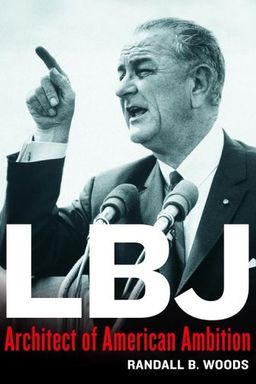
LBJ cover

LBJ

by Randall Woods

Explore the life of Lyndon B. Johnson, a controversial yet pivotal figure in American history. Discover how his early life, political ambitions, and transformative policies on civil rights and social welfare redefined the nation, despite the shadow of the Vietnam War.

The Shaping of Power: The Life and Vision of Lyndon B. Johnson

What drives a person to seize power not for vanity, but for transformation? That question sits at the center of Lyndon B. Johnson's life, a man both celebrated and reviled, remembered as the architect of the Great Society and condemned for the tragedy of Vietnam. His story begins in the dusty plains of Texas, shaped by love, dysfunction, and an unrelenting quest to wield influence for those forgotten by society. The book traces Johnson’s entire journey—from his tumultuous childhood through his presidency—to explore how ambition, empathy, and insecurity fused into the engine that drove one of America’s most consequential leaders.

A Childhood of Contradictions

Johnson’s early years in Stonewall, Texas, were a paradox. He was adored and pressured by his mother, Rebekah, who saw him as her savior and emotional anchor. Yet her affection came with cruelty; when displeased, she would pretend Lyndon was dead, a manipulative form of punishment that taught him how to win back favor—a skill that later defined his political tactics. His father, Sam Ealy Johnson, was a man of both principle and weakness, occasionally violent and often drunk but instilled in his son a belief in justice and service to ordinary people. These early lessons—love as leverage, power as protection—formed the blueprint for Johnson’s understanding of politics as deeply personal.

The Seeds of Empathy and Ambition

When Johnson began teaching in Cotulla, Texas, he found a community stricken by poverty and racism. The Mexican American children he taught were marginalized and ignored, destined for lives of labor rather than opportunity. Instead of accepting that, he took his first stand against systemic inequality—buying materials out of his own paycheck, improving the school, and treating his students with dignity. This experience foreshadowed his later domestic agenda, proving that his empathy for the underprivileged wasn’t theoretical—it was deeply rooted in personal exposure to suffering. (As biographers note, Cotulla was Johnson’s moral proving ground, his first encounter with injustice that demanded action.)

Political Ferocity and Human Vulnerability

Johnson carried that fierce compassion into politics, but with it came aggression and neurosis. Working for Congressman Kleberg, he demanded tireless loyalty from his staff, forbade breaks, and insulted subordinates in public. Yet he also paid their bills and supported their studies—a contradiction emblematic of his nature. Later, as Senate Majority Leader, he became legendary for his manipulative mastery—the 'Johnson Treatment.' He bent senators to his will through sheer force of charm and intimidation. This duplicity defined his leadership: always domineering yet deeply caring, ruthless yet idealistic.

The Presidency: Power Used for Good—and for Doom

When fate thrust him into the presidency after JFK’s assassination, Johnson grasped the moment with uncanny resolve. His Great Society reforms reshaped America’s social contract, birthing Medicare, Medicaid, and transformative civil rights legislation. He passed the Civil Rights Act of 1964 and the Voting Rights Act of 1965, facing down the longest filibuster in Senate history and appealing to America’s moral conscience. Yet, as he tried to build justice at home, he escalated conflict abroad. His decisions in Vietnam—a war he viewed as a moral duty to containment—tore apart the unity he had built, plunging him into despair and isolation. The visionary became the vilified.

Why Johnson’s Story Still Matters

In an age of distrust toward politics, Johnson’s contradictions feel eerily familiar. His life asks you to consider: can flawed humanity still produce moral greatness? He was manipulative yet genuinely compassionate, egocentric yet service-driven. Through every act—from comforting frightened schoolchildren to fighting southern segregationists—Johnson revealed the complexity of power in human hands. His legacy remains both heroic and haunted—a testament to what ambition can achieve when fused with empathy, and what it can destroy when unchecked. Understanding LBJ isn’t merely learning history; it’s confronting the timeless tension between idealism and ego within all who seek to lead.


The Favored Child: Roots of Power and Insecurity

Lyndon Johnson’s childhood wasn’t just a backdrop—it was the crucible that forged his lifelong obsession with control, affirmation, and recognition. Born on a stormy night that his mother romanticized as mystical, Lyndon grew up believing he was destined for greatness. This belief wasn’t entirely his own; Rebekah Johnson projected her dreams onto him, nurturing both love and pressure in equal measure. When his father’s drinking plunged the family into chaos, Lyndon became his mother’s protector—a role that taught him to equate emotional rescue with influence.

Maternal Worship and Emotional Manipulation

Rebekah’s love was both intoxicating and conditional. If Lyndon disappointed her, she withdrew affection with chilling theatrics, pretending he was dead. These psychological games left Johnson with a lifelong fear of rejection and an instinct to please—traits that later made him a master at understanding what others wanted and how to give it to them for power in return. As Rebekah’s surrogate protector, he learned how attention could be currency, and affection could be weaponized.

Sam Johnson’s Influence

Meanwhile, his father represented a different kind of lesson. Sam was a local politician whose commitment to fairness and regional service impressed Lyndon. Despite his flaws—temper, alcoholism, and financial mismanagement—Sam imbued his son with the belief that political life could be noble. The combination of his mother’s moral idealism and his father’s civic duty formed the foundation for LBJ’s later vision: leadership as both personal validation and social mission.

Psychological Patterns That Endured

This dual parenting dynamic made Johnson both empathetic and obsessive. He needed to be loved but feared losing it, so he worked tirelessly to stay indispensable. In politics, this manifested as relentless pursuit and fierce loyalty—whether to mentors, voters, or staff. The irony was that the emotional turbulence of Stonewall, Texas, became the incubator for America’s most skilled political operator. What Rebekah and Sam gave their son wasn’t balance—it was drive. And that drive would, for better or worse, reshape the 20th century.


Awakening to Social Justice in Cotulla

Before Lyndon Johnson became a political titan, he was a teacher in Cotulla, Texas—a small, segregated town where Mexican American families lived in poverty and despair. This experience marked the first time he wrestled with injustice not abstractly, but face-to-face, teaching children whose futures were quietly dismissed by society. As principal and teacher at Welhausen Elementary, he refused to be complicit in systemic racism, choosing instead to elevate the lives of his students.

The Power of Small Acts

Johnson used his own paycheck to buy volleyball nets, musical instruments, and choir books—simple items that gave dignity and joy to children accustomed only to hardship. He made sure classrooms were clean, sports were supervised, and every kid had toothpaste. These seemingly trivial gestures were revolutionary in an environment built to suppress. They revealed the power of tangible compassion as a political act.

Confronting Institutional Racism

The Welhausen School was designed not to educate but to contain Mexican children, preparing them for labor rather than leadership. Johnson defied that system, setting a precedent for his later civil rights battles. By equating opportunity with moral justice, he transformed teaching into activism. (Similar to educators like Booker T. Washington, Johnson believed education could be liberation, but unlike Washington, he wielded bureaucracy to achieve it.)

Empathy as Political Foundation

This phase of Johnson’s life grounded his lifelong commitment to marginalized communities. He saw human dignity as a nonpartisan cause. When he later pushed for civil rights legislation, it wasn’t just strategy—it was rooted in the dusty classrooms of Cotulla. You can feel his motivation echoing through every Great Society program: give every person the chance to rise above circumstance. This was empathy institutionalized into policy.


Political Mastery and Ruthless Leadership

Johnson’s rise in Washington was driven by a paradox: his capacity for domination intertwined with genuine loyalty. His tenure with Congressman Richard Kleberg was the stage for showcasing both. He demanded relentless work ethic—twelve-hour days, no breaks, perfection—and humiliated staff who fell short. But in the same breath, he helped them financially, promoted their education, and treated them like family. This blend of tyranny and generosity defined LBJ’s leadership style for decades.

The Johnson Treatment

As Senate Majority Leader, he developed what journalists dubbed the “Johnson Treatment”—a technique of physical and emotional persuasion mixing flattery, intimidation, and relentless conversation. LBJ would corner senators, lean inches from their faces, and overwhelm them with charisma and statistics until they capitulated. It was manipulation used for progress, and for himself. (Compared to Machiavelli’s teachings, Johnson’s form of influence was less deceitful and more psychological—he dominated through empathy as much as pressure.)

Building Alliances and Controlling Power

As Democratic leader in the 1950s, Johnson bridged divides between southern conservatives and northern liberals. He partnered with Eisenhower and moderate Republicans to craft consensus—a balancing act few could maintain. Politics became his stage for emotional management, mirroring the dynamics of his youth: control affection to secure loyalty. His knack for negotiation made him indispensable, which is precisely why JFK chose him as vice president—to neutralize his power.

From Frustration to Fate

Vice presidency deepened his bitterness; stripped of influence, he contemplated quitting politics. Then, the assassination of JFK changed everything, thrusting him into the role history had prepared him for—the man who used power not just to rule, but to reform. His old obsession with approval now found national purpose.


Building the Great Society

When Johnson assumed the presidency after Kennedy’s death, he saw the moment as destiny fulfilled. His vision—the Great Society—wasn’t just a set of policies but an ideal of equality, education, and justice woven into American law. He sought to erase poverty, protect the environment, expand healthcare, and elevate culture. The programs born from this vision transformed modern America.

Legislation That Redefined America

Under Johnson’s leadership, Congress passed over a thousand measures: Medicare and Medicaid for the elderly and poor, the National Endowment for the Arts and Humanities, and foundational environmental laws like the Air Quality and Water Quality Acts. These weren’t isolated attempts but parts of a holistic moral project. He viewed government as an instrument of compassion—a belief many presidents since have shared but few have executed so extensively.

Civil Rights as Moral Duty

His greatest fight came with the Civil Rights Act of 1964. Facing a nine-week Senate filibuster, Johnson appealed not to politics but to morality. He challenged Americans’ faith: how could a Christian nation tolerate segregation and prejudice? This moral rhetoric, rare for a pragmatic politician, turned the tide. When the bill passed, Johnson declared it a victory not for Democrats, but for decency. He proved that legislation could embody conscience.

Legacy of the Great Society

Medicare, arts funding, environmental protection—all remain pillars of modern America. The Great Society was both visionary and imperfect, a reflection of Johnson himself. He made the federal government an agent of human progress, reminding you that leadership, at its best, is empathy applied at scale.


The Burden of War and Domestic Upheaval

Johnson’s triumphs in civil rights and social reform were shadowed by the darkness of Vietnam and the unrest of American streets. Just as he secured voting equality in 1965, violence erupted in Watts, highlighting a painful truth: legislation could not heal social wounds overnight. As race riots multiplied, Johnson faced the reality that progress also provokes backlash.

Vietnam: The Unwinnable War

The Gulf of Tonkin Resolution enabled Johnson to escalate military involvement in Vietnam, believing communism must be contained. At first, public approval followed; later, outrage consumed him. As the war dragged on, students protested, draftees burned cards, and senators revolted. Johnson’s sensitivity made the criticism unbearable—he became paranoid, sleepless, and guilt-ridden. He even asked to be notified personally of every soldier’s death, an impossible emotional burden.

Moral Paradox of Leadership

Johnson’s belief in America’s duty to defend freedom collided with the horror of escalating casualties. He faced the moral dilemma of all powerful idealists: does doing good abroad justify destruction? His inability to reconcile moral purpose with geopolitical reality led to his downfall. For all his compassion, he was trapped by his convictions—proof that empathy without restraint can be as destructive as indifference.


The Final Days and the Weight of Legacy

By 1968, the exhaustion of war and social division had taken their toll. On March 31, Johnson announced he would not seek re-election, citing the limits of power and the divisiveness of the times. The relief was visible—he laughed and joked after stepping away—but tragedy followed quickly with the assassinations of Martin Luther King Jr. and Bobby Kennedy. America’s hope for unity dissolved, and Johnson’s presidency faded into the shadows of grief.

Stepping Down from Power

Johnson’s decision not to run again wasn’t an act of surrender; it was his acknowledgment of mortality—personal and political. His Great Society had launched a new era of governance, yet the Vietnam War had tarnished everything he’d built. By refusing another term, he gave America the space to heal, even if history would judge him harshly.

The Dual Legacy

Johnson remains one of history’s most conflicted figures: the champion of the poor and the architect of a bitter war. You might see him as proof that power is never pure—it magnifies both virtue and flaw. His story reminds you that leadership is not the pursuit of perfection, but the constant balancing of principle against pressure. It’s a human struggle, one that still shapes every political leader who dares to change the world.

Dig Deeper

Get personalized prompts to apply these lessons to your life and deepen your understanding.

Go Deeper

Get the Full Experience

Download Insight Books for AI-powered reflections, quizzes, and more.