
Idea 1
The Power and Practice of Lateral Thinking
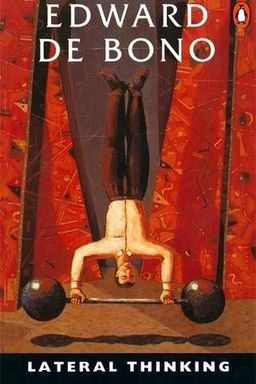
Have you ever felt stuck searching for the perfect solution, only to realize you’ve been digging in the same mental hole over and over again? Edward de Bono’s Lateral Thinking: A Textbook of Creativity tackles this universal challenge head-on. He argues that the human mind, however brilliant, is naturally structured for efficiency, not flexibility. We recognize patterns, classify information, and follow logical steps—but that very strength traps us within rigid ways of thinking. Lateral thinking, in contrast, teaches you how to break out of those mental patterns, deliberately generating fresh ideas, surprising insights, and innovative solutions.
De Bono’s central claim is bold yet practical: logical or “vertical” thinking is only half of the equation. Without its creative counterpart—lateral thinking—our ability to adapt, innovate, and problem-solve is dangerously limited. This book offers not a vague notion of creativity as an inborn talent but a structured set of tools and mental habits anyone can practice. De Bono aims to democratize creativity, turning innovation into a teachable, trainable skill.
Why Lateral Thinking Matters
De Bono begins by revealing how the brain’s natural efficiency works against us. In The Mechanism of Mind, his prior work, he described the brain as a self-organizing “memory surface” that arranges information into stable patterns. Once formed, these patterns govern attention and become self-reinforcing—just like well-worn paths in a field. We rely on these paths for speed and clarity, but they also blind us to better routes. Lateral thinking provides a method to break free from these “concept prisons,” updating our mental maps when old patterns no longer serve us.
The implications are profound for any field—business strategy, design, teaching, or everyday decision making. When you’re blocked by a “good enough” idea or stuck thinking inside the box of conventional wisdom, lateral thinking provides a toolkit to go beyond adequacy toward ingenuity. De Bono doesn’t preach chaos or random creativity; he proposes a complementary form of disciplined thinking that plays by different rules. While vertical thinking develops ideas, lateral thinking discovers new ones.
Vertical vs. Lateral Thinking
Traditional thinking moves step by step, judging each idea as right or wrong before proceeding. De Bono calls this vertical thinking—an analytical, selective, and sequential process that deepens existing patterns. Lateral thinking, by contrast, is generative, provocative, and non‑sequential. It invites you to move sideways, to make jumps, to explore “wrong” turns intentionally. Instead of searching for the supposedly best answer, you explore multiple possible answers—even absurd ones—because the unexpected can trigger insight.
As De Bono succinctly puts it, “You cannot dig a hole in a different place by digging the same hole deeper.” This memorable metaphor captures the difference perfectly. Logic helps you dig efficiently; lateral thinking helps you choose where to dig next. Both are necessary: logic refines ideas, while lateral thinking updates and expands them. Rejecting either makes your mind lopsided.
The Anatomy of Creativity
To teach creativity, De Bono breaks it into deliberate processes. He distinguishes between insight (the sudden restructuring of perception) and creativity (the deliberate production of new ideas). Lateral thinking gives you techniques to provoke both, on purpose. These include challenging assumptions, reversing standard procedures, using analogies, generating random inputs, and applying his signature linguistic tool, the word “PO.” Rather than waiting for the muse, you can engineer the conditions for an insight to occur. In this sense, De Bono’s approach prefigures modern design-thinking methods and brainstorming frameworks that have since become staples in creative industries.
From Theory to Practice
De Bono structures much of the book as a practical textbook. He guides teachers and learners through exercises that build the “lateral habit of mind.” Each chapter introduces a concept—such as fractionation, reversal, analogies, or random stimulation—followed by classroom exercises and real-world applications. Through examples like designing an apple-picking machine or connecting random words like “computer” and “omelette,” readers learn to generate movement in thought rather than accept the obvious. (This method influenced later innovation systems like IDEO’s brainstorming practice.)
The hallmark of lateral thinking is suspension of judgment. During idea generation, you don’t ask “Is this right?”—you ask “Where could this lead?” De Bono vividly shows how fear of being wrong kills progress. Many of history’s breakthroughs, from Lee de Forest’s radio valve to Marconi’s wireless telegraphy, came from pursuing ideas that seemed wrong at the time. Lateral thinking institutionalizes that courage, giving you permission to explore the absurd until it proves useful.
Why This Book Endures
Lateral thinking is more than a technique—it’s a stance toward reality. De Bono’s core message echoes decades later in creative problem-solving methods, the “design thinking” taught at Stanford, and even cognitive psychology’s research on insight. His vision of creativity as a learnable skill stands apart from the Romantic ideal of the “inspired genius.” For him, creativity is not magic—it’s behavior. When you adopt it consciously, you convert the unpredictable flashes of insight into something you can train, teach, and apply every day. That’s why businesses, educators, and inventors still study De Bono: he showed that creativity is not born, it’s built.