
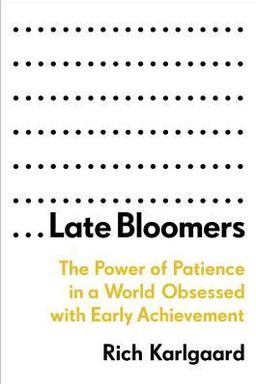
Late Bloomers cover

Late Bloomers

by Rich Karlgaard

Late Bloomers by Rich Karlgaard redefines success by challenging society''s obsession with early achievement. Through personal stories and scientific insights, it celebrates those who find their path later in life, promoting patience, mental well-being, and the joy of continuous self-improvement.

The Myth of Early Success

You live in a culture obsessed with speed and precocity. From Silicon Valley founders on magazine covers to “30 Under 30” lists, modern society celebrates those who succeed young and spectacularly. Rich Karlgaard, in Late Bloomers, challenges this fixation. He argues that the cultural worship of early achievers—what he calls the Wunderkind Ideal—distorts how you measure human potential, undermines well-being, and blinds institutions to the many ways people grow on different timelines.

Karlgaard asks a deceptively simple question: what if the majority of people are wired to bloom later? He builds his case by exposing how schools, corporations, and media reinforce a narrow definition of achievement based on measurable metrics, then leads you through the neuroscience, psychology, and life stories that show human development unfolds in stages across a lifetime. He concludes that the late bloomer possesses unique strengths—curiosity, compassion, resilience, equanimity, and wisdom—that early bloomers often miss.

The Cultural Machinery of Early Achievement

The Wunderkind Ideal isn’t just personal bias; it’s a structured system. Media reinforce it with under-30 lists, schools reward early specialization, and parents internalize the pressure. Karlgaard traces the economic consequences of this arms race: skyrocketing college tuition, a multibillion-dollar tutoring industry, and a generation of youth suffering stress disorders. The cost of chasing early wins has exploded into social crises—adolescent depression, anxiety, and even suicides in high-pressure communities like Palo Alto’s Gunn High School. (The CDC and WHO data he cites confirm global rises in adolescent mental-health disorders.)

This obsession is not sustainable. It pushes both kids and adults into anxiety loops, measured constantly against unrealistic timelines. And when those who peak early face inevitable setbacks, they can collapse under the weight of brittle self-worth—the same fragility visible in Jonah Lehrer’s fabrications or Elizabeth Holmes’s deception at Theranos.

The Measurement Trap

To understand how this happened, Karlgaard revisits the century-long evolution of human measurement. From Binet’s early IQ tests meant to assess momentary skill to America’s obsession with standardized testing, a system built for industrial efficiency colonized education. He invokes Campbell’s Law and Goodhart’s Law: when a measure becomes a target, it ceases to be a good measure. SATs, corporate rankings, and performance metrics became status filters that rewarded resources and test-taking savvy rather than genuine learning or creativity. In effect, number-driven culture began to define worth at the expense of deeper human variables—curiosity and resilience among them.

Karlgaard calls this mindset the illusion of objectivity—a Taylorist model of human potential that overvalues the measurable and undervalues context, motivation, and growth. Once a score defines you, the system starts to produce conformity, not innovation.

Why Speed Misunderstands Growth

Against the cult of early winners, Karlgaard presents biology and psychology as evidence for slower development. The brain’s prefrontal cortex—the seat of decision-making and judgment—doesn’t fully mature until your mid-twenties, confirming that delayed paths are not failure but natural design. Jeffrey Arnett’s theory of “emerging adulthood” extends adolescence to age 25, validating detours like gap years, military service, and work stints as essential incubators of maturity. Cognitive science adds that humans reach multiple peaks—processing speed early, emotional intelligence and judgment later—so your life isn’t a single race but a long relay.

This insight reframes time itself. Your peak creativity, empathy, or wisdom may come in your forties, fifties, or beyond. By realizing that growth runs on many timetables, you can stop measuring yourself against culture’s stopwatch.

A New Definition of Blooming

A late bloomer’s power is forged in adversity. Because society discounts them early, late bloomers learn habits that produce depth—curiosity to explore, resilience to rebound, equanimity under stress, and the wisdom to balance ambition with integrity. Karlgaard’s six late-bloomer strengths explain how slow-growing roots build durable success. He supports this with diverse examples: Captain Tammie Jo Shults maintaining calm while landing a damaged 737 at 56; John Goodenough inventing the lithium-ion battery in his fifties; and Geraldine Weiss mastering finance after decades of obscurity.

At its core, Late Bloomers is not a call to reject excellence but to expand what counts as it. Karlgaard insists you can still accomplish great things if you start later—indeed, your maturity, insight, and patience may make your contributions deeper. With this lens, success becomes less about velocity and more about alignment—matching your pace with your potential, your values, and the soil where you’re best planted. The book’s message is both practical and moral: culture must learn to respect diverse developmental clocks if it wants to harness human potential fully.


Breaking the Measurement Myth

You live in an age of relentless measurement—school tests, personality types, performance reviews, rankings, likes, and followers. Karlgaard shows how this obsession reduces human complexity to numbers and erodes authenticity. He traces the genealogy of the testing culture from Alfred Binet’s diagnostic tool to the SAT’s gatekeeper role and corporate Taylorism, all built on the illusion that human value can be quantified reliably.

From Binet to Big Data

Binet’s early 20th-century IQ test aimed merely to locate a child’s current capabilities; its purpose was educational help. When American psychologists like Lewis Terman reengineered it as the Stanford–Binet, it became moralized—as if a test defined destiny. The same mentality produced college entrance exams and workplace performance metrics. By the late 20th century, even personality instruments like the Myers–Briggs became corporate shorthand for identity, despite weak science. (Note: psychologists agree MBTI performs no better than astrology for predicting future performance.)

These tools were meant for guidance but turned into social sorting machines. When institutions fixate on metrics, they incentivize gaming behavior over genuine growth—a dynamic captured by Campbell’s and Goodhart’s Laws. This “measurement fallacy” doesn’t just misjudge people; it actively misleads them into optimizing for what can be counted instead of what counts.

The Taylorist Legacy

Frederick Taylor’s industrial management theory taught employers to time and track every movement for efficiency. Schools followed suit, standardizing schedules and curricula. Learning became assembly-line throughput, valuing speed and compliance over curiosity. Karlgaard notes how this legacy still shapes education: multiple-choice tests dominate because they’re easy to grade, not because they measure imagination or moral courage. As a result, students learn to chase grades, not insight.

Karlgaard contrasts this with evidence from creativity research and neuroscience—both show that deep learning and innovation often emerge in unmeasured, exploratory contexts. Google itself abandoned GPA and test-score filters after realizing they failed to predict performance. The broader message: measurement is useful but must serve humanity, not define it.

Insight

Numbers appear objective but can hide moral myopia. If you let metrics dictate direction, you risk becoming efficient at the wrong things.

For you, this means learning to read measures skeptically, value qualitative growth, and resist comparing your timeline to others'. Your creativity and depth might take years to measure—but those years are where real capability forms.


Rerouting the Human Clock

Karlgaard introduces what he calls the kinder clock—a reminder that human development doesn’t follow the rigid cultural timestamp of “success by twenty-five.” Neuroscience shows that the brain’s prefrontal cortex—responsible for decision-making and long-term planning—continues maturing into your mid-twenties and beyond. Reacting to this insight means building softer expectations for yourself and others: life happens in phases that reward experimentation, not conformity.

Why Timelines Mislead

Society’s clock pushes you to check boxes—college, job, marriage—by specific ages. But developmental psychology, from Erik Erikson to Jeffrey Arnett, confirms that identity formation and stability naturally stretch into your late twenties. Arnett’s “emerging adulthood” phase is a period to test different selves, not a sign of delay. Karlgaard champions gap years, side journeys, and sabbaticals as essential tools of discovery rather than detours. Phil Knight’s world trip before founding Nike and the Peace Corps’ effect on alumni careers illustrate that “detours” often become launch pads.

Multiple Peaks, Lifelong Growth

Data from psychologists Joshua Hartshorne and Laura Germine show that various cognitive abilities peak at different ages: working memory and processing speed in youth, pattern recognition and emotional insight in midlife, crystallized intelligence even into old age. This means your brain is wired to evolve, not decay. Later peaks often bring integrated thinking—combining logic, empathy, and judgment. The Berlin Wisdom Project found that wisdom, far from being a byproduct of age alone, is experience plus reflection—honed through trial, error, and perspective.

Takeaway

You likely underestimate your later potential. Biology grants you multiple opportunities to peak; culture only notices the first one.

By embracing the kinder clock, you free yourself to learn sustainably, redirect midlife energy productively, and let maturity—not speed—write your story.


Strengths of the Slow Grower

Late bloomers often appear behind on society’s scoreboard but quietly develop six interlocking capacities: curiosity, compassion, resilience, equanimity, insight, and wisdom. Karlgaard reframes these not as consolation prizes but as superior long-haul tools built through challenge and delay.

Curiosity and Compassion

Curiosity thrives in those who were allowed (or forced) to wander. Karlgaard’s nights in the Stanford library shaped ideas that later became his media ventures. Neuroscientists find curiosity activates dopamine circuits—the same reward loop that sustains learning for decades. Compassion stems from empathy born of struggle. Thoracic surgeon Michael Maddaus’s transformation from delinquent to medical leader proves that those who fall can later lead with care. Compassionate leadership, research shows, improves retention, outcomes, and personal health.

Resilience and Equanimity

Resilience—the ability to rebound—is the fruit of endured failure. Janet Evanovich faced years of rejection before publishing hits; pitcher Rick Ankiel reinvented himself after a career collapse. Equanimity, the calm core under pressure, belongs to those tested later and longer. Captain Tammie Jo Shults embodies this: her composed emergency landing at 56 saved lives and symbolized the confidence that comes from accumulated experience.

Insight and Wisdom

Insight pairs intuition with pattern recognition—an ability that often flowers after years of synthesis. Bill Walsh’s football innovations emerged from cross-sport analogies learned over time, not instant flashes of genius. Wisdom extends insight into ethics and long-view judgment. Karlgaard cites John Goodenough, who developed lithium-ion batteries in his fifties, as evidence that later life offers unmatched inventiveness when guided by moral imagination and patience.

Together these six strengths refute the myth that fast equals better. The late bloomer’s maturity allows durable achievement grounded in empathy and discipline—a lesson every burned-out wunderkind ultimately learns the hard way.


Rethinking Work and Age

Karlgaard expands the late-blooming viewpoint to careers, tackling entrenched ageism and outdated models of professional life. While society still views careers as upward escalators followed by decline, he advocates for career arcs—rhythmic patterns of peak, renewal, and mentorship that align with evolving strengths rather than rigid ladders.

The Myth of Youth Advantage

Contrary to cultural narrative, innovation is not youth’s monopoly. Kauffman Foundation statistics reveal the average entrepreneur starts at 47. Diane Hendricks, Tom Siebel, and Dietrich Mateschitz (Red Bull at forty) prove that experience deepens creative leverage. Even Silicon Valley’s icons—Steve Jobs and Elon Musk—produced transformative work after forty. As intelligence research distinguishes: fluid intelligence (speed) fades, but crystallized intelligence (wisdom and pattern mastery) rises and stabilizes with age. Many leadership and consulting roles depend on the latter.

Ageism’s Real Cost

AARP data show over 90% of U.S. workers above 45 report witnessing age bias. Older employees endure longer unemployment and steep pay cuts after layoffs. Women over fifty remain especially vulnerable. Karlgaard calls this wasteful myopia: discarding seasoned workers destroys institutional memory and stability. Instead, he proposes flexible rewrites—job-sharing, advisory roles, mentorship frameworks—that preserve wisdom and harness multi-generational teams.

For individuals, it means giving yourself permission to rebloom—through new skills, lateral moves, or entrepreneurship—and refusing to view age as a liability. For organizations, it’s an economic imperative to cultivate blended teams where youthful speed meets seasoned judgment.


Environment, Culture, and Repotting

Karlgaard reminds you that thriving is context-dependent. Like a plant confined to poor soil, you may suffer not because you're broken but because your environment can’t support the kind of blooming you’re built for. Families, schools, jobs, and cities all transmit invisible norms—some nurturing, some toxic. Changing them can ignite growth.

Cultural Pressures and Comparison Traps

Media saturation—eleven hours of daily consumption on average—rewires expectations of when and how success must occur. Social media amplifies this by showcasing manicured early victories. Karlgaard uses Solomon Asch’s conformity experiments and cultivation theory to show how these external scripts subtly dictate internal timelines. The antidote is awareness: name the norm, limit comparison exposure, and consciously design your media diet.

Repotting Yourself

If your current environment undervalues your potential, change it. Kimberly Harrington’s move from L.A. advertising to rural Vermont unlocked her writing career at 50. Journalist Quentin Hardy’s pivot from newspapers to Google Cloud demonstrates adjacent repotting—keeping skill cores while shifting soil. Karlgaard draws on Jay Belsky’s orchid–dandelion model to show that some people are highly sensitive to environment: in the right conditions, they excel exponentially.

Practical reflection

Ask: “Am I in soil that supports my roots?” If not, your next success may depend less on effort than on moving to a better garden.

Karlgaard’s advice: build or join cultures—teams, friendships, communities—that value growth over appearance. By repotting wisely, you turn independence into a developmental strategy.


The Psychology of Smart Quitting

“Winners never quit” is a myth Karlgaard dismantles. Persistent effort applied to the wrong path drains vitality. Quitting, done strategically, is not cowardice but calibration. Psychological research—including Hal Arkes on the sunk-cost fallacy and Dan Ariely on cognitive dissonance—shows how people trap themselves by rationalizing bad investments. Late bloomers, having navigated false starts, often master the art of quitting smartly.

Willpower as a Finite Resource

The ego-depletion studies of Roy Baumeister reveal that self-control is limited; forcing yourself through mismatched goals exhausts it. Karlgaard uses this to argue that selective persistence—saying yes only to aligned goals—produces higher returns. Like athletes alternating intensity with recovery (Arthur Lydiard’s training model), you should alternate push and rest in life’s marathon.

Quitting as Creative Strategy

Examples abound: Intel’s Andy Grove abandoned memory chips to pivot into microprocessors, transforming the company; writer Daniel J. Brown left law school after three days—freeing himself to later pen bestseller The Boys in the Boat. Each made quitting a prelude to redirection, not defeat. Research also finds that healthy goal disengagement lowers stress markers and improves sleep.

To quit wisely, keep three practices: plan alternatives before leaving, decide promptly to avoid rumination, and frame quitting as discovery. Once you treat energy as finite, you realize quitting preserves the stamina needed for authentic blooming later.


Self-Trust and Inner Dialogue

Late bloomers wrestle with self-doubt not because they lack ability but because culture mislabels slower growth as deficiency. Karlgaard draws on Albert Bandura’s concept of self-efficacy—your belief in your ability to act—to show how doubt can become fuel, not paralysis. Productive self-doubt alerts you to gaps you can bridge through deliberate practice.

Reframing Inner Dialogue

Ethan Kross’s research shows third-person self-talk (“Why are you nervous, Alex?”) increases composure and performance. Alison Wood Brooks adds that labeling stress as excitement reframes physiological arousal into confidence. Combined with Kristin Neff’s findings on self-compassion, this creates a toolkit for resilience: speak to yourself kindly, use distance language under pressure, and reinterpret anxiety as readiness.

Building Self-Efficacy Step by Step

Self-efficacy grows through mastery experiences (small wins), social modeling (seeing people like you succeed), and encouragement anchored in reality. Meryl Streep and Maya Angelou’s continued admissions of self-doubt highlight that real confidence coexists with vulnerability. Bill Walsh’s experimental coaching style demonstrates how doubt, used as data, drives innovation.

When you replace inner criticism with precise, compassionate coaching, you transform your mind into supportive terrain for late blooming. The goal isn’t to silence doubt—it’s to turn it into instruction.


Narrative, Grit, and the Long Game

Every late bloomer needs a story—a coherent narrative that links past struggles to future purpose. Drawing on narrative psychology (Jerome Bruner, Dan McAdams), Karlgaard shows that storytelling reshapes how you interpret setbacks, giving you stamina to persist. The book’s closing message: meaning sustains momentum.

Story as Structure

Geraldine Weiss’s financial career began in midlife; her story of persistence through invisibility kept her going until recognition came. Similarly, Karlgaard’s endurance anecdote—running a 52-mile marathon from curiosity—illustrates “effortless persistence”: continuing because you’re intrigued, not obligated.

The Science of Enduring Motivation

Angela Duckworth’s research finds grit increases with age; older adults sustain purpose longer. Hal Hershfield’s work on future-self visualization adds that imagining your future self builds continuity and motivation. When your narrative connects now and future, sacrifices today feel meaningful.

Key takeaway

Write your story as an arc, not a race. Each detour can be rewritten as fuel if it serves the plot of who you’re becoming.

Ultimately, blooming is a marathon of meaning. You win not by finishing first but by finishing as yourself.

Dig Deeper

Get personalized prompts to apply these lessons to your life and deepen your understanding.

Go Deeper

Get the Full Experience

Download Insight Books for AI-powered reflections, quizzes, and more.