
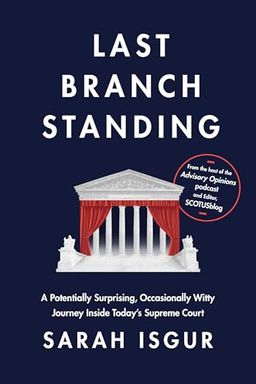
Last Branch Standing cover

Last Branch Standing

by Sarah Isgur

The editor of SCOTUSblog gives insights into how the current Supreme Court functions.

Bitcoin Moves Power From Banks to People

What if moving money felt more like sending an email than waiting in a bank line? In Bitcoin in Brief: What, Why, and How, Ben Isgur argues that Bitcoin shifts financial power from institutions to individuals by making money native to the internet. He contends that Bitcoin replaces slow, fee-laden, permissioned banking rails with a peer-to-peer system that lets you hold, send, and verify value directly—without asking anyone’s permission and without trusting a middleman to behave well.

At its core, the book claims Bitcoin has solved the oldest coordination problem in finance: trust. By marrying cryptography with an incentives-driven network of computers (miners), Bitcoin produces a shared, tamper-resistant ledger—known as the blockchain—that anyone can verify and no one can unilaterally control. The payoff is twofold: you get a digitally scarce asset (like “gold on the internet”) and a global settlement network (like Visa for value) that also doubles as a time-stamped archive for proofs, contracts, and records.

Why this matters now

Isgur opens with a frustration you probably recognize: banks take days to move ones and zeros, slap on opaque fees, and can arbitrarily limit access to your own funds. Meanwhile, Amazon ships physical products across the country in two days. That disconnect isn’t just annoying—it’s costly. In his fractional-reserve banking example, you might earn $1 of interest on a $10,000 deposit while banks collectively earn hundreds to thousands lending against it. The asymmetry persists because you haven’t had a credible alternative—until Bitcoin.

Bitcoin’s arrival makes custody of money a competitive privilege rather than a gatekept necessity. With your own digital wallet, you can store value, transact globally, and verify receipts without a bank. Any “middleman” who wants to charge you now has to prove real value, not just durable access. That’s a profound rebalance of power.

The big idea in one sentence

Bitcoin is a decentralized, internet-native money and ledger system that turns trust into math, scarcity into code, and payment into a peer-to-peer internet protocol.

What you’ll learn in this summary

First, you’ll get clear on what Bitcoin actually is: a network, a digital commodity, and a public, append-only ledger. You’ll walk through wallets, public addresses, private keys, mining, blocks, and the famed 21 million supply cap—plus why a “51% attack” is so hard. Then, you’ll explore what Bitcoin does well today: move value across borders quickly, time-stamp and notarize data with cryptographic certainty, and give you privacy by default and anonymity by effort.

Next, you’ll see how fees actually work and why they’re more like “tips” for faster service than mandatory tolls. You’ll learn how different people—business owners, investors, early adopters, and casual end-users—can plug in right now. From Coinbase’s merchant tools and Overstock’s early $2 million in Bitcoin sales to Gyft’s 3% rewards and Sean’s Outpost (a Bitcoin-funded charity), the book offers concrete paths to use and value.

Finally, you’ll zoom out to the societal stakes: Bitcoin as a lifeline against inflationary currencies (think Argentina’s peso slide), a potential catalyst for capital flight from weaker monies, and even a check on governments’ ability to wage war by inflating. Isgur frames Bitcoin as a “black swan” (borrowing from Nassim Taleb) that opens doors we didn’t think could exist—like global, non-sovereign money and cryptographically signed, time-stamped contracts accessible to anyone with a phone.

Key Idea

Bitcoin turns banks’ core advantages—custody, settlement, and records—into open, verifiable software capabilities. Once those functions become commodities, financial intermediaries must compete on service, not access.

The stakes for you

If you run a business, the takeaway is straightforward: you can gain margin and customers by accepting Bitcoin with instant cash-out and near-zero fees. If you’re an investor, Bitcoin is a volatile but asymmetric bet with gold-like scarcity and network-like utility. If you’re an everyday user, the experience increasingly feels like PayPal—but with faster settlement, fewer gatekeepers, and a ledger that doubles as a notary.

Isgur’s message is simple and urgent: the internet gave you email for information; Bitcoin gives you email for money and proofs. Once you see banking that way, it’s hard to unsee—and even harder to go back.


Inside the Bitcoin Machine

Ben Isgur demystifies Bitcoin by starting with the unit itself: a bitcoin is a digitally scarce token that you control with cryptographic keys and can divide down to 0.00000001 BTC (a “satoshi”). But the “coin” isn’t a file in your phone; it’s an entry in a public ledger—the blockchain—that says which addresses control how many coins. Your wallet doesn’t store coins; it stores keys that let you move entries on that ledger.

Wallets, addresses, and keys

A wallet is just software (or hardware) that generates a key pair: a public address (like an account number) and a private key (like a master password). Anyone can see an address and send Bitcoin to it; only the private key can authorize spending. Isgur even shares a tip address—12i9DZTfZbnYPxJQneqhcQQSMB9G4U6NZH—to make this tangible. The warning is stark: lose your private key, and no one can recover it. That’s by design—it removes reset buttons that centralized custodians exploit or abuse.

Mining, blocks, and consensus

So who updates the ledger? Miners do. They compete to assemble recent transactions into “blocks” and solve a cryptographic puzzle (a hashing challenge) whose difficulty auto-adjusts every 2016 blocks to target one block roughly every 10 minutes. Each attempt is a lottery ticket: try a different input, get a different hash, and hope it falls below the current “target.” When a miner finds a valid block, the network accepts it, appends it to the chain, and rewards the miner with newly minted coins plus transaction fees.

This design offers a crucial property: repeated, independent confirmation by many nodes. Think of it as a crowdsourced accountant team that checks your deposit and writes it into a book everyone can read and no one can erase. (For live, human-readable block history, Isgur points to Blockchain.info.)

Security: the 51% threshold

What if someone tries to cheat—say, by spending the same coin twice? The only practical route is a “51% attack,” where an adversary controls a majority of the network’s mining power to rewrite recent history. Isgur considers this unlikely: acquiring that much hardware and energy would cost billions today; anyone with that investment is probably long Bitcoin; and developers and users have historically responded quickly to existential threats. The wider takeaway is that Bitcoin’s security is economic, not just technical—you’d need to spend more to break it than you’d likely gain by cheating it.

Digital scarcity by schedule

Unlike fiat currencies, Bitcoin’s issuance schedule is fixed in code. Block rewards started at 50 BTC, fell to 25 BTC in 2012, to 12.5 BTC in 2016, and will keep halving roughly every four years until around 2140, when ~21 million coins will exist. Most coins arrive early—Isgur calls it “Zeno’s Paradox in action”—with >95% mined by the mid-2020s, but the tail stretches for a century. This predictability signals “hard money”: you can’t wake up to learn someone printed 5% more of the supply overnight.

Market value, human value

In late 2013, Bitcoin spiked above $1,100 and briefly outpriced an ounce of gold. By mid-2014, it hovered near $600. Isgur’s lesson isn’t to chase prices; it’s to note that Bitcoin’s value—like gold’s—is what people will trade for it. But Bitcoin’s utility extends far beyond gold’s jewelry and industrial uses. It’s programmable, globally transferable, and auditable. Where gold is heavy and slow, Bitcoin is weightless and near-instant across the planet.

Key Idea

Bitcoins don’t “live” in your phone. They live on a public ledger. Your private key is simply the authority to move those ledger entries. That mental model unlocks everything from self-custody to smart contracts.

If you remember only one structural takeaway, make it this: Bitcoin is a tamper-resistant database maintained by incentivized strangers. You don’t have to trust any single actor because the system pits everyone’s incentives against cheating. That’s the breakthrough Satoshi Nakamoto delivered (see “Bitcoin: A Peer-to-Peer Electronic Cash System”) and what Isgur wants you to internalize before you think about prices, apps, or headlines.


Three Jobs Bitcoin Does Well

Isgur distills Bitcoin’s practical utility into three buckets you can use right now: moving value across space, proving existence across time, and protecting identity by default. Each job matters to a different kind of user, but together they form a compelling reason to take Bitcoin seriously beyond speculation.

1) Transmission of capital: fast, final, borderless

When you send Bitcoin, the network cares only that your address is authorized and that the math checks out—not whether you’re in San Francisco, Seoul, or on the moon (Isgur winks at the “TO THE MOON” meme). That means no forms, no banker’s hours, no arbitrarily long holds “because it’s $5,000 not $50.” Miners confirm your transaction in blocks; after a handful of confirmations (10–60 minutes, depending on risk tolerance), settlement is final. No chargebacks. No rolling reversals. If you’ve ever had a PayPal account frozen because of a sudden spike in sales, this alone feels like a superpower.

And fees? There’s no percentage skim by design. Instead, you attach a tiny, optional tip to incentivize faster inclusion by miners. Unlike a wire’s $40 ACH fee, you can often move meaningful sums for pennies.

2) Recording and time-stamping: notarization in the ledger

Bitcoin’s hashing lets you turn any input—your book manuscript, a research dataset, a photo—into a unique digital fingerprint. If you commit that fingerprint to the blockchain, you get an immutable, public, time-stamped proof that your exact content existed then. Change even one character, and the fingerprint changes. Yet no one can reverse the hash to read your content, so your work remains private.

Isgur illustrates this with a thought experiment: hash your entire book and publish the digest in a transaction. Weeks or years later, you can prove authorship instantly. Tools like Proof of Existence make this push-button simple. Extend the idea, and you can cryptographically sign a deed transfer: seller’s address to buyer’s address, anchored on-chain, producing an indisputable, time-stamped record. It’s like a tamper-proof notary you can use from your phone.

3) Pseudo-anonymity: privacy by default, anonymity by effort

Every Bitcoin address is a pseudonym. The public can see that address ABC sent 0.5 BTC to XYZ at a certain time, but they can’t know who ABC and XYZ are unless they can link those addresses to real identities. If you buy coins on an exchange connected to your bank, attribution is easy. If you acquire coins for cash or earn them directly to a fresh address, it’s much harder to tie that on-chain activity to “you.”

Isgur cautions against overconfidence—on-chain analysis is powerful—but he shows how simple flows (Alice to Bob to Alice’s second address) already complicate tracing. Projects like Dark Wallet pushed this further (coin mixing, stealth techniques), underscoring a broader point: Bitcoin gives you default privacy; with care, you can approach practical anonymity.

Key Idea

Bitcoin isn’t only internet money. It’s also an open, global notary and a privacy-preserving accounting system. Those secondary uses become obvious once you see the blockchain as a public, time-stamped data structure, not just a payments rail.

In other words, even if you never hold Bitcoin as an investment, you can use the network as a universal settlement layer, a tamper-proof proof-of-existence service, and a way to transact without broadcasting your identity. Few technologies offer that combination with so little ceremony.


Fees, Finality, and Confirmation Culture

If bank fees feel like opaque taxes, Bitcoin’s fee model will feel refreshingly legible. Ben Isgur explains that fees in Bitcoin are not a percent cut taken by a central company. They’re micro-incentives, paid directly to miners, that help your transaction get included and confirmed faster. Think of them like tipping your barista so your drink gets made next—voluntary in principle, practical in a busy line.

How fees work today

The “standard” client suggests small fees under certain conditions (for example, a common heuristic around 0.0001 BTC per kilobyte back when BTC was ~$600). But Bitcoin is open source; each miner sets their own policies. If many miners accept tiny or zero-fee transactions, your transfer still clears—just more slowly if blocks are full. Services like Coinbase historically attached fees on your behalf to ensure speed, and wallets now estimate optimal fees in real time based on network conditions.

Speed vs. security: choosing confirmations

Bitcoin settles in blocks. After one confirmation (~10 minutes), your transaction is recorded. After six (~60 minutes), the odds of reversal become vanishingly small for most use cases. Merchants can calibrate: a coffee shop may accept zero or one confirmation (instant experience); a car dealer might wait for several. There’s no universal rule—just a transparent risk dial that you control.

A free market for settlement

Because miners compete to include transactions, users and miners effectively run a real-time auction. Users signal urgency via fees; miners signal preferences via inclusion policies. Unlike card networks with fixed percentage skims and one-size-fits-all tiers (business vs. personal, domestic vs. international), Bitcoin’s market clears dynamically. If miners accept 1 satoshi, that’s the market rate. If the network is congested, wallets nudge you higher.

This is what banking would look like if all payment rails were composable on a single internet layer and anyone could build a competing router. The net effect is pressure toward lower average costs and faster clearing over time (compare to how bandwidth costs fell as the internet scaled).

Defaults for people who don’t want to fuss

Not everyone wants to be a fee tweaker. Isgur points out that most wallets set sane defaults: a small fee for quick confirmation. That means you don’t have to read mempool charts to get reliable performance. If you’re patient (and cost-sensitive), send a low fee and wait. If you need speed, bump the fee and get priority. The important part is that you choose, not a processor that withholds funds for “review.”

Key Idea

Bitcoin replaces flat-plus-percentage tolls with a competitive market for block space. You pay for urgency, not for access. And once miners confirm, your payment is final—no chargebacks.

This “confirmation culture” takes a beat to learn, but it’s empowering. Instead of one network dictating terms, you decide how quickly you want certainty and what you’re willing to pay for it. It’s hard to go back to a system that bills you more for selling success (higher card rates) or holds your money when you need it most.


How You Can Use Bitcoin Today

Isgur segments the world into four roles—business owners, investors, early adopters, and end-users—and shows how each can plug into Bitcoin without becoming a cryptographer. Whether you want higher margins, portfolio diversification, a weekend tinkering project, or a convenient checkout button, there’s a path tailored to you.

Business owners: more margin, fewer headaches

If you accept credit cards, you likely pay 2–3% plus fixed fees. Bitcoin lets you accept payment for as little as 0–1%, often with instant conversion to dollars so you take no price risk. Services like Coinbase Merchant (as profiled by Isgur) offered easy buttons, automated receipts, and same-day bank deposits at the exact exchange rate at checkout—1% fee after your first $1 million processed free. No chargebacks, minimal fraud exposure, and customers who love paying with crypto.

Real-world proof: Overstock.com started taking Bitcoin on January 9, 2014, and cleared over $2 million in crypto sales by July, all from U.S. buyers. With traditional margins near 2%, ditching a few percentage points in card fees nearly doubled per-transaction profit on those orders. For brick-and-mortar, it’s even easier: print a QR code at the register, watch the payment hit your wallet, and hand over the goods.

Investors: volatility with asymmetric upside

Bitcoin trades like a commodity with network effects. In 2013, it climbed from ~$10 to over $1,100 before retracing—a rollercoaster that rewards the risk-tolerant and terrifies the rest. If you trade, expect stomach-churning swings and use reputable exchanges. If you invest, think of Bitcoin as a hybrid of gold (scarce, non-sovereign), Visa (payments network), and Dropbox (distributed data layer)—with a fat right tail if adoption grows. It’s also a hedge against dollar debasement that doesn’t depend on another nation’s central bank (unlike holding euros or yen).

Early adopters: build, mine, and give

If you like to tinker, set up a small mining rig, contribute to open-source wallets, or try projects like Sean’s Outpost, a Bitcoin-native charity serving the homeless in Pensacola. Read Satoshi’s white paper to grasp the elegance of the design. Experiment with smart uses of the ledger: a classified board where posting costs a few satoshis, or a simple notarization app for your creative work. The best way to learn is to ship something, even if it’s tiny.

End-users: click the button and go

You don’t need to understand mining to enjoy faster checkouts. When you see “Pay with Bitcoin” next to PayPal, click it and follow the prompts. The experience mirrors what you already know, except your payment settles in minutes and usually costs merchants less—which can translate into better prices for you over time. Meanwhile, services like Gyft let you buy gift cards (including Amazon) with Bitcoin and earn about 3% back—instant savings for routine spending.

Key Idea

You don’t have to “go all in” to benefit from Bitcoin. Start where you stand: cut fees as a merchant, diversify a sliver of your portfolio, fund a charity wallet, or try a Bitcoin checkout and pocket the rewards.

The unifying theme is optionality. Bitcoin meets you at your appetite for risk and complexity. As tooling matures, the “crypto” part recedes into the background and you’re left with something simple: a cheaper, faster, programmable way to pay and prove.


Deflationary Gravity and Fiat Flight

Zooming out, Isgur argues that Bitcoin’s fixed supply creates a competitive pressure that inflationary fiat currencies struggle to withstand. He frames it as a simple choice: Currency A inflates 2% per year; Currency B doesn’t. If utility and acceptance are equal, you’d rationally choose B. Extend that logic across millions of savers and investors, and capital starts leaking from A into B. If A’s government prints more to compensate, the leak can turn into a spiral.

From nibble to flood: the recursive loop

Isgur illustrates a recursive mechanism. Suppose there are 100 units of Currency A. People move 5% of their wealth into Bitcoin (Currency B), effectively reducing A’s purchasing power by 5%. A’s government wanted 2% inflation to service debts, so it prints more—2.1 units instead of 2. Now A has 102.1 units chasing the same goods, and confidence erodes. Next year, outflows grow to 10%, so the government prints 2.35851 units to keep its 2.31% inflation target. Each turn makes A less attractive, B more attractive, and the herd more eager to switch. At some tipping point, expectations flip and you get a bank-run-like rush.

Real-world pain: Argentina’s peso slide

For people living with unstable currencies, this isn’t theoretical. In Argentina, the peso moved from 5.6 to 8.2 per U.S. dollar between August 2013 and mid-2014. If you held pesos, you lost roughly a third of your purchasing power in a year—enough to wipe out thin-margin small businesses. Bitcoin offers a viable escape hatch: a currency you can earn, hold, and spend globally without a central bank moving the goalposts.

Why governments can’t easily stop it

Stopping capital flight into Bitcoin would require draconian controls—bans, surveillance, and penalties that are hard to enforce on an open, borderless protocol. As utility and acceptance rise, so does the cost—political and economic—of trying to cage it. Isgur sees this as a tragedy-of-the-commons variant: individuals optimize for their own wealth preservation, even if the collective outcome stresses legacy systems. Once the feedback loop starts, “stopping it is impossible, outside of totalitarian restrictions.”

War, taxes, and the black swan

One surprising implication Isgur offers: if inflation becomes a less viable hidden tax, governments must fund wars and large projects via explicit taxation. Populations rarely tolerate huge tax spikes for long; that friction could dampen the appetite for protracted, discretionary conflicts. Framed in Nassim Taleb’s language, Bitcoin is a black swan: an improbable-seeming invention with outsized consequences—shifting financial sovereignty and altering state capacity.

Key Idea

A credible, non-inflationary alternative exerts deflationary gravity on weaker monies. Over time, rational actors migrate to the harder asset, and legacy currencies face either reform or erosion.

You don’t have to agree with every geopolitical implication to see the pattern: when people can exit to a harder, global money with their phone, they will. Whether you’re a saver in Buenos Aires or a CFO hedging a balance sheet, Bitcoin’s fixed supply and global rails change your menu of options—and therefore change outcomes.


The Blockchain as Proof and Contract

Beyond payments, Isgur wants you to see the blockchain as an open, neutral infrastructure for proofs, signatures, and simple contracts. Once you grasp that a transaction can carry a cryptographic fingerprint and a time-stamp, you realize the ledger can double as a registry for ideas, agreements, and ownership—accessible to anyone with a wallet.

Proof of existence, without exposure

Hash your book manuscript today, anchor the digest in a Bitcoin transaction, and you’ve immutably claimed “I had this exact content at this exact time,” without revealing the content itself. Years later, hash the manuscript again and the digest matches—proof achieved. Proof of Existence (the tool Isgur cites) makes this trivial and free. That’s stronger than an email to yourself and more portable than a notary stamp locked in a single jurisdiction.

Contracts as signed, time-stamped state changes

Think of a deed transfer as a state change: the seller’s address signs a transfer to the buyer’s address, anchoring the event in a block with a universal clock. While today’s legal systems still mediate property rights, the cryptographic record offers a tamper-proof audit trail. For simpler agreements—IP assignments, milestones, delivery proofs—the ledger can function as a durable witness that doesn’t age, move, or forget.

Multisig for built-in consumer protection

Bitcoin also supports m-of-n multi-signature wallets, a powerful primitive for trust-minimized commerce. Imagine a marketplace escrow: buyer, seller, and arbitrator each hold a key; any two can release funds. If the deal goes fine, buyer and seller sign. If there’s a dispute, the arbitrator sides with one party. No one can unilaterally seize funds, and there’s no need for chargebacks. It’s consumer protection by cryptography, not corporate policy.

Public data layer: messages, ads, receipts

Because the chain is a time-stamped append-only log, you can also imagine small-fee message boards, micro-ad posting, or tamper-proof receipts the whole world can verify. Isgur muses about a secure, public message board where each post costs a tiny fee—spam becomes expensive, while history stays intact. Economists and auditors get a dream dataset: a global, indexed log of value flows that is searchable and permanent (with appropriate privacy layers).

Key Idea

Bitcoin is the internet of property: a neutral, tamper-resistant backbone where you can anchor claims, prove control, and automate simple agreements—without relying on a single company or country.

Seen this way, Bitcoin’s monetary use is just the first app. As with the early web, the obvious use case (email) paved the way for everything else (cloud software, streaming, social). The blockchain’s neutral, global timestamp plus digital signatures unlock a similar wave for property, proofs, and programmable agreements.


Risks, Myths, and How to Stay Safe

Isgur is bullish on Bitcoin’s promise, but he’s not naive about its pitfalls. To use it well, you need to be candid about risks and clear-eyed about what Bitcoin does—and doesn’t—guarantee. Think of this as your practical safety briefing.

Myth: Bitcoin is anonymous

Reality: Bitcoin is pseudonymous. Addresses aren’t tied to names by default, but flows are public forever. If you buy on a KYC exchange and send to a personal address, you’ve already linked identity to on-chain activity. You can improve privacy with fresh addresses for each payment, coin control, and privacy-preserving tools, but don’t assume invisibility. Treat privacy as a discipline, not a default cloak.

Myth: if something goes wrong, I’ll call support

Bitcoin’s superpower—self-custody—cuts both ways. Lose your private key, and no one can reset it. Send to the wrong address, and there are no chargebacks. That’s why hardware wallets, seed phrase backups, test sends, and small initial transactions are your friends. For high-value deals with strangers, use multisig escrow so no single party can run away with funds.

Myth: a bad actor can just “hack the blockchain”

The blockchain isn’t a website to be hacked; it’s a consensus mechanism backed by global computing power and economic incentives. A 51% attack lets an adversary reorder recent transactions they made, not steal everyone’s coins or rewrite ancient history. Mounting such an attack would be astronomically expensive and self-defeating for any rational attacker heavily invested in mining hardware and coins. Security here is game-theoretic and economic (similar logic appears in Nick Szabo’s writing on trusted third parties).

Myth: it’s too volatile to matter

Volatility is real—especially in early S-curves. But utility adoption can outpace price swings in importance. Merchants can auto-convert to fiat to avoid exposure, and users can treat Bitcoin as a long-term allocation rather than a checking account if swings bother them. Meanwhile, people escaping 30% currency collapses (see Argentina’s yearlong slide) often accept crypto volatility as the lesser evil.

Operational basics to stay safe

  • Use reputable wallets; for larger sums, use a hardware wallet and back up your seed phrase offline.
  • Send a small “test” transaction before moving large amounts.
  • For P2P trades, meet in safe public places or use escrow services.
  • Keep software updated; beware phishing; verify addresses carefully.
  • If you’re a business, set clear confirmation policies by ticket size.

Key Idea

Bitcoin removes institutional safety nets and replaces them with personal agency and cryptographic guarantees. That trade is worth it if you practice good hygiene and use built-in tools like multisig.

Finally, Isgur offers a cultural warning: don’t confuse memes like “TO THE MOON” with an investment thesis. Learn the technology, start small, and let the utility—not hype—drive your participation. The upside of a trust-minimized financial system is real; it rewards patience, curiosity, and caution in equal measure.

Dig Deeper

Get personalized prompts to apply these lessons to your life and deepen your understanding.

Go Deeper

Get the Full Experience

Download Insight Books for AI-powered reflections, quizzes, and more.