
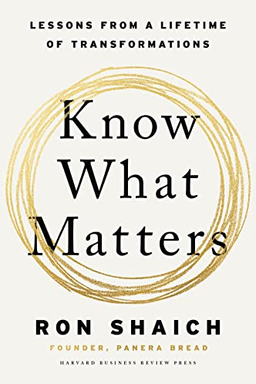
Know What Matters cover

Know What Matters

by Ron Shaich

In ''Know What Matters,'' Ron Shaich reveals the secret sauce behind Panera Bread''s success-mastering the desire-friction ratio. By embracing change and technology, Shaich demonstrates how reducing friction can transform businesses and elevate customer experiences, offering actionable insights for entrepreneurs seeking growth.

Know What Matters: Creating Value Through Transformation

What does it really mean to live a life—or build a business—that you can respect? In Know What Matters: Lessons from a Lifetime of Transformations, Ron Shaich, the founder of Panera Bread and Au Bon Pain, invites you to explore that question through his lived experience as a serial entrepreneur, leader, and relentless innovator. He argues that success isn't measured by money or market share but by your capacity to tell the truth, know what truly matters, and get the job done. These three actions—truth, discernment, and execution—create transformation in both life and business.

Across nearly four decades leading two iconic food brands, Shaich discovered that transformation isn’t a single moment but a continuous process—a way of thinking and living that must be exercised like a muscle. His story moves from humble beginnings as a student entrepreneur at Clark University to founding Au Bon Pain in Boston, transforming the food industry multiple times, and scaling Panera into one of the most successful restaurant companies in history. Yet his focus isn’t just on his achievements—it’s on how he learned to discern what truly mattered at each stage: to himself, his teams, and his customers.

Living from the Future Back

One of Shaich’s foundational insights is his practice of living “from the future, back.” After watching his father in his final days express deep regret over his choices, Shaich began a lifelong habit of conducting what he calls a pre-mortem—a reflection from the perspective of his future self. He imagines himself at life’s end asking, “Did I live a life I respect?” This reflection shifts his focus from reacting to daily demands toward consciously designing his future. In business, this becomes what he calls the future-back process—visualizing the desired outcome first, then working backward to decide which steps and innovations will bring that future into being.

Shaich adapted the method from psychologist Gary Klein’s concept of a “pre-mortem,” turning it into a practical strategy for innovation, leadership, and personal growth. By imagining that his business endeavors had failed and then asking why, he learned to anticipate challenges before they arose and to plan intentionally for success. This future-back lens underpins many of Panera’s most successful transformations—from introducing “clean food” to pioneering fast-casual dining long before others imagined its potential.

From Means and Ends to By-products

Shaich encourages readers to abandon the obsession with direct outcomes like profit or fame. Drawing on Viktor Frankl’s insight that happiness “cannot be pursued; it must ensue,” he reframes success as a by-product of focusing on the right ends and executing the right means. In business, this means that profits are not the goal—they emerge naturally when you deliver greater competitive advantage. The end, for Shaich, is building a better alternative for your customers; the means are the disciplined projects and initiatives that realize that goal. When he focused on offering fresh, artisan-quality food in environments that fostered connection and belonging, profit emerged as the by-product of trust and competitive differentiation.

Transformation as a Lifelong Discipline

The book’s title doubles as a philosophy: to know what matters, you must stay attuned to what will matter tomorrow. Shaich emphasizes that companies—and individuals—must transform repeatedly to stay relevant. Panera transformed four times under his leadership: from a failing French bakery into Au Bon Pain’s café model, from there into the fast-casual phenomenon Panera Bread, then by selling Au Bon Pain to focus entirely on Panera, and finally by reinventing Panera digitally and operationally at the height of its success. In each transformation, Shaich applied the same triad: truth, insight, and execution. He forced himself and his teams to confront the brutal facts, discern what customers would value next, and mobilize the organization to act on that insight.

Transformation, Shaich explains, is hard but endlessly rewarding. It demands courage to take risks when times are good and vigilance when success tempts complacency. Most companies fail not because they make mistakes but because they stop challenging themselves when they’re winning—a lesson he learned during Au Bon Pain’s IPO and applied repeatedly afterward. The willingness to reinvent at the peak of success, rather than waiting for decline, became his hallmark as a leader.

Why These Lessons Matter

Shaich’s reflections reach far beyond the restaurant business. He shows how the principles of transformation apply to any domain—entrepreneurship, leadership, politics, and even personal life. His idea of “competitive integrity” offers a moral lens on business: success must stem from creating genuine value for people, not manipulation or shortcuts. He challenges readers to build organizations—and lives—worth respecting, reminding us that nothing worth doing is easy, but consistent dedication to what matters yields both results and self-respect.

Ultimately, Know What Matters is not just a business memoir; it’s a blueprint for meaningful impact. Whether you’re leading a company, a team, or simply your own life, Shaich invites you to practice transformation daily: face the truth of where you are, discern what truly matters, and commit to getting it done. In doing so, you don’t just build a better business—you build a life worth admiring.


Future-Back Thinking: Design Tomorrow Today

Ron Shaich’s concept of living “future back” may be his most transformative contribution to leadership thinking. Rather than reacting to the past or scrambling to fix what went wrong, he urges you to start by imagining the future you want and then plan backward to make it real. This principle applies equally to building companies, designing products, and living your personal life.

The Personal Pre-mortem

Shaich learned this method in the most human way possible—from watching his parents die. His father, Joseph, died full of regret, realizing too late that his choices had not aligned with the life he respected. His mother, Pearl, died at peace, confident that she had cared for her family and lived with integrity. Observing the contrast, Shaich decided to live with his own future judgment in mind. He conducts what he calls a pre-mortem—a mental simulation of his old age in which he asks, “Will I respect myself when I look back?” Then he plans backward from that vision to determine the actions needed today. This prepares him emotionally and strategically to live intentionally rather than reactively.

Future-Back in Business

Applying the same principle to business, Shaich visualizes success years ahead. He imagines, for example, reading a future Wall Street Journal article celebrating his company’s achievements and then reverse-engineers what must happen for that story to be true. That reflection led Panera to invest in competitive advantage rather than quarter-to-quarter profits. When he visualized a guest-centered, digitally enabled café experience, he didn't wait for competitors to catch on—he rebuilt Panera from the ground up to prepare for that future.

This approach transforms how leaders think. Instead of managing by reaction or preservation, they lead by creation. It turns fear of failure into strategic foresight because every obstacle identified in a pre-mortem becomes a design prompt for smarter decisions. Shaich’s approach echoes Clayton Christensen’s idea of working “future forward” on customers’ jobs to be done but adds an emotional dimension: envisioning your future self to inspire moral and practical clarity.

Intent as a Force

For Shaich, everything meaningful begins with intent. Without it, our lives and businesses drift on autopilot, locked into yesterday’s habits. Intent creates direction—it’s the inner compass that tells you what deserves your energy. In practice, this means taking time annually to clarify goals in each area of life—health, relationships, wealth, and spirituality—and then mapping backward to the initiatives that will make those goals happen. In business, intent translates to strategy: disciplining yourself to define how the company will win in the future instead of reacting to present distractions.

Acting with the Future in Mind

Future-back thinking isn’t abstract; it’s actionable. It shapes how you prioritize, allocate resources, and evaluate decisions. When Shaich looked into Panera’s future, he saw consumers seeking healthier food, digital simplicity, and authentic experiences. Acting on that vision led to the clean-food revolution and the Panera 2.0 transformation years before “mobile ordering” became mainstream. His foresight gave Panera an edge that competitors later had to scramble to match.

Key Takeaway

You can’t build the future by perfecting the past. Start with the outcome you want, imagine the obstacles ahead, and then design your path backward with honesty and intention. Discovery today is preparation for tomorrow.

Living future back gives you a higher vantage point. It lifts you out of today’s noise and allows you to act on tomorrow’s truth. Whether you’re designing a business or a life, the future you imagine shapes the meaning you create.


Competitive Advantage: Everything That Matters

If transformation is the goal, competitive advantage is the engine that drives it. Shaich insists that being a “better competitive alternative” is the single most important measure of success in business. You don't have to be everything to everyone—you just need to be number one for someone. This philosophy shaped Panera’s rise and explains why so many companies falter when they ignore it.

Discovering the Need

Shaich’s lesson began at age twenty-one when he and his fellow students were thrown out of a convenience store. Angered by poor treatment and high prices, he created a nonprofit store to serve students better. He didn’t know it yet, but he had performed the essence of innovation: recognizing a customer’s unspoken job—to be respected while buying daily needs—and providing a better solution. His realization mirrors Theodore Levitt’s famous dictum: “Customers don’t want a drill; they want a hole.” Competitive advantage, Shaich learned, means understanding and fulfilling that job better than anyone else.

Defining Competitive Advantage

Competitive advantage isn’t only differentiation—it’s earned trust. It makes customers walk past competitors to choose you. At Au Bon Pain, Shaich saw that selling just bread limited growth. Watching a customer slice her baguette to make her own sandwich, he realized what job she wanted the bread to perform. That observation birthed the bakery-café concept—“good food served quickly”—bridging the space between fast food and fine dining. It’s a vivid case of turning empathy into strategy.

The Cycle of Decline

The paradox of success is that it breeds complacency. After Au Bon Pain’s IPO, Shaich warned that prosperity can destroy innovation: systems designed to deliver what mattered yesterday become incapable of shaping tomorrow. Businesses stuck in short-term fixes—cost cutting, copying competitors—lose long-term advantage. The world doesn’t reward imitation; it rewards foresight. Amazon thrives because it keeps asking, “What will matter next?”—a question Shaich built into Panera’s DNA.

Building Sustainable Advantage

To sustain advantage, Shaich introduced the means-ends-by-product framework. The end is competitive advantage itself; the means are disciplined initiatives that build it; and the by-product is profit and growth. Companies that reverse this order chase numbers instead of meaning and inevitably decline. Panera succeeded because it treated competitive advantage as a moving target—a standard that had to be redefined with every transformation, from artisan bread to digital convenience to clean food.

Key Takeaway

The world pays you not for what everyone else is doing but for figuring out where it’s headed—and being there first. Competitive advantage is everything because it’s the result of knowing what matters before others do.

By constantly asking, “What matters tomorrow?”, Shaich built companies that stayed ahead of their industries. His story reminds leaders that competitive advantage isn’t a static asset—it’s a living process of continuous reinvention.


Empathy Unlocks Innovation

Shaich argues that true innovation begins not with ideas but with empathetic observation. You can’t create value unless you truly feel what your customers feel. His turning point came when he watched a woman at Au Bon Pain slice a baguette lengthwise and transform it into a sandwich. In that small act, he saw a hidden need—the desire for “good food fast”—and built an empire around it.

Empathy in Practice

Empathy requires you to pull yourself out of your own frame of reference and step into someone else’s world. Shaich’s natural curiosity allowed him to see what others missed. When he acquired St. Louis Bread Company, he didn’t rush to change it; he studied the magic that drew customers in—the warmth, the community feel, the waiting without complaint. Empathy taught him that people weren’t just hungry; they were craving belonging. These observations seeded Panera’s mission to become “an everyday oasis.”

The Drive for Specialness

In partnership with psychologist Dwight Jewson, Shaich traveled across America studying boutique cafés and artisan bakeries. Their conversations—like the one about beer labels, where Jewson observed that people want brands that make them feel special—gave rise to Panera’s defining philosophy: customers seek experiences that elevate their self-esteem. This “drive for specialness” led to the fast-casual movement, where customers could have quality and speed without sacrificing dignity. (Comparable to Howard Schultz’s vision for Starbucks.)

Learning Through Observation

Shaich’s research process mirrors design thinking’s emphasis on human-centered curiosity. He didn’t rely on focus groups or analytics—he visited cafés, watched body language, and listened to what patrons said and didn’t say. For him, empathy isn’t sentimentality; it’s data collection through feeling. By understanding the emotional job customers were hiring Panera to do—to feel cared for, respected, and special—he transformed how the restaurant industry thought about experience.

Key Takeaway

Don’t ask customers what they want. Watch what they do. Empathy unlocks future innovation by showing you the needs people can’t articulate yet.

For Shaich, empathy was not just a marketing tool—it was the starting point of every transformation. It guided Panera’s evolution from bread-selling cafés to community gathering spaces, proving that when you understand humanity, innovation follows naturally.


Make Smart Bets and Seek the Tough Stuff

Shaich doesn’t believe in gambling—he believes in smart bets. Drawing inspiration from his poker-playing father, he learned to make decisions where the odds are stacked in his favor. Smart bets are informed risks built on foresight, empathy, and disciplined execution. They require courage but also wisdom: betting on what’s hard to copy and difficult to do.

What Makes a Bet Smart

A smart bet rests on deep understanding of what will matter tomorrow. It’s not about luck—it’s about having insight others don’t. When Panera offered free Wi-Fi in 2001, competitors mocked the idea. But Shaich saw the emerging “one-man laptop economy.” Free Wi-Fi attracted professionals, students, and creators, filling cafés during off-peak hours and generating 30% sales growth. It also created positive energy—the “Panera buzz”—that competitors couldn’t replicate. That’s what he calls competitive jujitsu: turning a difficult challenge into an advantage.

The Power of Barriers

Smart bets often depend on doing what others find too hard. Shaich deliberately sought what he called “the tough stuff.” When other chains froze their dough for convenience, Panera invested millions to deliver fresh dough daily—a logistical nightmare across thousands of locations. Why? Because fresh bread created a barrier to entry. Competitors couldn’t easily match that consistency or quality. The company’s difficulty became its moat. In industries where imitation is easy, Shaich suggests, look for problems complex enough to scare others away.

Decision-Making Under Pressure

Shaich teaches leaders to define a decision-making lens—filters that clarify priorities when teams face conflict. Panera’s lens had four questions: How will this affect guests? Does it fit our brand authority? How will it impact operators? How much will it cost? This systematic clarity prevented paralysis and allowed Shaich’s teams to move decisively on smart bets without being derailed by internal politics.

Key Takeaway

Don’t chase easy wins. Bet on what’s difficult and meaningful, and build capabilities competitors can’t easily copy. A smart bet done right can redefine an entire industry.

Shaich’s life demonstrates that risk isn’t the enemy—short-term thinking is. Smart bets balance foresight with discipline. They’re his formula for turning creativity into reliable success.


Transformation Is Never Done

Ron Shaich ends his book with a powerful truth: transformation never ends. After selling Panera for $7.5 billion, he could have retired. Instead, he formed Act III Holdings and invested in new ventures like Cava, Tatte, Life Alive, and Level99—applying the same principles to fresh opportunities. For Shaich, transformation is not a phase; it’s a philosophy for living.

The Art of Continuous Renewal

Every company—and every person—must continually evolve to stay relevant. Panera reinvented itself four times; Shaich himself transformed countless more. The essence of these reinventions lies in the willingness to face hard truths, ask what will matter next, and act before necessity forces change. Transformation is easier when success breeds momentum, but Shaich warns that ease can also breed inertia. To stay alive, you must keep asking uncomfortable questions.

Living with Purpose

Transformation is meaningful only when it’s guided by purpose. Shaich’s purpose was never just making money—it was improving people’s lives through business. That meant creating places where guests felt respected, employees felt valued, and communities felt supported. When Panera launched “Panera Cares,” a pay-what-you-can café model for food insecurity, he was expressing transformation as citizenship. This moral dimension mirrors John Mackey’s concept of conscious capitalism: business as a force for good.

The Courage to Let Go

Ultimately, transformation requires knowing when to move on. Selling Panera was Shaich’s act of letting go. He realized that transformation had done its work—the company could grow further with new stewardship. His son Michael’s letter after the sale captured the deeper message: endings aren’t deaths; they’re evolutions. Transformation is movement—forward, outward, always learning, always creating.

Key Takeaway

Transformation is not a destination but a discipline—a way of seeing, learning, and acting. Whether in business or life, you must keep discovering today what will matter tomorrow.

For Shaich, the point of work isn’t achievement—it’s meaning. As Bruce Springsteen sings in one of his favorite lines, he’s always “working on a dream.” Transformation, in Shaich’s view, is that lifelong dream—the creative work of becoming who you’re meant to be by building what truly matters.

Dig Deeper

Get personalized prompts to apply these lessons to your life and deepen your understanding.

Go Deeper

Get the Full Experience

Download Insight Books for AI-powered reflections, quizzes, and more.