
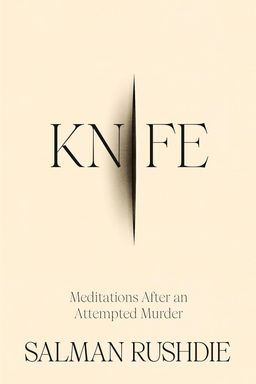
Knife cover

Knife

by Salman Rushdie

The Booker Prize-winning author details the attack on him at the Chautauqua Institution in 2022 and the steps he took to heal from it.

Surviving Hate with Love and Art

What do you do when violence collapses the frame of reality you trusted? Knife is Salman Rushdie’s intimate, unsparing answer to that question. One year after a 24-year-old man rushed the stage at the Chautauqua Institution and stabbed him repeatedly in a 27-second attack, Rushdie makes a claim that is as old as tragedy and as modern as the feed: hate may savage the body, but only love and art can reassemble a life. He contends that survival is not an end state but a practice—of telling the story yourself, of relearning your own body, and of refusing to surrender the future to someone else’s narrative of you.

Rushdie structures this meditation in two arcs—the Angel of Death and the Angel of Life. The first follows those 27 seconds into the trauma bay at UPMC Hamot in Erie, the ventilator he describes as an “armadillo’s tail,” the ruined right eye destined never to see again, the left hand with severed tendons and nerves, the humiliations of the body, the nightmares of the mind, and the stubborn voice inside that whispered two syllables: “Live. Live.” The second arc brings you into the disciplined work of recovery: Rusk Rehabilitation at NYU Langone, the ruthless grace of his hand therapist Monica, the compassionate clarity of ophthalmologist Dr. Irina Belinsky, the slow re-entry into New York, the reaffirmation of a private love with his wife, the poet and novelist Rachel Eliza Griffiths (“Eliza”), and the decision to return to the Chautauqua stage—this time upright, in a new Ralph Lauren suit, and unafraid.

The Core Claim

Knife argues that violence is not only physical harm but an attempt to seize authorship of your story. Rushdie insists on repossession. He refuses to live inside the perpetrator’s narrative—religious rectitude, ideological grievance, and the flattening label of “victim”—and instead writes forward: a first-person recounting (unlike his third-person memoir Joseph Anton), an imagined interrogation of his assailant (“the A.”), and a forthright restatement of his lifelong defense of free expression. Along the way, he reframes miracles (he doesn’t believe in them, but admits his survival feels like one), locates meaning in disciplined care, and stakes happiness—not rage—as his final rebuttal.

What You’ll Learn

You’ll see in granular detail what violence does to reality (“the crisis of the real”) and to the body (intubation; chest drains; catheterizations; the eyelid sewn shut under inadequate anesthesia). You’ll sit with the lonely interior of a near-death experience (no tunnel of light, only the ache of dying far from Eliza and his children) and hear how strangers—an audience, a retired fireman named Mark or Matt Perez pressing a thumb to his neck—made survival possible. You’ll watch the rebuilding: the unglamorous rigors of rehab, Monica’s sea-monster tools working the scar of the open palm, the decision to keep the damaged eye rather than rush to prosthesis, the long crosshatch of outpatient visits, scares (an MRI that read “cancer likely” before resolving), and incremental wins (touching thumb to little finger, making a fist, reading galleys of Victory City aloud).

You’ll also learn how private love and family-wide solidarity countermand terror’s script. Rushdie threads the meet-cute that began on a PEN World Voices stage in 2017 (he literally knocked himself out on a glass door as Eliza walked ahead), their 2021 wedding in Wilmington (Zoomed to his London family), and the five years of “white ink on white pages” happiness that preceded the knife. Eliza’s actions—the emergency flight, the no-sleep bedside vigils, the production-level logistics of medevac, police escorts, and ambulette transfers—become as central as any surgeon’s. Together they decide to document everything on camera, asserting creative control in the face of annihilation.

Why This Matters Now

Knife lands in a moment of what Rushdie calls a “world war of stories”—competing mythologies weaponized by tyrants, sectarians, and social platforms. He has little patience for the right’s co-option of “freedom” or the left’s censorious fragility; his north star remains the First Amendment’s “tongue set free” (pace Elias Canetti). The book is also an argument about religion: keep faith private, he says, but when it is weaponized in public it becomes everybody’s business. He draws a bright line between the art that challenges orthodoxy and the orthodoxy that tries to kill art—and extends a long view of vindication (Ovid, Mandelstam, Lorca outlasting their oppressors).

A line to carry with you

“Terror must not terrorize us. Violence must not deter us.”

In the chapters ahead, you’ll follow the 27-second attack and its moral reverberations; the body’s repair, humiliations and all; the imaginative cross-examination of “the A.”; the case for speech over sanctimony; and the return to the site of harm to stand where he fell. If you’ve ever had your life blown open—by illness, grief, public humiliation, or literal violence—Knife reads like a field manual for how to take the pen back. It’s unabashedly literary (Beckett, Calvino, Saramago, Pirsig, Borges, Dylan, and E. E. Cummings all walk through these pages) but lands in the blunt American vernacular of the ER: live or die. Rushdie chooses life, and, crucially, he chooses how to tell it.


Twenty-Seven Seconds, Then A Lifetime

Rushdie’s recounting of the attack on August 12, 2022 is brisk, unsentimental, and exacting. He was on stage to discuss “keeping writers safe” with City of Asylum’s Henry Reese; he noticed a figure in black sprinting low on his right—the last thing his right eye would ever see—and rose to face him. He didn’t run. He raised his left hand. Then the blade: the deep cut across the palm, the stabs to neck and chest, the long gash under the chin, the puncture that tunneled to the optic nerve. He fell, thinking his teeth would fall out with a broken jaw. Blood spread. Time stretched.

What Violence Does to Reality

Rushdie offers a concept you can use after any shock: violence induces a “crisis in our understanding of the real.” Classrooms, synagogues, supermarkets, amphitheaters—places whose meanings feel settled—become unintelligible. Your mind can’t “think straight” because straight has dissolved. That’s why he didn’t fight or flee; he was an animal frozen in the fact of the impossible. This reframing dissolves shame (“Why didn’t I fight?”) into anthropology. You don’t need to have faced a knife to recognize the phenomenon (Joan Didion’s “the center was not holding” comes to mind). When the frame shatters, paralysis is not failure; it’s a feature of the smashed frame.

The Knife as Intimacy

Rushdie makes a poet’s distinction that will stay with you: a gun kills at distance; a knife is intimate. “Here I am, you bastard,” the knife whispers. In those 27 seconds—just long enough to recite a Shakespeare sonnet—the two men achieve a terrible intimacy, an “intimacy of strangers.” It is the dark twin, he says, of the joyous intimacy between writer and reader. He even imagines the assailant’s emotion—happiness—as his blade entered its target, an ecstasy of imagined historical fulfillment. And then it’s over. Reese and audience members pile on; a retired fireman’s thumb clamps Rushdie’s neck wound; officers take the attacker down. The species reveals itself, Rushdie notes, as capable of both motiveless malignity (Coleridge’s Iago) and spontaneous heroism in a single morning.

Near-Death Without Mysticism

There’s no sentimentality here: no tunnels of light, no body rising. Rushdie felt “intensely physical,” tied to a dying body that pulled the “self” (the supposed ghost in the machine) along with it. The pain his caregivers heard (he wailed, they say) isn’t what he remembers; shock and opioids (fentanyl, morphine) turned agony into a strange dissociation. What he did feel with searing clarity was loneliness: the horror of dying among strangers, far from Eliza and his sons. His whispered concerns were mundane—credit cards, house keys—clinging to the future like talismans. In retrospect, that insistence on ordinary life looks like his psyche’s first rebellion against death.

Foreshadowing and Fate

Knife keeps circling back to art’s eerie prescience. Two nights before Chautauqua he dreamed of a gladiator with a spear in a Roman amphitheater; the venue is, of course, an amphitheater. He’d written Shalimar the Clown years earlier from an image of a man standing over a bloody body with a knife; now he found himself inside the image. He had penned, in The Satanic Verses, the line “to be born again, first you have to die”—and here was a near-death demanding rebirth. He refuses mystical causality (he’s a lifelong atheist), but he won’t ignore art’s foreshadowing either. The imagination, he suggests, builds bridges reality may one day cross.

The Two-Word Imperative

“Some part of me whispering, Live. Live.”

In the end, the attack’s meaning is not in the blow-by-blow but in the counter-movement it triggers. The audience’s leap to help, the officer’s arrest, the helicopter’s open doors, and finally the global chorus—from Biden to Macron to readers posting beneath a moonlit Instagram photo—form a civic answer to a private assault. If you’ve ever been tempted to fetishize a perpetrator’s seconds, Knife redirects your attention to the lifetime that follows.


Healing A Wounded Body

Rushdie’s convalescence is a portrait of the body as ship under new captaincy. In Erie’s trauma ward, then at Rusk Rehabilitation in Manhattan, he learns that survival means ceding sovereignty to teams—surgeons, nurses, techs—who prod, drain, inject, staple, and inspect. Dignity takes a hit (clothes cut from his body, legs hoisted, bowels discussed like weather), but the body’s ferocious instinct to mend asserts itself all the same. The liver regenerates. The small intestine does its work after resection. The heart, “bruised,” keeps time.

Eyes, Hands, Tongue, Lung

The right eye is gone the moment the blade reaches the optic nerve. The swelling grows so grotesque the nurses must drop saline hourly because the eyelid can’t close. Later, an eyelid-sewing procedure—anesthetic “in the needle,” yet blinding pain—buys safety; seven weeks afterward, Dr. Irina Belinsky snips the stitches and offers three options: do nothing if comfortable; a ceramic shell; or enucleation with a full prosthetic. He chooses “do nothing.” He doesn’t want surgery layered atop surgery or daily insertion/removal rituals. The left eye, long treated for macular degeneration with injections, becomes the vigil’s focus. “Look after this eye, doc. It’s all I’ve got.” (He revisits Saramago’s Blindness and Camus’s The Plague to insist: in life, blindness seldom just goes away.)

His left hand—the one he lifted to block the blade—is a second battleground. All tendons cut, most nerves severed, the palm caked with dried blood. Enter Monica, a small, smiling, book-loving hand therapist with “sea-monster” tools and a mantra: “This is going to hurt.” For months, she chips away the blood, mobilizes scar, coaxes tendons to glide in their channels. He works putty. He aims at two grails: fingertip-to-palm contact and a full fist. In March 2023, the surgeon’s verdict: “miraculous.” Feeling remains limited (the thumb and index are back; the middle and ring have “protective feeling”), but he can tie, type, and turn doorknobs. Human again.

There are smaller torments. A bitten tongue requires sutures; stitches dissolve in two weeks; a “soft diet” is endured. A cut in the cheek leaks saliva; a young doctor compresses an embedded wick twice daily (Rushdie names him “Dr. Pain”). A mysterious fluid pocket under the right lung gets drained twice—900 cc’s, then more than a liter—before a high-protein diet stops the reaccumulation. And there’s the humiliating urologic interlude at Rusk: retention, the Bladderometer, and his first ever catheter (“my penis begging for mercy”). Eventually a doctor isolates one culprit: a blood-pressure-raising drug prescribed in the hospital that he should have stopped.

Body, Mind, Sleep

He walks the corridor with a frame, then without. He relearns to brush teeth and squeeze toothpaste one-handed. He trains his head to swivel right because the dead eye can’t warn him. Yet power returns fastest to the night: what daylight composure denies, dreams stage with a vengeance. In bed he thrashes and howls, replaying pursuit-by-spear, Gloucester’s blinding in Lear (he saw Brook/Scofield at fifteen), Surrealists clawing each other’s eyes on Géricault’s raft. Eliza whispers him back. Eventually, with therapy (Dr. Justin Richardson), filming their days, and time, the nightmares ease.

The body’s lesson

“In the presence of serious injuries, your body’s privacy ceases to exist…You surrender the captaincy of your ship so that it won’t sink.”

The Humility of Care

Knife invites you to appreciate care’s unglamorous heroism. Nurses find eyepatches and better pillows; specialists bring the “best hot dogs in Erie.” Security guards stand sentry. At Rusk, glamorous physical therapist Faye ratchets the exercise bike’s resistance; occupational therapist Rose trains him to turn everyday life into therapy. Outside the clinical glare, Eliza orchestrates the impossible: transfers, escorts, a 3 A.M. discharge to a borrowed SoHo loft, a security firm, and—once he can climb into an Escalade unaided—the first night of real sleep in a non-screaming bed.

If you need a role model, Rushdie offers one out of cricket: Mansoor Ali Khan, the Nawab of Pataudi (“Tiger”), who captained India brilliantly despite losing sight in one eye at twenty. If Tiger faced Wes Hall’s pace, Rushdie reasons, he can relearn to pour water without spilling and navigate a two-eyed world with one-eyed grace. The lesson is bracing: resilience is less a posture than a sequence of unshowy tasks done daily until a life returns.


Love As The Counter‑Knife

From its title onward, Knife pits a blade against something softer and, in Rushdie’s account, stronger: love. He and Eliza meet on May Day 2017, backstage at PEN World Voices. She reads translations of the Syrian poet Adonis; later, he makes a clownish exit through a closed glass door and bleeds on the floor; she rushes to mop his face and then—because she’s worried—gets in the taxi with him. They talk until 4 A.M. Within weeks they are living together. Four years later he proposes high over Central Park. They marry in Wilmington in a private ceremony that blends garlands and broom-jumping, cummings’s “i carry your heart,” and a laptop portal to his London family.

Happiness That “Writes White”

Rushdie had once wanted to write a story called “White Ink on a White Page,” about a Candidean figure, Henry White, whose happiness made him a narrative blank (Henry de Montherlant’s quip: happiness writes white). Then happiness arrived in Rushdie’s own life, and the story stalled. The couple chose intense privacy—no social posts, no performative coupledom—and life became “happily private” for five years. The pandemic tested that compact (both got Covid in March 2020; they banged pots anyway). A lavish sojourn in Italy in summer 2022 renewed it: Sardinia nights under Dylan songs, Amalfi’s fireworks for Sant’Andrea, Umbrian castle time at Civitella Ranieri.

Then came the knife. The book’s most shattering pages are not Rushdie’s wounds but Eliza’s ordeal: hearing the crawl on CNN; the rumor-flood (he’s dead/he walked off stage/he’s fine); the urgent $20,000 private plane to Erie (“He’s not going to make it,” someone says on the phone); the hours in surgical limbo; the ventilator; the sci‑fi egg of the swollen eye. For weeks she sleeps on a hospital ledge. She becomes “superhero mode”: grilling doctors, securing insurance, reserving Rusk, locking in police escorts across state lines, reassembling a life out of logistical fragments.

Making a Film to Reclaim the Story

On Day Three, still in the trauma ward, Rushdie says, “We need to document this.” Eliza—novelist, poet, photographer—agrees. The cameras arrive by Day Five. They begin filming everything: his wounds, his halting first words, their quiet exchanges (“You did the biggest thing. You didn’t die.”). Later, at home, Rushdie sees the footage for the first time and understands why she shielded him from mirrors. That evening they decide together: the material will become a documentary with an outside director, and their footage will be its spine. In a universe of violent spectacle, they choose intimate authorship. (This act recalls Joan Didion’s dictum that we tell ourselves stories to live.)

Love’s thesis

“It’s a story in which hatred—the knife as a metaphor of hate—is answered, and finally overcome, by love.”

The Return of Ordinary Joy

Recovery takes tangible form in small rituals: a restaurant date on Valentine’s Day 2023; a sunlit photo shoot in Central Park beneath cherry blossom for Die Zeit; a private anniversary toast; reading the last page of Victory City aloud (“Words are the only victors”) with tears catching in his throat. He travels to London with 24/7 protection; family sees him in person and says he looks better than on FaceTime. Grief intrudes (Martin Amis dies; Paul Auster fights cancer; Hanif Kureishi is paralyzed), but the couple begins marking wins. By December 2022, the last scans clear, the prostate scare resolves to “1” on a 1–5 risk scale, the fluid stops pooling, the scale reads 55 pounds lighter (not a diet to recommend, he notes).

If you’re looking for a practical counterterror strategy, Rushdie’s is not policy but posture: build a private commons so strong—from family to PEN friends—that the public assault can’t hollow it out. Love doesn’t erase the shadow (their “wounded happiness” carries a corner-darkness), but it re-anchors a life. And on a September morning in 2023, standing where he fell, holding Eliza’s hand, he names the feeling that replaces fear: lightness.


Freedom, Stories, And Speech

Knife is a reaffirmation of Rushdie’s lifelong case for free expression and a diagnosis of our “world war of stories.” He’s candid about a paradox: the right has appropriated “freedom” for guns and bigotry, and parts of the left have elevated group protection over open debate. He rejects both. His line of argument—from the French Enlightenment to Thomas Paine to the First Amendment—remains steady: in public life, no idea deserves immunity from criticism, satire, or fearless disrespect. Private faith? Fine. Weaponized religion in politics and law? That’s everybody’s business.

The War of Stories

At a 2022 PEN gathering at the U.N., Rushdie sketched our narrative battlefield: Putin’s lies about “Nazis” in Ukraine; America’s backsliding into theocracy on women’s bodies; India’s Hindu majoritarian assault on Nehruvian secularism; Britain’s self-harming Brexit myths. Authoritarians don’t just seize territory; they flood reality with fake stories people want to live inside. The writer’s job isn’t to shoot (poems don’t stop bullets), but to make better stories—truer, more capacious, more livable—than the tyrant or troll can muster. (Compare to Arendt’s “organized lying” and Orwell’s “smelly little orthodoxies.”)

Rushdie revisits the Charlie Hebdo controversy: he is pained that, in 2015, many writers opposed PEN’s Courage Award to the murdered cartoonists because Charlie mocked Islam (it mocked Catholicism and French politicians far more, he notes). Knife implicitly restates the principle: satire’s target list cannot be pre-censored by offense. He also revisits The Satanic Verses with weary affection—he won’t re-litigate it, but he celebrates the younger readers who now approach it as “a plain old novel,” proof that literature can outlast scandal’s heat.

Religion: Private vs. Public

Rushdie draws a firm line. Religion, historically, answered childhood-of-the-species questions (why we’re here; how to live), but adults, he argues, don’t need parents in the sky to police morality. Keep belief private; in public it meets the hurly-burly like any other idea. He makes a secularist’s case with a believer’s library: he adores church music and architecture (King’s College Chapel; Handel’s Messiah), carries psalmic cadences in his ear, quotes Corinthians by reflex—and remains an atheist. The problem isn’t faith; it’s faith in the state’s holster.

Art’s long memory

“Ovid outlasted Augustus; Mandelstam outlasted Stalin; Lorca outlasted Franco. Art is not a luxury…It accepts argument, criticism, even rejection. It does not accept violence.”

Owning the Future Tense

Rushdie’s sharpest strategic insight is grammatical: tyrants often “own the present,” but writers can “own the future” by crafting the language in which deeds will be judged. This isn’t self-flattery. It’s a call to keep the story field open against algorithmic groupthink and pious gag rules. His own practice mirrors his advice. Instead of letting the attack reduce him to “the guy who got knifed,” he writes the book before the book he wanted to write (a novel about an enigmatic college), asserts first-person authority, and returns to the stage that nearly killed him. In a time of brittle speech, Knife models a spine: criticize, jest, refuse sanctimony, and keep the door to talk wide open.

If you’ve wondered how to hold both empathy and edge, Knife shows you. It’s full of gratitude (for medics, police, readers), generosity (even to the idea of miracles he doesn’t believe in), and unsparing clarity about the ideologies that sent a young man running with a blade. It ends not with a manifesto, but with a walk back onto a wooden stage, a deep breath, and the decision to live in public again.


Inside The Assassin’s Mind

Rushdie never meets his attacker. So he does what novelists do: he imagines him. “The A.” sits across a bolted prison table in Chautauqua County Jail. He’s surly, literal-minded, proud of the word “disingenuous” (misused), devoted to a composite online cleric Rushdie dubs “Imam Yutubi,” and notably under-read (he admits to two pages of Rushdie’s work and “a couple” of YouTube clips). The conversation, of course, is in Rushdie’s head—but because Rushdie treats the invented dialogue like cross-examination, it surfaces real indictments of digital indoctrination, lonely masculinity, and the seductions of a ready-made cosmos.

Deconstructing “Disingenuous”

The A. calls Rushdie disingenuous. Rushdie asks for a definition. The word means pretending to tell the truth while concealing it. Even if that were so, he asks, is that a reason to kill a man? The A. falls back on “everybody knows”—meaning “all good people.” The exchange is funny-sad: a pseudo-ethical claim, a vague appeal to the crowd (social-media argot), and the invocation of Manichean moral certainty. The point isn’t to dunk on a confused young man; it’s to map how thin a justification can be when the reward (in the A.’s theology) is eternal paradise with houris.

A Theology of Translation

Rushdie’s smartest move is a theological one: he asks how a God beyond human attributes (no mouth, no vocal cords) communicates in human words. Answer: through an angel who makes the divine comprehensible to a prophet—a translation. If the sacred text you read (especially in English) is an interpretation layered on the angel’s interpretation, might there be other valid readings across times? The A. rejects the thought; literalism is his linchpin. But Rushdie has planted the idea: absolutism forgets its own history of translation.

Loneliness, Games, and Proxy Hatred

Rushdie probes the A.’s biography: a New Jersey basement noctambulist; a 2018 trip to a Lebanese border village where “real men” opened his heart; a gym membership canceled the night before the attack; video games (Call of Duty), Netflix, and hours of Imam Yutubi. Was he an incel? The A. bristles. But Rushdie lingers on Jodi Picoult’s insight: many loners tried to blend in and were disappointed. In the gamer universe, killing is ubiquitous and consequence-free—“run kill shelter” on loop. Rushdie wonders if the A. didn’t know he’d do it until his feet started running. Then, on the stage, real reality arrived: Rushdie’s body in front of him, fifteen stabs later, a heap of strangers on his back.

The verdict Rushdie prefers

“I don’t forgive you. I don’t not forgive you. You are simply irrelevant to me.”

Why Imagine Him At All?

Rushdie acknowledges the danger of fascination. He started by wanting to meet the man; Eliza objected; he realized the likely banality of fanatic cliché. Yet he still stages the talk to accomplish two things: put words to the void that online radicalization tries to fill, and name the second self (“Rushdie”) that zealots conjure to stand in for the living man (“Salman”). He also writes a closing statement for court, in case he must testify. It’s not a thunderclap of moral eloquence; it’s a shrug. The assailant wrecked his own life and failed to wreck Rushdie’s. That, in the end, is the book’s angle of justice: not revenge, not even forgiveness, but indifference and forward motion.

If you’re tempted to glamorize evil through attention, Knife offers an antidote. Imagine just enough to see the pattern—loneliness, literalism, conspiratorial “everybody,” paradise calculus—and then take the camera off him. Put it on the people who pressed a thumb to a neck and on the woman who turned a hospital corridor into a home.


Returning, Reclaiming, Becoming

The book closes with a sequence of returns: to London, to work, to PEN’s stage, to the idea of public life—and finally, to Chautauqua. These returns are Rushdie’s definition of “closure”: not forgetting or forgiveness, but acceptance and movement. Or, as he borrows from Raymond Carver, everything after survival is “gravy.” Milan Kundera thought life allowed no second drafts; Rushdie politely dissents. A second shot has been granted; he intends to use it.

Owning the Name(s)

Rushdie revives Borges’s “Borges and I” and Günter Grass’s quip about “Günter” (the private man) and “Grass” (the public provocation) to explain his own double: “Salman” is Eliza’s husband, his sons’ father, his sister’s brother; “Rushdie” is the demon to some, the free-speech Barbie doll to others. After the fatwa he refused to write “frightened” or “revenge” books, knowing that would let the catastrophe author his style. Same now: Knife is not a change in prose because of the attack; it’s a decision about sequence—write this first so that later he can write the enigmatic college novel he wanted to.

There’s practical re-entry too: the U.K. reinstates 24/7 armed protection; airlines and hotels don’t balk; he returns to a gentler public affection than the tabloid demonization of the 1990s. He wins PEN America’s Centenary Courage Award (“Terror must not terrorize us…”). He reads reviews of Victory City that treat the book seriously, not as pity gifts. He grieves friends—Amis dies; Auster fights; Kureishi struggles—and yet plants his feet where a year earlier he lay bleeding. That last act, on a bright September day in 2023, is his benediction.

Chautauqua, Again

They fly to Buffalo. On the way, they stop at Chautauqua County Jail. Rushdie snaps a photo of the small red-brick complex where the A. sits; oddly, he feels like dancing. At the Institution, president Michael Hill’s voice breaks: “I have thought about you every single day.” Rushdie and Eliza walk through the stage door, pause where he met Henry Reese’s mother and accepted a check later held as evidence, and step onto the boards. He places the chairs approximately where they sat; points to where the assailant likely rose; traces the path to where he fell. Then he stands exactly on that spot. A circle closes.

The feeling he names

“Lightness.”

Becoming After

Rushdie’s last questions are ethical, not legal. The A. rejects a plea, so trials will likely come; Rushdie will testify if required, but the “Samuel Beckett moment” of confronting the attacker no longer feels necessary. He tells you why: as ordinary life returns, the “extraordinary” loses its glamour. The knife is now a red blot on an earlier page, not the story of the book. He reiterates art’s long game and offers one last crisp distinction: he won’t live as “the guy who got knifed,” but he will accept the role of “Free-Expression Rushdie” if the world insists. Closure, for him, is not a courtroom; it is a stage, a hand in his, and the quiet sense that the past has been faced without being invited to run the future.

If you’re crafting your own return, Rushdie’s sequence is a usable template: reclaim place, reclaim work, reclaim name. Stand where you fell; say no more than you must to the person who pushed you; then turn and walk out into the day.

Dig Deeper

Get personalized prompts to apply these lessons to your life and deepen your understanding.

Go Deeper

Get the Full Experience

Download Insight Books for AI-powered reflections, quizzes, and more.