
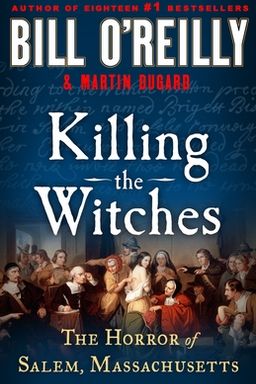
Killing The Witches cover

Killing The Witches

by Bill O'reilly And Martin Dugard

The 13th book in the conservative commentator’s Killing series gives a portrayal of the events of 1692 and 1693 in Salem Village, Mass.

Fear, Faith, and Power in America

When was the last time you felt a crowd push you toward a judgment you weren’t entirely sure about? In Killing the Witches, Bill O’Reilly and Martin Dugard argue that America’s most infamous witch hunt—Salem, 1692—was not a one-off eruption of superstition, but a recurring pattern: fear stoked by authority, weaponized by grievance, and ultimately restrained (or not) by law. They contend that you can trace a throughline from early colonial theocracy to the birth of American liberty, to modern “witch hunts” that play out in the media and online. Understanding this cycle—panic, prosecution, backlash, reform—helps you see how a society can lose its head, and how it learns, slowly and painfully, to regain it.

What the book really argues

The authors’ core claim is twofold. First, Salem happened because a tightly wound, scripture-policed society had no firewall between private fear and public power. Second, the American answer to Salem—imperfect and hard-won—took shape over the next century in key clashes over religion, law, and speech, culminating in constitutional protections. The book makes this case dramatically, moving from a 1591 Scottish burning (Dame Euphame MacCalzean) to the Mayflower, through the 1692 trials, and forward to Franklin, Adams, Jefferson, Madison, and the Constitutional Convention. It then jumps to a 1949 exorcism that inspired The Exorcist and a contemporary epilogue that equates parts of “cancel culture” with modern witch-hunting.

What you’ll learn in this summary

You’ll see how a frontier theocracy formed (Bradford, Standish, and the Puritan legal code), how dissenters such as Thomas Morton and Roger Williams exposed its limits, and how daily pressures—war scares, crop failures, taxes, and church feuds—primed Salem for mass accusation. You’ll meet the central actors: Reverend Samuel Parris and his enslaved servant Tituba; accusers like Ann Putnam and Abigail Williams; judges John Hathorne and William Stoughton; and victims such as Bridget Bishop, Rebecca Nurse, John and Elizabeth Proctor, and Giles Corey. You’ll see the legal pivot—spectral evidence in, due process out—and the later counter-pivot when Governor William Phips shuts the court and John Adams defends British soldiers after the Boston Massacre, showing how facts and procedure can beat heat and rage.

Why this still matters to you

The Salem story is gripping, but its pay-off is the long arc: how Americans fought over religious taxes (Patrick Henry’s Parson’s Cause), confronted charismatic revivalism (George Whitefield) and Enlightenment skepticism (Benjamin Franklin), and then hammered out a structure (thanks to Madison, Washington, and Franklin) that separated church from state and made prosecution harder than accusation. Those safeguards exist because someone, at some point, said: “No more.”

How the book is structured

The narrative unfolds in three acts. Act I builds Salem’s world: the Puritan settlement, its economic and moral code, its tensions with “Strangers,” Indians, and competing colonists. Act II zooms into 1692—how a small circle of “afflicted” girls, Parris’s sermonizing, and elite validation (especially from Cotton Mather) turned suspicion into trials and hangings—before Governor Phips ends it. Act III follows the intellectual and legal aftershocks from Boston to Philadelphia and Williamsburg: Adams’s courtroom defense, Franklin’s tussles with empire and religion, Madison and Jefferson’s insistence on religious liberty, and the Constitutional Convention’s compromises. A final arc tells the 1949 Jesuit-led exorcism of a Maryland boy (Ronald Hunkeler), the making of The Exorcist, then shifts to contemporary “witch hunts”—public shaming and career-ruining without due process.

A pattern to recognize

Panic thrives when: 1) authority blesses suspicion; 2) procedure yields to passion; and 3) incentives reward accusation. It fades when leaders reverse course, courts tighten proof, and society admits error.

If you’ve ever watched an online pile-on or felt pressure to endorse an accusation you hadn’t examined, this history is uncomfortably familiar. Killing the Witches asks you to see both sides of America’s inheritance: the zeal that can devour neighbors, and the frameworks—from jury standards to the First Amendment—that keep zeal at bay. In the pages ahead, you’ll walk the streets of Plymouth and Salem, sit in the pews as Parris preaches and as Franklin listens to Whitefield, stand with John Adams before a hostile Boston jury, and sit quietly in a St. Louis bedroom as a Jesuit whispers the Litany of the Saints. The question the book leaves you with is the one you began with: when the crowd swells and fear surges, which America shows up—Salem’s, or Madison’s?


From Refuge To Rigidity

O’Reilly and Dugard start by putting you on the deck of the Mayflower with John Alden, barrel-maker and keeper of the beer casks (beer was safer than water). What follows is less a Hallmark origin story than a portrait of a community choosing spiritual purity over pluralism—and the unintended consequences of that choice. The Puritans crossed an ocean to escape persecution, then built a legal-religious order in Plymouth and, later, Massachusetts Bay that tolerated dissent in principle but punished it in practice.

A society built on scripture and scarcity

The first winter kills nearly half of the Mayflower passengers. Survival for the rest depends on the kindness and skill of Native allies such as Samoset and Squanto (who, in a biography stranger than fiction, was kidnapped, enslaved, ransomed, taught English in London, and returned home only to find his tribe wiped out). Food is short, disease rips through the settlement, and security is fragile—Captain Myles Standish hauls cannon to the hilltop. In this crucible, the leaders, especially William Bradford, fuse communal survival with communal discipline. The law is moral as much as civil: blasphemy fined, public drunkenness branded with a red “D,” adultery punished by whipping and a sewn “AD.”

The Merry Mount heresy and the habit of banishment

Enter Thomas Morton and his “Merry Mount,” forty miles up the coast, where settlers trade freely with Indians, drink, and dance around an eighty-foot maypole with a buck’s horns nailed near the top. To Puritan eyes, this is pagan disorder. Bradford sends Standish to arrest Morton, pull down the pole, and burn the place. Soon after, Roger Williams, a Cambridge-trained firebrand, argues that civil courts have no standing over the soul, that conquistador treaties without fair payment are theft, and that the church must be separate from the state. For this, Massachusetts Bay banishes him in winter. He trudges through the snow to the Narragansett, buys land fairly, and builds Providence—America’s first sustained experiment in religious liberty (compare with John Barry’s Roger Williams and the Creation of the American Soul).

Puritan law hardens as prosperity grows

With John Winthrop’s arrival in 1630, Massachusetts Bay becomes a “city on a hill” backed by London capital. Winthrop is devout and practical—and deeply wary of democracy, which he calls “the meanest and worst of all forms of government.” Reverend John Cotton writes that a “fundamental task” of the state is “the establishment of pure religion.” The result is a theocracy that polices fashion (women’s gowns must sweep the floor, no lace), speech (no blasphemy), and holidays (no Christmas or Easter). Even affection is suspect: a sea captain kisses his wife on return and both are put in the stocks. And yet, superstition, the anti-intellectual twin of piety, seeps everywhere: witches are real, Satan manipulates flesh, and a birthmark can be a devil’s mark.

Cracks in the façade

Conflict is constant. “Strangers” (non-Puritan settlers), outnumbered and outvoted, still resist being forced to labor on Christmas. A minister sent by London investors to rein in Plymouth’s governance, John Lyford, conspires against Bradford—and is dramatically unmasked when Bradford reads Lyford’s letters aloud in church. Lyford is expelled. In Cape Ann and Naumkeag (soon renamed Salem), a new power center takes shape under John Endicott—severe, quick-tempered, and eager to enforce conformity. When dissenters like Roger Conant or free-traders like Morton thrive, force follows. Over time, these choices normalize a habit: when threatened, banish or brand—don’t bargain.

The setup for Salem

By the 1690s, Massachusetts has laws equating witchcraft with treason against God, a clergy preaching a vivid Devil, and courts accustomed to punishing private vice publicly. Add frontier wars, crop failures, and property feuds—and the fuse is laid.

If you lead or live inside a values-driven community, this chapter of American beginnings holds a sober lesson: virtue without pluralism curdles into compulsion. The line between “we survive because we cohere” and “we cohere by coercion” is thinner than you think. Salem will prove that painfully.


How Salem Happened

Salem’s crisis didn’t begin with a cackle over a cauldron. It began in a parsonage, in winter, with stories told to children. Reverend Samuel Parris, a hard-edged cleric who feuded with his flock over salary and wood for his fire, presided over a home that included two enslaved people from Barbados, Tituba and John Indian. On cold nights in January 1692, Tituba whispered to nine-year-old Betty Parris and eleven-year-old Abigail Williams about witches, demons, and the Devil. Soon, Betty convulsed—arms thrown back, body contorted, then a collapse. Abigail followed. A village already on edge from Indian raids and crop failures now had a new terror: an invisible enemy in the nursery.

From symptoms to suspects

When prayers and a village doctor failed, Reverend John Hale—experienced in “preternatural” cases—was called. He affirmed what many feared: “The hand of Satan.” A folk test followed: neighbors baked a “witch cake” (rye meal mixed with the girls’ urine) and fed it to a dog, hoping it would point to the culprit. Rumors fingered Tituba. Pressed in a hearing at Ingersoll’s Tavern-turned-meetinghouse, middle-aged, terrified Tituba did what many accused would later do to save themselves: she confessed. In a sensational performance, she told the magistrates that the Devil appeared to her; that she’d seen a book with nine signatures; that Goody Sarah Good and Sarah Osborne were witches. A gasp went through the room. With a single confession, Salem moved from mystery to manhunt.

Spectral evidence unlocks the dockets

The hearings—first by magistrates John Hathorne and Jonathan Corwin, then by the special Court of Oyer and Terminer—allowed “spectral evidence”: if an “afflicted” girl said she saw your specter (ghostly double) tormenting her, that was admissible. Bridget Bishop, a twice-widowed tavern owner who liked red bodices and had enemies, was the first to be tried and hanged (June 10, 1692). The afflicted fell into fits when she looked at them; an odd skin “teat” was found then vanished; neighbors testified to nightmares and “black pigs” and a talking monkey. The logic loop was tight: if you denied it, your denial enraged the devil and triggered more fits; if you confessed, you were spared but had to name others. Accusation begat accusation.

Who got swept up—and why

At first, the net nabbed the marginal—poor, quarrelsome, or unchurched women. Quickly, it widened to pillars. Rebecca Nurse, seventy-one, pious and hard of hearing, was initially acquitted. The girls shrieked; Judge Stoughton pressed the jury to reconsider a phrase (“one of us”) Nurse had used; she was condemned and hanged after Governor Phips briefly reprieved her, then rescinded. John and Elizabeth Proctor protested the fraud, angering Reverend Parris; both were convicted, though Elizabeth’s execution was stayed due to pregnancy. Giles Corey, eighty-one and refusing to plead (to save his farm from forfeiture), was pressed to death under stones: each time asked to plead, he rasped, “More weight.”

Clergy, courts, and a crisis of legitimacy

Cotton Mather, already famous for chronicling the 1688 Ann Glover witch case in Boston, backed the court’s vigor (even convening ministers to tolerate spectral evidence), while his father, Increase Mather, urged caution—better ten witches go free than one innocent be condemned. Lieutenant Governor William Stoughton, proud and unblinking, led the court; Thomas Newton prosecuted. With nineteen hangings (and one pressing), jails overflowing, and whispers of accusing a judge, the machinery began to sputter.

The hinge: Governor Phips

Returning from the Maine frontier, newly knighted Sir William Phips—whose wife Mary herself was whispered about—shut down the court on October 29, 1692; barred spectral evidence in the new Superior Court; and canceled pending executions. The panic ebbed as quickly as it had surged.

If you’ve ever wondered how decent neighbors come to endorse indecent things, Salem offers a map: fearful context, authoritative greenlights, loose evidentiary rules, social incentives to accuse, and a feedback loop of spectacle. Break any one link and the storm weakens. Phips broke three.


When Law Pushes Back

One of the book’s most important threads is legal: who guards the guards? Salem’s Court of Oyer and Terminer blessed a kind of proof no responsible tribunal should: invisible harms, unverifiable specters, and chain-of-hearsay fears. The reversal—halting executions, tightening rules, and later compensating victims’ families—did not happen because everyone in Massachusetts had a moral epiphany. It happened because a handful of leaders insisted that law restrain heat. The authors juxtapose that moment with a later one in Boston: John Adams’s defense of British soldiers after the 1770 “Boston Massacre.” Both moments teach you how due process beats panic—sometimes just barely.

Phips vs. Stoughton: power, proof, and pride

Governor Phips, advised (however ambivalently) by Increase Mather, shut the special court; created a new one that excluded spectral evidence; and pardoned many. Stoughton seethed and, at one point, ordered graves prepared for eight more condemned witches until Phips overruled him. The pivot from credulity to caution changed lives immediately. Over time, Massachusetts compensated some families and, in 1702, declared the trials unlawful; in 1711, the General Court paid restitution; and it wasn’t until 1957 that the state apologized publicly. Institutional repentance was slow, but the crux was procedural: what counts as evidence?

Adams in Boston: "Facts are stubborn things"

The Boston Massacre case echoes Salem, but flips the roles. An angry crowd taunted nine redcoats; snowballs and clubs flew; shots followed; Crispus Attucks fell first. Colonists wanted blood. John Adams—risking his career—took the defense. He insisted on witnesses, timelines, and burdens of proof, and he used a quirky doctrine, the “benefit of clergy,” to spare two convicted soldiers the gallows. In the face of howls, he told the jury: “Facts are stubborn things.” That a future revolutionary defended the king’s men underscores the lesson: liberty without law is just another mob. (Compare with Dan Abrams’s John Adams Under Fire.)

A legal culture begins to change

These episodes help explain why, when Americans later wrote constitutions, they obsessed over process—jury trials, confrontation of witnesses, ex post facto bans, and standards like “beyond a reasonable doubt” (articulated more fully later, but rooted in this sensibility). They also explain the founders’ queasiness about religious courts, compelled oaths, and coerced confessions. When you’ve seen spectral “proof” hang your neighbors, you draft documents that make it harder to hang anyone.

Practical takeaway

In any panic—corporate, civic, or online—ask first: what’s the rule of evidence? Who can be accused, on what showing, and with what right to respond? If the answer is “whatever the crowd feels,” you’re in Salem with better Wi‑Fi.

O’Reilly and Dugard are at their best where emotion meets procedure. They don’t deny evil or downplay harm. They point out that once you allow uncheckable claims to count as proof, you don’t just catch villains—you empower opportunists. Phips’s and Adams’s legacies lie less in their rhetoric than in their insistence that proof be something sturdier than fear.


From Salem To The Constitution

The book’s middle third shows how the memory of Salem, plus fresh fights over religion and power, shaped the nation’s architecture. You meet Patrick Henry denouncing royal meddling in church pay (the Parson’s Cause), George Whitefield thundering across the colonies as Benjamin Franklin—a self-styled deist—empties his pockets despite himself, and James Madison and Thomas Jefferson waging a decade-long campaign to separate church and state in Virginia. It culminates in the 1787 Constitutional Convention, where Franklin, Madison, Washington, and others craft a frame that assumes two things at once: people are passionate, and power must be balanced.

Religion as spark, solvent, and stumbling block

In Virginia, ministers’ pay was pegged to tobacco. After bumper crops, planters tried to cap clergy pay (the Two-Penny Act); King George II vetoed the cap; Anglican parsons sued—and won in principle. Patrick Henry rose and told a jury to award the parsons one penny in damages. It was jury nullification in defense of local self-rule and, implicitly, against a state church’s privileges. Elsewhere, the Great Awakening drew thousands to hear Whitefield. Franklin analyzed his voice’s reach—then donated to an orphanage. These cross-currents—skeptic meets revivalist, lawyer meets parson—trained Americans to argue religion in public without handing religion the keys to the courthouse.

Jefferson, Madison, and the Virginia Statute

After independence, Virginia still had an established church. Patrick Henry wanted tax support for “teachers of the Christian religion.” Madison’s Memorial and Remonstrance shredded the idea—conscience is unalienable; state churches distort piety and politics alike. Jefferson’s Bill for Establishing Religious Freedom finally passed in 1786: “No man shall be compelled to frequent or support any religious worship… nor shall otherwise suffer, on account of his religious opinions.” That statute is the pivot between Salem’s theocracy and the First Amendment. (For a focused study, see John Ragosta’s Religious Freedom: Jefferson’s Legacy, Madison’s Vision.)

Philadelphia, 1787: compromise or chaos

At the Constitutional Convention, tempers flared over representation (big vs. small states), slavery, and the role of religion. Franklin—eighty-one, gouty, and carried by sedan chair—pushed for humility: “doubt a little of [your] own infallibility.” Roger Sherman’s “Great Compromise” split Congress into two houses; Madison later drafted the Bill of Rights, embedding free exercise and no establishment. Washington, who had defended many denominations by simply attending their services, presided. The finished frame—imperfect, silent on “witches” but loud on process—was the anti-Salem by design.

Franklin’s quiet counsel

The same Franklin who once defended the Crown in London and was humiliated by the Privy Council returned home committed to a union that honored speech, dissent, and due process—because he’d seen what happens when power is unaccountable.

For you, the moral is straightforward: if you want a plural society that doesn’t melt down in moral panics, separate ultimate truths from police powers, and insist that evidence—not fervor—govern the courtroom. America didn’t stumble into that formula. It was hammered out by people who remembered what it felt like when the formula failed.


America’s Devil, Then And Now

Killing the Witches ends by widening the lens in two provocative moves. First, it tells the meticulously sourced story of a 1949 possession and exorcism—the case behind William Peter Blatty’s The Exorcist. Second, it argues that today’s “cancel culture” often mimics witch-hunt dynamics: accusation treated as guilt, reputations ended without due process, and institutions more fearful of mobs than of facts. You may agree or disagree with the modern analogy—but the parallels the authors draw are worth weighing.

The 1949 exorcism: diaries, doctors, and Jesuits

Thirteen-year-old Ronald Hunkeler of Cottage City, Maryland, began hearing dripping with no source, then scratching, then footsteps; furniture moved; a picture of Jesus shook on the wall. After mainstream clinicians shrugged (“high-strung”), the family turned to clergy. At Georgetown University Hospital, Father Edward Hughes attempted an exorcism; the boy ripped a bedspring free and slashed the priest, who required one hundred stitches and later suffered a breakdown. The family fled to St. Louis, where Jesuits Fathers William Bowdern and Raymond Bishop (with seminarian Walter Halloran) conducted a protracted exorcism. Bishop’s diary (later read by Blatty) notes scratches forming words (“HELL”), violent contortions, and a climactic voice identifying itself as St. Michael commanding the demon to depart. The episodes ceased. Decades later, the boy—now a NASA engineer—died quietly after receiving last rites from a priest who inexplicably arrived unbidden.

From bedroom to cinema to culture

Blatty tracked down the Jesuit record, fictionalized the boy as a girl named Regan, and wrote a novel that initially flopped—until a fortuitous Dick Cavett Show cancellation left the author on-air for forty-one minutes. The film’s production was plagued by mishaps (a set fire, on-set injuries, multiple deaths tied to cast and crew families), fueling lore of a “curse.” Whether you see the 1949 case as diabolic or psychological, the point is this: Americans never stopped taking the Devil seriously. The Salem imagination had gone underground, not away.

The modern "witch hunt" claim

In an afterword, O’Reilly argues that present-day public shamings—amplified by social media and risk-averse corporations—echo Salem: accusations stand in for adjudication; denials don’t deter destroyers; livelihoods are ruined (he cites analyst Doug Adler’s firing over a misheard word and teacher Kimberly Winters’s false arrest). You can push back that many modern exposés involve real wrongdoing and that exposure can be justice (note: the authors themselves acknowledge there are “guilty people today who should be held to account”). But their caution stands: when institutions outsource judgment to mobs, we repeat the Salem cycle—even when the targets deserve scrutiny.

Practical guardrails

Slow down. Separate allegation from evidence. Create fair forums for response. Calibrate consequences to facts, not fury. These aren’t luxuries—they’re lessons generations bled for.

Finally, the book returns to Salem today: a thriving tourist economy of “Witch City,” Wiccan shops, and memorials at Proctor’s Ledge and the Witch Trials Memorial. Historian Emerson Baker notes the oddity: by European standards, Salem’s body count was small; its global fame endures because the fall from “city upon a hill” to “city of hangings” captured an enduring American fear. If you lead teams, raise kids, or influence culture, the question is not whether panics will happen. It’s whether your systems default to Phips and Adams—or to Stoughton and the crowd.

Dig Deeper

Get personalized prompts to apply these lessons to your life and deepen your understanding.

Go Deeper

Get the Full Experience

Download Insight Books for AI-powered reflections, quizzes, and more.