
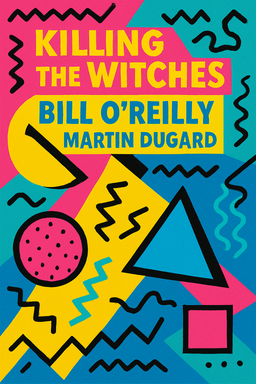
Killing the Witches cover

Killing the Witches

by Bill O''Reilly & Martin Dugard

Killing the Witches revisits the chilling events of the Salem Witch Trials, exploring how early Puritan beliefs fueled a deadly hysteria. This captivating narrative examines the trials'' lasting impact on American society, highlighting the destructive power of superstition and zealotry.

Faith, Fear, and the Recurring Witch Hunts of History

What happens when fear, faith, and power collide—and who do we become when we are convinced that evil walks among us? In Killing the Witches, Bill O’Reilly and Martin Dugard trace a chilling line from the literal witch hunts of seventeenth-century Salem to the metaphorical witch hunts of modern America. Their central argument is that hysteria, once kindled by fear and fueled by authority, returns throughout history wearing new faces—Puritan clergy in 1692, political zealots in 1950, or cancel culture mobs today.

The authors contend that witch hunts are never only about religion or crime; they are about control. When society feels threatened—by moral decay, cultural change, or new knowledge—leaders often disguise fear as faith, using panic to justify punishment. The book shows how this pattern repeats: from King James VI burning supposed witches in Scotland to Reverend Samuel Parris igniting hysteria in Salem, from Cotton Mather’s crusade against the Devil to the ideological purges that echo through American history. O’Reilly and Dugard’s story stretches across centuries, arguing that superstition is merely one form of a timeless human weakness—the need to find and destroy a scapegoat.

From Superstition to Law: The Seeds of Salem

The book begins far from Massachusetts, in late sixteenth-century Scotland, where King James VI, terrified that witches were conspiring against him, authorized burnings and torture. His religious paranoia—combined with political ambition—set Europe ablaze with accusations. This same mindset crossed the Atlantic. When the Mayflower landed in 1620, its passengers carried more than seed and hope; they carried a worldview in which the Devil was real, ever-present, and linked to disobedience. The authors portray early Puritan settlements as both devout and desperate—a people scraping life from frozen ground and interpreting every illness, death, or crop failure as divine judgment.

This fear hardened into law. In 1641, Massachusetts codified witchcraft as a capital crime, echoing Exodus 22:18: “Thou shalt not suffer a witch to live.” Religious law and civil law became the same thing, ensuring that doubt could be fatal. Within this suffocating framework, O’Reilly and Dugard set the stage for Salem’s tragedy, introducing the reader to Bridget Bishop, Giles Corey, and Rebecca Nurse—ordinary people destroyed by collective panic.

The Anatomy of Hysteria

In the authors’ telling, Salem was not simply a local outburst of ignorance but a social epidemic: famine, disease, Indian attacks, and theocratic power combined to create mass insecurity. Reverend Parris’s household became ground zero when his daughter Betty and niece Abigail fell into mysterious fits, egged on by the storytelling of a slave named Tituba. The ensuing chaos was less the work of magic than of manipulation—a society converting fear into accusation and accusation into power. Even the educated, such as Cotton Mather, rationalized torture and execution as holy necessities.

By vividly portraying each witness, trial, and hanging, O’Reilly and Dugard show how faith distorted into fanaticism. The judges permitted “spectral evidence” (dreams and visions) to outweigh fact. Ordinary citizens soon realized that anyone could be condemned by gossip alone. In this Puritan economy of guilt, confession became currency—if you admitted sin, you lived; protest innocence, you died. The resulting nineteen executions became a national parable of moral collapse.

Echoes through the American Century

The book then journeys forward through American history, showing how the pattern of moral hysteria resurfaces with new justifications. Benjamin Franklin’s essays on reason and religious freedom mark a revolt against Puritan rigidity. Patrick Henry’s oratory transforms spiritual zeal into revolutionary fervor. The Founding Fathers, scarred by centuries of persecution, embed freedom of religion in the Constitution to protect citizens from theocracy. Yet, as O’Reilly reminds readers, the impulse to destroy heretics never truly fades—it merely shifts from pulpits to politics, from fire to fear.

In its second half, the book leaps forward to the twentieth century and beyond, when the authors juxtapose Salem’s mania with another possession story—the 1949 exorcism of Ronald Hunkeler, a Maryland boy whose ordeal inspired The Exorcist. They interpret the public’s fascination with demons and dark forces as proof that superstition never disappears; it only evolves alongside scientific progress. For O’Reilly, modern “witch hunts” thrive not in churches but on social media, where outrage replaces sermons and reputation replaces life itself.

Why These Lessons Still Matter

The authors challenge you to see that witch hunts are less about religion than human psychology. As long as people crave certainty and leaders exploit fear, new witches will always be found. The power of the book lies not in retelling Salem’s gore but in exposing its recurrence—how mobs, whether Puritan or digital, destroy truth. O’Reilly’s closing commentary links Cotton Mather’s zeal to today’s “cancel culture,” arguing that the same righteous fury that ignited gallows now fuels online shaming campaigns. Like Arthur Miller’s The Crucible, this narrative insists that freedom depends on courage: the courage to doubt, to question collective madness, and to defend the accused even when it’s unpopular.

“Every generation must exorcise its own demons.” O’Reilly and Dugard suggest that America’s great challenge is not defeating witches or devils but overcoming the fear that invents them.

By connecting the flames of seventeenth-century Salem to the social fires of the twenty-first century, Killing the Witches becomes more than historical nonfiction—it becomes a mirror. If you see only the superstition of the past, you miss the warning meant for now.


The Puritan Origins of Fear

O’Reilly and Dugard root America’s witch hunt mentality in its colonial DNA. Long before Salem, fear of heresy—imported from England and continental Europe—defined early New England life. They describe how the Puritans, fleeing perceived corruption in England, intended to create a ‘city upon a hill,’ yet built a society obsessed with moral surveillance. Anything alien—Catholicism, Native traditions, or secular pleasure—became evidence of Satan’s work.

Faith, Law, and Control

The Massachusetts Bay Colony blended Bible and courtroom in a seamless web. Ministers preached that sin endangered the whole community, so policing it was a civic duty. When misfortune struck—famine, disease, raids—it was interpreted as divine wrath. This tightly woven theology created what psychologists 300 years later might call a “collective anxiety disorder.” In one gripping episode, the authors recount how Native attacks and harsh winters primed colonists to see invisible threats lurking behind every tree.

The legal embrace of Exodus 22:18 transformed personal suspicion into state power. With no distinction between crime and sin, mere accusation could trigger death. What began as spiritual vigilance soon devolved into paranoia. (Historian Perry Miller once called Puritan New England ‘a theocracy in a wilderness.’ O’Reilly’s account shows exactly how wilderness and theocracy fed one another.)

Tituba and the Birth of Hysteria

The flashpoint in Salem becomes the enslaved Barbadian woman Tituba. Her late-night storytelling to Reverend Parris’s daughter and niece—rich with Caribbean folklore and images of spirits—fused African, Native, and European fears. When the girls’ fits began, Puritans saw not trauma but proof of witchcraft. Under torture, Tituba confessed and named others, sparking a wave of deaths. O’Reilly treats her not as villain but as tragic conduit: an outsider crushed by two worlds of power, Puritan and demonic alike.

The Machinery of Accusation

The authors trace the bureaucratic precision that propelled the hysteria. Judges like John Hathorne and William Stoughton, acting as instruments of divine law, allowed children’s testimonies and dreams as evidence. Families turned on one another; vengeance disguised itself as piety. Wealthy widows such as Bridget Bishop and respected matriarchs like Rebecca Nurse were condemned alongside beggars. Each execution fed the next accusation until nearly 200 were jailed.

By rendering these stories in cinematic scenes—screaming crowds, swinging nooses, and burning faith—O’Reilly and Dugard force you to feel how righteousness can become cruelty when unchecked by reason. They show how the tragedy was less a failure of belief than an excess of it: an overboiling faith that consumed its own believers.


From Salem to Revolution

After Salem’s mass hysteria subsided, its legacy haunted America’s moral imagination. The authors transition from the witch trials to the birth of the republic, showing how early leaders learned from—and rebelled against—the Puritan model. The religious rigidity that killed witches eventually provoked an equal and opposite reaction: a passion for liberty of conscience.

Franklin and the Science of Doubt

Benjamin Franklin embodies that shift. O’Reilly paints him as the intellectual heir who exorcises America of its medieval thinking. Where Cotton Mather saw lightning as God’s wrath, Franklin saw electricity. His embrace of Deism—a belief in reason and natural law over revelation—helped redefine virtue not as obedience but as inquiry. This transition signals a national coming-of-age: America begins seeing doubt not as sin but as science. (Franklin’s later clash with British arrogance, detailed vividly here, marks another kind of rebellion against blind authority.)

Patrick Henry and the Politics of Faith

Meanwhile, on Virginian soil, Patrick Henry transforms Puritan passion into revolutionary rhetoric. His “Parson’s Cause” speech attacks the Anglican Church for taxing colonists to pay British clergy, echoing Salem’s lesson that spiritual power should never control civil life. When Henry declares, “If this be treason, make the most of it,” O’Reilly highlights the irony: the same fiery language once used to condemn witches now ignites liberty.

Jefferson, Madison, and the New Faith of Freedom

By the Revolution, Thomas Jefferson and James Madison complete the philosophical reversal. Their Virginia Statute for Religious Freedom—and later the First Amendment—becomes the nation’s exorcism of Puritan theocracy. The authors recount their struggle against Patrick Henry’s proposal to fund Christian education, illustrating how fragile the wall between church and state remained. Madison’s insistence that “religion must be left to the conviction and conscience of every man” becomes the antithesis of Salem’s coercion. Through them, America trades divine command for human rights.

In O’Reilly’s telling, the founding era doesn’t reject faith—it redefines it. The Founders’ God is not Mather’s punisher but Franklin’s cosmic architect, distant yet rational. The book invites you to see that liberty itself arose as a response to witch burning, that the U.S. Constitution is, in effect, the final verdict against Puritan law.


Science, Superstition, and the Modern Exorcism

Leaping three centuries forward, O’Reilly and Dugard bring their argument to a startling crescendo through the mid–twentieth-century story of Ronald Hunkeler, the Maryland boy whose 1949 possession inspired The Exorcist. By pairing this real exorcism with Salem’s past, they show how superstition persists even in the age of science.

When Faith Meets Psychology

The narrative begins with ordinary suburban life—radio shows, school desks, and postwar optimism—that fractures when young Ronald hears scratches in the walls after his occult-curious aunt dies. What his family interprets as haunting becomes a conflict between religion and modern medicine: psychiatrists label him “high strung,” while Lutheran and Catholic ministers wage spiritual war. The most gripping scenes unfold inside Georgetown Hospital, where Father Edward Hughes is slashed by the boy’s strength during the first exorcism. The authors’ description—holiness meeting horror—reads like history colliding with myth. (The Church of England’s cautious skepticism contrasts sharply with Rome’s enduring belief.)

The Jesuit Battle for a Soul

Transferred to St. Louis under Jesuit priests William Bowdern and Raymond Bishop, the saga turns procedural: thirty-one nights of prayer, Latin chants, and supernatural episodes documented in meticulous notes. Words like “HELL” and images of demons appear on Ronald’s skin, echoing Salem’s spectral testimonies. Yet O’Reilly frames these not as proof but as human responses to fear. Whether possession or psychosis, the ritual gives meaning—and relief—to chaos. When the priests invoke Archangel Michael, and Ronald finally calms, the authors pose the uncomfortable question: did they defeat a demon—or simply restore belief’s power to heal?

Hollywood and the New Witch Hunt

The story’s aftershock arrives through William Peter Blatty’s The Exorcist and its 1973 film adaptation by William Friedkin. O’Reilly describes a film cursed by accidents, deaths, and hysteria, almost mirroring the madness it depicted. Crowds fainted; priests blessed theaters; moral reformers denounced Satan in cinema. Once again, America relished seeing evil cast out while secretly feeding on fear. Just as Puritans found community in the witch trials, modern audiences found unity in shared terror. Technology changed, but the ritual remained: identify evil, watch it destroyed, believe we are safer for the spectacle.

Through Ronald’s final years at NASA—haunted yet private—O’Reilly closes the loop: reason and superstition coexist within the same man, the same nation. Whether burning witches or filming them, we still crave deliverance from unseen forces, proving that enlightenment has never fully exorcised our need for the dark.


The Age of Modern Witch Hunts

In his incendiary author’s note, Bill O’Reilly argues that witch hunts did not end with Salem—they’ve merely changed platforms. He equates the mob hysteria that once demanded burnings with modern cancel culture, where reputations rather than bodies are destroyed. The cycle remains identical: accusation, outrage, isolation, and the obliteration of nuance.

From Gallows to Screens

Today’s mobs gather not on Castle Hill but online. Rumor travels faster than torchlight. O’Reilly lists contemporary ‘witches’—celebrities like Roseanne Barr or J.K. Rowling—whose careers were torched by moral zeal. Like seventeenth-century Puritans convinced of holy mission, modern internet crusaders claim virtue while violating justice. The author sees this as the new spectral evidence: unverifiable allegations amplified by social media echo chambers. Where Parris’s sermons once echoed through meetinghouses, outrage now reverberates through Twitter feeds.

Fear, Virtue, and Hypocrisy

O’Reilly warns that beneath every witch hunt lies fear—fear of dissent, of appearing complicit, of being next. Societies under stress cling to moral absolutism for safety. His examples—a broadcaster fired for an innocent phrase, a teacher falsely accused—mirror the arbitrary cruelty of 1692 verdicts. In both eras, justice yields to performative righteousness; apologies buy no mercy. Quoting original Puritan rhetoric alongside modern headlines, O’Reilly demonstrates how history repeats through human psychology, not theology.

Learning from Salem’s Shadow

The book closes where it began: in Salem. The authors return to the modern “Witch City,” where souvenir shops stand atop Gallows Hill and Halloween revenue masks tragedy. They see irony in a town once corrupted by religious zeal now profiting from its own myth. Yet they also find redemption—a community that honors human rights and tolerates diversity. The lesson, they suggest, is not to erase dark history but to confront it. Each time we choose reason over rage, or forgiveness over fear, we break the cycle a little more.

“Fear has returned,” O’Reilly warns, “but this time the bonfires burn online.” His challenge: to remember that liberty demands courage not just to believe—but to doubt.

Dig Deeper

Get personalized prompts to apply these lessons to your life and deepen your understanding.

Go Deeper

Get the Full Experience

Download Insight Books for AI-powered reflections, quizzes, and more.