
Idea 1
The Moral and Strategic Calculus of Ending a Merciless War
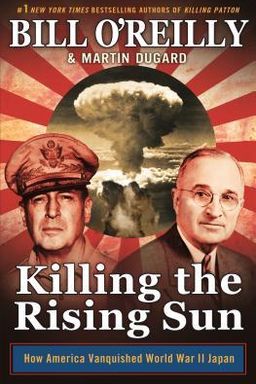
What would you do if faced with a weapon that could end the deadliest war in history — but only by unleashing unprecedented destruction upon civilians? In Killing the Rising Sun, Bill O’Reilly and Martin Dugard confront this moral and historical question as they recount how World War II in the Pacific reached its brutal conclusion. They argue that the atomic bombings of Hiroshima and Nagasaki, while horrifying, were necessary to end a conflict that had already cost millions of lives and might have claimed millions more. The book is not only a history of events but a moral exploration of leadership, power, and the limits of human endurance under total war.
The authors contend that Japan’s militarism, fueled by Emperor Hirohito’s divine status and a culture of death-before-dishonor, left the Allies with little choice but total destruction. To understand the staggering decisions behind the atomic bomb, O’Reilly weaves together vivid narratives—from General Douglas MacArthur’s campaign across the Pacific, to Harry Truman’s sudden rise to presidency, to Robert Oppenheimer’s race to harness nuclear energy. The result is both a human drama and a chilling study in the calculus of war: how far must nations go to stop tyranny, and what happens to the soul of a civilization when it crosses that line?
From Pearl Harbor to Hiroshima: A War Without Limits
The story begins with Japan’s dream of empire. In 1931, it seizes Manchuria; in 1937, its army commits unimaginable atrocities in Nanking, slaughtering and raping hundreds of thousands of civilians. The authors detail these crimes in graphic, documentary-like precision. They are not written to shock gratuitously but to remind the reader that Japan’s wartime brutality set the stage for the Allies’ merciless response. The Japanese worldview, embodied in the bushido code, made surrender shameful and dehumanized enemies as subhuman. This ideology produced kamikaze pilots, comfort women, vivisections of POWs, and mass suicides among civilians—atrocities that hardened the American resolve to use any means to end the war.
Meanwhile, in the United States, leaders such as Roosevelt and later Truman faced staggering moral and logistical challenges. The war’s enormity dwarfed normal politics: armies marched across jungles and oceans, while scientists at Los Alamos tried to invent the future. O’Reilly and Dugard frame the Pacific War as both tragedy and technological revolution—the point where humanity’s creative genius and its capacity for destruction became indistinguishable.
Enter Truman and the Weight of Destiny
One of the book’s most compelling threads is Harry Truman’s transformation. He is introduced as an unassuming Missouri senator, more comfortable playing piano than talking policy. When Franklin Roosevelt dies in April 1945, Truman inherits the most powerful nation on earth—and a secret that will change it forever: the Manhattan Project. The authors emphasize his humility and humanity. When he first learns of the atomic bomb, he barely understands its scale. But after years of Japanese refusal to surrender, brutal fighting at Iwo Jima and Okinawa, and intelligence showing preparations for a suicidal homeland defense, Truman concludes that only nuclear force can end the war swiftly.
In O’Reilly’s telling, Truman is a reluctant executioner—firm but not callous. He writes in his journal that the bomb is “the most terrible thing ever discovered,” yet resolves that using it will save “a million American lives.” This moral balancing act—between horror at mass killing and responsibility to end greater suffering—drives the story’s tension. The reader feels both the tragedy of necessity and the necessity of tragedy.
MacArthur, Oppenheimer, and the Machinery of Victory
To give the reader multiple perspectives, O’Reilly alternates between military, political, and scientific storylines. General Douglas MacArthur becomes the war’s theatrical face—an egotistical, brilliant commander whose promise “I shall return” turns into both prophecy and obsession. His campaigns through the Philippines and across the Pacific come alive in cinematic detail, complete with heroism, arrogance, and moral contradiction. He is a man convinced of his destiny, often clashing with admirals and politicians, longing to conquer Japan himself rather than see it annihilated from the air.
Simultaneously, in New Mexico’s deserts, physicist J. Robert Oppenheimer leads another kind of army. The authors illuminate his genius and fragility—his gaunt body, his tragic ambitions, his quoting of the Bhagavad Gita (“Now I am become Death, the destroyer of worlds”). His Manhattan Project becomes its own war—a battle of the mind fought with equations and fission tests. The Trinity explosion in July 1945 marks humanity’s arrival into the nuclear age, and its success seals Japan’s fate.
Why It Matters Today
By looking at these intertwined lives—Truman’s moral burden, MacArthur’s theatrical patriotism, and Hirohito’s divine detachment—the book forces you to reconsider what victory means. Was the nuclear ending inevitable? Could the world have learned peace without annihilation? These are not just historical debates—they’re warnings about power and psychology. O’Reilly and Dugard present the Pacific War not as a closed chapter, but as a mirror for all modern conflicts where technology outpaces morality. In a world still shadowed by nuclear arsenals, the question that haunted Truman remains yours to ponder: how do you stop evil without becoming part of it?
“We have discovered the most terrible formula in the history of the world... We can destroy entire cities.” – President Harry S. Truman, 1945