
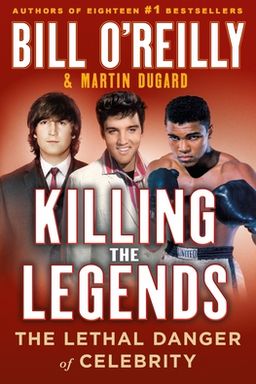
Killing The Legends cover

Killing The Legends

by Bill O'reilly And Martin Dugard

The conservative commentator’s Killing series profiles Elvis Presley, John Lennon and Muhammad Ali.

Fame’s Machine and Its Human Toll

How can you separate the glow of stardom from the systems that sustain—then consume—it? In this book, the author argues that modern celebrity is a machine built from managers, contracts, medicine, money, and myth. It can elevate a working-class talent from Tupelo or Louisville to global icon, and then, just as quickly, grind down their bodies, autonomy, and wealth. The arc is not just about Elvis Presley, John Lennon, or Muhammad Ali; it’s about how success creates dependencies—on handlers, substances, deals, and audiences—that become risks hiding in plain sight.

You watch three intertwined stories. Elvis’s ascent to “King of Rock ’n’ Roll” unfolds into a tragic decline propelled by Colonel Tom Parker’s extractive contracts and Dr. George Nichopoulos’s prescriptions. The Beatles’ split exposes how fragile great partnerships become when business replaces trust, and Lennon’s return with Double Fantasy shows how triumphant creativity can coexist with basic security negligence. Muhammad Ali’s career, guided by Herbert Muhammad’s relentless deal-making, reveals the steep physical cost of spectacle. Together, they show you how public comebacks often mask private collapse.

The system that builds and binds

You begin with the deal-makers. Colonel Tom Parker—born Andreas van Kuijk—turns carnival savvy into managerial dominance, taking an unprecedented 50 percent of Elvis’s earnings, tethering him to U.S. stages (because Parker lacked a passport), and selling Elvis’s catalogue for $5.4 million in 1973. On the boxing side, Herbert Muhammad leverages Ali’s cultural capital into record purses, but steers him into punishing fights and spectacle paydays (Coopman, Inoki, rematches) that fill coffers while draining resilience. These managers don’t just book gigs; they define the possible, narrowing an artist’s choices around their own constraints and incentives. (Note: this mirrors broader entertainment histories from Motown to modern streaming-era catalog sales.)

Money, contracts, and vanishing value

Contracts function like invisible architecture. Elvis’s 1973 RCA deal—two LPs and four singles annually for seven years, thin per-unit royalties, and a deleted audit clause—trades future control for immediate cash. The Beatles fracture under a different contract war: Allen Klein versus Lee Eastman. Paul McCartney’s refusal to accept Klein’s stewardship triggers legal estrangement, hardening personal rifts with Lennon. When you zoom out, you see the same pattern: once money management eclipses artistic governance, the institution serving the art becomes the institution serving itself.

Medicine as enabler, not cure

The clinical story reads like a cautionary case study. Dr. George “Dr. Nick” Nichopoulos writes more than ten thousand doses in seven months of 1977, institutionalizing Elvis’s dependence behind a veneer of medical legitimacy. Polypharmacy, steroids with Cushing’s features, and opioids cascade into a body failing under the pressure of performance schedules and insomnia. In sport, the medical dilemma flips: Ali’s corner and ringside doctors weigh life against legacy—Eddie Futch stops Frazier; Angelo Dundee debates letting Ali continue in Manila’s brutal heat. In both domains, the line between care and complicity blurs when revenue and reputation are on the line.

Entourages, partners, and isolation

Around every icon is a circle that promises protection but often delivers insulation. Elvis’s “Memphis Mafia” supplies loyalty and logistics while muting hard truths; when bodyguards Red and Sonny West and Dave Hebler raise alarms, they’re fired, then publish Elvis: What Happened? Lennon’s world showcases partnership narratives distorted by fame: Yoko Ono is scapegoated publicly while privately acting as manager, investor, and creative partner; May Pang becomes the emotional ballast of Lennon’s “Lost Weekend,” a phase that fuels a No. 1 hit with Elton John. These relationships reveal how intimacy, money, and image-management can entangle, leaving the star simultaneously surrounded and alone.

Comebacks as theater, not therapy

The book reframes your view of redemption arcs. Elvis’s 1968 NBC “Comeback Special” and 1969 Vegas run demonstrate authentic artistic resurgence, yet they don’t repair the structural failures—Parker’s control, predatory deals, and medical overuse—that continue backstage. The Beatles’ rooftop concert dazzles, but it’s an elegy for a partnership already splintered by governance vacuums. Double Fantasy completes in ten weeks and ignites Lennon’s creative return, while basic security protocols fail outside the Dakota. Ali’s late-career rallies against Spinks or returns after Holmes secure paydays and headlines even as they risk lasting harm.

Key Idea

Public triumph can coexist with private systems in collapse; unless you fix the systems—contracts, care, governance, security—comebacks become performances staged over a widening fault line.

Why this matters to you

If you lead a project, a company, or a creative life, you live inside structures that amplify both your strengths and your vulnerabilities. The lesson across Elvis, Lennon, and Ali is not simply to fear fame; it is to build resilient scaffolding: retain audit rights, diversify counsel, separate medical oversight from performance demands, invite dissent within your inner circle, and invest in unglamorous risk management. When you do, you trade the illusion of invincibility for the durability that legends rarely get—and that you still can.


The Manager’s Bargain

Managers make dreams legible to markets—and often make the artist legible to themselves. The book positions Colonel Tom Parker and Herbert Muhammad as twin case studies in the manager’s bargain: deliver unprecedented access to audiences and cash, but at the price of control, dependence, and sometimes damage. You see how two different arenas—music and boxing—produce similar power asymmetries when the intermediary’s constraints and appetites shape the star’s horizon.

Parker’s carnival calculus

Colonel Tom Parker, born Andreas van Kuijk, carries the barker’s eye for margins into Elvis Presley’s life. He dyes, polishes, and packages Elvis, pairing hit singles with films like Jailhouse Rock and Viva Las Vegas to multiply revenue streams. Then he institutionalizes dependence: a 50/50 split, no overseas touring (Parker lacked a passport), and a 1973 RCA contract that swaps royalty leverage for quotas and cash. His company, All Star Shows, extracts side fees from RCA and the Hilton, while he brokers the sale of Elvis’s catalogue for $5.4 million. The math works for the manager, not the musician; the cost is compounding—artistic options narrow, future earnings evaporate, and the artist performs to patch shortfalls.

The aftermath validates the critique. After Elvis’s death, audits and suits reveal a commission structure and side-deals that a Memphis court finds egregious. Parker’s gambling and secrecy become liabilities; his empire frays under scrutiny. (Note: this pattern rhymes with later catalog gold rushes, where immediate cash often obscures lost control.)

Herbert’s empire and Ali’s endurance

Herbert Muhammad, son of Elijah Muhammad, manages Ali in an ecosystem where religious authority, family loyalty, and international politics intersect. He co-engineers the Rumble in the Jungle’s financing and other mega-bouts, earning double-digit percentages while protecting the Nation of Islam’s interests. The incentives push volume and spectacle—Coopman in Puerto Rico, the bizarre Inoki bout in Tokyo, rematches for belts and checks—often at the expense of Ali’s long-term health. The result: money flows, yet so does punishment, culminating in late-career beatings (Holmes, Berbick) that strip reflex and speech.

Herbert’s discretion masks complexity. He is not a cartoon villain; he’s a shrewd operator inside a faith-inflected business network where Ali’s earnings stabilize more than one enterprise. Lawsuits in the 1990s over life-story rights and financial irregularities (they later reconcile) show the downstream friction of decades of opaque deals. You come away asking a hard question: when a manager’s mandate includes mission, family, and cash flow, who defends the fighter’s future self?

What the bargain really buys

The “bargain” buys acceleration—access to studios, stages, purses, and PR—but it often sells away optionality: foreign touring blocked; recording quotas locked; opponent choices skewed to financiers’ needs; and, critically, oversight diluted. In Elvis’s case, lack of independent counsel and audit rights makes the ledger opaque. In Ali’s case, the blended roles of manager, religious authority, and family embed conflicts that a single athlete cannot easily challenge. (Compare to modern best practices: dual counsel, sunset clauses, audit triggers.)

Key Idea

A powerful manager can be your rocket and your tether. Unless you separate growth incentives from governance safeguards, the same person who makes you rich can make you dependent.

How you apply it

If you’re an artist or founder, insist on structural guardrails: transparent commissions; independent legal and financial advisors; explicit audit clauses; and decision rights that preserve your long-term health and brand. If you’re a manager, codify duty-of-care norms—health vetoes, conflict disclosures, and revenue diversification that doesn’t treat the principal as the only ATM. The book’s portraits of Parker and Herbert are not warnings to avoid managers; they are blueprints for building non-predatory partnerships.


Owning the Work

In celebrity economies, the art is the asset, and the contract is the code. This chapter shows how ownership and governance determine whether success compounds or decays. Elvis’s RCA deals and catalogue sale, the Beatles’ Klein–Eastman battle, and Lennon’s late-career production choices illuminate a simple rule: if you don’t own it—and can’t audit it—you’ll work forever to rent back what you created.

Elvis and the disappearing royalty stream

The 1973 RCA contract obligates volume (two LPs, four singles per year for seven years) while shrinking leverage: meager per-unit royalties and a deleted audit clause. Parker stacks side-payments to his own company and then sells Elvis’s catalogue for $5.4 million. On paper, it’s liquidity; in practice, it is a forfeiture of future cash flows and control over licensing. Post-sale, ads, covers, and film syncs proceed without the artist’s voice—an especially perverse outcome for someone who helped sell a billion records. When the estate later sues and audits, the damage to compounding royalties is irreversible.

The Beatles: governance before genius

Brian Epstein’s death leaves an organizational vacuum. Into it steps a management cold war: Allen Klein, whom Lennon, Harrison, and Starr back, versus Lee Eastman, Paul’s preference. Klein renegotiates contracts aggressively, but the schism locks the band into legal quarrels where friendship used to reside. By the time of Abbey Road, the partnership is already bureaucratized; the rooftop concert feels like a coda, not a plan. Here, the governance lesson bites: even the best teams decay if they can’t align on who holds fiduciary duty and how decisions get made. (Note: startups often replay this plot in founder-investor standoffs.)

Lennon’s late work: speed, privacy, and risk

Double Fantasy’s ten-week sprint at the Hit Factory—produced by Jack Douglas at Yoko Ono’s request—shows the upside of clear decision lanes. Demos in Bermuda, sessions in New York, and material like “Woman” and “Beautiful Boy” demonstrate what focused control can deliver. But the same privacy ethos that helped the art also concealed security fragility: no bodyguards, predictable public appearances, and a casual approach to fan engagement at the studio and the Dakota. Ownership of process without ownership of risk management leaves the asset—John himself—exposed.

What owning really means

Owning the work isn’t only about publishing splits and masters; it’s about owning the levers that protect and enhance it: audit rights, touring autonomy, and physical security. Elvis loses negotiating leverage and becomes a touring dependent. The Beatles lose shared governance and become litigants. Lennon secures creative freedom but underestimates risk. In each case, a missing control surface—over money, management, or safety—turns success brittle.

Key Idea

Contracts compound. Small clauses—an audit right here, a veto there—decide decades of freedom and finance. If you don’t negotiate them up front, your future self pays the bill.

Practical moves you can make

Retain audit clauses and transparency provisions; split roles so the person who makes you money isn’t the only one tracking it; treat catalog sales like one-way doors; and design security as part of production, not an afterthought. If you manage a team, institute shared-governance rituals early—clear decision rights, conflict protocols, and third-party tie-breakers—so brilliance never has to compete with bureaucracy for oxygen.


Medicine, Pain, and Performance

Art and sport sell you the illusion of boundless energy. This chapter strips the illusion and shows you the body’s receipts. Elvis Presley’s polypharmacy, enabled by Dr. George Nichopoulos, and Muhammad Ali’s ring wars, preserved by corner decisions, map the same terrain: the performance must go on—until it can’t. You witness how medical authority can legitimize dependence and how competitive culture can normalize avoidable harm.

Elvis: prescriptions as performance infrastructure

As the touring and filming grind mounts, so does the pharmacy. Dr. Nick’s prescription cascade—more than ten thousand doses in seven months of 1977—covers stimulants, sedatives, painkillers, and steroids. A fall during Clambake and post-concussive issues complicate the picture; steroid exposure produces Cushing’s-like puffiness, and opioids slow bowels and respiration. The image—black leather swagger at the 1968 special—sits atop a body increasingly managed by pills. Medical paperwork becomes the hall pass for behavior that looks like health care from the outside and reads like dependency from within.

Clinically, you see the dominoes: drug interactions compromising liver and cardiac rhythm, nocturnal schedules feeding insomnia cycles, and escalating tolerance leading to round-the-clock dosing. The bathroom floor scene—gold pajamas, emesis, bottles—isn’t tabloid; it’s the endpoint of institutionalized over-prescribing. Legal outcomes track the truth: Dr. Nick faces indictment in 1980 (acquitted) and a license suspension in 1995. (Note: this prefigures America’s later opioid reckoning.)

Ali: the closest thing to dying

In Manila on October 1, 1975, the ring becomes a sauna. With temperatures above 100 degrees under TV lights, Ali and Joe Frazier trade brutality for fourteen rounds. Ali sustains hundreds of punches; his legs, ribs, and hands protest with every breath. Angelo Dundee debates the calculus of courage; Eddie Futch ends Frazier’s night. The referee waves it off as Ali collapses, later calling the bout “the closest thing to dying.”

But the damage isn’t a one-night wonder. The Inoki exhibition in 1976 shreds Ali’s legs with grounded kicks, leaving clots and swelling. Earnie Shavers (1977) hammers him; Larry Holmes (1980) dismantles him. The cumulative head trauma manifests over years as Parkinson’s; public adoration can’t cushion neurons. Where Elvis’s medical failure came via the bottle and pad, Ali’s arrives via courage monetized beyond prudence.

The ethics of care vs. the economics of shows

Physicians and trainers sit at the moral hinge. Dr. Nick rationalizes access; Dundee, Futch, and Dr. Ferdie Pacheco (who later departs Ali’s team over safety concerns) navigate a culture that valorizes endurance and punishes caution. In both cases, the institution needs a functioning star more than it needs a healed human. The incentives tilt toward “make it to the next date,” not “make it to old age.”

Key Idea

If the same people profit from you performing and from prescribing or clearing you to perform, you have a governance problem masquerading as medical care.

Your preventive playbook

Split roles: the clinician who treats you shouldn’t be paid to travel with you or measured by shows you complete. Institute third-party medical reviews for high-risk calls. Track meds with transparent logs—no secret scripts, no rotating prescribers. In sports, empower corners and ringside physicians with unambiguous stop authority; in music, tie tour insurance and contracts to health metrics that privilege cancelation over catastrophe. Courage is not the absence of caution; it is its partner.


Inner Circles and Isolation

You picture fame as community—parties, protection, people. The book shows you the paradox: inner circles meant to nurture often insulate. Elvis’s Memphis Mafia, Lennon’s partnerships with Yoko Ono and May Pang, and the Beatles’ studio dynamics reveal how loyalty morphs into complicity and how intimacy, when braided with money and image, can leave you profoundly alone.

Elvis and the praise bubble

Joe Esposito, Marty Lacker, Red and Sonny West, Dave Hebler, Lamar Fike—each carries a job title and a dependency. They secure rooms, manage lights, fetch medications, and run interference with press and dissent. Over time, access becomes currency; candor becomes risk. When the Wests and Hebler confront Elvis about drugs, they’re dismissed and later publish Elvis: What Happened? The machine prefers loyalty over truth, and the star’s world shrinks into a nocturnal cocoon at Graceland, where even family ties with Vernon orbit spending and control.

Yoko Ono: scapegoat and steward

Public myth casts Yoko as the villain who “broke up the Beatles.” Private reality is messier and more competent. Lennon calls her “teacher” and “Mama,” signaling a bond that mixes instruction, intimacy, and management. She buys Dakota apartments, assembles investment portfolios (farms, a dairy herd with high-priced Holsteins), and orchestrates creative sessions with attention to privacy—and even astrology. These moves, culturally coded as intrusive when done by a woman and a foreigner, protect assets and enable a domestic life Lennon increasingly values. The public needs a culprit; the couple needs a plan. (Note: the gendered double standard is a recurring theme in coverage of powerful women near male icons.)

May Pang and the productive separation

The “Lost Weekend” begins not with betrayal but with Yoko’s startling proposition: that May Pang, a 22-year-old assistant, companion Lennon through a cooling marriage. In Los Angeles and New York, Lennon mixes chaos—booze, coke, hijinks with Harry Nilsson—with creativity: Walls and Bridges, a No. 1 single (“Whatever Gets You Thru the Night” with Elton John), and Pang’s whispered cameo on “#9 Dream.” The period underscores a deeper pattern: alternative support systems can unlock output even as they signal unresolved personal fractures. Lennon later returns to Yoko in 1975, but he never fully disavows the joy of that interlude.

Studio sanctuaries breached

The Beatles’ studio—once sacred—is invaded by adulthood: business, lovers, and lawsuits. Yoko’s physical presence in sessions symbolizes a shift from lads-in-a-room to a company with porous boundaries. Creative friction rises; small slights calcify. By the time Lorne Michaels jokes on SNL offering $3,000 for a Beatles reunion, Lennon and McCartney toy with taking a cab yet never go—a casual almost-reconciliation that feels like fate’s shrug. The missed cab becomes a metaphor for how proximity without trust changes nothing.

Key Idea

An entourage can keep you famous while keeping you from feedback. Build for affection and dissent—or you’ll get the former until the latter arrives as a crisis.

What you can do differently

Formalize roles and incentives in your inner circle; reward candor explicitly; rotate independent advisors through your orbit; and separate intimacy from payroll wherever possible. If you lead, create rituals where criticism is safe and expected. Fame shrinks worlds; governance reopens them.


Comebacks and Final Acts

We crave redemption stories; the market sells them back to us. The book punctures the myth by showing that comebacks are usually theater unless their backstage systems change. Elvis’s 1968 special and 1969 Vegas run, the Beatles’ rooftop swan song, Lennon’s Double Fantasy sprint, and Ali’s late-title pursuits demonstrate three truths: authenticity can rekindle love, structure still rules outcomes, and risk ignored becomes fate.

Elvis: real spark, unchanged scaffolding

In 1968, Steve Binder’s NBC special strips Elvis to black leather and rhythm-and-blues roots. Ratings soar; “If I Can Dream” becomes a late-career anthem; Vegas 1969 re-crowns him. Yet Parker still boxes him into U.S. venues; RCA quotas remain; Dr. Nick’s bag still bulges. Aloha from Hawaii broadcasts to a claimed 1.4 billion, while catalogue rights quietly vanish and pills keep pace with applause. The public sees resurrection; the ledger shows dependency. By 1977, he can deliver a solid Indianapolis show even as his body totters toward collapse—performance masking physiology.

The Beatles: rooftop elegy

The rooftop concert turns a cityscape into a stage, capturing spontaneity the paperwork had strangled. Yet beneath those 42 minutes, Brian Epstein’s absence and the Klein–Eastman schism keep dissolving the band’s glue. Abbey Road closes like a perfect bookend as lawyers open new volumes. Creative magic, it turns out, cannot outplay governance deficits indefinitely; the band ends not with a bang but a writ.

Lennon: creative bloom, security winter

Double Fantasy finishes in ten weeks—October 19, 1980—after Bermuda demos and carefully shielded sessions at the Hit Factory. Lennon poses for fans, gives an autograph to Mark David Chapman, and walks unguarded to the Dakota because cars block the driveway. Seven weeks from release, he is dead. The juxtaposition stuns: art brimming with domestic tenderness (“Beautiful Boy,” “Woman”) and logistical naivete (no bodyguards, predictable routines). You can make the record of your life; you still must protect the life that makes records.

Ali: legacy vs. longevity

Ali regains a belt from Spinks in 1978, a headliner’s flourish on a body’s diminishing returns. The Holmes fight in 1980—the night Las Vegas watches an idol’s reflexes freeze—becomes the cautionary parable. He fights Berbick in 1981, then retires into a world that will love him more gently than the ring did. The torch in Atlanta (1996) glows with grace, even as Parkinson’s claims more motion and voice. Some comebacks purchase nostalgia at the price of neurons.

Key Idea

Treat every comeback as a system redesign, not just a stage return. If contracts, care, counsel, and security don’t change, the ending won’t either.

Designing your own final acts

Before your next high-stakes return, run a pre-mortem: what fails if nothing backstage changes? Audit the manager’s incentives; rewrite health protocols with independent oversight; re-price deals to favor rest over grind; and invest in unromantic controls—bodyguards, route plans, safe routines. The point isn’t to distrust triumph; it’s to ground it. Legends are built on choices like these; tragedies, too.

Dig Deeper

Get personalized prompts to apply these lessons to your life and deepen your understanding.

Go Deeper

Get the Full Experience

Download Insight Books for AI-powered reflections, quizzes, and more.