
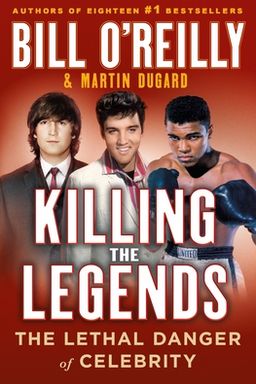
Killing the Legends cover

Killing the Legends

by Bill O''Reilly and Martin Dugard

Killing the Legends offers a riveting exploration of the tragic stories of Elvis Presley, John Lennon, and Muhammad Ali. This compelling narrative examines how their immense fame, coupled with external manipulation, led to their untimely ends, providing a sobering lens on the high cost of celebrity.

The Price of Fame and the Fall of Legends

What happens when extraordinary success becomes a trap? In Killing the Legends, Bill O’Reilly and Martin Dugard explore how fame—often imagined as the ultimate reward—can mutate into a destructive force. They argue that icons like Elvis Presley, John Lennon, and Muhammad Ali did not merely live extraordinary lives; they became prisoners of their own legend. Each man, hailed as a global symbol of greatness, gradually surrendered control of his destiny to others who profited from him. Their downfall reveals how fame, when unexamined, corrodes both body and soul.

O’Reilly and Dugard contend that these legends exemplify a universal paradox of success. You might chase acclaim for validation, freedom, or power—but once fame arrives, it often isolates rather than liberates. With vivid narratives and exhaustive historical detail, the authors show that these men’s worlds—music, boxing, celebrity—were shaped not only by their talents but by sycophants, addictions, and manipulative managers. The book’s thesis: when a genius hands over autonomy to flattery and greed, history gains a legend but loses a human being.

Elvis Presley: A King in Chains

Elvis Presley begins as the embodiment of American possibility. A poor boy from Mississippi with a magnetic voice, he becomes the world’s first truly global rock star. His charisma, energy, and sensuality define a new era. But O’Reilly paints him as a man trapped—controlled by his manager, Colonel Tom Parker, and numbed by drugs and celebrity. As Parker’s greed grew, Elvis’s creative autonomy vanished. The King’s decline culminates in addiction, isolation at Graceland, and a fatal dependence on sycophants who fed his habit rather than his heart. Through his story, you see how external adoration can erase self-discipline, and how genius becomes performance without vitality.

John Lennon: The Rebel Consumed by Contradiction

For Lennon, fame manifests differently. His celebrity is intellectual—his words, his politics, his rebellion—yet it leads to emotional dependency. O’Reilly and Dugard describe Lennon as alternately visionary and vulnerable. The Beatles’ success brings unimaginable influence, but also strain. Lennon’s relationship with Yoko Ono becomes a refuge and a cage. The authors depict the couple’s isolation in the Dakota apartment, surrounded by privilege but haunted by obsession and paranoia, culminating in his murder at the hands of a deranged fan. In Lennon’s story, fame destroys not through excess but through disconnection: his dream of universal peace intensifies the loneliness behind closed doors.

Muhammad Ali: The Greatest and His Burden

The third legend, Muhammad Ali, represents fame in its most heroic and spiritual dimension. From his youth as Cassius Clay to his transformation under the Nation of Islam, the fighter turns athletic triumph into moral resistance. Yet Ali’s fame becomes its own oppression. Manipulated by powerful figures within his organization and his management, he fights too long, enduring physical ruin. His charisma remains, but his health and clarity fade; Parkinson’s disease is the final toll of a life spent entertaining and enduring for others. O’Reilly and Dugard show that even courage, when commodified, can consume its vessel.

Why These Stories Matter

You might see fragments of these stories in your own world—ambition, dependence, exhaustion. The authors ask you to reflect: how do you protect your authenticity when recognition threatens to define you? Whether you’re an artist, entrepreneur, or leader, Killing the Legends is less about celebrity than about autonomy. It’s an anatomy of power, addiction, and manipulation—of how culture elevates individuals and then exploits them. Each legend’s death mirrors our fascination with fame itself, reminding you that greatness is not only an achievement but a test.

The book’s deeper significance lies in its invitation to rethink fame as a social contract: the public craves heroes, but heroes pay with their lives. The authors situate these tragedies within broader cultural patterns—America’s hunger for spectacle, the globalization of media, and the commercialization of art. By following Presley, Lennon, and Ali from triumph to tragedy, O’Reilly and Dugard reveal that the mark of true greatness is not survival of fame but resistance to it. Fame, they warn, will always demand a sacrifice. The question the book leaves you with: if given the chance, would you survive your own legend?


Elvis Presley and the Trap of Indulgence

Elvis Presley’s story begins as an inspirational myth and ends as a cautionary tale. His rise captures the hope of postwar America—a young artist electrifying audiences with a blend of gospel, blues, and rock. Yet O’Reilly and Dugard reveal how the adoration that made him King also imprisoned him. Controlled by Colonel Tom Parker, an ex-carnival barker with a criminal past, Elvis became a commodity rather than a man. Parker’s manipulative contracts, his refusal to let Presley perform abroad, and his relentless pursuit of profit turned artistry into assembly-line entertainment.

From Raw Talent to Cultural Phenomenon

O’Reilly paints early Elvis as authentic—a man in control of his craft. His charisma electrified the world, his combination of rebellion and vulnerability redefining pop culture. But fame’s machinery quickly took over. Parker kept Presley constantly working, insisting on formulaic films like Clambake and Girls, Girls, Girls. Rather than evolve artistically, Elvis was trapped in creative stagnation. By the mid-1960s, rock music had moved on to Dylan and the Beatles; Elvis was stuck re-enacting his golden years.

Addiction and Isolation at Graceland

Presley’s downfall wasn’t sudden—it was a slow descent fueled by dependency. Unable to cope with fame, he turned to prescription drugs. Dr. George Nichopoulos, his personal physician, prescribed thousands of narcotics. Friends watched as Elvis’s health deteriorated: his nights reversed into days, his diet bloated with calorie-rich meals, and his performances became erratic. Even love—his marriage to Priscilla—became business under Parker’s management. Graceland, the mansion that symbolized success, transformed into a gilded tomb.

The “Comeback Special”: A Brief Resurrection

In 1968 NBC offered a lifeline—the Christmas special that became known as his comeback. Against Parker’s wishes, producer Steve Binder redesigned the show to reveal the authentic Elvis. Dressed in black leather, rediscovering his roots, Presley rekindled his identity as an artist. But the revival was short-lived. Parker’s grip tightened again, chaining Elvis to endless Vegas residencies that turned vitality into routine. O’Reilly uses this moment to show how occasional bursts of authenticity rarely outweigh systemic exploitation.

Endgame of the King

By 1977, Elvis was physically and emotionally broken. His final concert tour revealed a bloated man who could barely perform. Yet fans still adored him—the irony being that the world loved the fantasy more than the person. When he died in his Graceland bathroom at age forty-two, surrounded by drugs and enablers, it was both tragedy and inevitability. The authors argue that Elvis’s demise wasn’t just personal failure—it symbolized what happens when creativity becomes captive commerce.

For you, Elvis’s story warns of the subtle cost of success: when comfort replaces curiosity and admiration replaces authenticity, decline begins. True mastery demands independence—the freedom Presley lost when he surrendered his legend to others.


John Lennon and the Illusion of Liberation

John Lennon’s life demonstrates how rebellion can become confinement. As cofounder of the Beatles, Lennon symbolized the creative explosion of the 1960s, channeling youth discontent into music that reshaped a generation. But in Killing the Legends, O’Reilly and Dugard portray him not only as a visionary but as a man trapped by contradictions—between idealism and addiction, activism and emotional fragility.

Rise from Rebellion to Reverence

From Liverpool’s working-class streets to global acclaim, Lennon’s ascent parallels the Beatles’ transformation into a cultural revolution. Fame elevated him beyond music into ideology: peace campaigns, antiwar rallies, experimental art. Yet as he courted attention for his politics and free love, he withdrew inward, increasingly reliant on Yoko Ono. The authors show how the couple’s creative partnership and addiction to publicity blurred boundaries of identity—John could not be apart from Yoko nor fully independent within the relationship.

Dependency and Decline

The “Lost Weekend,” Lennon’s eighteen-month separation from Ono, exposes the depth of his need. In Los Angeles, he spiraled through drugs, alcohol, and public humiliation—thrown out of clubs, battling depression. His return to Yoko marked not recovery but surrender. By the late 1970s, Lennon’s isolation in the Dakota was profound. His creative voice resurfaced on Double Fantasy, an album reflecting domestic peace rather than artistic rebellion. O’Reilly calls it a poignant illusion—the calm before catastrophe.

Fame, Violence, and the Modern Myth

On December 8, 1980, Lennon was shot outside his home by Mark David Chapman—a fan obsessed with authenticity. That contrast fascinates the authors: Lennon preached peace, yet fame attracted violence. His death illuminates the paradox of celebrity as communion and curse. Like Elvis, Lennon had become a projection for the world’s desires; his individuality dissolved into symbol. The Dakota, fortress-like yet unguarded, represents this irony: isolation creates vulnerability.

Lennon’s life is a lesson in emotional honesty. You might pursue freedom through expression, but if fame becomes your identity, you risk losing the self that creates. In seeking to change the world, Lennon struggled to maintain his own inner peace.


Muhammad Ali and the Weight of Glory

Muhammad Ali’s legend transcends sport. To millions, he was not merely a boxer but a prophet of defiance—a man who fought oppression in the ring and in society. Yet Killing the Legends shows how even moral courage can be exploited. O’Reilly and Dugard depict Ali’s trajectory from triumph to illness as the most physical manifestation of fame’s cost: his body became the battlefield not only for opponents but for ideology, management, and public demand.

The Making of a Symbol

Born Cassius Clay, Ali’s victory over Sonny Liston launched him to superstardom. His conversion to Islam and refusal to fight in Vietnam transformed him into global conscience. But this moral victory carried economic and professional consequences. Suspended from boxing, Ali lost prime years of his athletic life. When reinstated, he fought not from passion but necessity, managed by Herbert Muhammad and allied with the Nation of Islam, both eager to use his fame for profit and propaganda.

Fighting Past Humanity

Through legendary bouts—against Frazier, Foreman, and Norton—Ali displayed unmatched resilience. Yet those victories came at the cost of his health. The “Thrilla in Manila” left him near death. O’Reilly’s vivid descriptions of his exhaustion, blurred vision, and swelling evoke not only physical pain but existential fatigue. Still, his managers and followers pushed him to fight again and again. His body was commodified, used to finance both his entourage and ideological institutions that profited from his image.

From Fighter to Saint

Decline did not end Ali’s symbolic power. In retirement, he became a global ambassador of peace, yet his frailty mirrored his sacrifice. Parkinson’s disease silenced his words but amplified his meaning. The book’s final scenes—Ali lighting the 1996 Olympic flame with trembling hands—are achingly poetic: the world cheering not only his strength but his vulnerability. Fame had made him immortal, but at a human cost. By the time he died in 2016, his body had absorbed the weight of his crown.

Ali’s life reminds you that greatness carries responsibility: to protect your soul from the empire of admiration. In his courage and ruin, he shows that glory gained through endurance still demands compassion for one’s limits.


The Anatomy of Exploitation

Across these three lives, O’Reilly and Dugard explore the mechanics of exploitation—how fame becomes a business sustained by manipulation. Each legend’s circle of confidants acted as both support and siphon. Colonel Parker treated Elvis as inventory; Yoko Ono managed Lennon’s isolation; Herbert Muhammad turned Ali’s virtue into economy. These figures represent a common pattern: when trust transforms into dependency, autonomy collapses.

The Sycophant Economy

O’Reilly details how entourages—nicknamed the “Memphis Mafia” for Elvis and various handlers for Lennon and Ali—create echo chambers. Surrounded by admirers on payroll, each legend was insulated from dissent. Genuine concern disappeared, replaced by the pursuit of access and money. This dynamic accelerated decline, as no one dared oppose destructive habits.

Power Without Protection

The authors highlight a cruel irony: fame offers recognition but erases safety. Elvis’s open home at Graceland attracted dependency. Lennon’s belief in connection left him exposed to violence. Ali’s devotion to his cause made him exploitable. In each case, autonomy surrendered to apparatus.

The Lesson of Agency

You learn here that protection doesn’t mean isolation; it means discernment. O’Reilly and Dugard suggest that creative giants must manage their legend before it manages them. Fame should amplify integrity, not anesthetize it. For anyone leading a team, brand, or cause, these stories emphasize why boundaries are acts of survival.

Remember this pattern: every legend had charisma beyond measure, but lost the power of restraint. The people closest to them built their cages. Protect your autonomy first; admiration can come later.


Culture’s Hunger for Heroes

Why does society create—and then consume—its idols? The authors argue that America’s fascination with fame reflects a deeper cultural hunger: a need for identifiable hope in exchange for personal anonymity. Elvis offered erotic liberation; Lennon intellectual rebellion; Ali moral courage. Yet the public’s worship easily becomes entitlement, demanding endless access until identity collapses.

From Hero to Commodity

O’Reilly connects the rise of mass media with the dehumanization of personal grandeur. Television and tabloids didn’t just report fame—they manufactured it. By televising Presley’s performances and Beatles mania, society industrialized intimacy. The audience didn’t want art; it wanted ownership. “The King,” “The Walrus,” and “The Greatest” ceased to be people—they became brands, perfectly packaged mythologies for cultural consumption.

The Moral Chemistry of Admiration

Every era defines its legends through what it needs to believe. In times of conformity, Presley’s rebellion resonated. During war and political turmoil, Lennon’s peace mattered. Amid racial tension, Ali’s defiance uplifted millions. Their stories show that idols serve moral functions—until society moves on. Fame is cyclical: admiration today becomes nostalgia tomorrow. The same crowd that cheered may later demand reinvention or witness collapse as entertainment.

Our Role as Audience

The book invites reflection about complicity. You consume fame every time you follow viral icons or idealize success without context. Like the spectators of Presley’s final tour or Lennon’s last autograph signings, audiences often reward exhaustion, not excellence. O’Reilly reminds you that genuine admiration requires empathy—the recognition of limits. Greatness should inspire, not devour.

Understanding culture’s hunger helps you resist it. Don’t just idolize success—examine the human cost behind it. The legends we build reflect the values we crave. Their falls mirror our own unchecked desires for spectacle.


The Human Lessons of Decline

In its conclusion, Killing the Legends reframes these famous deaths not as endings but as mirrors for self-awareness. O’Reilly and Dugard emphasize that decline does not occur because of weakness—it occurs through surrender. Their stories teach you how autonomy, integrity, and humility are the only safeguards against external validation.

The Pattern of Capitulation

Each legend began with resistance and ended with submission. Presley to his manager’s control, Lennon to his psychological dependencies, Ali to relentless exploitation by those profiting from his courage. The authors highlight these patterns to caution that excellence without awareness leads to extinction.

Recovery Through Reflection

What if they had stopped? You can imagine alternate paths—Presley recording raw blues again, Lennon living his peace privately, Ali retiring before permanent damage. The book’s underlying message is that reevaluating purpose is not weakness but wisdom. Let success be a tool, not a cage.

Legacy and Redemption

Despite tragedy, their influence endures. Elvis’s music still moves hearts; Lennon’s lyrics inspire empathy; Ali’s courage honors justice. The final chapters acknowledge this duality: brilliance and fragility coexist. The legends are “killed” not by fate but by conditions that remain recognizable in our own culture—overwork, spectacle, self-doubt.

Ultimately, you take from their story a challenge: define success on your own terms. True greatness begins not in acclaim but in autonomy—the quiet strength to be whole even when the world demands your legend.

Dig Deeper

Get personalized prompts to apply these lessons to your life and deepen your understanding.

Go Deeper

Get the Full Experience

Download Insight Books for AI-powered reflections, quizzes, and more.