
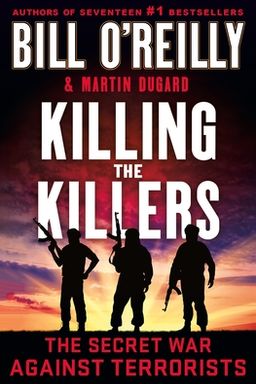
Killing the Killers cover

Killing the Killers

by Bill O''Reilly and Martin Dugard

Killing the Killers delves into the secretive battle against global terrorism, spotlighting key figures like Soleimani and al-Baghdadi. Authors O''Reilly and Dugard reveal the intricate operations and decisive moments that shaped the modern war on terror, offering a gripping narrative that uncovers the hidden dynamics of international conflicts.

The Hidden War on Terror: A Global Hunt for Killers

Can you imagine living in a world where every shadow might hide an enemy and every click on a keyboard could locate a killer? In Killing the Killers: The Secret War Against Terrorists, Bill O’Reilly and Martin Dugard unravel the modern, often invisible war against terrorism—a war waged not only with guns and bombs but also with intelligence, satellites, and silence. They argue that the real battle against global terror is fought largely out of sight, in classified operations, diplomatic rooms, and the air-conditioned nerve centers of drone pilots in Nevada rather than the public battlefields we see on the evening news.

O’Reilly and Dugard contend that terrorism did not disappear after Osama bin Laden’s death—it evolved, spreading through radical cells and online propaganda networks that transcend national borders. Their central claim is that true victory over terrorism requires a combination of intelligence gathering, precision military strikes, and moral resolve that few nations can sustain. This book pulls back the curtain on how the United States and its allies fought to decimate ISIS, al-Qaeda, and the Iranian Revolutionary Guard Corps while confronting new enemies born from ideology, ambition, and revenge.

The Shift from Public Wars to Silent Hunts

The story begins with the aftermath of bin Laden’s death, illustrating how the global counterterrorism effort transformed from open warfare in Iraq and Afghanistan into a shadow campaign led by drones, intelligence operatives, and elite Special Forces. The authors use vivid, cinematic scenes—such as the SEAL raid on Abbottabad, the drone command rooms at Ellsworth Air Force Base, and the CIA missions tracking Abu Bakr al-Baghdadi—to show how modern warfare became a technological cat-and-mouse game. These operations balance precision with patience, embodying the philosophy known as “Find, Fix, Finish,” a triad that defines twenty-first-century counterterrorism.

Terror’s Evolution and the Rise of ISIS

The book’s early chapters chart the shift in global terror networks: how ISIS emerged from the ashes of al-Qaeda in Iraq under Abu Bakr al-Baghdadi, redefining savagery through its caliphate and worldwide propaganda. O’Reilly and Dugard portray a chilling timeline of attacks—from the invasion of Mosul and the horrors of Raqqa to massacres in Pulse nightclub, Manchester Arena, and London Bridge. They demonstrate how ISIS evolved beyond physical territory, transforming into a digital jihad reaching people from Minnesota to Pakistan. This retelling is part history and part thriller, emphasizing how ideology, not geography, sustains terrorism.

Technology and Morality in Warfare

Another major theme explores how technology changed morality. Drones, for instance, allow precision killings with minimal risk to American lives—but raise moral questions about remote warfare. O’Reilly examines the tension between effectiveness and ethics, comparing Obama’s reliance on targeted drone strikes with Trump’s aggressive authorization of Special Forces raids. Each administration, despite political differences, faces the same dilemma: how far can democracy go to eradicate an enemy that thrives on fanaticism and secrecy?

Interconnected Conflicts and the Power of National Will

Beyond individual missions, the book situates terrorism within a larger geopolitical chessboard involving Iran, Russia, and other powers. Figures like Iranian general Qasem Soleimani represent state-sponsored terror, while Western leaders—Obama, Trump, and later Biden—grapple with limited options, domestic divisions, and media scrutiny. The authors argue that defeating terrorism requires unity of purpose and moral clarity, qualities often weakened by politics.

Why This History Matters

Ultimately, Killing the Killers is both a documentation and a warning. It reminds you that terrorism adapts faster than bureaucracies, that intelligence gathering demands human intuition as much as technology, and that the courage of unsung operatives—those who risk their lives in silence—is the cornerstone of global safety. O’Reilly and Dugard want readers to understand that while you may not see this war unfold, it defines the age we live in, testing our ethical boundaries and our capacity for vigilance.


The Rise and Fall of ISIS

Bill O’Reilly and Martin Dugard capture the meteoric rise of ISIS as a modern Frankenstein created from the remnants of al-Qaeda. After the U.S. withdrew from Iraq, power vacuums allowed Abu Bakr al-Baghdadi—a failed scholar turned fanatic—to build a caliphate stretching from northern Syria to central Iraq. This empire of terror made headlines for its mass beheadings, enslavement of women, and televised executions, branding itself not just as a movement but as a global brand of fear.

Birth of a Caliphate

ISIS’s birth was not accidental. The book traces its origins to the American invasion of Iraq and Camp Bucca, a U.S. detention center where al-Baghdadi learned from jihadists and hardened criminals. When released in 2004, he transformed radical ideology into a bureaucratic war machine. By 2014, ISIS had conquered Mosul, forcing Iraq’s army to flee and proclaiming itself the Islamic State. Millions lived under its brutal sharia laws while its black flag spread across continents—from Africa to Southeast Asia.

Terror as Theater

O’Reilly shows how ISIS perfected the use of media as a weapon. The beheadings of journalists James Foley and Steven Sotloff were filmed with cinematic precision—symbolic acts meant to shock democracies into paralysis. Kayla Mueller’s kidnapping and murder became another grim chapter, merging horror, propaganda, and psychological warfare. As viewers across the world consumed these videos, ISIS exploited freedom of expression to spread its ideology online, transforming ordinary people into potential killers through social media.

Global Recruitment and Local Devastation

More than forty thousand recruits joined ISIS from ninety countries. The average recruit, O’Reilly writes, was a young man seeking purpose through “jihad romanticism.” This global reach made ISIS unprecedented—an army both physical and digital. From attacks in Paris and Manchester to “lone wolf” shootings in San Bernardino and Orlando, the movement redefined what modern terrorism looks like. Every act was part of al-Baghdadi’s message: chaos can be created anywhere, anytime.

The Collapse of a Monster

The fall came through coordinated intelligence. Drone surveillance, informants, and captured ISIS couriers like Ismael al-Ethawi slowly cornered al-Baghdadi. By 2019, his empire was reduced to rubble. The Delta Force raid that killed him mirrored the bin Laden operation years earlier—a furious yet precise dance of technology and human courage. Still, as O’Reilly warns, ISIS’s ideology did not die with its founder; it mutated, especially in Africa, where groups like Boko Haram and ISIS-K carry on its legacy of cruelty.


America’s High-Tech War

The authors describe a world where warfare no longer happens in trenches but through screens. You meet drone pilots at Ellsworth Air Force Base in South Dakota and Creech Air Force Base in Nevada—young men and women who fight wars from thousands of miles away, commanding Reaper drones and Hellfire missiles. This new combat style represents the technological backbone of the United States’ secret campaign to “kill the killers.”

Drones as Modern Predators

Each drone mission is described in intricate detail. Pilots sit in dark rooms, gripping joysticks as they target terrorists half a world away. The silent hover of Reaper drones replaced the roar of B-52 bombers, allowing invisible observation and strikes with surgical precision. Obama’s administration expanded the drone program dramatically—authorizing nearly two thousand strikes. Yet, O’Reilly highlights the moral complexity: How do you measure justice when killing occurs via remote control?

The Emotional Toll of Remote Warfare

Drone piloting blurs the line between civilian and soldier. These operators work eight-hour shifts, then drive home to eat dinner while their actions have eliminated terrorists in Yemen or Syria. The monotony of surveillance mixed with sudden violence creates psychological strain comparable to combat veterans, reminding readers that invisible wars still scar the human soul. (In A New Kind of Warfare, Richard Clark similarly argues drone pilots face unseen emotional burdens.)

Precision and Ethics

Drones embody the balance between accuracy and error. While they prevent mass casualties among agents, mistakes—so-called collateral damage—can kill innocents and provide jihadists more propaganda. For O’Reilly, the technology’s blessing is also its curse: efficiency without empathy risks alienating the very moral high ground Western forces claim to defend. Still, without these tools, capturing figures like al-Baghdadi or Soleimani would have remained impossible.

The New Global Battlefield

In the end, the drones symbolize the transformation of combat itself. Wars are now fought through data streams, AI analytics, and precision satellites. Terrorism lives in the shadows, so the counterattack must live there too. The authors urge readers to appreciate the paradox of invisible war—its quiet triumphs, silent traumas, and uncertain ethics guiding nations at the frontier of technology and morality.


Inside the Hunt for Al-Baghdadi

The chase for Abu Bakr al-Baghdadi reads like a thriller, yet it’s entirely real. O’Reilly reconstructs Operation Kayla Mueller—named in honor of the murdered American aid worker—as a culmination of years of tracking, interrogations, and informant betrayals. The saga displays the immense coordination between intelligence agencies and elite military units like Delta Force and the Night Stalkers.

From Whisper to Target

The operation began with tiny fragments of information: a courier’s phone, a wife’s confession, even al-Baghdadi’s stolen underwear. Each piece became part of a mosaic revealing his final hideout near Barisha, Syria. The authors detail how human weaknesses—family ties, greed, and revenge—broke through the terrorist’s cloak of secrecy. Intelligence analysts relentlessly followed these breadcrumbs, leading to the summer 2019 decision to strike.

The Raid Itself

In a breathtaking account, helicopters slice through Syrian night skies filled with Russian surveillance. Delta Force demolishes compound walls, rescues women and children, and corners al-Baghdadi in a tunnel. Real-time footage streams back to Washington, where Trump watches silently as ‘Jackpot’—the code word confirming success—arrives. The caliph kills himself with a suicide vest, taking his children’s lives as well. The scene epitomizes the moral abyss separating soldiers honoring life from fanatics exalting death.

Global Ripples

The death of al-Baghdadi signaled victory but not closure. Within days, his successor Abu Hassan al-Muhajir was killed in a subsequent strike. Yet ISIS’s ideology seeped into Africa and South Asia, proving how decapitation of leadership rarely ends extremism. The authors remind you that terrorism regenerates like a hydra—removing one head only births another. What endures are the courage and coordination behind such missions, unseen triumphs carried out by warriors whose anonymity is the price of success.


Qasem Soleimani: A State Terrorist

Not all terrorists lurk in caves. Some wear uniforms and govern nations. Qasem Soleimani, Iran’s intelligence mastermind, exemplified state-sponsored terror. O’Reilly portrays him as the most dangerous man in the Middle East—a charismatic strategist whose Quds Force simultaneously propped up dictators, funded militias, and orchestrated attacks against Americans.

Soleimani’s Shadow Empire

Through alliances with Hezbollah, Hamas, and Syria’s Assad regime, Soleimani wove an intricate web of control stretching from Tehran to Beirut. He used religion as both justification and weapon, seeking Shia dominance over Sunni rivals like ISIS. The book depicts him directing Iranian drone strikes and supplying deadly explosives that maimed thousands of U.S. soldiers in Iraq. His polished demeanor masked blood-soaked ambition.

Operation Martyr Soleimani

When Soleimani ordered rocket attacks killing an American contractor in December 2019, the U.S. retaliated with surgical precision. On January 3, 2020, two Reaper drones struck his convoy outside Baghdad Airport. The description of the blast—reducing him to mist, save for his severed hand and trademark ring—illustrates the cold efficiency of modern assassination. Trump’s decision divided the world: some saw justice, others foresaw escalation.

A Clash of Ideologies

Iran’s fury birthed Operation Martyr Soleimani—missile retaliation that failed to kill Americans but triggered catastrophic mistakes, including the downing of a Ukrainian passenger jet. Soleimani’s death symbolized victory against terrorism entwined with statecraft, yet his legacy remains dangerous. O’Reilly presents him as proof that fanaticism can cloak itself in politics, making diplomacy and counterterrorism inseparable in the modern world.


The Human Cost of Terror

Beyond military operations, Killing the Killers reminds you that terrorism’s greatest impact is emotional. O’Reilly humanizes global conflict through stories of ordinary people—aid workers like Kayla Mueller, soldiers haunted by unseen wars, and civilians slaughtered in Paris or Mozambique. These personal narratives inject empathy into geopolitical analysis.

Kayla Mueller’s Legacy

Kayla’s courage becomes a symbol of innocence amid chaos. Her captivity and death expose bureaucratic failures and moral dilemmas within the American government—should nations negotiate with terrorists or risk their citizens’ lives? Her parents’ ongoing fight for justice turns pain into activism, showing how the human spirit can resist even extremist cruelty.

Invisible Warriors

The book ends with voices like Rory Larkin, a retired Navy SEAL who rescued hostages around the world but still battles PTSD. His testimony underscores that wars fought for freedom often leave invisible scars. While politicians debate strategies, soldiers and spies carry the psychological weight of unending vigilance. Their stories remind you that heroism is rarely celebrated and often lonely.

The Toll on Humanity

O’Reilly’s emphasis on victims and warriors grounds the book’s message: terrorism is not abstract ideology—it’s human suffering multiplied across continents. Whether in Kabul or Orlando, each attack fractures families and communities, proving that the war on terror is not only a military contest but also a moral reckoning for humanity itself.

Dig Deeper

Get personalized prompts to apply these lessons to your life and deepen your understanding.

Go Deeper

Get the Full Experience

Download Insight Books for AI-powered reflections, quizzes, and more.