
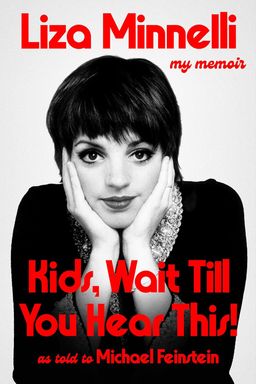
Kids, Wait Till You Hear This! cover

Kids, Wait Till You Hear This!

by Liza Minnelli, As Told To Michael Feinstein, With Josh Getlin And Heidi Evans

The EGOT icon shares some of the highs and lows of her life and career.

Childhood’s Chaos Is the Truth

When was the last time you laughed at a tiny family disaster or a school rule that made no sense—and then felt a sting of recognition? In You Wait Till I’m Older Than You, Michael Rosen argues that the unruly, hilarious, sometimes frightening everyday life of children isn’t a sideshow; it’s the main event. He contends that the language kids speak, the scrapes they get into, and the way they test (and retell) reality are how they build a self. But to see that, you have to listen to the child’s voice with respect and delight.

Rosen writes in short, vivid pieces—poems, sketches, and micro-stories—that capture the texture of growing up in postwar London. Through tussles with brothers, baffling teachers, grubby food rituals, and wild adventures with friends like Harrybo, he shows you how a child learns power, risk, love, and language. The core claim is bold and generous: humor isn’t a way to dodge seriousness; it’s how kids face it. The punchline opens a door to the truth.

The Case for Listening to Kids

Rosen treats children’s speech as serious literature. Whether it’s a three-year-old declaring, “My pasta is kidnapped and my mouth is a dungeon,” or a six-year-old inviting you to a party with “ice-cream, jelly, a punch in the belly,” he shows you that kids don’t just imitate adults; they invent metaphors, twist logic, and test how words work. The book invites you to tune your ear to that creativity in your own family or classroom. (Compare to Shel Silverstein’s wordplay, but closer to oral storytelling and observational comedy.)

Small Stories, Big Systems

The pieces look small—an argument about who started a fight, a teacher confiscating a “Handball,” a dad trying to return a waterlogged torch—but they reveal large patterns. Gendered playground lines, the class-sorting brutality of the 11-plus exam, and the quiet freight of Jewish family history all flow through the laughter. Rosen’s childhood friend Harrybo fails the exam, drifts away, and later dies young. A made-up “nest” becomes a study of wishful thinking and the gentle shame of being believed. A grandmother’s wedding faint and a cousin’s hidden diamonds (that turned out to be glass) show how identity and survival are knotted into family lore.

Humor as X‑Ray of Family Life

Domestic scenes—covert matzo bray when Mum’s out, Dad’s “deal” about scoldings, Mum’s eternal shirts and apricot jam—make the kitchen a stage where affection, secrecy, and power play out. You laugh because you recognize the script. You wince because you’ve said those lines. Rosen’s point: the ordinary is epic, and kids are noticing everything. (Think of Roald Dahl’s Boy for the shock of school authority; Rosen is warmer, more tender to adults, but no less exact.)

Why This Matters to You

If you’re a parent or teacher, Rosen gives you a way to decode tantrums, testing, and tall tales. If you write or lead, he models how to dignify another’s point of view without solemnity. And if you simply love language, he shows you how an exit-row instruction card or a calculator display can become a poem. You come away convinced that childhood speech—and the mischief that births it—is not just cute; it’s a curriculum in becoming human.

What You’ll Learn in This Summary

  • How rules and power look from a child’s eye—especially when they’re arbitrary (“The Line,” “The Register”).
  • How friendship and class shape identity—and how memory honors lost friends (“Harrybo,” “Stobs,” “My Friend Roger”).
  • How family rituals, food, and secrets carry cultural identity and love (“Don’t Tell Your Mother,” “The Wedding,” “Leosia,” “The Cupboard”).
  • Why risk and mischief are the real laboratories of learning (“The Torch,” “Eddie and the Car,” “Robin Hood’s Bay,” “Top Board,” “Australia”).
  • How language play is both craft and coping—turning confusion into creativity (“Useful Instructions,” “Calculator,” “Found Poem,” “Invisible Ink”).
  • What modern parenting looks like under pressure—funny, flawed, and fiercely loving (“Eddie and the Supermarket,” “Great Day,” “For Naomi”).

Key Idea

Rosen’s child narrator isn’t naïve; he’s a philosopher with jam on his shirt. Laughter is the form; truth is the content.

Read this book to remember the smell of school corridors, the shock of a rubber hammer in hospital, the glory of walking into England with your trousers down—and to see how those memories become tools for empathy now. You’ll likely finish wanting to listen better, laugh sooner, and take children’s words at their full value.


Rules, Power, and The Line

Rosen shows you that childhood is a masterclass in navigating power—especially the kind enforced by adults with whistles and registers. In “The Line,” the school opens with a decree: boys here, girls there, divided by an imaginary border policed by Miss Wheelock, the Head’s “Deputy Sheriff.” The rule is arbitrary but absolute, and it turns the playground into a map of authority. When Gunter, a bewildered new boy from Germany, brings a “Handball,” the line collapses in a rush to play, and the adults double down: confiscation, public scolding, and caning by a headmaster who breathes menacingly through his nose.

This is how kids learn what power feels like. The logic often isn’t moral; it’s procedural. “Why do we have the Line?” the head demands. No one knows. The rule exists to assert rule-making. (Compare this to Roald Dahl’s headmasters in Boy; Rosen’s portrait is less cartoonish but equally chilling in its banality.)

How Arbitrary Rules Are Made Real

An imaginary line becomes real because adults enforce it. Miss Wheelock calls crossing it tantamount to moral failure—“by God, I’ll have it, boy” she says of the ball—and by doing so, she teaches children that borders can be created by fiat and backed with pain. The caning “as fast and as hard as he could” drives home that power does not require a good reason, only a good ritual.

Gender, Fairness, and Surveillance

The line is also gendered. When Frances tries to teach Michael to skip, she remains on her side, passing the rope over the border. Miss Wheelock shuts it down: passing a rope is “just the same as crossing.” Frances is expected to “know better” after one week in the new school—girls are deputized to uphold the system. This is early socialization at work: girls as guardians of propriety, boys as likely culprits. The effect is to make cooperation suspect and surveillance normal.

Finding a Voice: Booing as Micro-Resistance

When Miss Wheelock wrests the Handball away, Michael boos. That single boo unlocks a chorus. It’s not a revolution, but in a world of arbitrary lines, small no’s matter. The headmaster’s response—individualizing punishment (“You—you—you— and you”)—is a classic move: isolate, shame, and inscribe it “in a book.” Kids learn that speaking up carries cost, yet they also learn the felt solidarity of a shared objection.

Everyday Bureaucracy in “The Register”

Rosen widens the lens in “The Register,” a comic chaos of a classroom where snails escape, parents intrude, and forms appear without purpose. The teacher’s voice (breathless, kind, exasperated) reveals a softer absurdity: systems that consume attention instead of aiding learning. While no one is evil here, the result is similar—a scatter of partial tasks, a missing register, a missing snail (Robin, retrieved from Darren’s pocket). Kids sense that adults run on bafflement too, which can be both comforting and destabilizing.

Adult Blind Spots: “Mum’s School” and “Hospital”

At his mother’s school, Michael’s skipping provokes her private shame: “You let me down.” He answers with a child’s rhyme—“inky pinky ponky”—which both resists and misfires. In “Hospital,” after a cricket ball smashes his nose, the teacher’s first question is, “Did you catch it?” That punchline is a diagnosis: institutions prefer performance metrics to pain. Children learn: some adults will miss the point.

Key Idea

Rules teach two things at once: what’s allowed, and how power works. Rosen shows you both—and how kids quietly push back.

Why this matters to you: whether you parent, teach, or lead teams, your “lines” can become tyrannies if they’re unexamined. Ask what purpose a rule serves and whether children can see that purpose. Notice small acts of resistance; they signal a need for explanation or revision. And remember that sometimes, like the teacher in “The Register,” your best move is humility: name the muddle, find the snail, and keep going.


Friendship, Class, and Growing Apart

Rosen’s friendships are tender, testing grounds where loyalty, shame, class, and loss collide. The most haunting strand is Harrybo. As boys, they roam ponds, make go-karts, and nick toy cars from Woolworths. The mischief is ordinary; the bond is real. Then comes the 11-plus exam—Rosen passes into grammar school; Harrybo goes to secondary modern—and the sorting machine of British education quietly severs them. They wave across bus windows. Harrybo grows into teenage snogging under a mother’s gaze; Rosen moves house. Years later, a classmate named Jimmy tells him: “Harrybo died when he was 17.” The breath goes out of the book for a beat. The boy whose name rings through the poems never read them.

This arc is about class as a social technology: it reassigns who you see every day, who your friends are “allowed” to become, and ultimately, who tells your story. (For context, recall Alan Johnson’s This Boy or Billy Bragg’s writings on the 11-plus; Rosen captures its human-scale effect on friendship, not just careers.)

Making and Unmaking Friends

In “The Nest,” the boys co-create a fiction. Michael weaves dead grass into a “find”; Harrybo champions it with full-hearted belief. The teacher’s raised eyebrow questions the myth, but the boys keep their pact. Even after the “nest” becomes a heap of straw under the sink, Harrybo loves it—keeps it on his chest of drawers, shows it off for years. Friendship is this: shared make-believe that becomes a real memory, even when its facts are bogus.

The Politics of Belonging: Stobs and Staff

At the new school, Michael’s best friend is Stobs, who proposes a London scrapbook. But when Michael tells their mutual friend Staff about the idea, Stobs freezes him out without explanation—“He just ignored me.” Staff’s aside (“He’s always like that”) reframes the pain: this isn’t Michael’s unique failure; it’s Stobs’s pattern. The lesson is formative: sometimes relief comes not from fixing a friend, but from naming a dynamic and choosing where to place your loyalty and attention.

Shame and Visibility: Roger and Mr Baggs

“My Friend Roger” won’t walk up the road with Michael for fear his parents will see them together. The rejection is quiet, social, and scalding. Michael leans around the wall to watch him anyway. In “Mr Baggs,” the football coach praises the ideal “centre-half” and then realizes: it’s Michael’s position. “I’m sorry. I wasn’t thinking.” Adult thoughtlessness lands like a verdict on talent and belonging. Friendship and authority both carry the power to include or exclude with a sentence.

Memory as Tribute

Rosen’s craft is an act of keeping. By writing Harrybo into dozens of pieces—raw beans in the garden, redcurrant chins, pockets full of stolen cars—he defies the forgetting that class movement and death impose. The stories become a counter-archive: “Before Jimmy told me this I had sometimes wondered if somewhere some time Harrybo had read all these things … but he hadn’t.” You feel the ache; you also feel the dignity of being remembered well.

Key Idea

Children choose each other inside systems that later choose for them. Rosen writes so the choosing—and the loss—won’t vanish.

What you can take with you: notice which “exams” in your world separate you from your people; name them, and find ways to keep telling each other’s stories. When a friend goes silent, ask whether it’s about you—or about a pattern they repeat. And when a shared fiction (the “nest”) binds you, honor the feeling even if the facts are messy. You’re building the archive you’ll need later.


Family, Food, and Secret Deals

Step into Rosen’s kitchen and you’ll see that families run on rituals, negotiations, and delicious conspiracies. In “The Deal,” the parents have agreed that only one will scold at a time. Dad honors it when he’s raging about shaving soap stuffed with toothpaste; Mum, less so—she scolds about muddy shoes and Dad can’t resist chiming in from the sidelines with “Quite!” and “You’re right there, Connie.” The rule is sound; the practice is human. Children learn the difference.

Food magnifies this dance. “Don’t Tell Your Mother” is a culinary heist: when Mum goes to evening classes, Dad fries up contraband matzo bray (“It tastes best … in hinner shmaltz”) and swears the boys to secrecy. The next day, Mum asks, “What did your father cook you last night?” The boys stall—“stuff … egg on toast.” You can feel the grease and the grin. The kitchen is where rules get bent in the name of love.

Kitchens as Theaters of Power and Care

In “Shirt,” Mum buys him things he hates but insists, “They’re wearing them like that now.” She wants him to be acceptable in the world. In “Motto,” a wall sign—“Seek and ye shall find”—turns into a schoolboy gag. In “For Naomi,” Rosen lists the habits that mortify his kids: “shouts in shops … sings on buses … has long hair and writes poems.” Underneath the jokes is a question every family lives: how do we love each other when we embarrass each other?

Heritage and Hidden Histories

Rosen’s Jewish family life hums throughout. “The Wedding” takes place under the khuppe; Uncle Ronnie faints, gets propped up by the shammes, and the marriage proceeds. “Gypsy” ponders a dark-skinned aunt with gold earrings who sits beside Bubbe; identity arrives as rumor, scarf-tied and laughing. “The Cupboard” opens to wartime letters—Dad writing to Mum as the war ends—revealed through a crawl space beyond a box where gas masks and an army jacket whisper from the dark. You sense how family culture is transmitted: not in lectures, but in trunks, food, and jokes.

The Gravity Beneath the Play: “Leosia”

The book’s quietest, heaviest story arrives when Rosen visits his father’s cousin, also named Michael, who survived both Nazi and Soviet camps. He can’t bear to tell his own tale but asks his wife to tell the story of cousin Leosia. She hid diamonds (actually glass, unbeknownst to her) in her heels to survive the war while passing as Christian. The reveal—that Grandmother had replaced the diamonds years before—lands like a parable: sometimes you live by faith you think is backed by assets. The “diamonds” were belief and nerve. (This sits alongside Primo Levi’s memoirs as a different mode—domestic anecdote rather than testimony—but the moral weight is palpable.)

What Families Really Teach

Rosen’s families teach through doing: cooking what’s forbidden, returning broken torches with a wink (“You were going to tell him all about your underwater swimming fandango, weren’t you? Blabbermouth!”), and saving letters in cupboards that scare the kids. The contradictions aren’t glitches; they’re the curriculum. Kids learn that love can be bossy and disobedient, that history is in the house, and that a good story heals the places a lecture can’t reach.

Key Idea

Home is a laboratory where culture, conscience, and comedy mix. The recipe is messy; the meal is unforgettable.

Application for you: make a ritual (even a silly one) that your family alone understands; tell the old stories near the stove; admit your double standards with a smile; and, once in a while, fry the forbidden thing—then do the washing up together.


Risk, Mischief, and Learning by Doing

The bravest thing Rosen does is let kids learn on the edge. “The Torch” begins with a boy’s dream: a waterproof flashlight. Dad says it’s waterproof; the boy hears submarine. He swims with it; it dies. Dad roars. They return it to the shop, and Dad lies with a straight face—“I dunno, it just went off”—while kicking his son’s ankle to shut up the truth. The scene is comic and crooked; it’s also a workshop on how rules, consequences, and cover stories get made in real time. The boy learns both physics and social physics in one afternoon.

“Eddie and the Car” is a full-body parable of parental misjudgment. During a picnic, three-year-old Eddie climbs into the Renault 4 and “drives”; Dad tries to stop the rolling car by hanging on to the pillar, chanting “I know it’s moving” while peaches fly off the roof. They plunge into a ditch; Eddie bites his mum in panic. A farmer arrives three hours (and a lunch) later with a tractor and a Gallic “Jamais, jamais, jamais.” The car is retrieved; the story becomes family legend. (Lenore Skenazy’s Free-Range Kids argues for risk as a teacher; Rosen gives you the pratfall edition.)

Edges and Thresholds

Children chase thresholds: “Top Board” asks Michael to dive from the high board, where the clock is now his height and the air “full of shouting.” He leaps; it feels like a handstand on nothing. Mr Hicks asks for five more. In “Robin Hood’s Bay,” two boys take a train alone, build a dam from “hundreds and hundreds of stones,” and return to parents with muddy binoculars and talk of helicopters. Risk is both euphoria and the moment when adults realize what they fear most.

Bodies Teach Before Rules Do

In “Hospital,” a cricket ball smashes his nose; he learns pain, fear, and empathy via the man with no face named Charlie. The nurse’s promise—“bang your nose straight with a rubber hammer”—is both clinical and comic, and it registers how kids metabolize terror via absurdity. In “Trousers Down,” the boys decide to “walk into England with our trousers down” to celebrate climbing The Sugarloaf. Parents thunder; the boys grin. Bodies mark achievement long before certificates do.

Nature Has Notes of Its Own

“Australia” turns the bush into a slapstick hazard course: magpies dive-bomb, a grey spider growls “Grrrrrr,” a scorpion scuttles (later squashed by Richard Scarry’s giantest book), and a fat lizard flashes a red mouth with a blue tongue. Adults say, “Don’t worry about them.” Then: “Lucky you didn’t see a Red Back … a few people die.” The punchline is existential: danger is both nothing and something, depending on the story you tell after.

Adults Are Improvisers, Not Oracles

In all these pieces, adults are winging it. Dad bluffs the torch vendor; a teacher mistakes concern for competence; parents forget bread after surviving the supermarket with a tantruming Eddie. The lesson isn’t cynicism; it’s compassion. You won’t always get risk right. But you can retell the near-miss in a way that turns fear into family knowledge.

Key Idea

Experience is the teacher; comedy is the transcript. The bruise, the dive, the rolling car—each becomes a story that teaches everyone how to go again.

Try this: give your kids bounded edges to test (a supervised “Top Board” of their own), narrate your mistakes without shame, and ask, after the scare fades, “What did we learn?” Then write it down. You’re building your family’s playbook.


Language Play and Kid Logic

Rosen is a poet of everyday talk. He doesn’t prettify children’s language; he listens until it sings. “Useful Instructions” scrambles parental bark—“Wipe that face off your smile,” “Don’t eat with your mouthful,” “How many tunes do I have to tell you?!”—to reveal how kids hear adult authority as glorious nonsense. “Running” takes a sign above a tap—“Run a long time to get hot water”—and obeys it literally by running around the room. This is how metaphor is learned: by trying it on and laughing when it doesn’t fit.

“Calculator” flips 8075 07734 to read “hELLO SLOB,” then builds a lexicon (“LIZZIE SIZZLES,” “BOB gOggLES”). It’s a workshop in constraints and delight—the same pleasure poets find in forms. “Found Poem: Safety Instructions on United Airlines 1995” isolates a bureaucratic sentence until it reveals its absurdity: if you can’t understand the card, how can you understand the instruction to say you can’t? (Think of Ogden Nash’s brevity or Brian Bilston’s found-poem winks; Rosen locates poetry in lost-and-found bins of daily life.)

Child Logic Is a Different Intelligence

A three-year-old says, “My pasta is kidnapped and my mouth is a dungeon,” and you glimpse metaphor forming in the wild. Another child asks if a sheepdog is “half-dog, half-sheep.” Kids are philosophers who test categories by mashing them together. In “Invisible Ink,” lemon juice works as the answer—but the child’s practical challenge, “I can’t read it,” nails the adult’s half-help. The humor asks you to meet children where their questions actually land.

Music, Repetition, and Minimal Forms

“Is It Possible to Sleep on a Train?” is a rhythmic mantra that ends with “I sleep.” The form embodies the answer. “Great Day” lists everything lost—bathroom, socks, lunchbox, pen—until the only thing found is bed. “Sweetshop” is a chorus of pestering that any parent can sing along to. Repetition here is not filler; it’s an x-ray of compulsion and desire. (This is Dr. Seuss energy without the whim-creatures—music born from ordinary nouns.)

Translation and Cultural Code-Switching

“Muss i’den” captures a cultural glitch: Miss Joseph teaches an Austrian folk song just as Elvis releases “Wooden Heart,” built on the same melody. Pat Phipps screams. Miss Joseph, appalled, scraps the lesson. Two languages—pop and pedagogy—collide. Elsewhere, Yiddish words (Bubbe, shmaltz) and synagogue life surface without footnotes, trusting you to catch up. Kids live in code-switch, and Rosen lets the music of it stand.

Pictures That Talk Ruder Than Adults

In “Proverbs,” the family owns a Flemish painting where people literalize sayings—peeing on the moon, many men backing into one toilet. Rosen notes that his friends visit “to look at the rude bits.” It’s a primer in metaphor from the other end: start literal, then discover the idea. Children learn how language says two things at once by laughing at the one thing it seems to say first.

Key Idea

Language play isn’t extra; it’s how kids claim reality. When you laugh at the twist, your brain has just learned a new route.

Try this at home or school: turn instructions into tongue twisters, make found poems from appliance manuals, flip calculator words, and ask kids to explain their wild metaphors back to you. You’ll stretch meaning together, which is another way of saying: you’ll grow.


Parenting in the Trenches

Rosen’s parenthood pieces are as instructive as any manual, precisely because they refuse to be a manual. “Eddie and the Supermarket” is a tantrum opera: a child who turns to iron when placed in the trolley, chants “Bince, bince, bince” (beans) while grabbing chocolate wafers, and detonates into a “screaming demon.” The shelf-stacker’s finger trick, the gender misfire (“She is making a fuss, isn’t she?”), and the arrival of four armored security men (instant calm) are slapstick and sociology at once. Parents nearby pretend not to notice while the noise seeps into their bones. Rosen checks out, floats into the car park—then realizes he forgot bread, jam, toilet rolls, milk, orange juice, tuna fish, and cornflakes. Back home: “Dinner time, Eddie.” “Bince.” They’ve run out of beans.

This is the texture of daily life: good intentions, structural traps (store layouts, nap schedules), and the humble truth that you will forget something. The piece dignifies the difficulty without sanctimony.

Tantrums as Theater, Not War

Rosen stages the tantrum with cinematic detail—face going red, eyes swollen, body heaving—to validate how overwhelming it feels. Instead of prescribing a fix, he observes what calms Eddie (a surprise: imposing figures doing something unrelated). You learn to look for environmental levers rather than moral narratives. A meltdown is a performance the nervous system puts on when under-resourced; your job is stage management, not verdict.

Comic Coping and Shared Humanity

“Great Day” catalogs a parent’s fog—can’t find the bathroom, the pen, the paper—until bed brings reprieve. “Is It Possible to Sleep on a Train?” chants itself to sleep. “For Naomi” lists the lovable embarrassments of a poet-dad (“says hello to babies … argues with policemen”). These pieces teach compassion for your future self. You will be the parent who sings on buses; your kid will cringe; love holds anyway.

Teaching by Trying (and Failing Publicly)

“Eddie and the Car” showcases a parent choosing the worst immediate tactic (physically stopping a moving car) and then turning it into family lore. You’re invited to notice your own error-making with less shame and more curiosity. Likewise, “The Register” invites parents to see teachers’ chaos with empathy; no one is in full control. Modeling how to narrate a fiasco may be the most powerful skill you pass on.

What Children Actually Remember

The book suggests kids won’t remember whether you always had beans; they’ll remember the time you didn’t, the chant you both laughed at, the colossal security men, the car in the ditch, the torch returned on a technicality. This doesn’t absolve you from planning; it relieves you from perfectionism. You are building a repertoire, not a résumé.

Key Idea

Good parenting isn’t tidy; it’s truthful, funny, and durable. You don’t avoid mess—you metabolize it into a story you can use next time.

Practical takeaways: pre-commit to leaving the aisle with dignity (even if you forget the tuna), name the feeling rather than the fault (“Eddie’s tired and wants beans”), recruit the environment (a new sight, a song, even a friendly “security guard”), and when it’s over, narrate the day together. Then go to bed. “Ah—find bed.”

Dig Deeper

Get personalized prompts to apply these lessons to your life and deepen your understanding.

Go Deeper

Get the Full Experience

Download Insight Books for AI-powered reflections, quizzes, and more.