
Idea 1
How Rich Countries Really Became Rich
Have you ever wondered why some countries are rich and others remain poor—despite seemingly following the same economic advice? In Kicking Away the Ladder, economist Ha-Joon Chang turns this question into a historical investigation and a moral challenge. He argues that the world’s richest nations did not become wealthy by practicing the open trade, privatization, and deregulation they now preach to developing countries. Instead, they achieved prosperity through protectionism, state intervention, and deliberately nurturing their own industries—strategies they now deny to others.
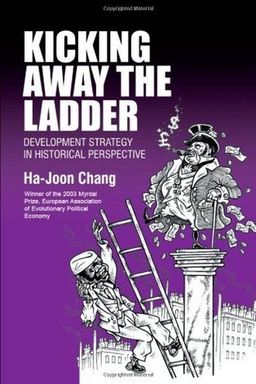
Chang’s central argument is simple but explosive: rich countries are effectively kicking away the ladder of economic development. They climbed to prosperity using state-led industrial policies and flexible institutions but now force developing nations to adopt supposedly “good policies” and “good governance”—policies that the rich themselves ignored during their rise. The result, he contends, is a global double standard that stifles poorer countries’ ability to develop.
Why This Question Still Matters
Today’s international economic order—shaped by the IMF, World Bank, and WTO—pressures developing countries to open their markets, reduce tariffs, and adopt Western-style financial and legal systems. These terms are justified through what Chang calls the Washington Consensus, a set of neoliberal principles promoting free trade and minimal government interference. But, Chang asks, if these policies truly lead to growth, why did they fail to produce prosperity for many developing regions—while helping none of the now-rich countries in their own histories?
Instead of remaining abstract, Chang dives deep into economic history, showing that from eighteenth-century Britain to twentieth-century America, nearly every successful economy relied on aggressive protectionism and industrial policy. His analysis covers Europe’s main powers, East Asia’s latecomers, and even the supposed free-trade champions like Britain and the United States, whose own histories reveal decades of strategic interference.
The Ladder Metaphor from Friedrich List
The book’s title originates from nineteenth-century German economist Friedrich List, who accused Britain of hypocrisy. After using tariffs and state-supported industry to rise to global dominance, Britain, according to List, began preaching free trade to poorer nations. He famously described this behavior as “kicking away the ladder by which [Britain] climbed up,” leaving others stranded at the bottom. Chang sees modern globalization as a replay of this same pattern.
By revisiting List’s ideas, Chang makes two bold claims: first, that free-market capitalism is not a universal pathway to prosperity; and second, that economic theories are deeply political—often designed to serve the interests of those already in power. This historical perspective challenges the moral legitimacy of the current global economic advice dispensed to developing nations.
Why History Matters More Than Theory
A major methodological contribution of Chang’s book is his call to “bring history back” into economics. Where modern neoclassical thinking relies on mathematical models and abstract assumptions, Chang favors an inductive, historical approach. He revisits how actual economic policies worked in practice rather than how they’re supposed to work in theory. This allows him to illuminate contradictions between what nations did and what they later claimed was responsible for their success.
Through this lens, he demonstrates that Britain industrialized behind stiff tariffs, the U.S. protected its infant industries for over a century, and latecomers like Japan and South Korea soared thanks to deliberate state planning—not pure market freedom. Ironically, once these nations achieved industrial maturity and competitive advantage, they switched to preaching laissez-faire to others.
Why Institutions Aren’t the Whole Story
In later chapters, Chang examines the second part of what he calls the “modern orthodoxy”: the belief that adopting “good institutions” is the key to development. Western powers insist that developing nations implement democratic governance, independent central banks, and rigid property-rights regimes. But, again, history tells a different story. Most developed countries only achieved these institutional qualities after—they were already rich. For instance, the United States established a central bank as late as 1913; Switzerland became a technological leader before having a patent law; and many Western nations extended the vote to all adults only in the twentieth century.
Chang argues that strong institutions often emerge because of economic development—not before it. Demanding them prematurely can drain resources, create bureaucratic burdens, and impede growth. He doesn’t reject institutional reform outright but calls for context-sensitive adaptation instead of blind imitation.
Challenging the Moral High Ground
Ultimately, Kicking Away the Ladder is as much an ethical critique as an economic one. It exposes the double standards of international economic policy and asks you to question what counts as “good behavior” in global development. Chang doesn’t deny the complexity of globalization, nor does he idealize protectionism. Rather, he urges readers to recognize history’s lessons: that countries need the freedom to experiment with policies suited to their stages of development. Otherwise, the global system will keep reinforcing inequality rather than reducing it.