
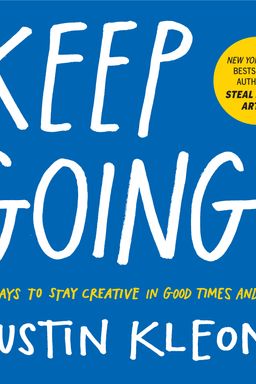
Keep Going cover

Keep Going

by Austin Kleon

Keep Going by Austin Kleon is your guide to sustaining creativity through life''s ups and downs. Packed with actionable tips and insightful anecdotes, this book helps artists and creatives of all kinds stay inspired and motivated, encouraging a joyful, unpressured creative journey.

The Art of Perseverance and Creative Renewal

When the world feels overwhelming, how do you keep creating, keep thinking, and—most importantly—keep going? In Keep Going, Austin Kleon offers ten timeless principles for sustaining a creative life, whether you’re a painter, writer, entrepreneur, or simply someone trying to stay sane and inspired in a noisy world. His central argument is simple but profound: creative persistence isn’t about being brilliant—it’s about showing up every day with curiosity, patience, and attentiveness to the ordinary.

Kleon contends that inspiration doesn’t strike like lightning. It grows slowly, rooted in daily habits, mindful routines, and an openness to change. Creativity isn’t a heroic journey but a cyclic process—closer to Groundhog Day than The Odyssey. You wake up, face the same questions, do the same work, and discover new meaning through repetition and reflection. Every day, he says, is a chance to make something beautiful, even in moments of doubt or despair.

Why This Message Matters

Our modern culture glorifies speed, novelty, and measurable success—followers, profits, metrics. But Kleon reminds you that a creative life doesn’t fit those parameters. It’s about nurturing what the poet Rainer Maria Rilke called “ripening like a tree”—slow, patient, and cyclical. He argues that even the greatest artists—from Corita Kent to Leonard and Virginia Woolf—understood the importance of endurance and renewal as creative forces.

This book is Kleon’s antidote to burnout, disillusionment, and digital distraction. It’s not a motivational speech; it’s a manual for living creatively even when the world feels bleak. It teaches you to walk instead of scroll, to tend your inner garden instead of chasing external validation, and to make things that matter not for profit, but for love, connection, and attention.

The Ten Practices That Keep You Going

Across ten chapters, Kleon unfolds a series of habits and philosophies that reinforce creative longevity:

  • Groundhog Day living: building daily routines that ground creativity in consistency and craft rather than mood.
  • Bliss stations: creating sacred spaces and times for solitude and focused work away from the chaos of the world.
  • Doing the verb, not the noun: focusing on making, exploring, and playing rather than trying to embody an identity or job title.
  • Making gifts: using creativity to connect and give, rather than always trying to sell or monetize your passions.
  • Finding extraordinary in the ordinary: paying deeper attention to the everyday as a source of art and inspiration.
  • Slaying the art monsters: rejecting the myth that great art excuses bad behavior.
  • Changing your mind: embracing uncertainty and curiosity as central to creative growth.
  • Tidying up: using organization and play not for perfection, but to rediscover possibilities and connections in your messy world.
  • Getting outside: reclaiming your senses and sanity through the act of walking, disconnecting from screens, and reconnecting with nature.
  • Planting your garden: nurturing your work patiently like a tree, knowing that seasons of growth and dormancy are both essential.

A Philosophy of Attention and Renewal

Kleon’s deeper thesis is that creativity is a way of paying attention to life itself. In a distracted age, he encourages you to build a daily rhythm that protects your attention, restores your senses, and grounds your imagination. Whether you draw, write, teach, or simply live thoughtfully, this practice of attention transforms the mundane into the miraculous. Like Corita Kent’s tree or Leonard Woolf’s iris bulbs, the art of living creatively depends on small, steady tending.

By weaving together stories from artists, writers, and thinkers—Nietzsche, Thoreau, Joan Rivers, Toni Morrison, and others—Kleon celebrates perseverance as the highest form of creativity. He concludes that the point isn’t to become famous or rich but to keep doing the verbs that make you come alive: painting, walking, gardening, writing, thinking, dreaming. Life and art, he insists, are sustained through kindness, curiosity, and commitment. The creative act isn’t about changing the world in one stroke, but about leaving things better than you found them—every day, in every little way.

“Worry less about being a great artist. Worry more about being a good human being who makes art.” —Austin Kleon

Ultimately, Kleon’s message is steady and humane: when everything feels uncertain—when you’re burned out, uninspired, or overwhelmed—just keep going. Walk. Write. Draw. Notice something. Plant a seed. Tend it carefully. Let time do its work. Creativity, like life itself, is not a race—it’s a rhythm.


Turn Daily Repetition into Creative Freedom

Kleon begins with the idea that creativity isn’t a path of sudden inspiration but a daily cycle of commitment. He compares the creative life not to a triumphant hero’s journey but to the endless loop of the movie Groundhog Day. Every morning, you face the same blank page, the same doubts, and the same demands on your attention. Yet, as you repeat this cycle with discipline and openness, you start to find clarity, beauty, and rhythm in the ordinary.

The Value of Routine

A daily routine, Kleon writes, “defends against chaos and whim.” It’s your safety net when life gets noisy. Creative work thrives not on passion or talent alone, but on habit. Famous creators have always known this: Kafka wrote late at night; Plath wrote early mornings before her children woke; Steinbeck sharpened twelve pencils before starting work. Their eccentricities don’t matter—the discipline does. Your job isn’t to find the perfect schedule, but to find a schedule and stick to it.

Routine frees you from the tyranny of mood. You don’t wait to feel inspired—you show up and do the work, knowing that consistency yields creativity. (James Clear makes a similar case in Atomic Habits—small daily actions compound into mastery.) Kleon reminds you that a structured day isn’t a prison, it’s liberation: by limiting randomness, you carve out space for genuine focus and play.

Lists as Anchors

Another form of structure is the humble list. Kleon adores lists—to-do lists, to-draw lists, to-learn lists. They clear mental clutter and transform vague anxieties into concrete actions. Lists can even become creative prompts: artist David Shrigley makes lists of fifty things to draw; Leonardo da Vinci made lists of questions to answer. When you can’t see the next step, make a list—it’ll show you where to begin.

Embracing Imperfect Days

Not every day will sparkle. Some days, you’ll simply “get rid of the day as best you can,” as Hawthorne wrote about his time with his son. The secret is to keep moving and forgive yourself for days that feel wasted. Success in creative life, Kleon says, isn’t about any single day—it’s about how you spend your days over time. One wasted day won’t matter if you persist through a thousand ordinary ones.

“Finish every day and be done with it. Tomorrow is a new day.” —Ralph Waldo Emerson

Kleon’s wisdom here is pragmatic: build small rituals, make lists, forgive yourself, and keep working. These humble tools—routine, reflection, persistence—are what separate fleeting inspiration from lasting creative freedom.


Find Ordinary Magic Through Attention

Kleon believes that extraordinary creativity doesn’t come from exotic adventures—it blossoms in ordinary life when you start paying attention. He draws inspiration from Sister Mary Corita Kent, who looked at Los Angeles billboards and saw spiritual messages in Wonder Bread bags and Safeway logos. She taught her students to carry “finders,” tiny frames through which they could crop the world and rediscover beauty hidden in plain sight.

Seeing for the Sake of Seeing

To create meaningful work, you must slow down and look. This is harder than it sounds in a hyper-speed culture. Kleon praises artist Peter Clothier’s One Hour/One Painting movement, inviting people to gaze at a single artwork for sixty minutes. When you look slowly, discoveries surface. Likewise, drawing pushes you to notice and inhabit a moment fully. Roger Ebert began sketching in later life not for skill, but because it made him see. “An artist using a sketchbook always looks like a happy person,” he wrote.

Attention Is Love

Attention, Kleon reminds us, is the purest form of love. Psychologist William James said our experience “is what we agree to attend to,” and that simple truth means what you notice shapes who you become. If your attention is swallowed by headlines and algorithms, your creative vision shrinks; if you attend to what’s real and near you—birds, light, loved ones—you reclaim your clarity and compassion.

Rereading Life

Kleon’s own discipline includes keeping a daily diary and then rereading it to identify patterns. The act of looking back helps you know yourself and refine your purpose. Rereading your sketchbook, camera roll, or journal reminds you what mattered most, helping steer your future work. (Julia Cameron’s The Artist’s Way uses similar daily practices of “Morning Pages” and reflection.)

“To pay attention, this is our endless and proper work.” —Mary Oliver

Ordinary life becomes art when you attend to it with care. Pay attention to your attention, Kleon insists—it’s how you rediscover both beauty and meaning in a world that constantly tries to distract you.


Do the Verb, Forget the Noun

One of Kleon’s sharpest challenges is to stop obsessing over what you are—artist, writer, musician—and focus on what you do. “Lots of people want the noun without doing the verb,” he writes. The noun sounds glamorous, but it’s static. Doing the verb—drawing, writing, composing—moves you forward, keeps you alive, and frees you from ego-driven stagnation.

The Trap of Titles

Titles often cage creativity. “Job titles are not for you,” Kleon says. They restrict what you feel permitted to explore. If you call yourself a “painter,” what happens when you want to write? If your sense of self depends on external recognition, you might stop experimenting altogether. Instead, practice without waiting for permission. Artists don’t make art after someone calls them artists—they earn that noun through the verb.

Play as the Core of Creation

Children naturally embody this principle—play is their work. Kleon watches his young son Jules draw with total focus yet complete detachment from results: once he’s done, the medium and outcome don’t matter. That’s the essence of creative freedom—playing without demanding validation. Adults lose this ease when their creativity becomes commerce. To reclaim it, Kleon encourages you to “practice for practice’s sake.” Make art, destroy it, toss it out, and enjoy the act itself.

Bad Art, Good Spirit

Kleon quotes Sol LeWitt: “Try to do some bad work—the worst you can think of—and see what happens.” Making intentionally ugly or stupid art can reignite creative joy. When results stop mattering, you rediscover the process. Vonnegut, too, told students to write poems and throw them away, because creating something—anything—makes your soul grow.

“Forget the nouns altogether. Do the verbs.” —Austin Kleon

Creative vitality depends not on titles or outcomes but on engagement. Work lightly, play deeply, and do your verbs. They’re what keep you free and awake to life.


Create Gifts, Not Just Commodities

Modern culture urges you to monetize everything you love—turn hobbies into side hustles, passions into brands. Kleon resists this mindset. Creativity, he argues, loses its soul when it’s confined to the marketplace. The antidote is making gifts: creating something for another person or for the sheer joy of giving. “Where there is no gift, there is no art,” writes Lewis Hyde, a line that Kleon echoes throughout this chapter.

The Danger of Monetization

Turning passion into profit alters its spirit. When your art becomes your job, you risk hating what you once loved. Kleon warns artists to keep at least a small sanctuary of creativity “off-limits to the marketplace”—a private space for joy and experimentation. Keep your overhead low, he says, and your spirit free. A “free creative life is not about living within your means—it’s about living below your means.”

Ignoring Metrics

Kleon also critiques the rise of digital metrics—likes, shares, views—that distort artistic judgment. Online numbers have little correlation with quality or human impact. To refocus, he advises temporarily ignoring analytics and returning to qualitative measurement: Did your work move someone? Did it move you? (Adam Grant in Originals makes a similar argument—true creation values novelty over popularity.)

Giving as Renewal

When Kleon feels discouraged, he makes robot collages for his five-year-old son Owen. Owen, in turn, makes robots for him. This exchange of gifts revives Kleon’s joy. Many beloved children’s books, he notes, began as gifts for single children—Winnie-the-Pooh, Pippi Longstocking, The Hobbit. Gifts create connection and restore meaning to creation.

“Make gifts for people—and work hard on those gifts.” —John Green

Creativity becomes art when it connects hearts, not markets. In this chapter, Kleon invites you to make gifts—acts of generosity that remind you why you started creating in the first place.


Protect Your Space and Sanity

In an age of endless notifications and media noise, solitude is revolutionary. Kleon builds on Joseph Campbell’s advice to create a bliss station—a personal sanctuary for deep focus and reflection. Every artist, he says, needs time and space to disconnect from the world and reconnect with themselves.

Building Your Bliss Station

Your bliss station can be a physical room or simply a daily hour of disconnection. Campbell imagined a space where you “don’t know what was in the newspaper that morning” and can rediscover who you are. This doesn’t require luxury—a corner desk, early morning silence, or a walk can suffice. What matters is deliberate retreat. (Cal Newport’s Deep Work echoes this same call for sustained focus amid distraction.)

Digital Detox

Kleon criticizes our habit of starting each day with news and screens, flooding our minds with chaos. Thoreau felt similarly about his weekly newspaper—it made him neglect his own life. Kleon suggests plugging your phone across the room at night, waking up without checking notifications, and reclaiming the quiet moments that nurture creativity and sanity.

The Joy of Missing Out

To protect your sacred time, you must learn to say no. Le Corbusier did so literally, telling a journalist “he’s not in” when asked for an interview during painting hours. Kleon urges embracing the Joy of Missing Out—celebrating that others are having fun while you preserve peace and purpose. Agnes Martin summarized this perfectly: “I paint with my back to the world.”

“Almost everything will work again if you unplug it for a few minutes—including you.” —Anne Lamott

The bliss station is both a space and an attitude—a daily decision to disconnect from noise and reengage with life’s deeper rhythms. Protecting your attention, Kleon says, is the first and most urgent creative act.


Work With Seasons, Not Deadlines

In one of the book’s most beautiful metaphors, Kleon tells the story of artist Corita Kent and her maple tree. After thirty years as a nun, Kent moved to Boston and spent two decades watching the tree outside her window transform through the seasons. It taught her that creativity—like nature—moves in cycles of growth, dormancy, decay, and regeneration.

Accepting Creative Seasons

Sometimes you blossom; sometimes you rest underground. Winter isn’t failure—it’s incubation. George Carlin lamented society’s obsession with constant progress, but nature thrives through contraction and renewal. Kleon urges you to imitate trees: observe your own creative rhythms and be patient during quiet periods.

Think Like a Perennial

Kleon rejects the culture of “35 Under 35” lists, preferring “8 Over 80.” He celebrates lifelong creators such as Bill Cunningham, Joan Rivers, Pablo Casals, and David Hockney—all of whom kept making art into their eighties and nineties. They weren’t annuals chasing fame—they were perennials tending their craft steadily. Like Hockney says, “I’ll go on until I fall over.”

Planting Hope

Gardening becomes Kleon’s ultimate metaphor for hope. He tells of Leonard Woolf refusing to stop planting irises even as Hitler broadcast his tirades: “I’m planting iris and they will be flowering long after he is dead.” Creativity, like gardening, defies despair. Each act of making is a seed; each day is potential growth. As Toni Morrison said, “This is precisely the time when artists go to work.”

“Imitate the trees. Learn to lose in order to recover.” —May Sarton

By aligning your creative process with natural cycles, Kleon teaches resilience: everything passes, everything renews. No matter the season, keep tending the soil—you’ll find beauty growing quietly beneath the surface.


Tidying as a Form of Discovery

Kleon ends his book with a surprising insight: tidying isn’t just physical—it’s creative and spiritual. While modern minimalism idolizes spotless desks, he embraces messy studios where ideas collide. Creativity, he argues, thrives on disorder and serendipity. A clean space doesn’t make art; readiness does.

Balancing Chaos and Order

Borrowing from chefs’ concept of mise en place, Kleon says artists need organized tools but messy materials. “Keep your tools organized and your materials messy,” advises his friend John T. Unger. Tangled piles often lead to fresh juxtapositions—connections you wouldn’t foresee. When in doubt, tidy up—not to sanitize, but to rediscover forgotten scraps and sparks of ideas.

Dreamy Tidying

For Kleon, tidying is “productive procrastination.” It’s a way to busy your hands while your mind intuitively solves problems. He often finds buried drafts or clippings that inspire new work mid-cleanup. This meandering process contrasts sharply with Marie Kondo’s strict minimalism—he refuses the notion that you shouldn’t read while decluttering. Reading, he says, is the point.

Tidying the World

Kleon extends tidying beyond the studio into the world. Writer David Sedaris spends hours picking up litter along roads near his home, and a garbage truck was even named after him. This act of cleaning echoes artistic restoration—making beauty from waste, creating order out of chaos. Kleon argues we need fewer vandals and more artists who mend and repair. Real art doesn’t just make marks; it leaves things better than it found them.

“Things are already a mess. We need art that tidies, mends, and repairs.” —Austin Kleon

To tidy is to reconnect with the forgotten and neglected parts of creation. Kleon’s version of cleaning isn’t sterile—it’s alive, exploratory, and filled with love for what’s imperfect. In his final message, he reframes creative action as quiet restoration: leave the world, and your own space, a little cleaner, a little more beautiful, every day.

Dig Deeper

Get personalized prompts to apply these lessons to your life and deepen your understanding.

Go Deeper

Get the Full Experience

Download Insight Books for AI-powered reflections, quizzes, and more.