
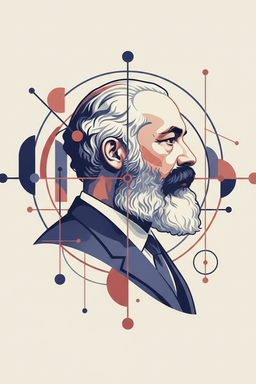
Karl Marx cover

Karl Marx

by Karl Marx

Karl Marx, a German philosopher born in 1818, is best known for his ideas on socialism, communism, and critiques of capitalism. Despite facing opposition and exile, he collaborated with Friedrich Engels and published influential works like The Communist Manifesto and Capital, which continue to impact economic thought today.

Karl Marx and the Human Cost of Capitalism

Have you ever felt disconnected from your job, wondering whether your work really means anything beyond the paycheck? Karl Marx’s lifelong obsession with this question wasn’t just political—it was deeply human. In his writings, Marx asked why so many of us end up laboring without joy, consuming without fulfillment, and living in societies overflowing with production yet lacking compassion. His critique of capitalism wasn’t just about economics; it was about our sense of meaning, our relationships, and our capacity to become fully ourselves.

Across his career—spanning from the fiery Communist Manifesto to the intricate analysis of Capital—Marx argued that capitalism’s success hides a moral and emotional disaster. It makes us richer in goods but poorer in spirit. The modern economic machine, he believed, turns workers into cogs, drains purpose from labor, and destabilizes life itself through constant crises, inequality, and insecurity. Yet Marx didn’t offer rigid political recipes; instead, he gave us a set of diagnoses—a kind of moral X-ray of modern society—that still help us identify where value, compassion, and creativity have gone astray in our systems of production.

From Rebellion to Reflection

Born in 1818 in Trier, Germany, Marx was the descendant of a long line of rabbis whose family converted to Christianity to assimilate. His early life showed flashes of rebellion—he was jailed for drunkenness, challenged classmates to duels, and dreamed of becoming a dramatic critic. But at the University of Berlin, Marx found philosophy, and with it, a lifelong adversary: the capitalist order. In the company of radical thinkers known as the Young Hegelians, Marx explored ideas about freedom, justice, and the material conditions shaping human life. These were not ivory-tower debates; they were attempts to understand why modern society seemed to breed misery despite its promise of progress.

Fleeing from political persecution with his fiancée, Jenny von Westphalen, Marx ended up in London, broke but driven. There, with his friend Friedrich Engels—whose father’s cotton mill represented the capitalist world Marx sought to critique—he produced some of history’s most influential works. His concern was less with overthrowing capitalism overnight than with exposing its internal contradictions: how it simultaneously produced abundance and poverty, innovation and alienation.

The Central Diagnosis: Alienation and Human Diminishment

Marx’s most enduring insight was alienation—his term for the way work under capitalism disconnects people from what makes them human. In the Economic and Philosophic Manuscripts of 1844, he explained that meaningful labor should reveal our best qualities, allowing us to see our care, creativity, and precision made visible in the products we build. But industrial capitalism shattered this bond. Workers specialized into narrow roles—accountants, packaging technicians, or assembly line operators—deprived of any sense of creating something that expressed themselves. Work became mechanical and external, a daily act of self-betrayal.

For Marx, this alienation extended beyond the workplace. It infected relationships and even our sense of self-worth. We came to define success in purely economic terms—how much money we earn, how many possessions we own—rather than how deeply we connect with others or contribute to shared well-being. As he later put it, capitalism doesn’t just exploit—it teaches us what to value, often in all the wrong ways.

Economic Instability and Emotional Hunger

Marx saw that capitalism’s miracles of production came with violence. Factories could churn out goods that should have liberated humanity from toil, but instead they created cycles of unemployment and recession. These crises weren’t born from scarcity but from abundance—from producing more than the system could profitably sell. The result was instability and suffering amidst material plenty. And behind this turbulence lay an emotional void. Workers were made expendable, their livelihoods subject to the whims of market costs and technological shifts. Marx recognized the terrifying emotional parallel: being laid off from a job feels, in many ways, like being abandoned in a relationship. We long for security—not just economic, but existential.

Capitalism’s Hidden Victims

Crucially, Marx didn’t stop at the suffering of the working class. He saw that capitalists themselves were trapped. Their lives revolved around profit, their relationships became transactions, and their marriages turned into financial alliances. This spiritual damage—what Marx called “commodity fetishism”—transforms people into objects of economic use. The bourgeois world, for all its comfort, was built on emotional poverty. For Marx, capitalist ideology taught everyone—workers and owners alike—to see worth through productivity and monetary gain. “The ideas of the ruling class,” he wrote, “are in every epoch the ruling ideas.”

Why Marx Still Matters

Marx’s solutions—a classless society, the abolition of private property—may strike us today as unrealistic or even dangerous, given the 20th century’s failed experiments. But his diagnosis remains piercingly relevant. We live in an era of digital excess, perpetual employment anxiety, and ecological strain—all symptoms of the same disease Marx recognized: an economy that forgets its human purpose. To embrace Marx today doesn’t mean reviving old revolutions; it means recovering his moral insight—that our economic structures should serve human flourishing, not consume it.

“Philosophers have only interpreted the world in various ways. The point, however, is to change it.”

Marx’s final challenge wasn’t just about politics—it was about imagination. The power to change the world begins when we dare to question what kind of economy would truly make us free.


Alienation: The Emotional Cost of Modern Work

Marx’s idea of alienation sits at the heart of his critique of the modern economy. He believed that under capitalism, workers become disconnected from the essential joy of labor—the ability to see themselves reflected in what they create. Work, when meaningful, allows us to express our inner creativity, logic, and care in tangible form. But in industrial conditions, this bond breaks. Jobs are fragmented and repetitive, stripping workers of pride and self-recognition.

The Loss of Meaning

Marx observed that fulfilling work offers a sense of personal accomplishment—a carpenter who builds a strong, elegant chair can point to it and say, “That is me.” But factory workers, ad designers, and corporate clerks often produce intangible results. Their efforts are scattered, their intelligence dissipated. As a result, they lose connection not only to their output but also to their sense of self. Marx called this estrangement Entfremdung: being foreign to one’s own life.

He saw that modern specialization, though efficient, narrows humanity. “We are generalists inside,” Marx wrote; we want to explore multiple sides of ourselves—to think, build, grow, and create. Yet capitalism locks us into one rigid identity for profit. It’s a spiritual betrayal disguised as progress.

The Desire to Help Others

At a deeper level, Marx believed that meaningful work satisfies two primal drives: the urge to reduce suffering and the wish to increase delight. We thrive when our labor directly benefits others. A doctor healing patients or a musician inspiring an audience meets this need perfectly. But much of modern work fails this test. Teaching disinterested students or selling products no one needs leaves workers emotionally drained, even if materially comfortable.

Alienation in Glamorous Work

Alienation isn’t limited to drudgery. Marx noted that even glamorous professions—news anchors, models, influencers—can be hollow. They may be exciting day to day, but over time their efforts don’t accumulate into anything lasting. Unlike an architect who spends years building a structure of enduring value, these workers produce fleeting outputs. The sense of direction and purpose vanishes.

Seeing Ourselves Again

Marx’s solution wasn’t merely economic; it was existential. He urged the creation of a system that allows people to develop multiple sides of their nature—to “hunt in the morning, fish in the afternoon, rear cattle in the evening, criticize after dinner.” His vision was a society where work expresses our full humanity. What he sought wasn’t uniformity, but freedom—the ability to shape our labor so it reflects who we truly are.

The lesson

The real tragedy of modern work isn’t just economic exploitation; it’s emotional exile—the quiet suffering of being unable to see ourselves in what we do.


Insecurity: The Fragile Heart of Capitalism

Marx was one of the first thinkers to grasp that capitalism breeds chronic insecurity. Unlike earlier systems where communities and trades were stable, capitalism treats human beings as expendable costs of production. Companies hire and fire whenever convenient, technological changes make skills obsolete, and the market’s fluctuations determine life’s stability.

Emotional Vulnerability

Marx saw the emotional toll of this arrangement with remarkable empathy. He compared job insecurity to emotional abandonment. Just as we crave loyalty and permanence in love, workers yearn to feel valued beyond utility. Yet capitalist logic denies this—your worth depends only on profitability. When that disappears, so does your security.

The Promise of Belonging

Marx’s ideal of communism wasn’t only political; it was profoundly emotional. At its core, it promised that everyone would “have a place in the world’s heart”—a guarantee of belonging. This might sound utopian, but it reveals something essential: the longing for unconditional value in a system that measures everything conditionally.

The Modern Parallel

In our gig economy and automation-driven world, Marx’s insight feels fresh. Jobs vanish overnight due to algorithmic shifts or profit margins. Beneath the data lies the same ancient fear: to be cast out. Marx understood that stability isn’t just an economic concept—it’s a psychological need.

The lesson

Capitalism’s insecurity undermines human dignity; we need systems that treat people not as disposable resources but as irreplaceable contributors to shared life.


Exploitation: Why Workers Earn Less and Capitalists Gain More

One of Marx’s most recognizable insights is his analysis of exploitation. He argued that the capitalist profit system depends on paying workers less than the value they create. This difference—called surplus value—is what capitalists keep, growing wealthy from the labor of others. Marx wasn’t just pointing to unfair paychecks; he was revealing how inequality is structurally built into capitalism itself.

Structural Inequality

Workers compete with each other for scarce jobs, driving wages down, while landlords and employers conspire to raise living costs. Marx saw this cycle as self-perpetuating: the proletariat (working class) remains trapped in dependency because the whole system is engineered to keep them desperate. He described grim scenes of urban poverty—disease, cramped housing, factory injuries—showing how economic pressure sustains social misery.

Endless Exploitation

Marx noted that the modern economy can extract labor “almost endlessly.” Even when workers succeed in raising wages, the corresponding rise in living expenses cancels out the gain. It’s a treadmill without exit. Today, this dynamic survives in global outsourcing, gig labor, and stock-driven employment—all reflecting Marx’s prediction that capital always seeks cheaper human energy.

The lesson

Marx teaches that inequality isn’t a flaw we can patch—it’s the engine of capitalism itself. To change it, we must rethink value, not just wages.


Instability: A System That Consumes Itself

Decades before modern economists identified boom-and-bust cycles, Marx saw instability as capitalism’s defining trait. He described it as a system in constant motion, driven by the pursuit of ever-higher profits and innovations that periodically destroy their own foundations. He compared capitalism to a “sorcerer” who cannot control the spirits he has summoned—production, consumption, and speculation.

Crises of Abundance

Marx’s insight is startling: capitalism doesn’t collapse from scarcity, but from abundance. Our industries are so efficient that we produce far more than we can sell, leading to layoffs and recessions. “Too much civilization, too much industry,” he wrote—meaning the very success of production destroys balance.

Unemployment as Progress

Marx provocatively argued that unemployment signals progress: machines replacing humans should mean liberation, not shame. But since wealth is not shared, freed workers face destitution instead of freedom. Modern societies still treat joblessness as a failure rather than an achievement of efficiency—proof that Marx’s criticism remains tragically relevant.

The lesson

Economic stability demands that abundance serve everyone, not just profit margins; otherwise, progress turns into crisis.


Capitalists as Victims of Their Own System

Marx’s compassion extended even to the bourgeoisie—the affluent business class he often criticized. Far from portraying them as villains, he saw them as prisoners of an ideology that makes money the ultimate measure of worth. They too lose their humanity, turning relationships into transactions and love into strategy.

The Business of Marriage

In Marx’s time, bourgeois marriages often served financial consolidation rather than affection. Wealth concentrated in men, who controlled wives and children through economic power. Marx saw these domestic arrangements as miniature replicas of capitalist oppression—a marketplace for emotions.

Commodity Fetishism

Marx coined the term “commodity fetishism” to describe our tendency to worship possessions and treat human beings as instruments of exchange. The result is psychological impoverishment: we believe buying more will make us happier and that our value depends on productivity. This ideology infects everyone, rich or poor.

The Ideology Trap

Marx’s concept of ideology explains why these beliefs feel natural. The ruling class defines what counts as wisdom: working hard equals virtue, being poor equals failure, love equals economic stability. These ideas aren’t neutral; they protect the system itself.

The lesson

Capitalism’s tragedy isn’t confined to the poor—it traps everyone in a world where economic value replaces emotional truth.


Reimagining Capitalism: Marx’s Legacy Today

Marx’s final message is not that we should abolish private property or launch revolutions, but that we should rethink our relationship to work, value, and nature. His insights help us imagine an economy that fosters human freedom and fulfillment rather than anxiety and waste.

Beyond Revolution

Instead of adopting Marx’s extreme proposals, the book suggests learning from his diagnosis. Capitalism must evolve—not be destroyed—to balance prosperity with humanity. We don’t need a dictatorship of the proletariat, but we do need a deeper understanding of why consumption and competition dominate our imaginations.

Changing Our Minds

True reform begins internally. Marx believed that ideology shapes our desires and fears. To reform capitalism, we must first “upend the contents of our own minds.” That means questioning the habits that make us worship growth over compassion and security over meaning.

A Future for Humanity

Marx envisioned a world where humans embrace their multiplicity—where we can be thinkers, makers, and dreamers all at once. A humane economy would make this possible. His work reminds us that philosophy isn’t just about interpreting life; it’s about changing it for the better.

The lesson

Marx’s ideas endure because they ask us the timeless question: how can we build an economy that serves our humanity instead of demanding its sacrifice?

Dig Deeper

Get personalized prompts to apply these lessons to your life and deepen your understanding.

Go Deeper

Get the Full Experience

Download Insight Books for AI-powered reflections, quizzes, and more.