
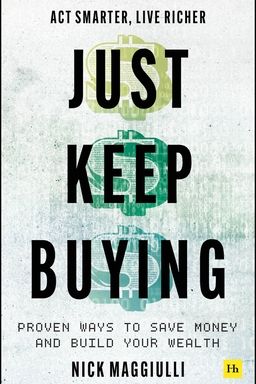
Just Keep Buying cover

Just Keep Buying

by Nick Maggiulli

Just Keep Buying is a refreshing guide to personal finance that challenges conventional wisdom by emphasizing context-driven decisions. Nick Maggiulli unravels financial myths and offers realistic strategies for saving, investing, and managing debt, all tailored to your unique circumstances.

The Power of “Just Keep Buying”

How do you build wealth in a world where markets swing wildly, expenses creep upward, and financial advice conflicts at every turn? In Just Keep Buying, Nick Maggiulli argues that the single most reliable path to wealth isn’t found in timing markets or mastering complex strategies — it’s about developing the simple habit of continually investing in income-producing assets. His mantra, Just Keep Buying, distills a century of financial data into one principle: wealth is built not by perfection, but by persistence.

Maggiulli’s philosophy began with a personal story — watching his grandfather lose everything to gambling. He realized that consistent investment, even in small amounts, could have made his grandfather a millionaire. From that realization emerged a data-driven but deeply human approach to finance: consistency trumps strategy. Whether markets are rising or falling, winners are those who show up month after month and keep buying.

A Philosophy Built on Evidence, Not Emotion

Maggiulli is an empiricist at heart. He weaves behavioral economics, investment history, and personal anecdotes to show why emotional decision-making destroys wealth. Instead of reacting to market volatility or economic headlines, the book invites you to look at decades of market data revealing that dollar-cost averaging — investing at regular intervals regardless of price — consistently outperforms waiting for the perfect opportunity. Even if you had omniscient timing, his data suggests you’d barely beat a disciplined DCA strategy over time, proving that waiting for dips usually costs more than it saves.

Why “Buying” Matters More Than “Saving”

Throughout the book, Maggiulli distinguishes between saving and investing. Saving, he explains, is crucial early on — “saving is for the poor” — but as you accumulate wealth, investing becomes the main growth engine. His “Save-Invest Continuum” helps readers decide where to focus: if your savings outpace investment returns, focus on saving; if your portfolio’s growth now exceeds new contributions, shift your attention to investing smarter. It’s an evolving balance where time, income, and compounding tilt control from your paycheck to your portfolio.

Making Money Human Again

Unlike most financial books heavy on formulas, Maggiulli speaks in personal, easy language. He uses stories — from his gambling grandfather to friends timing GameStop trades — to show how emotions sabotage financial plans. He dismantles guilt-based financial advice (“skip coffee, stop eating out”) and replaces it with what he calls The 2x Rule: anytime you splurge, invest an equal amount in assets or donate it. This approach ties spending directly to wealth creation and rewires the psychology of guilt into a practice of balanced enjoyment.

Evidence Over Ideology

Maggiulli’s data-driven style challenges sacred cows in personal finance. He shows that credit card debt isn’t always bad, that saving less than you think can still lead to retirement security, and that waiting for “buy the dip” moments wastes precious compounding power. His arguments echo modern thinkers like Morgan Housel (The Psychology of Money) and James Clear (Atomic Habits): success isn’t luck, timing, or genius—it’s systems and habits executed over time.

Ultimately, Just Keep Buying is a roadmap for anyone navigating the long journey from earning to investing to retiring. It’s practical and psychological; empirical yet optimistic. The message is timeless: stop worrying about market noise, guilt, and perfection. Just keep buying — relentlessly, confidently, and for the long term. Over decades, the world’s growth will work for you, and your wealth will snowball — one consistent purchase at a time.


The Save-Invest Continuum

When Maggiulli says “saving is for the poor and investing is for the rich,” he’s not being condescending — he’s describing how wealth-building priorities shift over time. At twenty-three, he obsessed over spreadsheets and investment returns, even though his entire portfolio was just $1,000. It took him years to realize that saving even one more night’s worth of restaurant spending would grow his net worth faster than optimizing portfolio percentages.

How to Measure Where You Are

Maggiulli introduces a straightforward formula to find your place on the Save-Invest continuum. Compare your expected annual savings to your expected annual investment growth. If you’ll save more money than your investments will earn, you’re in the “saving” stage. If your investments are doing more growing than your paycheck additions, you’ve crossed into the “investing” stage. Most people move gradually from one to the other as compound growth overtakes earned income.

From Early Scruples to Later Strategy

Maggiulli divides life into financial eras: in your early career, focus on income and savings habits; in middle age, prioritize investment management; and later in life, guard against risk. Using data examples, he shows that after about thirty years of saving $10,000 annually at a 5% return, investment growth eventually dwarfs yearly contributions — nearly 70% of total wealth comes from compounding. That turning point transforms your role from accumulator to investor.

The Smart Focus Shift

This continuum changes how you allocate attention. Early on, improve income, automate savings, and cut costs without guilt. Later, spend less time agonizing over budgets and more time shaping your portfolio. As Maggiulli frames it, “For the poor, saving is the only path to wealth; for the rich, investing is the only way to stay wealthy.” Recognizing where you stand lets you focus effort where it will compound fastest.


Save What You Can — And Stress Less

Most financial advice tells you to save a fixed percentage — often 20% of income — no matter what. Maggiulli calls that myth dangerous. Drawing inspiration from biology, he compares human saving to the Dolly Varden char fish, which changes its metabolism with food scarcity. When life is abundant, save more; when it isn’t, save less. He calls this financial flexibility.

Static Rules Are Stressful

His research shows that fixed savings goals ignore income instability. Panel data from decades of U.S. households proves incomes vary more than ever. When he moved from Boston (with roommates) to New York City (solo), his savings rate dropped from 40% to 4%. Instead of punishing himself, he learned that saving “what you can” leads to longer-term consistency and lower anxiety. According to the American Psychological Association, money has been the top stressor in the U.S. since 2007; Maggiulli argues that flexibility is the cure.

Why Saving Too Much Can Backfire

Ironically, he finds that many retirees don’t spend enough — a byproduct of saving too hard. Studies from Texas Tech and United Income show that most retirees’ wealth actually increases over retirement rather than depleting. They die with hundreds of thousands still in their portfolios. Maggiulli suggests something radical: you probably need to save less than you think. The fear of running out of money hurts more than scarcity itself.

The Practical Side

To calculate savings, use the simple equation: Income – Spending = Savings. Find your fixed costs, estimate variable expenses, and save the residual. If your budget feels tight, focus on boosting income instead of obsessing over every dollar. Maggiulli’s flexible-saving mindset echoes Elizabeth Dunn’s happiness research (Happy Money): save enough to live well, not enough to live worried.


Focus on Income, Not Frugality

“The biggest lie in personal finance,” Maggiulli declares, “is that you can get rich by cutting your spending.” Instead, wealth comes from growing your income and investing that excess. He dismantles the latte-shaming ideology popularized by pundits, showing that most low-income households already spend more than 100% of earnings on necessities (food, rent, healthcare, transport). There’s simply nothing left to cut.

Why Frugality Has Limits

Using data from the Consumer Expenditure Survey, Maggiulli demonstrates diminishing returns to saving: each income rise leads to less proportional spending. This “law of the stomach” — borrowed from economics — states that every additional slice of consumption yields less satisfaction. Frugality has a cap, but income growth doesn’t.

The Five Paths to More Income

  • Sell your time/expertise — start small with tutoring, consulting, freelancing.
  • Sell a skill or service — develop a craft and charge premium prices online.
  • Teach others — create scalable income with courses or YouTube lessons.
  • Build products — solve a problem and sell digital or physical goods.
  • Climb the corporate ladder — invest in human capital through steady career progression.

Each option transforms skills and time into money — what economists call converting human capital into financial capital. It echoes the long-term patience described in The Millionaire Next Door and other wealth studies: focus on professional growth early, ownership later.

Think Like an Owner

To truly accelerate, Maggiulli says, evolve from earning to owning. NFL legend Jerry Richardson became a billionaire not from playing but owning businesses. Likewise, use extra income to acquire income-producing assets — stocks, real estate, or your own venture. In the end, ownership, not thrift, builds enduring wealth.


Spend Guilt-Free with the 2x Rule

How can you enjoy money without shame? Maggiulli offers a simple, behavioral trick: The 2x Rule. Anytime you splurge, invest or donate that same amount. Spend $400 on shoes? Put $400 in an index fund or donate $400 to charity. This doubles each purchase’s psychological impact — pleasure now, progress later.

Breaking Money Guilt

Most financial “gurus” build systems around guilt: don’t buy lattes, don’t dine out, work harder. Maggiulli flips that script. His contrasting examples of James (the heir who spends mindlessly) and Dennis (the Uber hacker obsessed with saving) show two extremes. The right balance combines joy and discipline. Whether it’s a vacation, laptop, or bottle of wine — pair indulgence with an equal investment, and guilt disappears.

Maximizing Fulfillment Over Happiness

Maggiulli distinguishes between fleeting happiness and enduring fulfillment. Borrowing from Daniel Pink’s Drive, he emphasizes autonomy, mastery, and purpose. Spend to enhance these — not status or impulse. Buy what enriches your long-term goals or supports self-expression. Donate or invest for long-term meaning, not momentary dopamine.

Tailor Your Spending Personality

Citing research from Cambridge University, Maggiulli notes that happiness grows most when spending fits your personality — not when following generic advice. Extroverts gain more from experiences; introverts may prefer quality goods. The only “right” way to spend is the way that fulfills you. The 2x Rule simply ensures you enjoy it guilt-free and still move toward wealth.


Why You Shouldn’t Wait to Invest

Timing the market feels tempting — but Maggiulli shows that even with perfect foresight, waiting almost always hurts. He presents the “God vs. Dollar-Cost Averaging” experiment: even if a godlike investor bought only at absolute bottoms, their results barely beat someone who just invested every month. Why? Because most markets go up most of the time.

The Price of Waiting

His data spanning a century reveals that 95% of trading days eventually see lower prices in the future — meaning you’ll almost always find a better entry point later. But waiting for dips wastes compounding time. Every day withheld from investing is lost growth. Historically, buying now beats averaging in slowly 70% of the time across stocks, bonds, and even Bitcoin. Buy Now typically outperforms Average-In by 2–4% annually.

Emotion Is the Real Risk

“Buy now, but sell slowly” summarizes Maggiulli’s optimal rhythm. Risk isn’t volatility — it’s hesitation. If fear paralyzes you, lower risk by holding a mixed portfolio (for example, buy now into a 60/40 stock-bond blend). Your long-term success depends far more on consistent participation than precision timing. Waiting for certainty leads to missed decades of gains, as seen with investors who sat out after the 2008 crash or pandemic panic.

The Compounding Advantage

Dollar-cost averaging isn’t sexy, but it wins because it reinvests regularly, letting exponential returns build quietly. The lesson mirrors Warren Buffett’s maxim: “The best time to buy was yesterday; the next best time is today.” Maggiulli’s advice transforms anxiety into action — commit, invest as soon as you can, and let time be your ally.


Time: Your Most Valuable Asset

Nick Maggiulli ends with a profound reminder: you can always earn more money, but you’ll never earn more time. He quotes longevity expert Peter Attia, who challenges audiences to imagine trading lives with Warren Buffett — enormous wealth, but age 87. Few would make that trade. Time, not money, is the supreme currency.

The Mountain Man Lesson

To prove time’s power, Maggiulli recounts Dashrath Manjhi, the Indian laborer who spent 22 years carving a road through a mountain with just a hammer and chisel. He didn’t need money, only persistence and time. Manjhi’s sweat reduced a 34-mile trek to nine. That mountain became metaphor: time, used purposefully, moves mountains and builds wealth.

From Growth Stock to Value Stock

Maggiulli reflects on his own youthful expectations. At 23, he planned to have $500,000 by age 30 — he didn’t. But the failure taught him the worth of time over ambition. Early goals often skew too high; later wisdom teaches satisfaction. He compares life’s trajectory to investing styles: we start as “growth stocks,” overflowing with hope, and end as “value stocks,” appreciating stability over spectacle.

Happiness, Expectations, and Reality

Drawing from economist Hannes Schwandt’s “Happiness Curve,” Maggiulli explains that beings are happiest when their expectations align with reality — not when they peak in wealth. As dreams temper, satisfaction returns. The true measure of success isn’t how much you accumulate but how meaningfully you use your finite years. Ultimately, time is both the investment and the dividend; spend it on what compounds joy, growth, and purpose.

Dig Deeper

Get personalized prompts to apply these lessons to your life and deepen your understanding.

Go Deeper

Get the Full Experience

Download Insight Books for AI-powered reflections, quizzes, and more.