
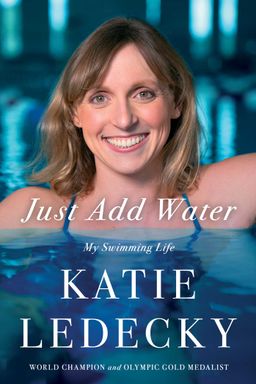
Just Add Water cover

Just Add Water

by Katie Ledecky

A memoir by the seven-time Olympic gold medalist and 21-time world champion swimmer.

Just Add Water: A Life Built in Lanes

What if the most dependable compass for your life sat 25 yards in front of you, painted as a black line on the bottom of a pool? In Just Add Water, Olympic legend Katie Ledecky argues that a meaningful, high-performance life is built by returning to that line—day after day—with humility, curiosity, and joy. She contends that greatness isn’t a single lightning strike or a rare physiology; it’s the cumulative effect of community roots, process-obsessed coaching, honest self-reflection, and a relentless but playful commitment to the craft.

Ledecky’s core claim is deceptively simple: if you love the water enough to show up, listen, and keep learning, the water will raise you. But to do so, you must understand how identity, family, coaching, technique, mindset, ethics, and adversity braid together into a durable whole. Across three Olympics and six World Championships, she shows how a childhood summer-league team, a brother who became her first rival and best coach, and mentors who taught her to breathe to one side—and to breathe through pressure—shaped a career that outlasts medals.

What This Book Really Argues

At heart, Ledecky is not mythmaking; she is demystifying. She insists that her story is not about precocity but about place (the Palisades Porpoises), people (parents, coaches Yuri Suguiyama, Bruce Gemmell, Greg Meehan, and Anthony Nesty), process (journals, stroke counts, and color-coded heart-rate zones), and perspective (clean sport, Title IX, and paying it forward). She reframes elite performance from a lonely quest to a community project that asks you to become a better teammate, student, daughter, and citizen.

How the Book Unfolds

You begin in Bethesda, Maryland, where an unpretentious outdoor pool becomes Ledecky’s North Star and a frog-printed first swim cap marks the start of an ordinary summer that grows into an extraordinary life. Then you meet Michael, her older brother and first training partner; her parents, who prized kindness over medals; and grandparents whose war, immigration, and medical-service stories hardwire resilience and gratitude into family DNA.

From there, coaches enter like architects. With Yuri, a shoulder-saving high-elbow catch and a serendipitous “loping” gallop turn freestyle into a signature. With Bruce, journals and a pull buoy scrawled with “565” (a private code for 3:56 and 8:05 time goals) translate dreams into daily behaviors. With Greg, collegiate range and team-first joy keep burnout at bay. With Nesty, stroke-length and efficiency—swimming “pretty” even on easy days—power a late-career renaissance.

Why This Matters To You

Whether you’re chasing a personal record, leading a team, or parenting a young athlete, Ledecky’s blueprint is profoundly transferable. She shows how to turn scary goals into friendly enemies (write them on a pull buoy), how to handle public pressure with private process (rate your wellness, sleep, and nutrition in a notebook), and how to metabolize setbacks (a 2019 ER visit in Korea and POTS diagnosis) into confidence and craft. Her pandemic adaptation—training in a stranger’s backyard pool while virtually drug-tested by USADA—is a case study in agile habits and resilient ethics (compare to James Clear’s Atomic Habits and Angela Duckworth’s Grit).

What You’ll Learn in This Summary

We’ll explore nine big ideas that braid technique with tenacity: the power of community as a performance multiplier; the family engine that shapes identity; the craft of stroke-building and injury prevention; the mindset architecture of goals, visualization, and journaling; the art of stagecraft from London to Rio and beyond; the conversion of adversity—illness, postponements, and pressure—into adaptable fuel; the ethics of clean sport and women’s equity; and the late-career upgrade that comes from rethinking tempo and length. Along the way, you’ll see how tiny choices (breathe right, not left) aggregate into enormous outcomes (Olympic gold at 15), and how an athlete can be both “extraordinarily ordinary” (her brother’s phrase) and historically great.

Guiding Mantras

“No shortcuts.” “Have fun.” “Why not?” “Take the lead, keep the lead.” These refrains—handed down by coaches and grandparents—recur like a tempo trainer, syncing behavior to belief.

Ultimately, Just Add Water is a memoir of record-breaking as a side effect of character-building. You learn how to love the grind without losing your joy, how to compete clean in a messy world, and how to be generous with your gifts—from teaching a three-year-old to ride a bike to sliding your Olympic medal across a hospital bed. It’s not about becoming Katie Ledecky. It’s about becoming the kind of person who, given a pool and a plan, can keep showing up until excellence has no choice but to meet you halfway.


Community First: Palisades as North Star

Ledecky begins where few greatness narratives do: a modest outdoor pool ringed by trees, picnic tables, and pep rallies. Palisades wasn’t elite—it was welcoming. That mattered. In a league of ~80 pools and 20,000 summer swimmers, the Palisades Porpoises taught her that swimming is a lifestyle and a village, not just a stopwatch. If you want sustained excellence, you need a place that makes obsession feel like belonging.

Belonging Before Becoming

At six, Katie’s first 25 free included ten pauses on the lane line and copious nose-wiping. Her parents were timers, the older teens coached, and Fun Fridays turned practice into sharks-and-minnows. A pediatrician okayed a final meet despite an ear infection; Katie wore a frog swim cap and, for the first time, made it across the pool without stopping. That memory—hot chocolate at Panera afterward—is the template: show up, be supported, smile through the learning curve.

This “maximum chill” environment countered the hyper-specialized pathways many prodigies take. There was no master plan, no talent agent. The emphasis was fun, camaraderie, and tradition: pasta pep rallies, poster-making, goofy outfits. When she was 17—fresh off two world records—Ledecky returned to a summer meet, won her events, signed caps for eight-and-unders, and, crucially, cared more about the barbecue than the splits. That homecoming wasn’t nostalgia; it was maintenance of identity.

Rituals That Compound

Repetition can be revelatory when wrapped in ritual. Saturday mornings meant racing, then racing home to compare times across the whole county—a charmingly nerdy, self-driven film study. The league’s record boards seeded ambition; younger kids now chase her 8-and-under times the way she once eyed area Olympians like Michael Phelps and Katie Hoff. Palisades remains a living museum: a cardboard cutout of teen Katie holding a porpoise mascot in the lifeguard office, a plaque by the record board, neighbors who still ask about meets.

Why Community Scales Performance

You can measure yardage and lactate; you can’t quantify a place that says, “You belong here even if you pause ten times.” Yet that welcome creates psychological safety, which research shows is essential for risk-taking and long-term learning (compare Daniel Coyle’s The Culture Code). For Ledecky, a low-pressure origin story inoculated her against future hype. When the London Aquatics Centre roared for Britain’s Rebecca Adlington, she mentally converted the chants—“Becky! Becky!”—into “Ledecky! Ledecky!” That playful reframing traces to a pool that taught her to laugh at themes (and wear a Halloween wig to every pep rally).

A North Star You Can Revisit

After World Championships in 2023, her first Paris-Olympic-Year swim wasn’t at a high-tech facility; it was early-bird laps at Palisades while her mom did water aerobics. That symbolic choice—first steps forward by stepping back—keeps her compass calibrated. The ROI is real: emotional regulation, gratitude, and joy protect performance against burnout (see Deena Kastor’s Let Your Mind Run). Palisades didn’t just make her fast; it made her durable.

Takeaway

Build your training life in a place that would miss you if you stopped winning. Speed fades. Community doesn’t.

If you lead a team, emulate Palisades: mix cross-age mentorship, silly traditions, and parent service. If you’re an athlete or parent, hunt for “maximum chill” with high standards—the rare combination that lets kids be kids and, paradoxically, sustains adult excellence. Your North Star doesn’t need a dome or a scoreboard. It needs grills, posters, and a lane line sturdy enough to hold a small swimmer who’s learning to let go.


Family Engine: Siblings, Parents, Ancestors

Ledecky’s speed is powered by kinship. Her brother Michael is the first coach, competitor, and comedian in the story; her parents model a clean, grounded ethic; her grandparents anchor purpose in sacrifice and service. If you want longevity, connect daily effort to something older and bigger than yourself.

Michael: Goofy Grit and Gentle Rivalry

Three years older, Michael is the quintessential big brother: touch-football ally, math-drill rival, and poolside pace bunny. At 9 and 6, they join Palisades together. Michael chases the Saturday “A” team, drops 20 seconds in a summer, and the siblings spend Saturday nights refreshing county results while quoting SNL. He transitions from distance to sprint in high school, watches his little sister pass his times, and writes an honest essay—“Why can’t I beat my younger sister?”—that ends in pride when her times eclipse everyone at his all-boys school. As a Harvard undergrad, he covers 2012 Trials as a credentialed reporter and is the first family member to hug her on deck after she makes the Olympic team.

The dynamic is instructive: comparison gives way to collaboration. He becomes the family’s unofficial PR, facebooking photos, buying a real camera, and learning when to talk about anything but swimming. The week before Stanford, he teaches 19-year-old Katie to dismount a bike—proof that mastery in one domain doesn’t generalize automatically. The sibling lesson is humility and humor.

Parents: Framework Without Pressure

Mary Gen (Title IX collegiate freestyler turned hospital administrator) and David (sports-loving lawyer and Springsteen superfan) enforce standards—early bedtimes, homework on weekends, “eat the right things, not the fun things”—without performance ultimatums. When an announcer tells 12-year-old Katie she’ll be an Olympian, David pushes back: don’t put that pressure on her. After a narrow miss in the 400 at 2012 Trials, he tells a reporter he’s proud she broke Janet Evans’s age-group record—“not disappointed at all”—and gets hung up on mid-quote. Their mantra: support the person, not the podium.

The minivan soundtrack—five discs of Bruce Springsteen, one of Southside Johnny—becomes a traveling seminar on endurance and show-up energy (three-hour concerts mirror mile sets). Post-Rio, the family meets Springsteen backstage; he hefts a gold medal and quips, “I always wondered what athletes do with these things,” before telling her, “Wow, you’ve accomplished a lot for a freshman.” That mixture of awe and normalcy is the Ledecky tone.

Grandparents: Grit as Inheritance

Grandpa Jerry defects from Soviet-dominated Czechoslovakia, washes dishes at Howard Johnson’s, learns eight languages, and earns a PhD at NYU. He urges relentless learning and laughs through difficulty. His story colors Katie’s swims in Prague’s Podolí pool and inspires the 2015 Kazan performance, where she honors his birthday by saying, “Wouldn’t it be cool if I go 8:08 tomorrow?”—then goes 8:07. Grandma Berta, a Brooklyn writer who once took dictation for Albert Einstein, models curiosity, culture, and chutzpah; her texts sign off “precious darling,” and she drags the family to Broadway between meets.

On the Hagan side, Grandpa “Bud” serves as a combat surgeon in Peleliu and Okinawa, earns Silver and Bronze Stars and a Purple Heart, then returns to Williston to build a clinic and a community pool, pushing for required swim lessons after his own daughter falls off a dock. His mantra—“Always be kind to people and animals”—surfaces decades later as Katie hands her medal to hospital patients and kids at Children’s National. In 2014, she opens the E.J. Hagan Natatorium by swimming the first lap as eight hundred locals watch—one of her most meaningful 100s.

Family Operating System

Do your best, be a good neighbor, practice gratitude, and enjoy the music on the way to practice. Medals are outcomes. Character is the point.

For you, the blueprint is clear: create a household where ambition is owned by the athlete, expectations target effort and kindness, and history furnishes meaning. If you don’t have that family, borrow one—through mentors, teammates, and traditions that extend your sense of self beyond the next time on the clock.


Craft and Coaching: Building the Stroke

Ledecky’s speed is engineered, not assumed. Across four coaches, she turns curiosity into craft, solving problems before they become injuries and converting tiny technical choices into world-stage outcomes. This is the anti-mystique chapter: how a high-elbow catch, a right-side breath, and a disciplined pull buoy birthed a revolution.

Yuri Suguiyama: Injury-Proofing and the Gallop

At 11, Katie joins Yuri’s elite group at Curl-Burke (now Nation’s Capital). Early focus: shoulder prehab, jump rope, and symmetrical stability—prevent overuse before going “hard.” After noticing a straight-arm swing that torques her shoulder, Yuri bluntly warns, “Don’t come crying to me in ten years if your shoulder is wrecked.” She fixes it. He adds stroke counting and 125s at fixed intervals: hold time and stroke count. One day, a late-lap power kick produces a subtle “gallop”—a micro-glide on one side. “That’s it!” he beams. The loping stroke, sometimes mislabeled “a man’s technique,” becomes her signature (Rowdy Gaines later clarifies: she doesn’t swim like a man; she swims like Katie Ledecky).

Yuri also gives her a composition notebook with a countdown to Trials (“168” circled) and weekly exchanges notes on wellness, nutrition, sleep, and “something special” from practice. The journal becomes a private channel to talk Olympics without saying “Olympics.” He makes her breathe less to the left—critical advice before London’s 800 final—and teaches two-day back-to-back sets to simulate prelim/final reality.

Bruce Gemmell: Systems, Pacing, and Beilke

Post-London, Bruce (an engineer by training) layers Jon Urbanchek’s heart-rate color system onto threshold sets, builds yardage, and obsessively tunes tempo. He expands dryland work with trainer Lee Sommers, adds pulling strength, and chisels starts, turns, and underwater kicks—an edge for a “distance swimmer with a sprinter’s mentality.”

Then there’s Beilke—the pull buoy scavenged from lost-and-found, named for the Sharpie’d last name on its foam. After she uses it in Orlando to win Junior Nationals at 14, the buoy becomes a talisman. In 2013 she writes “565” on it—short for 3:56 (400) and 8:05 (800). In Rio she goes 3:56 and 8:04, and wins the 200. Later she gifts the cracked, mildewed relic to Bruce.

Greg Meehan: Range and Joy

At Stanford, Greg and Tracy Slusser protect team culture and fun while letting Ledecky set NCAA and American records. Wednesday mornings are country playlists; the team room features a piano. She widens her range, learns to be an anchor for relays, and maintains balance—friends outside of swimming, a psychology major under Dr. Alia Crum (whose “mindset effect” research prompts Katie to reflect on whether slightly bolder goals would have yielded even faster times).

Anthony Nesty: Florida 2.0—Length Over Tempo

Post-Tokyo, she moves east to train with Nesty’s distance supergroup (Bobby Finke, Caeleb Dressel, Kieran Smith). Nesty tells her things she may not want to hear: get in better overall shape; your stroke has gotten “choppy.” The big shift: stop over-indexing on tempo; prioritize stroke length and water-holding. Swim “pretty,” even on easy days. Reduce strokes per length; kick a touch more. In 2023 she swims an 800 faster than any time since 2016, in fewer strokes than Rio and thirty-two fewer than Tokyo.

Coaching Through-Lines

Prevent injuries; measure what matters; make goals visible; rehearse realities; finish strong; and always, as Bruce said before every race, “Have fun.”

For your craft—athletic or otherwise—treat technique like compounding interest. Fix small leaks early, count what you want to conserve (strokes, words, reps), and encode goals in your tools. When you plateau, question your tempo; often the answer is “longer and cleaner,” not “faster and harder.”


The Mindset Playbook: Goals, Journals, Process

Ledecky’s mental model trades hype for habits. She builds a private scaffolding—journals, visualizations, lap counts, mantras—that steadies her in finals and in life. If your inner game wobbles, borrow hers.

Make Goals Concrete (and Quiet)

As a kid, she taped “want times” to a mirror. As a teen, she writes a 168-day Trial countdown in a notebook. With Bruce, she compresses audacious targets onto Beilke (“565”). She rarely broadcasts aims in advance—protecting herself from media amplification and preserving the purity of the chase (contrast with public goal-sharing frameworks that can create false completion). Even so, she rehearses the reality: two-day back-to-backs, afternoon/evening schedules, walk-outs, and medal ceremonies.

Journal What You Can Control

The composition book with Yuri is simple: daily yardage; 1–10 ratings for wellness, nutrition, and sleep; a note on “something special.” Later, she journals solo through Rio, Tokyo, and beyond—less about scores, more about state. On rough days she scrolls back to remember: you’ve been here before. The practice echoes Stoic review (Ryan Holiday) and cognitive reframing (Dr. Alia Crum’s mindset studies).

Visualize With Specificity

Before London’s 800, she mentally assigns the crowd’s “Becky!” to “Ledecky!” and plans to breathe right more than left. In Rio’s 200 final, she commits to not breathing the last seven strokes—a practiced move that wins gold by three tenths. In Tokyo’s 1500, after a disappointing 200, she centers on her grandmothers—“Grandma Hagan, Grandma Berta”—instead of counting laps, anchoring identity to love, not doubt. Phelps famously visualized worst-case scenarios (leaky goggles); Ledecky adds familial anchors and tactical breath choices.

Talk to Yourself Like a Teammate

Her self-talk is brisk and directive—“Hit this turn,” “500 left, it’s time to go”—but she also zooms out when pain spikes: eight 50s left, you’ve done thousands of these. Songs act as metronomes (U2, Springsteen). She rehearses the finish in practice; the last 15 meters are sacred. Even on easy days, she tries to “end with effort,” because who you are when no one watches is who shows up on race day (compare to Wooden’s definition of success as peace of mind from effort).

Mantras That Move You

“No shortcuts” governs training ethics. “Why not?” ignites ambition against self-imposed ceilings (it shows up in Houston in 2014 when she breaks a world record in a high school meet). “Have fun” (Bruce) and “Take the lead, keep the lead” (Grandpa Hagan) shape race strategy and life posture. Together they protect joy and assertiveness—guardrails against perfectionism and passivity.

Process Over Podiums

She treats “person before swimmer” as policy. That’s why she can joke in a cardboard Olympic Village, make friendship bracelets with teammates, and still flip the switch to “all-in” on the blocks. Joy is not a luxury—it’s performance tech.

Try this: Identify one scary goal, encode it physically (on a sticky note, a barbell, a desktop), and track only the controllables you’ll need to touch it. When pressure surges, find a personal mantra that reattaches you to your people. Then, at the end of every workout, finish strong—because you’re practicing the only moment you can’t fake.


Performing on the Stage: London, Rio, Kazan

On the biggest nights, Ledecky isn’t superhuman; she’s super prepared. Three meets illustrate the anatomy of her breakthroughs—and how you can architect your own.

London 2012: Underdog With Instructions

At 15, the youngest member of the entire 530-athlete U.S. delegation, Ledecky enters the ready room next to Michael Phelps, who high-fives her—“Good luck, and have fun.” She hasn’t even seen Yuri on deck (no credential), but she has his last-minute directives: breathe more right, less left; don’t go out too hot; harness the roar. In the final, broadcasters speculate she’s out too fast. At 600 she reframes: “This is just a 200.” She breathes once to the left to check the field, sees clean water, and slams the wall 5+ seconds ahead, breaking Janet Evans’s 23-year-old U.S. record. Rebecca Adlington, the British favorite, swims over to hug her and says she can see Katie breaking her world record someday. Grace meets grace.

Rio 2016: Goals Meet Reality

She adds a surprise silver in the 4×100 free, then detonates the 400 in 3:56—the first half of “565.” The 200 is a dogfight with Sarah Sjöström; Katie wins by three tenths by not breathing the last seven strokes. The next night she anchors the 4×200, overtakes Australia, and shares a tearful gold with Allison Schmitt and Maya DiRado. Finally, she cruises 8:04 in the 800—the second half of “565.” Multiple golds, one silver. More importantly, goals exactly met. When asked about Bruce, she cries, realizing this arc is the end of their chapter. Emotional authenticity as competitive closure.

Kazan 2015: Shock and Flow

This World Championship week showcases audacity inside control. In a mostly empty soccer-stadium-turned-pool, she spies a “world record line” on the sideboard during a prelim 1500, feels the tug-of-war between coach’s plan (cruise) and the green minus sign, giggles at the internal debate, and breaks the world record anyway—then breaks it again in the final that night and still sneaks into the 200 final minutes later with jelly legs. She sweeps 200/400/800/1500 and the 4×200—dubbed the “Ledecky Slam.” On the 800 final eve, she learns it’s Grandpa Jerry’s birthday: “Wouldn’t it be cool if I go 8:08?” She goes 8:07, slaps the water thrice for three world records in a week, and heads home to get her wisdom teeth out.

Pattern Recognition

Pre-event joy; simple cues; audacious but embodied goals; tactical breathing; a sacred finish. The show looks different each time. The script doesn’t.

Apply it anywhere you perform: craft one or two race-day instructions (e.g., “first 30 seconds controlled, last 30 seconds all gas”), anchor to a personal story that makes you brave, and decide the finish you’ll accept. Then rehearse these exact beats until your body can carry them when your brain gets loud.


Setbacks, Health, and Adaptation

Adversity isn’t a subplot in Ledecky’s career; it’s an engine for design upgrades—in health, training, and ethics. Three crucibles—Korea 2019, Covid 2020–21, and a lifelong commitment to clean sport—reveal how to suffer well and keep your soul intact.

Korea 2019: From ER to 800 Gold

At Worlds in Gwangju, she loses appetite, is chewed by bugs, and tanks mid-400. During a 1500 prelim she considers getting out—a first. In the ER, a high troponin level triggers panic (heart attack? myocarditis?). After scans, doctors conclude “likely virus,” not cardiac event. She scratches the 1500 final, swims a gutty relay split for silver, and barely sneaks into the 800 final. In that final, she battles Italy’s Simona Quadarella, delays her move three times, then wins on the last 50. She later shares a private burden: a milder form of POTS (postural orthostatic tachycardia syndrome) diagnosed in 2015, managed through sodium, hydration, and reclined aerobic work—ironically, swimming.

Pandemic Pivot: Backyard Pool, Virtual Testing

When Stanford locks down, she and Simone Manuel train in Tod Spieker’s backyard 25-yard, two-lane paradise. The only spectators are Spieker’s grandkids, who chant “Simone Manuel and Katie Ledecky are the best swimmers in the world!” She finishes her Stanford degree online, takes an infectious-disease course, and rides the emotional whiplash of the postponed Games. USA Swimming’s letter helps; so does routine. She bikes nowhere, drylands in the living room, and does “death by relay” practice to keep it fun. During the testing gap, she opts into virtual USADA drug tests—Zoom bathroom checks and at-home blood collections—underscoring her clean-sport stance.

Clean Sport and Rules as Love

Ledecky views anti-doping not as hassle but as love for the game. She’s been tested ~25 times a year for 12+ years. In Shenandoah, Texas, a high-school-hosted meet, she breaks two world records; USADA agents are dispatched to her hotel. During 2020, she volunteers for virtual testing while other countries’ programs waver. She is frank about frustration with repeat offenders and murky “therapeutic use” loopholes, especially given the historical harms to athletes who swam clean (e.g., East German doping). She also follows NCAA rules scrupulously—famously declining a waffle maker on Ellen.

Adaptive Principles

Name the problem (virus, POTS, pandemic); design a constraint-friendly plan (backyard pool, sodium and sleep, Zoom testing); guard your ethics aggressively; and keep a childlike thread (chocolate-milk TikTok lap with a full cup balanced on her head).

Your version: codify non-negotiables (health metrics, testing/QA, values), make Plan B delightful (tiny-team rituals, family FaceTimes), and let embarrassment go (you’re practicing resilience, not optics). When the crowd disappears, be the one who still sings.


Clean Sport, Equity, and Leadership

Ledecky’s leadership shows up in how she wins—and how she works for a fairer sport. She insists that medals without meaning aren’t worth much, and that women’s progress is an unfinished relay that demands your leg.

No Shortcuts, No Excuses

She frames testing as part of the privilege of competing: constant whereabouts updates, hotel-room collections after small meets, even during a pandemic. She’s blunt about athletes who serve short suspensions and return: it doesn’t feel fair; it hurts clean competitors; and, long term, it robs cheaters of knowing what they could have done on their own. Her solution is personal integrity plus systemic vigilance—do the work and support agencies that do theirs.

Women’s Distance at the Games—Finally

For half a century, the Olympic 1500 free was a men-only event, despite women proving capacity at Worlds. Tokyo 2021 added it. Ledecky won the inaugural gold—and cried in her goggles thinking about the women who never had the chance. She also calls out gendered media frames (her Rio 800 world record once relegated to a subhead beneath a men’s silver) and the habit of praising her as “swimming like a man.” She prefers Rowdy Gaines’s upgrade: “She swims like Katie Ledecky.”

Title IX and Everyday Advocacy

Her mom was one of the first Title IX scholarship swimmers; Grandpa Hagan literally built a town pool and mandated elementary swim lessons. Ledecky speaks at schools, visits children’s hospitals, and loans medals so kids can feel “the power of gold.” With teammates, she crafts friendship bracelets at camp (Lilly King’s a Swiftie) and in Fukuoka, hands a poker chip inscribed “You’ve got this” to 16-year-old Alex Shackell before the relay final. Leadership here looks like ordinary generosity.

A Better Yardstick

Judge performance by courage, craft, and contribution—not by how closely a woman’s stroke resembles a man’s. And amplify women’s sports with coverage proportional to achievement.

Where you sit—coach, parent, journalist, teammate—you can move the needle: ensure equal opportunities, celebrate women on their own terms, and hold the line on clean competition. The relay isn’t over. Run your leg.


Training to Last: Technique, Tenacity, Florida 2.0

If you want to keep winning while you age, you need an update cycle. Ledecky’s training philosophy is equal parts monk and mechanic—high-heart-rate thresholds, love for long swims, and ruthless attention to micro-skills—plus a late-career firmware refresh in Gainesville.

Thresholds, Metronomes, and the Last 15

Distance pain is unique; your body begs to stop. Her answer: become a human metronome. Breathe every two strokes, listen to the whoosh, and count laps to quiet the brain. She targets threshold sets that keep HR 180+ for 45–60 minutes. Lactate sets? Her kryptonite. Long straight swims? Her playground. She’s an average kicker but an exceptional puller. Weakness noted, strengths weaponized. And whatever the set, the last 15 meters are non-negotiable—practice the finish you’ll need.

Routine Without Ruts

Swimming’s tedium becomes her meditation. Early alarms, senior-citizen dinners, zero alcohol, and long naps create consistency. During Covid, she learned to enjoy training for training’s sake—no guaranteed meets on the horizon. Today she even swims an easy Sunday session—no assigned practice, nothing for time—just to keep feel for the water and banish Monday rust. That’s habit design for mood and momentum (see Clear’s “make it obvious and attractive”).

Florida’s Efficiency Upgrade

Nesty’s group offers world-class training partners and a cultural jolt: guys talk (a lot), freshmen bring electricity, and the combined men’s/women’s program injects variety. The big technical tweak is lengthening: fewer strokes per 50, more water held each pull. After years of tempo obsession, this feels counterintuitive—but the watch agrees. In 2023, she becomes the first swimmer ever to win six world titles in the same event (800), edging Michael Phelps’s individual world-title record the night before. Post-race, she’s briefly disappointed not to hit a world record, then regains perspective: the season arc and the context make the performance historic. That emotional elasticity is itself a late-career skill.

Longevity Recipe

Train hard enough to adapt, soft enough to absorb; fix the finish daily; change environment before you calcify; measure stroke count as fiercely as time.

Your action plan: audit one habit for “feel” (what keeps touch with craft?), identify one finish to ritualize, and pick a single efficiency metric to track (strokes per rep, quality words per page, errors per build). Then, once a season, find your Gainesville—people who challenge your defaults and a coach who will tell you the truth kindly.

Dig Deeper

Get personalized prompts to apply these lessons to your life and deepen your understanding.

Go Deeper

Get the Full Experience

Download Insight Books for AI-powered reflections, quizzes, and more.