
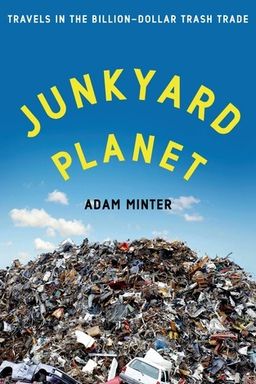
Junkyard Planet cover

Junkyard Planet

by Adam Minter

Junkyard Planet by Adam Minter exposes the hidden world of the recycling industry, where profit meets sustainability. Through vivid narratives and global insights, Minter reveals how recycling offsets consumption and how readers can influence greener practices in waste management.

The Global Life of Scrap

Where does your old phone, soda can, or Christmas light strand go after you toss it in the bin? In Junkyard Planet, Adam Minter turns this simple question into a global economic detective story—following recycled goods from American suburbs through Chinese scrapyards, Indian foundries, and Southeast Asian refurbishing markets. His core argument is that recycling isn’t just green virtue: it’s a massive industrial, entrepreneurial, and transnational system that underpins the modern economy. To understand globalization, you must understand its junkyard.

Minter writes as both journalist and industry insider (his family ran a Minneapolis scrapyard). He shows that recycling tracks the same forces as regular trade—demand, logistics, labor markets, and policy—all reimagining garbage as resource. You realize that tossing something into your bin is only the harvest; the real recycling happens when price, technology, and ingenuity convert that harvest into feedstock for new production.

From Bins to Global Circulation

The book begins with your curbside routine. In Houston, Alan Bachrach’s Material Recovery Facility (MRF) separates massive quantities of mixed recyclables with conveyor lines, magnets, and human pre-sorters. Those bales—of paper, plastic, aluminum—then enter global commodity markets. Whether they’re reused nearby or shipped to China depends primarily on economics: the highest bidder dictates destination. Because China’s factories crave raw materials, and container shipping favors backhaul export, your soda can might travel 7,000 miles for its next incarnation.

Why China Became the World’s Recycling Engine

In the 2000s, China accounted for roughly 40% of global copper demand. It lacked sufficient mines but had voracious manufacturing and cheap labor for processing scrap. Entire towns—from Shijiao, where millions of pounds of recycled Christmas lights reemerge as copper feedstock and slipper soles, to Qingyuan’s metal yards—turned low-grade junk into valuable industrial fuel. This phenomenon made China not just a consumer of global scrap but its refining powerhouse.

The impact was enormous: between 2001 and 2011, China’s recycling industry saved an estimated 110 million tons of coal and avoided excavating billions of tons of ore. Recycled aluminum alone prevented over half a billion tons of carbon dioxide emissions. Yet the human element remained central—people cutting, sorting, and judging in ways no machine could fully match.

Entrepreneurs and the Logic of Junk

Minter’s portraits of characters—Leonard Fritz “grubbing” in Depression-era Detroit dumps, Joe Chen founding Tung Tai in Zhuhai, or Raymond Li processing light strands in Shijiao—illustrate capitalism in its rawest form: recognizing neglected value. They show that recycling grew less from environmental idealism than from entrepreneurial discovery. The industry evolved from ragpickers and small dealers to multinational traders like Alpert & Alpert, moving commodities across oceans using shipping’s backhaul imbalances.

In logistics terms, transporting scrap to China was cheaper than shipping it across the U.S.—a container from Los Angeles to Yantian could cost as little as $600 versus $2,400 to Chicago. That structural quirk made global recycling not a moral choice but a market inevitability.

The People, the Machines, and the Trade-offs

In modern recycling, humans and technology operate together. At Houston’s MRF, infrared sensors and eddy current separators share conveyor space with workers who spot contamination by eye. In China’s Qingyuan Jintian yard, women hand-snipping USB plugs off cables earn their pay by raising copper purity and hence company profits. This balance—manual skill supported by advanced systems—embodies recycling’s enduring paradox: it’s high-tech yet deeply human.

But there’s a darker mirror image: Wen’an’s plastic pits and Guiyu’s e-waste fields show how wealth and poison coexist. Workers bathe parts in acid to extract metals, inhale burnt insulation fumes, or live amid toxic sludge. Shutdowns meant job loss for tens of thousands. Minter portrays the moral tradeoff: without developing-world recyclers, global supply chains would rely even more on destructive mining—but their health costs remain unacceptable without proper regulation and investment.

The Broader Lesson

Recycling’s complexity forces a rethink of sustainability. It isn’t a simple virtue loop; it’s a multi-step, market-driven network shaped by global inequality, consumer behavior, and design. When you buy a glued-together gadget impossible to repair, you predetermine its toxic afterlife. When you sort clean recyclables, you improve downstream efficiency. And when you delay upgrading your phone, you reduce both waste and the invisible harm embedded in reuse economies abroad.

Key idea

Minter’s central insight is both humbling and empowering: the junk you toss reflects—and fuels—an entire planetary order. To make recycling truly sustainable, you must shift from moral ritual to informed participation: understanding markets, demanding better design, and acknowledging the human labor that makes your recycling real.

Across the book’s journey—from Houston’s sorting lines to Guangdong’s copper mills, from Wen’an’s toxic graves to Shanghai’s refurbished laptop markets—recycling emerges as the visible face of globalization’s metabolism. Waste, Minter insists, is not the end of consumption but its shadow economy—one that mirrors our values, our inequalities, and our chance to do better.


From Bins to Buyers

What you do on recycling day is only the first link in a long industrial chain. Minter calls your home sorting "harvesting"—a vital but partial act. The true recycling begins after harvesting ends, as mixed loads pass through mechanical plants, specialized processors, and finally international markets that decide their fate by price.

The Mechanical Middle

At Houston’s Material Recovery Facility, belts, magnets, air jets, and optical sensors whir through thousands of pounds per hour. Machines sort by density, bounce, magnetism, and color, producing saleable bales. Yet the facility still relies on trained eyes: removing plastic bags or stray wires before they jam the system. These plants transform household “harvest” into commodities recognizable to mills, foundries, or buyers abroad.

Specialized Processing

Once bales leave the MRF, some materials travel to advanced granulators like OmniSource’s Fort Wayne plant. There copper emerges from shredded wire at over 99% purity. In contrast, in Shijiao, China, workers still feed strands of Christmas lights through wet vibrating tables separating green plastic from gold copper. Each stage adds value. These global differences reveal recycling’s flexibility: it happens wherever the mix of labor, capital, and demand makes it profitable.

Markets Make the Final Decision

After processing, traders decide destinations. If domestic mills pay poorly, paper or copper rides a container to Asia. The result is counterintuitive: the greenest-seeming local act is governed by global commodity logic. Backhaul shipping—container vessels needing cheap return cargo—amplifies this flow, turning waste collection into global logistics arbitrage. Your cardboard bale floats across oceans because that route costs less than hauling it inland by truck.

Recycling only works when markets want your material. Understanding that simple fact transforms your role from virtue performer to informed participant in a worldwide economic circuit.

Minter wants you to see recycling not as an end in itself but as one segment of material commerce—an industry where environmental outcomes and financial incentives collide. To make it better, you must recognize how every bale becomes a bargaining chip between ecological conscience and market math.


China’s Recycling Machine

China’s rise as “the world’s recycling engine” anchors Minter’s story. The country’s demand for metals, plastics, and paper eclipsed its domestic supply. Instead of mining, it imported mountains of scrap, transforming entire regions into processing clusters. Recycling didn’t just complement industrialization—it powered it.

How Demand Created a System

By 2012, China consumed over 40% of global copper. Domestic ore couldn’t meet this appetite, so millions of tons arrived as worn cables, motors, and Christmas lights. Towns like Shijiao or Qingyuan developed expertise in separating and refining these materials. Yong Chang Processing recycled over two million pounds of lights annually. What looked like trash became a strategic resource—fuel for export-led manufacturing.

The Local Logic of Global Waste

Guangdong yards existed near dense clusters of smelters and factories. Labor was cheap; logistics through ports like Yantian were swift. This positioning gave China a comparative advantage. It made low-grade scrap profitable where Western recyclers might landfill it. Entrepreneurs like Joe Chen and Raymond Li exploited this opening, investing in furnaces and shredder lines that multiplied the value of imported junk.

The Numbers Behind the Miracle

Minter grounds his narrative in staggering data: recycling consumed hundreds of millions of tons of scrap per year and saved energy equivalent to 110 million tons of coal between 2001–2011. Real savings in carbon and resources made this industrial-scale recycling a hidden climate project. Yet it also exported pollution risk to small towns where crude burning and acid leaching left toxic residues.

Insight

China’s recycling boom shows how necessity—scarce resources amid rapid growth—can align economic incentive with environmental logic, even if imperfectly. But it also warns that scale without safeguards can replicate mining’s harms under a different name.

By weaving through copper plants, plastics villages, and electronic scrapyards, Minter portrays China’s recycling not as a fringe activity but as an industrial pillar. It mirrored the country’s broader strategy: transform global surplus into domestic strength—absorbing not just the world’s commodities but its cast-offs.


The Hands and Tech of Recycling

Behind every bale of recycled copper or aluminum stands an interplay between human judgment and technological muscle. Minter’s field visits reveal that successful recycling is not fully automated—human eyes and hands still deliver purity that sensors can’t achieve.

Machines That Sort Mountains

Facilities like Houston’s MRF or OmniSource’s Fort Wayne plant run sophisticated conveyor systems. Infrared cameras fire air jets to isolate plastics; magnets pull steel; eddy currents eject aluminum. The process transforms chaos into uniform bales within minutes. Likewise, modern car shredders—descendants of Alton Newell’s side-feed invention—devour entire vehicles, supplying steel mills globally. Shredder operators can process 130 tons per hour, with vibration and sound signaling success.

The Irreplaceable Role of Hands

In Chinese yards, human precision still beats digital optics. At Qingyuan Jintian, women snip USB plugs from wires to prevent steel contamination in copper streams. Sigma Group in Shanghai trains 800 workers to hand-sort shredded metal by feel. Their wages—around 400 yuan monthly—sustain both families and industrial profit margins. In markets where a single impurity can cut metal value 10%, such labor makes economic sense. Human care upgrades material quality faster and cheaper than another magnet or sensor ever could.

Recycling succeeds not because it removes labor but because it combines human finesse with mechanized force—a hybrid model of precision and power.

Minter’s portrayal dispels a myth: automation doesn’t eliminate people; it redefines their value. Whether tuning granulators in Indiana or hand-sorting brass in Shanghai, human attention bridges the gap between chaos and commodity. The best recycling economies respect both machine rhythm and manual intelligence.


Reuse before Remelt

Not every discarded thing needs to melt to matter again. Minter introduces you to the global reuse markets that transform broken devices and machine parts back into functioning goods. In this realm, repair and resale—not pulverization—drive profit and sustainability.

Second-Life Markets

In Shanghai’s electronics malls, technicians refurbish laptops that Americans considered obsolete. You can buy a serviceable computer for $75. In Penang, Malaysia, Net Peripheral repairs monitors by the tens of thousands, selling them to Africa and the Middle East, where reused tech powers education and connectivity. This isn’t charity—it’s economic arbitrage: working goods fetch more value than scrap metals.

Guiyu’s Reuse Reality

Guiyu, often vilified as an e-waste dump, turns out more complex. Traders like Henry explain that roughly 80% of profits there come from reuse and resale, not toxic extraction. Factories buy recovered chips for toys or GPS units, and buyers in Japan refine valuable chips with higher-tech methods. The same global supply logic applies—value travels to where it’s best unlocked.

The Trade-offs

Reuse doubles the life of goods and avoids energy costs of remanufacturing, but without safety standards, it perpetuates informal labor and pollution. Guiyu’s acid baths and Wen’an’s pit laundries show how low-barrier recycling trades one resource problem for human health challenges. Yet Minter reminds you that even their “dirty” recycling may have lower planetary cost than new mining’s devastation.

Reusing is the world’s most effective recycling. But to make it humane and sustainable, you must pair it with better design and safer labor standards.

When you donate electronics, seek refurbishers over recyclers. Every repaired circuit or remanufactured valve delays the furnace and keeps resources in circulation. The world’s reuse markets thrive on this principle: durability as prosperity, not discard as destiny.


When Markets Break

Recycling may look environmentally noble, but underneath it sways with price like any commodity. The 2008 financial crisis proved how fragile that structure is. When metal prices collapsed, Chinese buyers canceled contracts for containers already at sea. Ports filled with unpaid scrap. In Function Room 12 of a Shanghai hotel, tempers flared as exporters demanded payment from defaulting importers.

The crisis rippled outward: Western cities piled unsold recyclables in warehouses or sent them to landfills. The event exposed recycling’s dependence on credit, trust, and international liquidity. “You can’t make metal products out of air,” as broker Robert Stein quipped—manufacturing depends on a steady flow of affordable scrap, and when contracts fail, environmental ideals falter alongside profit.

Lessons in Vulnerability

Recycling markets must hedge against volatility—through diversified buyers, risk-sharing contracts, or domestic capacity. Government policies that ban, subsidize, or tax trade also reshape flows. Arbitrary import bans can safeguard health but destabilize global recovery systems. In short, barrels of copper and cardboard bales obey the same market physics as oil or wheat.

Sustainability depends as much on resilient economics as on good intentions. Without functioning trade finance, there is no global recycling, only garbage.

Minter’s financial lens completes the book’s portrait of junk as commerce. Market crashes bury not just metal but moral resolve, reminding you that recycling’s success requires both environmental will and financial pragmatism.


Design and the Consumer’s Choice

In the closing argument, Minter turns from global yards to your desk. Recycling, he insists, begins long before disposal—with design and consumption choices. A glued smartphone battery or soldered laptop chip obstructs repair, ensuring eventual toxic shredding abroad. Product design dictates recyclability; consumer habits amplify or constrain it.

The Paradox of Green Behavior

Studies show recycling options can increase resource use: people print more when a blue bin is nearby or upgrade faster under trade-in programs. Recycling psychologically “licenses” waste. Apple’s attractive credit programs, for instance, often accelerate the replacement cycle rather than reduce it.

Design for Repair

Manufacturers can—and should—design products for disassembly and component reuse. Detachable batteries, modular builds, and standardized screws improve recycling efficiency. Without them, even high-tech recyclers in Guiyu or Huron Valley lose precious rare metals like indium or cobalt. Your purchasing power, meanwhile, signals demand for durable and repairable goods.

Environmental responsibility means more than placing cans in bins—it means buying less, buying better, and extending product life.

Minter’s final lesson is deeply personal: recycling’s future lies not merely in global factories but in how you consume. Each design change or spending restraint ripples through the global junkyard planet, reshaping how industry, labor, and ecosystems interact. True sustainability begins with smarter design and disciplined desire.

Dig Deeper

Get personalized prompts to apply these lessons to your life and deepen your understanding.

Go Deeper

Get the Full Experience

Download Insight Books for AI-powered reflections, quizzes, and more.