
Idea 1
Obsession to Stewardship
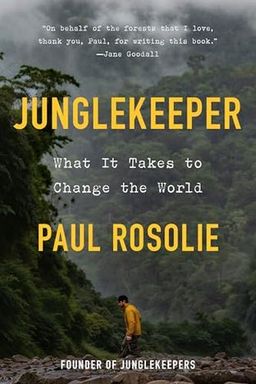
How do you turn a childhood obsession into a force that protects one of the most complex ecosystems on Earth? In Junglekeeper, Paul Rosolie argues that wonder only becomes conservation when you weld it to place-based learning, indigenous mentorship, political courage, and a deepening sense of duty. He contends that saving the Amazon means learning its language—ecological, cultural, and political—and then acting across all three arenas at once.
Across the book, you watch a dyslexic kid from New Jersey discover belonging in a zoo exhibit, bolt for Peru, and slowly apprentice himself to a forest and its people. The story scales from intimate episodes (an orphaned anteater, a jaguar’s breath at night) to system-wide stakes (roads, mining, and park politics). What begins as adventure becomes stewardship because Rosolie keeps choosing immersion, collaboration, and accountability over distance, credentials, or spectatorship.
The engine: belonging becomes vocation
An eight-year-old freezing in awe at Jungle World in the Bronx Zoo is the primal scene. That feeling—"belonging"—guides every later decision. Rosolie leaves high school for a GED, lifeguards to save cash, and cold-emails his way to the Explorer’s Inn and then Las Piedras Station, where two mentors reshape him: Emma, a Cambridge-born biologist who runs a rough-and-ready research base, and Juan Julio “JJ” Durand, an Ese-Eja guide whose forest fluency is a living syllabus.
He crafts a “double life”: semesters at Ramapo College, then long Peruvian field seasons, with lifeguard paychecks and early finals as logistics. A peccary-tooth necklace becomes outreach; it starts deli-line conversations that send volunteers to the station. (Note: like Teddy Roosevelt’s critique of armchair science, Rosolie prizes mud-and-sweat learning without rejecting classrooms entirely.)
The stage: a superlative ecosystem
Madre de Dios, where the Andes dump mineral wealth into lowland rainforest, is a biological crucible. Rosolie points to Conservation International’s tally of hundreds of previously unrecorded species in a single site and details the everyday machinery of abundance: colpas (salt licks), strangler figs as keystones, huicungo palm dynamics, and palisadas—the debris islands where anacondas bask and ambush. Remove a piece, and you unravel the web (think John Terborgh’s “subtract figs and the whole thing can collapse”).
The gauntlet: risk stacked in layers
Lushness doesn’t blunt danger. Trees kill more people than snakes. A low-pressure storm turns the canopy into a bombardment; solo travel multiplies risk. A jaguar breathes beneath a hammock; a 14’9” anaconda thrashes in a capture-and-release; and a MRSA infection nearly ends the story in a hospital bed. Add human threats—poachers with infant macaws in a bucket, loggers tied to political muscle—and you grasp why survival is as much about people and pathogens as predators.
The fight: extraction, roads, and politics
Conservation isn’t neutral science; it’s conflict. The mahogany boom and illegal mining pull chainsaws and mercury upriver. Julio García Agapito is murdered after reporting an illegal timber truck; Dorothy Stang’s assassination in Brazil echoes the pattern. Roads amplify it all: the trans-Amazonian highway and spur cuts create a "fish-bone" deforestation pattern that converts wilderness into farms and pits. Unfinished bridge pylons near Las Piedras sit like fossils of a future that could still arrive if financing returns.
The method: indigenous knowledge and visible value
JJ teaches Rosolie to smell peccary, find water in bamboo, and read tracks like prose. Don Santiago, the family patriarch, maps hidden corridors (the whispered “Western Gate”) and models land titling for his community, Infierno. Together they prove a rule: science without local partnership is slow and brittle; together, it becomes agile. Camera traps, volunteer programs, and short films make the forest legible to outsiders and valuable without extraction. Visibility is leverage; it helped reclaim Las Piedras Station.
The ethic: predators, wilderness, and limits
Protecting jaguars and giant snakes isn’t romanticism; apex predators stabilize systems (as with Yellowstone’s wolves). When a poacher named Lucco likely wounds a jaguar, it’s a moral wound and a trophic one. Rosolie rejects reckless “contact” with uncontacted tribes, recognizing disease risk and autonomy. India’s tiger “core zones” show a workable if imperfect model: inviolate refuges paired with human-use buffers. The lesson is sobering—without political will, even sacred icons become “ghosts.”
The heart: one life, many stakes
Lulu, an orphaned giant anteater, anchors the book’s emotional truth. Nursing her on mashed ants and milk, then coaching her back to wild feeding, Rosolie learns the cost of love in conservation: you must help, then let go. That small arc mirrors the larger mission—rescue a place, rewild its economies, and then trust communities to keep it alive.
Core claim
Belonging fuels skill; skill plus partnership creates power; and power, made public, can hold a forest against roads, rifles, and fever. That is Junglekeeper’s path from obsession to stewardship.