
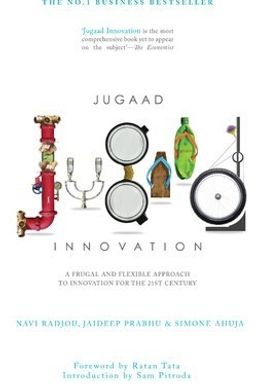
Jugaad Innovation cover

Jugaad Innovation

by Navi Radjou, Jaideep Prabhu, Simone Ahuja

Jugaad Innovation provides business leaders with innovative strategies from India, China, and Africa to thrive in unpredictable markets. Discover how to transform constraints into opportunities, engage with untapped markets, and seamlessly integrate frugal techniques with traditional methods for breakthrough growth.

The Jugaad Mindset: Innovating Through Constraint

How do innovators thrive when resources are scarce, institutions slow, and markets unpredictable? In Jugaad Innovation, Navi Radjou, Jaideep Prabhu, and Simone Ahuja argue that the world’s most resilient breakthroughs don't emerge from abundance—they arise from constraint. The book introduces you to the jugaad mindset, a flexible, frugal, empathetic, and inclusive approach derived from Indian ingenuity but applied globally by leaders from GE to Google.

The authors identify six interconnected principles—seeking opportunity in adversity, doing more with less, thinking and acting flexibly, keeping it simple, including the margin, and following your heart. These are not abstract virtues; they are operational behaviors modeled by entrepreneurs and leaders in India, China, Latin America, and the West. By practicing them together, you can unlock high-impact innovation without heavy budgets or complex infrastructure.

Turning Constraints into Catalysts

Every entrepreneur and leader encounters adversity—regulatory gridlock, limited funding, broken infrastructure. The jugaad mindset teaches you to reinterpret these obstacles as raw material for creativity. Tulsi Tanti, frustrated by the cost of unreliable electricity for his textile firm, transformed power scarcity into Suzlon, India’s wind turbine giant. Kanak Das converted poor roads into propulsion energy for bicycles, and Ratan Tata pivoted the Nano project amid political turmoil without losing sight of its mission. Adversity becomes not a wall but a launchpad.

Frugality as a Competitive Strategy

Doing more with less requires frugality born of design intelligence, not deprivation. Gustavo Grobocopatel grew Los Grobo into a continental farming powerhouse while renting land and equipment rather than owning them. Bharti Airtel scaled nationwide by outsourcing network operations. You learn to strip away waste, reuse assets creatively, and prioritize agility over ownership. (Note: Radjou contrasts this with Western cost-cutting—true frugality produces value, not merely savings.)

Flexibility Over Formality

In a volatile environment, rigid planning collapses. Jugaad innovators improvise deliberately—building feedback loops and small experiments that allow fast pivots. Haier, under Zhang Ruimin, decomposed itself into thousands of micro-units empowered to respond directly to customers. Harish Hande at SELCO tested multiple models for solar financing until rural poor became self-sustaining customers. Flexibility doesn’t mean chaos—it’s disciplined responsiveness.

Simplicity that Scales

Simplicity is the design thread connecting low-cost clay refrigerators (Mitticool) to mobile money (M‑PESA). You start not with features but with user context—an incubator built from wood and lightbulbs saves lives in rural India because it fits what hospitals can maintain. Global firms are adopting simplicity too: Philips’ “Sense and Simplicity” and Siemens’ SMART framework show how elegant minimalism broadens reach. (Note: simplicity is now a Western differentiator, not just an emerging-market principle.)

Inclusion as Strategy

Including marginalized populations generates markets and builds resilience. Zone V designs phones for visually impaired users; YES BANK builds financial tools for unbanked microentrepreneurs; Reuters Market Light delivers affordable data to farmers. These examples prove that inclusion is strategic, not charitable—the “margin” is turning into the majority as demographics shift. When you serve underserved communities, you co-create distribution networks and unlock new revenue streams.

Empathy and Intuition

Data can’t always guide innovation. Intuition and empathy help you make bold decisions amid ambiguity. Mansukh Prajapati trusted his artisan instincts to craft Mitticool; Steve Jobs followed intuition when creating intuitive interfaces; Diane Geng and Sara Lam redesigned Chinese village education by living among students. Heart-led leadership merges emotional intelligence with experiment-driven validation—an authentic combination of instinct and iteration.

Scaling Jugaad within Systems

The authors stress that jugaad complements structured innovation—it doesn’t replace it. GE’s Healthymagination and MAC 400 ECG demonstrate how frugal ideas thrive when big companies supply scale and quality assurance. To institutionalize it, you design incentives, grant time for experimentation (3M’s 15% rule, Google’s 20% time), decentralize authority, and connect to grassroots networks like Stanford’s Frugal Innovation Lab or Ashoka Fellows. Jugaad innovation becomes an organizational and societal ecosystem—a global movement toward resilient creativity grounded in constraint.


Opportunity in Adversity

Seeking opportunity in adversity is the mental pivot that unlocks jugaad. Instead of resisting constraints, you mine them for strategic advantage. Innovators like Tulsi Tanti, Enrique Gómez Junco, and O.P. Bhatt demonstrate that scarcity can reveal hidden assets if you are willing to reframe problems.

Reframe Constraints

Tulsi Tanti reframed erratic electricity as an opportunity for independence and founded Suzlon. Kanak Das turned potholes into power. When you change the question from “How can I avoid this?” to “How can this serve me?”, you shift into adaptive innovation. Corporate parallels exist too—O.P. Bhatt mobilized employees at State Bank of India despite bureaucratic inertia, proving that reframing is both a mindset and a method.

Iterate Rapidly

Improvisation beats paralysis. Tanti’s pivot, Tata’s relocation of Nano, and Junco’s business model shift at Optima Energía all illustrate iterative resilience. Act quickly, test ideas, and adjust continuously. Frugal innovation favors speed over perfection—because in uncertain contexts, delay is risk. (Parenthetical: Six Sigma’s predictability orientation often smothers this improvisational rhythm, which is why top firms blend both disciplines.)

Build Psychological Capital

To embed this mindset, leaders must nurture optimism, creativity, and local autonomy. Danone empowered regional teams and rewarded risk-taking, building collective resilience. Your role is to enable reframing—not decree innovation by memo. When adversity hits, flexible structures and an empowered workforce will discover opportunity faster than command-and-control hierarchies.


Frugality: Doing More with Less

Frugal innovation transforms limitation into leverage. It’s not about cutting corners—it’s designing smarter systems that reuse, recombine, and repurpose resources. The book’s examples—from Bharti Airtel’s outsourcing to Los Grobo’s asset-light farming—show how strategic thrift can outperform capital-heavy rivals.

Asset-Light Business Models

Asset-heavy incumbents struggle to adapt quickly. Frugal innovators convert fixed investments into variable partnerships. Airtel outsourced its infrastructure, freeing capital for growth. Gustavo Grobocopatel farmed via contracts and rentals, scaling faster. You can apply similar thinking by outsourcing non-core tasks and focusing assets where flexibility matters most.

Reuse, Recombine, Redistribute

Frugal inventors exploit dormant capabilities. Zhongxing Medical repurposed existing x-ray technology for mass rural use. MicroVentures used sari-sari stores to distribute goods through the Hapinoy network. M-PESA and Embrace show how local actors and first-principle engineering cut costs while raising impact. Frugality thus becomes a design lens for value creation at scale.

Design for Affordability

The most powerful frugal solutions begin by asking: what does affordability mean to our users? Revolo retrofit kits bring hybrid efficiency to low-income drivers; Embrace’s infant warmer costs 1% of Western incubators yet meets strict medical needs. You focus on function and maintainability, not feature complexity—simplifying without sacrificing reliability or dignity.


Flexible Thinking and Action

Flexibility turns improvisation into capability. The jugaad mindset values responsiveness over rigidity, experimentation over prediction. It helps organizations sense change early and move swiftly when conditions shift.

Challenge Conventional Wisdom

Harish Hande at SELCO challenged the belief that poor customers couldn’t manage solar products. By trusting local entrepreneurs, he reshaped the entire model of energy access. You too can question industry dogmas to uncover latent opportunities. (Compare this to Clay Christensen’s disruption logic—both start from questioning outdated assumptions.)

Empower Local Innovation

Zhang Ruimin made Haier an ecosystem of micro-companies. Decisions happen closest to the customer, eliminating bureaucratic delay. When you decentralize, frontline creativity flourishes—because the people with the most context have authority to act. Flexible firms design for permission, not control.

Experiment Relentlessly

Dr. V. Mohan’s telemedicine van used satellites, volunteers, and local trainers to test multiple care models simultaneously. Jugaad innovators prototype several pathways rather than betting everything on one. If you frame plans as experiments, you’ll adapt faster—and avoid the sunk-cost trap of rigid strategy.


Simplicity as Strategic Design

Simplicity isn’t the opposite of sophistication—it’s applied intelligence that strips away the nonessential. In jugaad innovation, simplicity ensures adoption, affordability, and adaptability across diverse users. From rural incubators to global product architectures, simplicity builds scale by respecting context.

User-Centered Design

Designing for context means starting from local realities. Nokia’s 1100 added a flashlight and durable casing suited for truck drivers and rural users—it became the world’s best-selling phone. Dr. Sathya Jeganathan’s wooden incubator used available bulbs to keep infants warm. When you observe real environments, simplicity emerges naturally.

Universal and Collaborative Simplicity

Western firms revive simplicity through universal design. OXO’s ergonomic tools, Google’s minimalist interfaces, and GM’s platform-sharing model all weave simplicity into engineering and user experience. Cross-functional collaboration between designers, engineers, and writers ensures clarity without compromise. (Mary Barra’s push for 90% component sharing exemplifies systemic simplicity.)

Simplicity Across Product and Service

Programs like Ushahidi make crisis mapping accessible through SMS; SELCO’s product-service integration provides solar maintenance that customers can handle locally. Simplicity is holistic—when interaction, service, and hardware align, adoption becomes effortless and cost drops dramatically.


Inclusive Innovation: Turning Margin into Market

Jugaad celebrates inclusion as a business imperative. It views marginalized populations not as charity cases, but as co-creators and consumers. This inclusive lens has allowed firms such as YES BANK, Danone, and Neusoft to expand profitably while transforming lives.

Design for Underserved Users

Zone V created phones for blind users; Embrace developed affordable infant warmers; YES BANK used digital platforms like YES MONEY to serve the unbanked efficiently. These innovations thrive because they start with empathy and design for aspiration as much as need. To include the margin, you model dignity, not dependence.

Co-Creation and New Models

Inclusive innovation involves collaboration with local partners and micro-entrepreneurs. MicroVentures’ Hapinoy network trains store owners who become distributors and educators, while SELCO’s decentralized model empowers local maintenance providers. You design networks that distribute both value and capability.

Technology-Enabled Scale

Reuters Market Light delivers crop information via SMS for pennies, and Neusoft’s wearable sensors use cloud computing to democratize healthcare. Affordable technology bridges physical and social gaps. (Note: As demographics shift globally, inclusion strategies redefine mainstream competition—the margin now forms the majority.)


Heartpower and Human Insight

Following your heart is the sixth jugaad principle—an antidote to sterile data-driven decision-making. It means trusting empathy, intuition, and moral clarity when information is scarce. Heartpower fuels persistence and creativity when uncertainty dominates.

Empathy as Innovation Tool

Diane Geng and Sara Lam immersed themselves in rural China to redesign education around learner engagement. Dr. Devi Shetty’s cardiac care mission stems from compassion, not only competition. When you sense user pain directly, you design meaningfully and sustainably.

Intuition in Action

Kishore Biyani ignored consultants and modeled Big Bazaar after Indian street markets, creating one of India’s largest retail chains. Steve Jobs trusted instinct when developing products that felt right before testing data could confirm it. Heartpower doesn’t ignore feedback—it moves faster because it combines gut feeling with rapid experimentation.

Cultivating Passion with Discipline

Leaders can institutionalize empathy through action: run empathy boot camps, create passion incubators, and combine heart-led ideas with prototype-based validation. Empathy and intuition sustain courage; disciplined experimentation ensures rigor. Together they make innovation emotionally intelligent and operationally sound.


Embedding and Scaling Jugaad

To make jugaad part of a lasting system, organizations must design structures that nurture spontaneity. The authors outline how giants like GE and 3M blend bottom-up creativity with top-down scaling, balancing freedom and discipline.

Institutional Design for Improvisation

3M’s 15% program, Google’s 20% time, and SAP’s AppHaus create protected spaces for tinkering. These deliberate slack moments let employees test ideas cheaply. Decentralized models such as Haier’s micro-units or Danone’s polycentric teams further prevent hierarchy from suffocating innovation.

Align Rewards and Networks

PepsiCo and Florida Ice & Farm link performance metrics to frugality and sustainability. P&G’s Connect + Develop and TCS’s COIN network show how partnering externally multiplies creative range. Structure incentives around resource-effectiveness and local impact, not only profit.

Integrate with Formal R&D

GE’s MAC 400 ECG and Vscan ultrasound integrate jugaad principles with Six Sigma rigor—high quality at low cost. Successful organizations blend grassroots experimentation with robust engineering. When you marry flexibility to discipline, innovation becomes both fast and dependable.


Global Ecosystem and Future of Jugaad

Jugaad has evolved into a global movement spanning universities, start-ups, governments, and grassroots innovators. These ecosystems make frugal innovation not a regional tactic but a worldwide capability. To innovate effectively now, you must connect your organization to this broader network.

Talent Networks and Education

Universities like Stanford, Cambridge, and Santa Clara run Frugal Innovation and Inclusive Design Labs that produce skilled “constraint innovators.” These graduates blend empathy with engineering. Recruiting and sponsoring such programs strengthens your innovation pipeline.

Government and Institutional Support

Governments now fund bottom-up innovation. The White House Social Innovation Fund and France’s auto-entrepreneur scheme help micro-ventures flourish. Firms partnering with these initiatives gain local credibility and low-cost experimentation grounds.

Cross-Cultural Sharing

Global organizations such as Ashoka and Skoll connect innovators across continents. Makers like Limor Fried or educators like Sal Khan extend jugaad beyond emerging markets through open-source, online platforms. By plugging into such ecosystems, you access tested models and talent from a worldwide pool driving the frugal, inclusive future.

Dig Deeper

Get personalized prompts to apply these lessons to your life and deepen your understanding.

Go Deeper

Get the Full Experience

Download Insight Books for AI-powered reflections, quizzes, and more.