
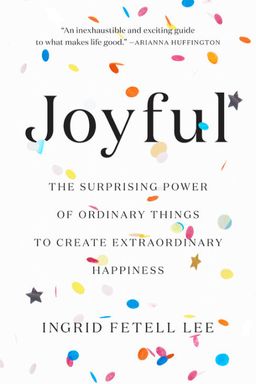
Joyful cover

Joyful

by Ingrid Fetell Lee

Joyful by Ingrid Fetell Lee explores the transformative power of design in creating happiness. By embracing vibrant colors, playful designs, and harmonious spaces, this book reveals how everyday surroundings can be molded to spark joy, enhance well-being, and inspire innovation in our lives.

Designing Joyful Worlds

What makes life feel buoyant instead of burdensome? Ingrid Fetell Lee’s Joyful begins with that deceptively simple question and proceeds to argue one radical idea: joy is not just an emotion, but an interaction between your body and the world. The material surroundings—color, light, form, pattern, and texture—have direct psychological effects, and by designing them intentionally, you can cultivate joy as reliably as nutrition or exercise.

Drawing on neuroscience, evolutionary biology, and design, Fetell Lee identifies recurring visual and spatial signatures of joy that appear across cultures and eras. These aren’t fleeting pleasures; they’re aesthetic principles rooted in how your senses interpret safety, abundance, and possibility. The book organizes them into ten distinct aesthetics—energy, abundance, freedom, harmony, play, surprise, transcendence, magic, celebration, and renewal—each revealing a different path to delight.

Joy as Sensory Dialogue

Lee views joy not as a luxury emotion but as a survival signal. Bright color and sunlight function as cues of vitality, lushness, and safety; human brains evolved to equate those sensations with thriving conditions. This explains why dull gray offices drain energy and why colors like yellow or turquoise can lift mood before thought even intervenes. Her thesis implies design can act therapeutically—turning a neglected space into a positive feedback loop of civic or personal energy.

From Environment to Emotion

The argument expands beyond aesthetics into anthropology and public policy. The Tirana repainting experiment under Mayor Edi Rama becomes a parable: by changing surface color, an entire city’s morale shifted. That pattern repeats in Publicolor’s school refurbishment projects, in James Turrell’s skyspaces, and in Dorothy Draper’s exuberant hotel interiors. Joy is contagious when embedded in the physical world—what design theorist Victor Papanek might have called “social ergonomics of happiness.”

A Map of Joy’s Forms

Each aesthetic corresponds to a universal longing: for dynamism (energy), fullness (abundance), openness (freedom), coherence (harmony), experimentation (play), novelty (surprise), uplift (transcendence), connection to mystery (magic), community (celebration), and restoration (renewal). Together they form a cohesive emotional ecology. You can mix them deliberately: abundance and harmony balance each other; surprise and play enhance engagement; freedom and renewal reconnect you with time and nature’s rhythms.

The Practical Dimension

The Joyful Toolkit at the end transforms theory into practice—inviting you to audit where joy already lives in your environment and to design projects that amplify it. Through small, sensory tweaks—brightening lighting, organizing clutter, rotating textures—you can shift mood patterns as measurably as through therapy or mindfulness. The book’s overarching purpose is empowerment: to remind you that joy is not random luck but designable, renewable, and collective.

Core Thesis

Joy is the product of a material dialogue with your surroundings; every hue, texture, and pattern is an instrument you can tune to foster vitality, connection, and creative resilience.

In short, Joyful reframes aesthetics from decoration to nourishment. By reawakening your sensory intelligence and using the ten aesthetics as design tools, you turn ordinary spaces into engines of emotional growth. The book’s message is not about chasing happiness—it’s about making your physical world a collaborator in well-being.


Energy and Abundance

Color and light are the most direct catalysts of joy in Ingrid Fetell Lee’s framework. The human brain associates brightness and saturation with vitality and safety—a connection dating back to primate evolution when recognizing ripe fruit and fertile foliage meant survival. Vibrant hues work as psychological nutrients, while daylight regulates physiology through circadian rhythm, mood, and recovery speed.

Color as Visible Energy

Edi Rama’s Tirana transformation—painting decayed city blocks in candy-colored tones—demonstrates color as social energy: optimism broadcast through pigment. Similar results appear in Publicolor’s school projects where turquoise and lemon yellow walls improved attendance. Lee encourages small, high-impact color interventions: paint a door teal, introduce a yellow lamp, or use warm light (2700–3000K CRI 90+) to restore natural vibrancy.

Abundance and Sensory Nourishment

Abundance complements energy by creating sensory richness rather than clutter. You perceive abundance not from accumulation but from variety and layered textures—a blooming garden, a brimming candy jar, or a patterned quilt. Psychologists John Balling and John Falk’s landscape studies show this instinct transcends culture; lush environments trigger feelings of safety and pleasure. Fetell Lee warns, however, that overconsumption kills joy; what matters is organized multiplicity—diversity within harmony.

Designing Radiance

  • Use color deliberately—saturated hues to signal vitality, light tones to reflect illumination.
  • Build sensory abundance through varied materials: velvets, woods, leaves, confetti.
  • Balance intensity with coherence: repetition of pattern or color lets the eye rest.

Design Lesson

Color and abundance are humanity’s oldest joy codes—evidence that sensory nourishment sustains emotional life as food sustains the body.

When you tune your surroundings for radiance and richness, you don’t just beautify them; you broadcast life. Joy begins with what your eyes and skin perceive as thriving—and spreads through every human system that registers safety, excitement, and hope.


Freedom and Harmony

Freedom and harmony represent two sides of spatial joy—one expansive, the other grounding. Where freedom evokes open air, movement, and prospect, harmony brings order and coherence that calm the mind. Fetell Lee shows how design can balance both: a clear sight line liberates, a symmetrical rhythm restores.

Nature and the Prospect–Refuge Instinct

Jay Appleton’s prospect-and-refuge theory is the scientific backbone: people prefer environments offering sweeping views plus nearby shelter. Olmsted’s Central Park and Capability Brown’s English landscapes apply this instinct with lawns, tree clusters, and meandering paths. Contemporary urban analogues—the High Line or pocket parks—recreate freedom in small doses, letting commuters glimpse life’s larger rhythm.

Harmony Through Order and Flow

While freedom opens, harmony unifies. Biological preference for pattern and symmetry rewards recognition with neural pleasure, as V.S. Ramachandran notes. Fetell Lee applies this to design: repetition, alignment, and balance make complexity comprehensible. Feng shui’s concept of chi aligns with this—the flow of movement through uncluttered paths reflects emotional ease.

  • Cultivate prospect: windows, lowered partitions, open corridors.
  • Include refuge: window seats, alcoves, canopy beds—micro-shelters of calm.
  • Create harmony with visual rhythm—pairs, symmetry, clear pathways.

Balance Principle

Freedom offers expansion; harmony provides coherence. Together they yield the quiet confidence that a space supports movement without chaos.

You can build freedom and harmony incrementally: clear windowsills, align furniture, plant greenery, or restore symmetry. These small gestures reconnect body and mind to the enduring geometry of calm exploration.


Play and Surprise

Play and surprise animate joy’s mischievous side—the spontaneous sparks that transform routine into wonder. Fetell Lee traces them to evolutionary curiosity and physical invitation: rounded shapes and incongruous moments draw attention and encourage risk-free experimentation.

Circles and Curves as Invitations

Play begins in form. Circles and spheres—balls, bubbles, Ferris wheels—convey safety and motion. Biologists note babies and animals alike gravitate toward roundness; Konrad Lorenz’s “baby schema” explains why soft curves evoke care and enjoyment. Spaces that incorporate curvature (Antti Lovag’s Bubble Palace, Gaetano Pesce’s furniture) visually disarm, helping creativity flow.

Surprise and Hide‑and‑Reveal

Surprise sharpens play’s spark. From yarn-bombed poles to brightly painted doors, small contrasts interrupt monotony and return attention to the present. Hide‑and‑reveal designs—objects with hidden details or secret notes—invite repeat discoveries. They use curiosity as gratification: the brain earns pleasure for seeking and finding.

Everyday Experiments

  • Swap angular objects for rounded ones to reduce tension.
  • Hide joyful tokens—notes, shells, stickers—in pockets or drawers for later rediscovery.
  • Use contrast sparingly but pointedly: a single bright accent can awaken a whole room.

Psychological Insight

Surprise operates like a reset button—interrupting prediction loops and reconnecting you with direct perception.

Whether through bubbles, balloons, or a hidden message in a scarf, play and surprise expand possibility. They remind you that lightness is not immaturity; it’s the flexible intelligence that keeps curiosity alive.


Transcendence and Magic

Transcendence and magic represent joy’s most expansive tier—the feeling that lifts you beyond ordinary perception. Fetell Lee uses elevation, light, and enchantment to explain how physical height and luminous vastness shrink self-focus and evoke awe, while cultural myths and illusions sustain mystery amid modern rationality.

Elevation and Light

Treehouses, towers, and balloons grant literal and metaphorical ascent. Pete Nelson’s treehouses offer refuge and perspective; even twelve feet of height alters thinking patterns—ascending primes abstraction, descending concreteness. Light extends that lift vertically: James Turrell’s skyspaces and Doug Wheeler’s infinity rooms immerse viewers in gradients of blue and white that dissolve boundaries and trigger awe responses identified by Dacher Keltner and Jonathan Haidt.

Magic and Everyday Enchantment

Fetell Lee explores how societies preserve wonder through folklore and illusion. In Iceland, belief in elves embeds respect for landscape and unpredictability. Olafur Eliasson’s fog installations or magician Andrew Evans’s Magic Patio demonstrate intentional design of the impossible—crafting sensory astonishment through light, air, and narrative. These experiences reawaken the intuition that the world still hides forces beyond comprehension.

  • Seek altitude or uplift when creativity stalls—balconies, rooftops, skylights.
  • Add light gradients or reflective surfaces to invoke spaciousness.
  • Encourage playful illusion—mirrors, fog, or optical tricks that reveal hidden phenomena.

Transformative Principle

Elevation and enchantment dissolve boundaries, fostering awe that makes you feel smaller but more connected—an antidote to isolation and monotony.

Transcendence is not escapism; it is perspective restored. You can't live permanently in a balloon or skyspace, but you can design glimpses of the infinite that steady your sense of meaning on the ground.


Celebration and Renewal

Joy reaches full social scale in celebration and renewal—the aesthetics of togetherness and rebirth. Fetell Lee treats them as cyclical antidotes to isolation and fatigue. While celebration amplifies collective happiness through rhythm and synchrony, renewal reconnects you to natural cycles that replenish vitality and sustain anticipation.

Communal Joy and Music

Festivals, weddings, and civic rituals—from Carnival’s radiant costumes to Rockwell’s reimagined Oscars stage—turn private emotion into shared experience. Music and synchronized movement trigger physiological alignment; heartbeats and neural rhythms sync, breaking down social barriers. Oversized shapes, sparkle, and radiating patterns act as celebratory amplifiers, signaling that ordinary time has been suspended for connection.

Renewal and Growth

Renewal, by contrast, is quiet celebration. The Japanese hanami season—cherry blossoms under pink lanterns—embodies mono no aware: awareness of beauty’s impermanence heightens joy. Urban analogues like the High Line show renewal as ecological and emotional regeneration. Forms that mimic growth—spirals, blossoms, S‑curves in Eva Zeisel’s designs—convey becoming and hope.

  • Mark personal seasons with rituals that repeat joy—birthdays, first‑firefly night, blossom walks.
  • Balance exuberance with restoration: rest after celebration to sustain the rhythm.
  • Use organic forms and timing in design to create ongoing renewal rather than static perfection.

Rhythmic Wisdom

Life’s joy operates in cycles: burst, rest, rebirth. Designing for rhythm sustains happiness the way breathing sustains life.

Celebration reminds you to share joy outward; renewal teaches you to trust its return. Together they form the pulse of living design—an ongoing conversation between collective exuberance and quiet hope.


The Joyful Toolkit

Fetell Lee closes the book with practical synthesis: joy is designable, so its principles can become daily practice. The Joyful Toolkit offers structured reflection and iterative adjustment to embed the ten aesthetics in your personal world.

Finding Joy

The Joy Journal and Joyfinding worksheet guide self-observation—where do you already feel uplifted? By cataloging places, people, and objects that trigger joy, you identify your most resonant aesthetics. Some might find energy and abundance in bright kitchens, others freedom and harmony in nature walks.

Making Joy

You then translate findings into design projects. The Joyful Project worksheet prompts you to choose three aesthetics, outline sensory cues, and prototype small actions—from hanging garlands (surprise) to adding plants (freedom). The Joyful Palette summarizes key traits: energy favors color and sunlight; harmony uses symmetry; play introduces curves; renewal adds blossoms.

Iterate and Evolve

Joy design is iterative. Use the More/Less worksheet to guide accumulation and editing: more saturation, less clutter; more openness, fewer barriers. Like adaptive architecture, your responses change with season and mood; the toolkit encourages revisiting choices as life evolves.

Action Principle

Treat joy as a design brief—observe, prototype, refine. Every small adjustment can rewire perception toward aliveness.

The toolkit transforms abstract aesthetics into a practical habit of noticing and shaping. By seeing your surroundings not as background but as collaborators, you sustain joy as ongoing creative dialogue.

Dig Deeper

Get personalized prompts to apply these lessons to your life and deepen your understanding.

Go Deeper

Get the Full Experience

Download Insight Books for AI-powered reflections, quizzes, and more.