
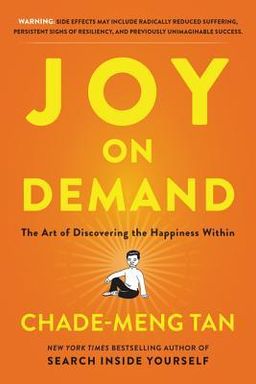
Joy on Demand cover

Joy on Demand

by Chade-Meng Tan

Joy on Demand by Chade-Meng Tan offers a transformative guide to finding happiness through meditation. Explore how simple practices can turn misery into hope, enhance emotional resilience, and discover profound joy in everyday life. Embrace meditation to achieve true, sustained happiness effortlessly.

Joy as a Trainable State of Mind

How often do you wait for joy to arrive—after success, after love, after the weekend? In Joy on Demand, Chade-Meng Tan, Google's original “Jolly Good Fellow,” argues that joy doesn’t have to wait. Far from being dependent on wealth or fortune, joy is a trainable mental skill—available to you here, now, in the space of a single breath. Drawing from Buddhism, neuroscience, and his own experience as an engineer and meditation teacher, Tan contends that cultivating inner joy is the most practical thing you can do for happiness, leadership, and life itself.

At the heart of this book is the idea that how you use your mind determines your baseline happiness. Just as regular workouts strengthen the body, regular mind training strengthens your capacity for peace, clarity, and joy. Tan builds his case with an engineer’s precision and a monk’s warmth, using humor, metaphors, and everyday examples from Google’s halls and mindfulness classes. The book presents meditation not as an esoteric practice, but as a practical system of exercises for cultivating the mind toward “joy on demand.”

The Three Core Practices: Easing, Inclining, and Uplifting

Tan structures the entire journey toward sustainable joy around three master skills. First comes easing—learning to rest the mind in calm relaxation so that joy naturally arises from a state of ease rather than effort. Second is inclining—training the mind to notice and savor moments of joy so that it becomes more predisposed toward positivity. Third is uplifting—using wholesome emotions like kindness, compassion, and altruistic joy to elevate your state of being. Together, these practices create a feedback loop: joy makes meditation easier, meditation makes joy more reliable, and both reshape your brain toward happiness.

Joy and Success Are Not Opposites

The book challenges one of modern life’s biggest myths: that success leads to happiness. According to Tan—and research cited by psychologists like Shawn Achor—happiness precedes success. A joyful mental state improves creativity, decision-making, and resilience, all of which enhance your performance at work and in relationships. Joy, Tan says, is not the reward for getting life right—it is the foundation that helps you handle life better.

Accessible Science and Practice

Tan democratizes meditation by stripping away mysticism. He translates complex Buddhist ideas into plain English and jokes (“Don’t worry, be lazy”) to make principles memorable. He leans on research in neuroplasticity and positive psychology to show that even one mindful breath can reduce stress, enhance focus, and begin building the habit of calmness. Across stories—from Google engineers discovering creativity mid-meditation to ancient parables about compassion—Tan demonstrates that sustainable joy is not only possible but measurable.

Why This Matters Now

In a world addicted to busyness and external validation, Joy on Demand offers a mental revolution. By redefining happiness as a skill rather than a circumstance, Tan empowers you to depend less on stimulation or ego and more on mindful presence. The larger promise is societal: joyful individuals become kind leaders, compassionate innovators, and resilient communities. With a smile and a breath, this book invites you to start training your mind for a happiness that truly lasts.


Easing into Sustainable Joy

Tan begins the journey to joy with the act of easing. To ease is to let the mind rest until its natural calmness resurfaces—much like setting down a shaken snow globe and watching the flakes settle. This quieting process reveals an essential truth: peace is not created, it is uncovered. The mind doesn’t need fixing, only space to be still.

The Power of One Breath

Tan's signature exercise, One Mindful Breath, proves that transformation can begin in seconds. By taking a single slow, attentive breath, you trigger a biological and psychological shift: the vagus nerve engages, lowering your heart rate and activating the parasympathetic nervous system. Psychologically, you return to the present, away from regret and worry. “The moment you breathe mindfully,” he writes, “you’re already a little freer than you were before.”

He likens this approach to “bicep curls for the mind.” Just as repetitive strength training sculpts the body, mindful breathing incrementally trains attention, relaxation, and joy. Each breath is a microdose of calm, and repetition creates a stable trait of peace. Over time, you discover that mind training, like physical fitness, is easy to learn but difficult to master.

Wise Laziness

As a self-proclaimed “lazy engineer,” Tan celebrates what he calls wise laziness: using insight and efficiency to do the least unnecessary work while achieving maximum benefit. He warns against overexertion in meditation. The trick is to apply just enough effort to create the conditions for calm, then let the mind settle itself—like placing the snow globe on the table and allowing gravity to do the rest. “We don’t settle the mind,” he notes, “the mind settles itself.”

Experimentation and Familiarization

Different people calm their minds differently. Some use anchoring—focusing on breath, body, or sensation. Others prefer resting—mentally reclining into stillness, repeating the mantra, “Nowhere to go, nothing to do.” Still others practice being, surrendering all agenda to simply sit. The right method, Tan insists, depends on your temperament, your day, and even your energy level. Regular practice—no matter how brief—familiarizes your mind with ease, allowing joy to emerge naturally.

Joy Arising from Ease

The first glimpse of joy, Tan discovered, came not from excitement or achievement but from ease—a quiet contentment in knowing he was breathing. That joy of ease becomes the seed of “joy on demand.” By learning to calm the mind, you free it from constant stimulation. In that pause, joy has room to grow—sustained not by external pleasure but by inner stability. Ease, he says, is the foundation on which all other happiness stands.


Inclining the Mind Toward Joy

Once the mind learns to rest, Tan’s second major skill begins: inclining the mind toward joy. Instead of chasing joy, you train your awareness so that joy finds you. Like water naturally flowing down a mountain slope, the mind, when properly shaped, gravitates toward optimism and ease.

Noticing Thin Slices of Joy

Tan observes that life is full of “thin slices of joy”—the warmth of a shower, the taste of the first morning sip of coffee, a friend’s smile—that pass unnoticed. His practice of noticing joy asks us to simply recognize these micro-moments. Once noticed, they multiply. What we attend to becomes more visible, and joy, like blue cars once you start tracking them, suddenly appears everywhere.

Attending to Joy

The step after noticing is attending—giving joy your full, caring attention. To attend is to nurture, not pursue. Tan suggests savoring one moment each day completely: a bite of food, a walk, a conversation. This act “consolidates” joy, deepening its impression on the brain. Neuroscientists like Rick Hanson call this process “taking in the good”—embedding positive experience into neural structure.

The Joy of Blamelessness & The Gratitude Habit

You can also incline joy through ethical clarity and gratitude. The “joy of blamelessness,” Tan writes, comes from simple integrity—doing what’s right leaves the mind light and unburdened. Gratitude magnifies this peace. By acknowledging the miracle of ordinary life—clean water, breath, blue sky—you override habituation, the brain’s tendency to get numb to blessings. Tan also recommends a powerful mortality reminder: “Someday I will die; everyone I love will die.” Far from nihilistic, it reawakens appreciation, softening anger and indifference into presence.

The Joy of Not Being in Pain

Among Tan’s most potent insights is rejoicing in what’s absent—pain. After enduring a series of dental surgeries, he realized that the absence of suffering itself is a profound joy we overlook. Reminding yourself “I am not in pain right now” transforms neutrality into contentment. The same logic applies emotionally: being free from hatred, grief, or fear, even for moments, is worth celebrating.

Seeing “Gone” as Freedom

Building on teachings from meditation master Shinzen Young, Tan trains you to note Gone—to observe when sensations, thoughts, or emotions end. Every “gone” reveals impermanence and frees you from clinging. In that gap between arising and passing, the mind glimpses liberation—a joy that doesn’t depend on what’s happening, but on awareness itself.


Uplifting the Heart Through Kindness and Compassion

Tan’s third and final foundation of joy is uplifting the mind through the heart practices of loving-kindness, compassion, and altruistic joy. These are the mental equivalents of nourishing food: they are wholesome, sustainable, and contagious. Where earlier chapters focus on joy arising within, this one focuses on joy spreading outward—and coming back amplified.

The Ten-Second Kindness Experiment

Tan begins with a simple exercise: pick two people and silently think, “I wish for this person to be happy.” That’s it. Ten seconds of secret goodwill. When he shared this at a talk, one woman tried it every hour the next day and emailed Tan to say it had been her “happiest day in seven years.” Such is the power of metta—boundless friendliness. The act of wishing well, he explains, lights up the brain’s reward circuitry. You don’t need religious devotion or hours of sitting; one kind thought is enough to change your internal chemistry.

From Kindness to Compassion

Loving-kindness naturally evolves into compassion—the wish to relieve suffering. Compassion feels more challenging because it demands that we face pain. Yet studies by neuroscientists like Richard Davidson and experiences of monks such as Matthieu Ricard show that compassion is neurologically the most joyful state ever measured. When rooted in inner peace and joy, compassion transforms sadness into courage and equanimity. As Tan says, “When sadness meets equanimity, what arises is love.”

Rejoicing in Goodness

The next heart quality, altruistic joy (or mudita), celebrates others’ happiness. Whereas envy constricts the heart, rejoicing expands it. Tan admits it’s the hardest of the heart practices, but also the most rewarding: by delighting in others’ success, you multiply your own joy without limit. He advises practicing “rejoicing in inner goodness”—reflecting on your generous acts not with pride but gratitude. Even remembering a kind gesture you’ve made can lift the mind into self-acceptance and self-compassion.

The Science of the Heart

Modern science supports ancient wisdom: loving-kindness and compassion literally strengthen the heart. Through what researchers call neurocardiac coupling, the vagus nerve links emotional warmth to physical resilience. Regular activation increases vagal tone, correlating with better health, empathy, and trust. As Tan jokes through a story of laughing monks, “If you want to measure compassion, stop scanning the head and start with the heart.”

Practiced together, these sublime states steady the mind, soften the ego, and infuse ordinary life with extraordinary warmth. Joy, he concludes, “is the natural companion of love.”


Working with Emotional Pain

A book about joy must inevitably talk about pain. Tan devotes an entire chapter to the art of working with emotional pain, teaching that joy is not the absence of suffering—it is the capacity to hold suffering differently. Borrowing from Buddhist and therapeutic models, he proposes a three-step process for transforming emotional wounds into wisdom: the attentional, affective, and cognitive steps.

Step 1: Calm the Mind (Attentional)

The first task in any crisis is calming the storm. Turning attention to the breath anchors the mind in the present, interrupting spirals of worry or regret. Tan illustrates this with the Buddhist parable of Patacara, who lost her entire family in one day and was guided by the Buddha to first “calm her mind,” beginning her path to healing. Even amid chaos, one mindful breath opens a window of sanity.

Step 2: Attend with Love (Affective)

This stage shifts from control to compassion. Pain manifests as sensations—tightness in the chest, knots in the stomach—that are real but impermanent. By applying loving-kindness and equanimity, you gradually reduce aversion. Tan’s retelling of the “Anger Monster” parable shows how kindness, even toward emotions, shrinks them over time. The goal isn’t to eliminate pain but to hold it gently, much like Rigoberta Menchú, the Nobel laureate who radiated joy despite immense personal loss.

Step 3: Reframe Reality (Cognitive)

Once calm and compassion return, you can rethink the story. Our perception is inherently flawed, Tan reminds us, citing the “Invisible Gorilla” experiment where half the viewers missed the gorilla on screen. We fill in gaps with assumption and negativity. Cognitive reframing—seeing through kindness, humor, and long-term perspective—restores balance. As comedian Louis C. K. jokes, “Everything is amazing and nobody’s happy.” Tan agrees: gratitude realigns perception with truth.

The Art of Suffering

For moments when suffering overwhelms skill, Tan draws from Thich Nhat Hanh’s teaching on “The Art of Suffering.” Stop analyzing; just feel. Cradle your pain like a crying child. Let compassion, not resistance, hold the hurt until it transforms. In that tenderness, he says, “the pain becomes the soil in which compassion blooms.”


Joy Beyond the Ordinary Mind

In the book’s final chapters, Tan explores joy at its most refined—beyond worldly pleasure, beyond effort. He describes the three pillars of mature meditation—calm-abiding (samatha), insight (vipassana), and sublime states (brahmavihara)—as the foundations of the Great Mind: a state of effortless awareness so joyful it has been likened to something “better than sex.”

From Effort to Effortlessness

After thousands of hours of disciplined meditation, Tan found himself, paradoxically, stuck. No further progress came until a Zen master advised, “Abandon effort.” Like a sailboat pushed into the ocean, meditation must eventually trade muscular striving for natural flow. Once stable, the mind becomes self-sustaining. Joy blossoms without cause—the effortless joy beyond doing.

Seeing Clearly, Being Free

In deep insight practice, awareness penetrates perception itself, seeing thoughts, emotions, and even the self as processes rather than objects. Tan recounts tasting states described in spiritual traditions as kensho or stream entry—where the “observer” dissolves into pure observation. In such moments, suffering drops dramatically because the “I” who suffers is seen as a construct. Freedom, he says, isn’t about control—it’s about letting go.

Letting Go as the Ultimate Joy

Tan concludes with disarming simplicity: all meditation, at its heart, is the practice of letting go. We release clinging, aversion, ego, even the desire to feel good. Each surrender brings a new kind of joy—freedom from want, fear, resentment, identity. “At every stage,” he writes, “I was rewarded with a new source of wholesome joy.” In this sense, joy isn’t a goal; it’s what remains when striving ends. The great mind—calm, clear, loving—is already within you, waiting to be remembered, one breath at a time.

Dig Deeper

Get personalized prompts to apply these lessons to your life and deepen your understanding.

Go Deeper

Get the Full Experience

Download Insight Books for AI-powered reflections, quizzes, and more.