
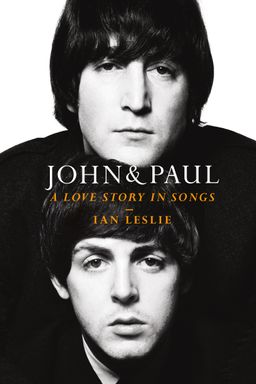
John & Paul cover

John & Paul

by Ian Leslie

The 23-year relationship between John Lennon and Paul McCartney is viewed through the lens of the songs they wrote together.

Love, Rivalry, and the Making of Modern Pop

How do two teenagers on the edge of a Liverpool field become the engine of twentieth‑century pop? This book argues that the Beatles’ achievement rests on a specific chemistry: Lennon and McCartney’s emotionally charged partnership, hardened by grief and apprenticeship, amplified by a visionary manager and producer, and expanded by studio experimentation until the medium itself became their instrument. The same forces that lifted them—intense interdependence, public pressure, and risky business choices—also set up the fracture that produced their late‑period tensions and the enduring, post‑Beatles conversation in song.

A partnership formed in imbalance

The story begins with a lopsided meeting: July 1957, St. Peter’s church fete. John Lennon, older and swaggering, fronts the Quarry Men; Paul McCartney arrives as a 15‑year‑old with technique and ambition. Their first exchange—Paul clocking John’s brazenly mangled “Come Go with Me” and John noticing Paul’s fluency—becomes emblematic. They sign a radical pact: any song either starts becomes “Lennon–McCartney.” This simple credit rule erases public ego, forces private collaboration on unfinished ideas, and creates an economic engine that rewards output. You see quickly that process and incentives shape art.

Apprenticeship: stealing like artists

Before fame, the group gorges on American records—doo‑wop harmonies, Buddy Holly’s economy, R&B drive—and then stress‑tests the mix in Hamburg’s clubs. Eight‑hour sets at the Indra and Kaiserkeller forge stamina, extended arrangements, and audience command. Their friends Astrid Kirchherr and Klaus Voormann lend a visual seriousness; Tony Sheridan throws in dominant sevenths and blues dynamics. What looks like imitation becomes personal: they make American idioms “theirs.” (Note: this resembles the jazz apprenticeship cycle—copy, assimilate, innovate.)

Grief as fuel, music as language

Both John and Paul carry losses that become artistic grammar. Paul’s mother Mary dies when he’s 14; he develops a shell that later surfaces as caretaking songs and consoling melodies (“Let It Be”). John’s unstable maternal world (Julia and Aunt Mimi) and Julia’s death in 1958 leave him with fear of abandonment and a drive for total connection. Their closeness is emotional before it’s commercial: each becomes the other’s attachment figure, and songs become the safe place to say what can’t be said aloud.

Epstein and Martin: platform and palette

Enter Brian Epstein (image, ambition, structure) and George Martin (ears, craft, laboratory). Epstein polishes and projects what’s already there—suits over leathers, higher fees, a professional frame—then secures Parlophone after Decca’s rejection. Martin reframes the studio from a microphone to a palette. His early call to have Paul sing the “Love Me Do” refrain sets a pattern of vocal swapping; his later openness to strings, tape, and unusual arrangements makes the recordings distinctive artifacts rather than stage replicas.

Two voices diverge—and weave

Over time you hear Paul’s melodist/arranger tendencies (counterpoint bass lines, bridges, stylistic range) and John’s satirical, interior focus (compressed lyrics, emotional bite). Yet they keep occupying the same “I” inside songs—“If I Fell,” “A Hard Day’s Night,” “In My Life”—producing a third voice that is neither one alone. Proximity breeds fusion; divergence sharpens the edge.

From touring to tapes: the studio turn

Beatlemania gives and takes. Shea Stadium proves the scale; the “more popular than Jesus” flare‑up (republished by Datebook) and the Manila fiasco prove the danger. By 1966, the studio becomes sanctuary and instrument. Psychedelic reading (Timothy Leary), Paul’s tape‑loop tinkering, and Martin’s permissiveness yield “Tomorrow Never Knows,” where Leslie‑treated vocals float atop drone and loops, and “A Day in the Life,” where orchestral glissandi bridge two lives into one epic chord. Singles no longer must be live‑feel; albums can become worlds.

Sgt. Pepper and medium as message

With Sgt. Pepper, Paul leads a pop Gesamtkunstwerk: cover collage (Peter Blake, Jann Haworth), printed lyrics, costumes, gatefold—an object that tells you the record is the art. The album folds time: brass bands, music‑hall gestures, harpsichords sit with tape and studio tricks. The Beatles invite the past into the present, not to mock it but to transform it, as if a party includes dead and living alike. Dream logic, not narrative logic, rules.

Fracture, reckoning, and afterlives

After Epstein’s death, Paul becomes de facto project manager; John oscillates between brilliance and vulnerability. India promises salvation, then cracks open John’s need for certainty—“Sexy Sadie” is the aftermath. Apple Corps’ utopia collides with real money; Eastmans vs. Klein becomes a proxy war about trust, culminating in Paul’s High Court writ to dissolve the partnership. Yet the rooftop concert shows the old spark; post‑breakup songs become letters, attacks, and apologies (“How Do You Sleep?,” “Dear Friend”). Lennon’s murder freezes the story into myth; Paul’s “Here Today” writes the conversation that death stopped. (Note: projects like 2023’s “Now and Then” continue this slow reconciliation.)

Key idea

The Beatles teach you that big art needs a triangle: intimate partnership, enabling institutions, and a medium you dare to reinvent. Break any side, and the structure wobbles; strengthen all three, and you change culture.


Meeting, Pact, and Apprenticeship

The July 6, 1957 fete at St. Peter’s in Woolton is the hinge of this story. You watch John Lennon, 16, swagger through skiffle covers with the Quarry Men, and you watch Paul McCartney, 15, clock his bravado—and his weak chord changes—before tuning a guitar backstage and singing “Twenty Flight Rock” cleanly, in key. The imbalance is instructive: John has charisma and leadership; Paul has craft and a hunger to belong. Their immediate exchange of originals—Paul’s “I Lost My Little Girl” and John’s “Hello Little Girl”—signals what comes next: a private school for two in which both will learn to write, arrange, and perform.

The pact that changed the work

They agree to a simple rule: everything is Lennon–McCartney. This isn’t a legal trick so much as a cognitive frame. It removes public ego (shared credit), lowers the cost of showing rough drafts (you bring fragments without shame), and makes writing the engine of identity and income. They keep a school exercise book labeled “ANOTHER LENNON–McCARTNEY ORIGINAL,” converting adolescent bravado into a system. You see the practical effects: faster iteration, mutual finishing of songs, and a shared “I” that later defines their sound.

What listening did for them

Both boys inhale American records. Doo‑wop teaches stacked harmonies and vocal color; Buddy Holly proves you can write and perform your own hits without elite training. You can hear Holly’s economy in “Hello Little Girl” and Paul’s nascent rock instinct in “I Lost My Little Girl.” John, taught chords via banjo shapes at Julia’s, and Paul, a left‑hander who restrung his guitar, develop idiosyncratic grips that become musical fingerprints. (Note: like programmers sharing snippets, they swap voicings and riffs until each can “speak” the other’s idiom.)

Hamburg: the bootcamp

Hamburg in 1960 is a crucible. Eight hours a night at the Indra and Kaiserkeller forces stamina, repertoire expansion, and improvisational length. They stretch “What’d I Say” into marathons, learn to extend bridges, and invent stagecraft to command hard crowds. John’s mach schau antics and the side‑by‑side mic stance begin here. Friends Astrid Kirchherr and Klaus Voormann introduce existential seriousness and a new look; Tony Sheridan shows how to sit inside a blues groove and use dominant sevenths to sting. The band returns to Liverpool transformed: tighter, louder, funnier, and serious about art.

From copying to bending the form

By cross‑pollinating skiffle, doo‑wop, R&B, and British music‑hall, they learn not just songs but categories—verse/chorus shapes, harmony stacks, rhythm shots. That grammar lets them bend forms later: think of how “Please Please Me” races through compact sections or how early call‑and‑response becomes a template for dual‑lead vocals. Their apprenticeship isn’t glamorous, but it’s the foundation: obsessive listening plus public testing equals originality.

Lessons you can use

If you’re building a craft, this early period is a blueprint. Make an explicit sharing pact to align incentives. Practice in conditions that force endurance and invention. Surround yourself with peers who expand your taste and standards. And keep a log of outputs; counting “ANOTHER LENNON–McCARTNEY ORIGINAL” is a technique to turn identity into habit.

Key idea

Their origin story is not just romance; it’s operations. A simple credit rule, long hours, and fearless borrowing produce the conditions where genius can show up.


Loss, Attachment, and Songcraft

You can’t understand Lennon–McCartney without the griefs that shaped them. Paul McCartney’s mother Mary dies of cancer when he is 14; his family’s stoicism teaches him to hide pain beneath competence. John Lennon grows up oscillating between Julia’s spontaneity and Aunt Mimi’s stability; Julia’s death in 1958 seals a lifelong fear of abandonment. The book argues that pop, for them, isn’t frivolous—it’s emotional shorthand, a way to metabolize feelings their families didn’t name.

Paul: the shell and the caretaker

Paul’s early flippancy (“How are we going to get by without her money?”) reads as shock management. He builds a shell—an instinct to soothe others and keep the machine running. You hear it in consoling, family‑centered music and in his band role as morale manager. “Let It Be” addresses Mary directly, a prayer set to piano and gospel inflection; “I Lost My Little Girl,” his first rock song, arrives in grief’s wake. The melodic generosity that marks Paul’s writing often doubles as care for listeners and bandmates.

John: urgency, humor, and the abyss

John’s attachments are intense and risky. Julia’s intermittent presence and early encouragement (teaching him banjo shapes, sharing songs) mix maternal and erotic confusion in his psyche; her death triggers rage and need. You hear the bite and the plea in early lyrics; later, “Julia” fuses mother and lover in a whisper. When security collapses—after Epstein’s death, during India—John’s humor turns brittle and his songs (“Yer Blues,” “I’m So Tired,” “Don’t Let Me Down”) pivot from cool irony to naked dependence.

Attachment in the partnership

Their friendship reads as mutual reparenting. Paul offers steadiness and forward motion; John gives daring and a demand for depth. Paul quits a job to rejoin the band not simply as a career choice, but as a pledge to John. In the studio, you can see the attachment in glances and micro‑adjustments—the way they finish each other’s lines. When Paul later tries to prod John during Get Back, the dynamic echoes a spouse or sibling more than a colleague.

Songs as a private language

They use the pop song to speak what they can’t say. “Hey Jude,” written for Julian and Cynthia Lennon, is Paul’s letter of comfort; “Dear Friend” tries to lay down arms after public feuding. John’s “Sexy Sadie” relabels his sense of betrayal in Rishikesh; “Jealous Guy” (evolving from “Child of Nature”) confesses possessiveness without naming Paul, Yoko, or himself explicitly. The record becomes their correspondence.

Why this matters for your work

Artists don’t need trauma to create, but unprocessed grief often distorts collaboration. The Beatles show that making a shared language—musical, procedural, and ethical—lets pain turn into connection rather than control. (Context: psychologists call suppressed mourning “disenfranchised grief”; the book treats pop as a socially acceptable ritual for its expression.)

Key idea

Behind the hooks you hear a pact of care: Paul’s melodies hold you; John’s words tell you the truth that hurts. Together they build a space where hurt can sing.


Epstein, Martin, and the Frame

Great bands need a frame—someone to make the room and someone to tune the room. Brian Epstein makes the room; George Martin tunes it. The book places Epstein and Martin as co‑architects of the Beatles’ leap from Cavern damp to Abbey Road clarity, showing how management and production changed what the songs could be and how the world would hear them.

Epstein: belief, polish, leverage

Epstein sees them at the Cavern in 1961 and offers more than gigs. He offers belief—“I didn’t change them; I projected what was there”—and a business plan: suits instead of leathers, higher fees, punctuality, and a story to sell. When Decca says no, he turns rejection into leverage and lands Parlophone. He also formalizes the Lennon–McCartney publishing split, aligning money with partnership. In modern terms, Epstein does founder‑market fit: he clarifies the value proposition and cleans up the pitch without sanding off the edge.

Martin: the studio as instrument

George Martin’s comedy‑record background and classical training make him playful and precise. His early call—have Paul sing the refrain on “Love Me Do”—creates a template for swapping lines and sharing the protagonist. He is pragmatic (hiring session drummer Andy White on an early take) and ambitious (later bringing strings, brass, Mellotron, and tape tricks). The “Please Please Me” album sprint (recorded largely in a single day) shows his discipline; “A Day in the Life” shows his appetite for impossibility (the orchestrated glissando and the cathedral‑length piano chord).

Structure enables risk

By professionalizing the band, Epstein reduces friction and expands reach; by expanding the palette, Martin turns rough ideas into singular recordings. Their contributions are complementary: without Epstein’s scaffolding, the band stays a regional marvel; without Martin’s lab, the songs stay live arrangements captured on tape. Together, they make a world where a risky request—“make it sound like an orange”—can be attempted, not laughed out of the room. (Note: this is the Pixar “Braintrust” principle applied to pop—safe to try bold things because the system holds.)

Publishing, contracts, and the long game

The book underlines how early legal choices echo for decades. The Lennon–McCartney 50:50 split ties identity to output; later, the tangle around Northern Songs and Apple Corps shows how unclear governance can weaponize intimacy. Epstein’s absence after 1967 becomes a vacuum into which Allen Klein and the Eastmans rush; that fight shreds trust. The lesson: formalize relationships in peacetime; crisis magnifies ambiguities.

What this means for you

If you lead a creative team, you need an Epstein to project and sell and a Martin to stretch the work. The Beatles’ leap came not from talent alone but from a precise combination: belief, brand, contracts, and a studio philosophy that treated recording as composition. Build those conditions, and your team can chase its strangest, truest ideas.

Key idea

Management makes room; production makes meaning. The Beatles had both, and that’s why their songs still sound inevitable.


Two Voices, One Pronoun

By the mid‑60s you can spot a Lennon song and a McCartney song—but the magic is how they occupy the same first‑person singular. The book traces the divergence and the weave: Paul’s structural fluency and stylistic elasticity; John’s compressed candor and satirical bite. Their interplay produces a third voice—the Lennon–McCartney “I”—that feels both intimate and universal, as if two minds share one diary.

Paul: architect of melody and arrangement

Paul often arrives with full melodic arcs and arrangement ideas. “Yesterday” famously comes in a dream, placeholder lyrics and all. He loves bridges that lift, key bass countermelodies that re‑compose the song from below (“Please Please Me”), and harmony textures that widen the frame (“A Hard Day’s Night”). He expands the band’s palette: chest‑voice ballads, music‑hall swing, and later, domestic warmth that anticipates Wings. His instinct is to include the listener, to make singable lines you can inhabit.

John: interiorist with a scalpel

John’s songs slice to the feeling fast. He likes irony, social snapshots, and emotional states pressed into short lines. “Please Please Me” carries impatience; “Ticket to Ride” turns a breakup into resigned momentum. Later, he pushes into surreal imagery and naked confession, guided by personal upheaval and therapy. If Paul builds rooms for you to live in, John points out the draft and the crack in the wall—and then admits it’s his wall.

The shared “I”

From “If I Fell” to “In My Life,” they swap lines, blend timbres, and make one narrator sound like two sensibilities braided together. Producer George Martin’s early nudge—Paul takes the “Love Me Do” refrain—becomes a habit. The effect is uncanny: a lover’s quarrel sung as one voice, a memory that feels collective. It’s why Beatles lyrics land as both specific and archetypal; the singer is “I,” but the “I” is plural.

Rivalry as fertilizer

Difference doesn’t weaken them; it forces invention. Paul hears John’s edge and writes sharper; John hears Paul’s craft and tightens structure. “She Loves You” is fireworks designed by two pyrotechnicians; “In My Life” marries John’s words to a melody Paul likely shaped. The dance continues even in tension: during Get Back, Paul’s bass‑chord doodle births “Get Back” only because John, George, and Ringo join without ego.

A template for partnerships

If you collaborate, treat proximity as vocabulary‑building. Steal each other’s moves until you can ghostwrite for each other, then lean into difference to avoid sameness. The Beatles show that a team voice can be more expressive than any single voice, especially when each member insists on bringing their own weather.

Key idea

The Lennon–McCartney voice works because it’s paradoxical: two distinct sensibilities speaking as one narrator you feel you’ve always known.


Studio Dreams, Psychedelia, And Exit Tours

By 1966, touring turns from craft to hazard. Screaming crowds at Shea drown out monitors; the Datebook‑amplified “more popular than Jesus” remark sparks U.S. burnings and threats; Manila’s fiasco exposes the band to physical peril. The Beatles stop the road not out of snobbery but survival. In the quiet that follows, they take the studio as their stage and psychedelia as their brief: make records that sound like inner life.

Psychedelic aims, technical means

John reads Leary’s “The Psychedelic Experience” and asks to “sound like an orange”—synesthetic shorthand for altered perception. Paul arrives with loops and tape experiments. George Martin and engineer Geoff Emerick supply the how: routing John’s voice through a Leslie cabinet for a swirling, disembodied timbre; anchoring Ringo to a hypnotic drum pattern; splicing loops into textures that behave like instruments. “Tomorrow Never Knows” is a recorded environment, not a song arranged for stage.

Composition by production

“A Day in the Life” braids John’s newspaper meditation with Paul’s morning vignette, then detonates the gap between them via an orchestral glissando that climbs from chaos into a cathedral‑length piano chord. This is composition through tape and room, not just notes—performance, arrangement, engineering, and concept collapse into each other. The studio is no longer a mirror for live sound; it is an instrument with knobs and time as parameters. (Note: this turn parallels what Brian Eno later formalizes; here, the Beatles pioneer it inside pop.)

New rules for pop

Once the studio becomes palette, singles aren’t bound to three‑minute live takes. Songs can be collages, mantras, or sonic films. Albums can be cohesive experiences rather than compilations. The shift changes incentives: fewer tours, more sessions; fewer compromises to stage realities, more exploration for headphones. You can trace the payoff in Revolver’s textures and Pepper’s theatrical conceit; you can also trace the cost in the band’s growing distance from the embodied joy of playing to a room.

The human calculus

Remember the tears behind the turn. John breaks down at a press conference fearing he endangered his friends; Brian Epstein’s health frays under logistics and press; Paul becomes chief morale officer. Pulling the plug on tours creates the time and safety needed to invent. The lesson travels: sometimes you must leave the road that built you to build the work that defines you.

What you can copy

Make your “studio”—whatever your medium—a sandbox where production choices are part of composition. Read widely (Leary for John; mixtapes for Paul), ask “impossible” questions, and recruit collaborators who translate metaphor into process. And when the audience’s roar becomes noise, step back long enough to hear the new music you’re trying to make.

Key idea

Stopping touring wasn’t retreat; it was R&D. The studio gave them the tools and time to put interior life on record.


Pepper and The Album As Art

Sgt. Pepper’s Lonely Hearts Club Band is the Beatles’ audacious claim that an album can be a total artwork—music, image, and packaging fused into a single experience. Paul McCartney’s concept reframes the band as a fictional troupe performing for you; Peter Blake and Jann Haworth’s cover turns the sleeve into a curated crowd of icons; printed lyrics and a gatefold insist the record is the art object, not just a container. You don’t just hear Pepper; you attend it.

Folding time into a party

Pepper treats history as material. Harpsichords, brass bands, and music‑hall gestures sit with tape loops and studio tricks; Marilyn Monroe and Karl Marx stand shoulder‑to‑shoulder on the cover. The point isn’t nostalgia; it’s transformation. Electronic media let the past coexist with the present, so the Beatles invite the dead to dance with the living. In a decade split by culture war, that inclusivity is political: the party welcomes tradition and experiment, pomp and prank.

Medium specificity, pop edition

The album leans into what records do best: sequence, segue, and sustain fantasy. Clement Greenberg’s “medium specificity” gets a pop version; McCartney insists the thing—vinyl, sleeve, sequencing—is part of the message. You notice how the reprise and “A Day in the Life” bookend the masquerade, how lyric sheets formalize the words as poetry, how costumes license stylistic play. Hearing Pepper as tracks on shuffle misses the theater McCartney engineered. (Note: this anticipates later debates about streaming atomizing albums.)

Dream logic over narrative logic

Pepper privileges associative drift. “Fixing a Hole” slides from handyman chores to headspace; Paul’s daydream in “A Day in the Life” interrupts John’s reportorial gloom. The record argues for imagination as its own defense—art for art’s sake at a moment when politics and commerce press hard. It’s subversive because it refuses reduction: music that won’t be just propaganda or product.

How it rewired expectations

After Pepper, albums can be conceived, not compiled. Covers can be arguments; song order can be dramaturgy. Artists can claim the listener’s attention as a sustained encounter. The Beatles don’t invent the idea of cohesive albums, but they popularize it at scale, making it a standard artists aspire to. The ripple runs forward to concept records across genres and backward to how we remember the 60s as an era where pop dared to be museum‑worthy.

What you can apply

Package matters. Think about the total experience—how your work looks, arrives, and unfolds. Fold your influences in without apology; let old and new talk. And decide what your “reprise” is—what architectural gesture tells your audience they’re inside a world, not a playlist.

Key idea

Sgt. Pepper isn’t just an album; it’s a thesis: the record itself is the art, and pop can be a museum without losing its mischief.


Fracture, Get Back, and Afterlives

The second half of the story is a study in how intimate partnerships wobble under shifting roles, spiritual quests, and money. After Epstein’s death, Paul becomes the organizer by necessity; John, vulnerable after India, oscillates between needing the band to “see himself” and wanting to detonate expectations. Apple Corps embodies their utopia and their chaos: an artist‑friendly company run by artists under siege.

India: a promise that breaks

Rishikesh begins as relief from acid and pressure. Transcendental Meditation offers structure and serenity. John, primed by childhood losses and Epstein’s death, invests the Maharishi with a nurturing authority. When rumors of misconduct (via Magic Alex) surface, John feels conned and exposed, leaving in a fury. The music registers the swing: tenderness (“Dear Prudence,” “Julia”), despair (“Yer Blues”), exhaustion (“I’m So Tired”), and spite (“Sexy Sadie”). The spiritual quest becomes a creative fault line.

Management wars, legal endgame

Klein versus the Eastmans maps onto trust versus tradition. John, George, and Ringo sign with Allen Klein; Paul refuses, trusting his in‑laws’ counsel. The Northern Songs and Apple tangles turn boardroom decisions into moral trials. In 1969, the three sign Klein’s contract; Paul later files a High Court writ to dissolve the partnership, a move the court supports by appointing a receiver and questioning Klein’s integrity. The legal split formalizes a personal one.

Get Back: a last experiment in being a band

Paul’s back‑to‑basics plan—14 songs in two weeks, live performance, cameras rolling—is part rescue, part stunt. Twickenham’s cold hangar exposes frayed bonds: George quits briefly, Ringo walks, John drifts. Yet the cameras catch magic: Paul’s bass‑chord vamp becomes “Get Back” as the others lean in, proof of their reflexes. The rooftop concert is both triumph and elegy; the set—“Get Back,” “Don’t Let Me Down,” “I’ve Got a Feeling”—reads like a plea for unity sung from a roof they won’t share for long.

Lovers as catalysts

Romance rewires priorities and songs. Paul’s relationship with Linda stabilizes him and tilts his writing toward warmth and family (“Hey Jude,” offered to Julian and Cynthia). Yoko reframes John as a capital‑A Artist and emboldens public provocations; she is neither villain nor saint in this telling, but a catalyst whose presence changes studio chemistry and John’s sense of self. The songs absorb these currents without footnotes.

Feuds, apologies, and mourning

After the split, songs become letters and weapons. Paul’s “Too Many People” needles; John’s “How Do You Sleep?” retaliates with public cruelty. Then come softening gestures: “Dear Friend,” “Jealous Guy.” Lennon’s murder collapses the chance for tidy reconciliation. Paul’s “Here Today” builds a small chapel of words—short verses, two bridges, the whispered “I love you”—where grief can sit. Over decades, Paul works to balance the myth, honoring John while reclaiming his own place (recently in 2023’s “Now and Then,” a long‑arc act of care).

Your takeaway

Creative partnerships are romance‑like: they thrive on shared codes, wither when mental models go stale, and often continue in art after the work ends. Formalize the business early, build spaces for honest feeling, and expect that your best apologies may be songs—artworks that tell the truth you couldn’t say directly.

Key idea

The end isn’t an end but a change of address: the Lennon–McCartney conversation keeps speaking through records, lawsuits, tributes, and a last piano chord that never quite fades.

Dig Deeper

Get personalized prompts to apply these lessons to your life and deepen your understanding.

Go Deeper

Get the Full Experience

Download Insight Books for AI-powered reflections, quizzes, and more.