
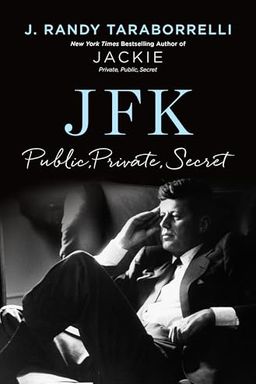
Jfk cover

Jfk

by J. Randy Taraborrelli

The author of “Jackie” provides a portrait of the public and private sides of President John F. Kennedy.

Public, Private, Secret Power

Public, Private, Secret Power

How do you judge a leader whose courage and flaws are inseparable? In this life study of John F. Kennedy, J. Randy Taraborrelli argues that you only understand JFK when you hold three layers together—his public, private, and secret lives—and track how they collide to create (and sometimes compromise) statesmanship. The book uses Jackie’s aphorism—“I have three lives: public, private, and secret”—as its organizing lens, showing you how family ambition, hidden illness, and clandestine intimacy live right alongside high politics and world-threatening crises.

The frame you read with

The public life is the image you know: the decorated PT‑109 skipper, the Senate star, the telegenic presidential candidate, the crisis manager. The private life is the household crucible—Rose’s ritualized stoicism, Joe’s relentless engineering, sibling loyalties, and a marriage that mixes tenderness with brutal bargains. The secret life is what few were meant to see: chronic pain and Addison’s disease, ampules and back braces under a tailored suit; covert affairs and the reputational machine that shielded them; and back‑channel diplomacy that averted nuclear war. Taraborrelli refuses a single, simple JFK—as a reader, you hold contradictions without collapsing them (a method closer to Robert Dallek’s moral nuance than to Camelot hagiography).

A guiding line

“I have three lives: public, private, and secret.” —Jackie Kennedy

Formation: family, secrecy, and pain

You begin at home. Rose Fitzgerald Kennedy enforces ritual and restraint—prayers, maps on the wall, even a locked retreat, “Rose’s Cottage,” for solitude. Joseph P. Kennedy models power without apology: he shapes military paperwork, buys newspaper goodwill, and plants columns (Walter Winchell) to manage Jack’s romances and reputation. The most searing family secret is Rosemary’s lobotomy and disappearance to St. Coletta—an extreme act of image protection that teaches the children, including Jack, that secrecy is a survival skill. Later, guilt helps convert into policy: disability legislation (Public Law 85‑926, 1958) and the White House’s Committee on Mental Retardation (with Eunice Kennedy’s advocacy) emerge from this wound.

Running alongside the family story is the body story. JFK’s Addison’s disease, spinal injuries worsened by PT‑109, infections, and the perilous 1954 spinal fusion (followed by a coma and last rites) harden his habit of compartmentalization. Jackie nurses him; medications multiply; pain narrows his emotional bandwidth. In the political culture of the 1950s, illness is concealed; that discipline of concealment bleeds into sex, strategy, and staff dynamics.

Rise to power: a machine and a message

After 1956, Jack and his team execute a four‑year build toward 1960. Larry O’Brien and Kenny O’Donnell tenderize party bosses and track delegates; Ted Sorensen hones message and prose; Bobby runs hard-edged operations, fresh from the televised McClellan Committee jousts with Jimmy Hoffa. Jackie crafts visual credibility—wardrobe, ritual, a domestic image designed for Life and Time covers—while the campaign confronts the Catholic question head‑on. The crucial choice is West Virginia, only 3% Catholic; Kennedy wagers that economic solidarity can trump sectarian suspicion. He wins big, then uses television to full effect in the fall debates. Nixon sweats; Kennedy looks ready for prime time. Joe’s money and media muscle oil the gears, but the son must still deliver at the microphone—and he does.

Governing: failure, brinkmanship, and restraint

The early catastrophe is the Bay of Pigs: an inherited CIA plan, sugar‑coated assumptions, and a president reluctant to send U.S. troops. The operation collapses; JFK weeps in private and accepts blame in public, then fires Allen Dulles and Richard Bissell, and becomes a skeptic of covert overconfidence. That skepticism pays off in October 1962: when U‑2 photos reveal Soviet missiles in Cuba, ExComm debates airstrikes versus blockade. Kennedy picks a legally calibrated “quarantine,” communicates sober red lines to the nation, and pursues secret bargaining. The quiet quid pro quo—removing obsolete U.S. Jupiter missiles from Turkey and Italy later, without public linkage—lets both sides step back from annihilation.

Conscience and consequence

Out of crisis come speeches and treaties that reframe the age: the American University “Peace Speech,” the Limited Nuclear Test Ban Treaty, “Ich bin ein Berliner,” and a civil‑rights address that turns morality into policy. Yet process can still fail: in August 1963, Cable 243 accelerates a Vietnam coup while senior principals are away and Kennedy is raw with grief. That grief is real—Patrick Bouvier Kennedy’s death rips open a stoic; Jack vows to “stop lying to the people I love,” signs newborn research funding, and tries to be different at home. Taraborrelli leaves you with a leader still forming—his character tugged by parents and pain, tempered by failure, briefly redeemed by restraint, and rushing toward an unfinished future.


Parents and the Dynasty Machine

Parents and the Dynasty Machine

To understand JFK’s choices, you start with the two poles that set his compass: Rose Fitzgerald Kennedy and Joseph P. Kennedy. Rose shapes a household of ritual, faith, and emotional distance—world maps on walls, precise schedules, minimal hugging, and a locked retreat she calls “Rose’s Cottage.” That ethic prizes composure over confession. Joe builds a parallel school of power—money as leverage, media as instrument, and reputation as asset to be guarded at any cost.

Rose: discipline without warmth

Rose’s managerial mothering trains children to perform duty. She holds weekly weigh‑ins, prizes modesty, and sees sacrifice as a spiritual discipline. You feel her influence in Jack’s tendency to self‑contain and to default to composure in public crisis. When Jackie later navigates humiliations, Rose’s maxim—“You have to choose: take what you get, or walk away”—captures the family’s stark, binary moral calculus.

Joe: ambition with moral risk

Joe’s portfolio includes Navy paperwork maneuvers, cash to newspapers (a Boston Post payoff in earlier races), and planted columns (Walter Winchell) to neutralize romantic obstacles like Inga Arvad. He sees politics as a family enterprise, grooms sons with individualized letters and trust funds, and expects obedience. He even admits to Jackie that he once “wished” hardship on Jack to toughen him—a chilling confession that frames how love and manipulation mingle in this dynasty.

The Rosemary tragedy and the pedagogy of secrecy

Nowhere is Joe’s priority on image more devastating than with Rose Mary (“Rosie”). As her cognitive challenges grow, Joe secretly authorizes a prefrontal lobotomy—then hides the catastrophic result by placing her in institutions (Craig House; later St. Coletta) and commanding confidants, “This secret dies here.” The household sets an empty place where she isn’t; the lesson to the children is brutal and clear: protect the family’s image above disclosure. Jack’s anger and private visits to St. Coletta later feed public work—funding research and programs for intellectual disability (with Eunice’s leadership through the Kennedy Foundation). (Note: Mid‑century norms on consent and psychiatry were radically different; Taraborrelli resists easy anachronistic judgment while facing the harm squarely.)

What the crucible bequeaths to Jack

From Rose, Jack inherits a devotion to duty and an almost liturgical self‑control; from Joe, a taste for glory and a willingness to outsource scruples to “the operation.” The combination explains selective bravery (PT‑109 heroism) paired with compartmentalized intimacy (affairs handled by aides) and a frequent tolerance for optical fixes (e.g., Profiles in Courage’s ghostwriting defended as normal political craft). It also explains his instinct to take responsibility in public even when advisers fail him—a warped but genuine son’s tribute to two unforgiving teachers.

If you lead a team or a family, the lesson stings: formative gifts can double as flaws. Joe’s strategic genius accelerates Jack’s ascent but mortgages moral agency; Rose’s poise steadies him in crises but starves the vulnerability needed to ask for help. Taraborrelli’s family portrait isn’t gossip; it’s a working map for the choices Jack makes later in war rooms and in bedrooms.


A Body in Pain

A Body in Pain

JFK’s public brand—youthful, tanned, vigorous—hides a lifelong medical struggle that shapes his temperament and leadership. Taraborrelli catalogues a litany: childhood scarlet fever; adrenal insufficiency (Addison’s disease) discovered dramatically in 1947 London; spinal damage from football and compounded by PT‑109; digestive issues; infections; and a 1954 spinal fusion that nearly kills him. You read a leader managing injections, braces, and a pharmacy’s worth of pills while selling the image of robust command.

The 1954 near‑death and its aftermath

In October 1954, surgeons cut into Jack’s back in New York Hospital in a procedure contemporaries called “the one that kills you or cures you.” It nearly kills him. Post‑op infection, coma, last rites—then months of an open, draining wound. Jackie becomes nurse and sentinel; political ambitions pause; family members fear permanent disability. Even after recovery, pain remains a daily fact and medications multiply. (Note: some modern clinicians question whether muscle spasm, not structural failure, drove the worst pain; the book presents that debate to sharpen your sense of risk and uncertainty.)

Secrecy as survival strategy

Mid‑century politics punished visible frailty. The Kennedys adopt a “liability model”: conceal, compartmentalize, and keep moving. Aides manage schedules around flares of pain; photographers avoid shots that reveal braces; doctors travel discreetly. That discipline doesn’t just hide symptoms—it trains the mind. If you hide illness successfully, you learn to hide other liabilities, too. The secrecy that protects his body becomes the habit that protects his appetites and his political maneuverings.

How pain bends personality

Chronic pain shortens patience and encourages retreat. Taraborrelli invites you to read emotional distance through this lens: a man in pain often draws tight circles around attention and tolerates only relationships that accommodate those circles. It helps explain the baffling mix of tenderness and coldness in his marriage, the oscillation between intense charm and abrupt withdrawal with staff, and the almost athletic use of compartmentalization in moral life.

Why this matters for leadership

When you evaluate decisions—travel while Jackie is pregnant, erratic romantic boundaries, even tempered crisis performance—remember the body underneath. Pain is not an alibi, but it is a shaping force. It may also sharpen strengths: tolerance for discomfort can translate into calm under pressure; having rehearsed catastrophe in hospital rooms, he recognizes it in nuclear briefings and reaches for restraint. The same brace that keeps him upright also reminds him how easily things can break.

If you lead while managing a hidden vulnerability, take two cues here: build trusted inner circles that can carry you through flare‑ups, and resist letting secrecy metastasize into your moral life. Taraborrelli’s medical chapters aren’t detours; they’re the skeleton key to the rest of the story.


Marriage, Affairs, and Secrecy

Marriage, Affairs, and Secrecy

JFK’s intimate life operates like a covert portfolio—managed risk, rapid compartmentalization, and aggressive damage control. You meet the template early with Inga Arvad, a brilliant Danish journalist. Their 1941–42 affair is intense and equal; FBI surveillance (triggered by misread Hitler‑era photos) and Joe Kennedy’s interventions (a Charleston transfer, press items) break them apart. The lesson lands: outside forces can erase private joy, and reputation trumps romance.

A pragmatic marriage that still holds tenderness

Jack meets Jacqueline Bouvier through Washington society. He asks her to translate French Indochina documents, signaling respect for her mind; they marry in a Newport spectacular in 1953 (Ann Lowe’s gown, Hammersmith Farm, family theater everywhere). Yet by 1956, crisis: the stillbirth of Arabella while Jack sails the Mediterranean. Public scandal ignites; Joe offers Jackie $100,000 to stay—an “illusion of choice,” Taraborrelli argues, that secures stability at deep cost. Jackie accepts and writes her own rules: demand discretion, protect dignity, hold the family together for the larger political project.

The pattern of infidelity—and a breaking point

Affairs recur: Gunilla von Post; Mary Meyer; Judy Campbell Exner (whose mob‑mediator claims remain contested); and Joan Lundberg, whose 1958 pregnancy leads Jack to push for an abortion and wire money twice when the first transfer is stolen. Dave Powers and others “handle” logistics—screening calls, smashing a photographer’s camera, paying expenses. The emotional ledger is ugly. Joan tells him, “You love Caroline … but I’m somebody’s daughter, too,” a rebuke that punctures Camelot varnish.

A woman draws a line

Jackie to JFK about Mary Meyer: “It’s either her, or me. You choose.”

Jackie’s agency and the secrecy economy

Jackie is not a passive ornament. She polices phones, manages optics, and—in the Mary Meyer crisis, after Phil Graham’s loose talk—issues a non‑negotiable ultimatum. Her boundary forces a behavioral shift and reveals the mechanics of elite reputation: aides, money, and silence turn scandal into survivable rumor. But secrecy is never total; it always leaks—into gossip, investigative files, and, most corrosively, into the hearts of the people you live with.

For your own reading of power couples, Taraborrelli offers a sober model: political marriages are often negotiated partnerships, not fairy tales. Compromise can preserve the public mission, but it exacts a private price. The question—never fully answerable—is whether the mission justifies the price.


How 1960 Was Built

How 1960 Was Built

If you assume JFK’s 1960 victory was inevitable charisma, Taraborrelli shows you the scaffolding: four years of relationship‑building, institutional savvy, and disciplined media craft. After falling short for the 1956 vice‑presidential slot, Kennedy’s team turns the next cycle into a marathon of party work. You watch a modern presidential campaign being invented in real time.

Party machines and people who count

Larry O’Brien, Kenny O’Donnell, and Stephen Smith map every governor, county boss, and delegate slate. They don’t treat speeches as strategy; they treat relationships as currency. JFK’s Senate role on the McClellan Committee—where Bobby as chief counsel grills figures like Jimmy Hoffa—builds a televised brand of toughness. It’s policy theater that doubles as campaign advertising (a tactic both parties use now).

Image is message, and Jackie is the quiet editor

The team war‑games magazine covers and living‑room television. Jackie shapes wardrobe, setting, and ritual to convey steadiness. Time and Life placements become totems of viability (one sits framed in the kitchen). The message machine must also firewall liabilities: medical secrecy, marital strain, and occasional indiscretions. Dave Powers and Pierre Salinger keep narratives tight as the candidate moves from town halls to television studios.

The Catholic question and a strategic gamble

Primary wins in New Hampshire and Wisconsin prove vote‑getting muscle but highlight religious polarization: victories root in Catholic precincts. The test is West Virginia—only 3% Catholic. Joe Kennedy advises skipping it; Jack insists on fighting. He floods the state with family and surrogates, centers shared economic struggle, and wins decisively on May 10, 1960, pushing Humphrey out and blunting the “can a Catholic win?” narrative. Rumors swirl about Sinatra, Sam Giancana, and cash in Appalachia; investigations echo for years. The point remains: risk, executed well, changes the race.

The television presidency begins

Seventy million watch the first Kennedy–Nixon debate. Makeup, posture, and camera poise meet policy prep. Nixon looks haggard; Kennedy looks composed and direct. The audience learns a new truth: in the television era, visible confidence is policy. (Parenthetical comparison: this is the prototype for later image revolutions—Reagan’s stagecraft, Obama’s digital fluency.)

If you’re building anything—startup, campaign, movement—this playbook scales: start early, map the gatekeepers, create proof of competence in public venues, protect the downside, and make one bold bet that redefines your perceived ceiling.


Bay of Pigs: Failure as Teacher

Bay of Pigs: Failure as Teacher

Presidents inherit plans, but they own outcomes. The Bay of Pigs—an Eisenhower‑era CIA blueprint to land Cuban exiles, trigger an uprising, and topple Castro—meets a new president wary of overt U.S. invasion but too credulous about covert assurances. In April 1961, inadequate air cover, faulty assumptions, and fierce Cuban defense collapse the mission. Exiles are captured or killed; the world watches a superpower flail.

Responsibility and reform

JFK cries in private—Jackie sees rare tears—then steps to the podium and declares, “I am the responsible officer of this government.” He does not share operational detail, but he does not pass the buck. He fires CIA director Allen Dulles, his deputy Richard Bissell, and General Charles Cabell, and he re‑wires White House process to inject skepticism and broaden counsel. The lesson lands: never let institutional confidence substitute for your own rigorous review.

Owning the defeat

“Victory has a hundred fathers and defeat is an orphan. I am the responsible officer of this government.” —JFK

From humiliation to doctrine

The experience transforms Kennedy’s appetite for covert adventurism. He learns that “plausible deniability” rarely withstands reality and that surgical options can metastasize into demands for military rescue. In practice, this yields tighter oversight of Langley, elevated roles for skeptical voices (McNamara’s systems analysis, McGeorge Bundy’s hard questions), and a personal habit of what you might call strategic second‑thoughts: challenge best‑case assumptions, run red‑team scenarios, and ask “What if they don’t do what we expect?”

Why this matters for you

Any leader can inherit a glossy plan with invisible risks. Taraborrelli’s episode gives you a checklist: interrogate assumptions, demand independent channels of verification, and separate political embarrassment from strategic disaster (refusing troop escalation saved the U.S. from a potentially wider war). Failure, owned and studied, can upgrade your operating system; failure, denied, becomes culture.

In the Kennedy arc, Bay of Pigs is the necessary wound that makes the Cuban Missile Crisis survivable. Pain taught him prudence—and prudence, later, saves the world.


Missile Crisis: Quiet Deal, Loud Resolve

Missile Crisis: Quiet Deal, Loud Resolve

October 1962: U‑2 photos reveal Soviet MRBMs in Cuba. The Joint Chiefs push for airstrikes; diplomats warn of escalation; lawyers parse international law. Kennedy convenes ExComm—Bobby Kennedy, McGeorge Bundy, Robert McNamara, Dean Rusk, and others—and gropes for a path that signals resolve without locking in war. The answer is a naval quarantine (a blockade in everything but name) plus measured, public red lines.

Communication as deterrence

On October 22, he tells the nation that any missile launched from Cuba will be treated as a Soviet attack on the United States, setting a bright line that is both simple and terrifying. Jackie refuses to flee Washington, insisting on sharing the risk—a private gesture that stiffens public resolve. Behind the scenes, ExComm keeps a daily rhythm of alternatives, costs, back‑channel signals, and contingency plans.

A historic warning

“Any nuclear missile launched from Cuba against any nation in the Western Hemisphere will be regarded as an attack by the Soviet Union on the United States.” —JFK

Two letters, one solution

Khrushchev sends two messages: the first conciliatory (remove missiles; U.S. pledges no invasion), the second tougher (demanding public removal of Jupiters in Turkey and Italy). Kennedy chooses diplomatic aikido—publicly answer the first; privately address the second. Through Bobby Kennedy’s meeting with Soviet ambassador Anatoly Dobrynin, the U.S. promises to withdraw the obsolete Jupiter missiles in a few months, quietly, with no fanfare. If anyone leaks, the politics on both sides could force escalation. No one leaks.

Why it worked

The crisis resolves because the administration pairs credible force with face‑saving off‑ramps. The quarantine pressures without cornering; the speech threatens without humiliating; the private concession trades metal for survival. It’s a negotiation masterclass: keep channels open, respect your adversary’s domestic needs, and separate what must be said publicly from what can be conceded quietly. (Parenthetical note: historians debate whether earlier disclosure of the Turkey deal would have changed NATO dynamics; Taraborrelli stresses that survival required secrecy.)

For your own high‑stakes decisions, remember the template: design proportional pressure, script clear public messages, and cultivate trusted intermediaries who can carry private terms. Loud resolve, quiet deal.


From Brinkmanship to Peace

From Brinkmanship to Peace

After staring into nuclear abyss, JFK tries to change the weather. Taraborrelli highlights three rhetorical pivots that reframe policy: the American University “Peace Speech,” the Berlin address, and his civil‑rights appeal. Together with the Limited Nuclear Test Ban Treaty, they show a leader translating near‑catastrophe into moral and strategic clarity.

American University: moral imagination as policy

On June 10, 1963, Kennedy asks Americans to reexamine their view of the Soviet people and proposes outlawing atmospheric tests. It’s an invitation to empathy in the very grammar of the Cold War. Politically risky, yes—but strategically necessary to lower the temperature. In less than two months, the U.S., U.K., and U.S.S.R. sign the Limited Nuclear Test Ban Treaty in Moscow (August 5), and the Senate later ratifies it. This is not just treaty‑making; it’s agenda‑setting through speechcraft (akin to Lincoln’s use of moral argument to bend policy).

Berlin and civil rights: clarity abroad and at home

In West Berlin (June 26), “Ich bin ein Berliner” converts solidarity into deterrence, signaling unwavering U.S. commitment to a city caged by a wall. Days earlier, at home (June 11), his civil‑rights address declares equal rights a moral imperative, not a mere regional dispute. Martin Luther King Jr. praises the moment; Southern support bleeds. Kennedy accepts the cost, betting that moral clarity builds durable legitimacy.

The craft behind the words

These speeches are crafted by a tight partnership—JFK’s instincts, Ted Sorensen’s prose, and an inner circle now trained by crisis to prize restraint. They aim to move publics and elites simultaneously: calm the afraid, challenge the cynical, and give allies language they can defend. Taraborrelli’s point is practical: in a media age, speech is statecraft. If you want to shift a strategic equilibrium, first change how people talk about it.

For leaders of any kind, the pattern scales: survive a shock, articulate a new frame, codify it in policy, and accept the near‑term price for long‑term alignment.


Vietnam and Lost Control

Vietnam and Lost Control

August 1963 exposes the fragility of presidential process. While senior principals vacation and the president reels from Patrick’s death, a cluster of aides led by Michael Forrestal drafts Cable 243 to Ambassador Henry Cabot Lodge in Saigon. It pressures Ngo Dinh Diem to remove his brother Nhu and, failing that, implies U.S. support for a coup. Forrestal pushes urgency, overstates clearances, and gets a distracted president to approve transmission. The center does not hold.

How process failed

Key actors—CIA director John McCone, Secretary of State Dean Rusk—are effectively bypassed. Lodge, empowered by the cable, escalates contact with generals. Momentum outruns reconsideration. When Kennedy tries to reassert control, events in Saigon run faster; Diem and Nhu are overthrown and later murdered. The president feels manipulated by his own machinery.

A raw verdict

“My God. This shit has got to stop. My government’s coming apart!” —JFK

Contrast with Cuba—and a warning

Cuba’s survival owed to structured deliberation, dissent in the room, and tight message control. Vietnam shows the flip side: zeal plus absence plus grief equals policy drift. Taraborrelli doesn’t pretend JFK had a magic exit from Southeast Asia, but he is clear that Cable 243 represents a procedural self‑own—a cautionary tale about decision rights and the risk of “Saturday night emergencies” in complex systems.

Your playbook for avoiding it

For any leader: codify who can authorize what; require red‑team reviews on regime‑change proposals; pause when principals are absent or the decision‑maker is emotionally compromised; and distinguish “must send now” from “can wait 48 hours.” Process isn’t bureaucracy; it’s risk management. Kennedy learned that in Cuba. Vietnam is where he forgot.

The irony is bitter: a president newly committed to restraint is pulled into escalation logic by his own house. The lesson endures because the temptation endures.


Grief and Late Transformation

Grief and Late Transformation

Patrick Bouvier Kennedy’s brief life (born August 1963, dying two days later of respiratory distress) becomes the book’s most intimate hinge. You sit in hospital corridors with aides removing TV tubes so Jackie won’t hear via broadcast; you watch Janet Auchincloss faint over the isolette; you see the president sob in a boiler room and fold over a tiny coffin. The public avatar of vigor is suddenly a father in pieces—and that collapse changes him.

From sorrow to vow

That night, Joan Kennedy tells him some changes are for good and that he might be the one to “break the cycle.” Jack tells her he’s ashamed of his past and wants to stop lying to the people he loves. He signs a $265 million grant for newborn research at the National Institute of Child Health and Human Development—policy as penance and prevention. Friends notice a softened husband, a more present father, and a man who takes Jackie’s boundaries seriously.

A private confession

“I just want to stop lying to the people I love.” —JFK

Boundaries that finally bind

Jackie’s earlier ultimatum to end the Mary Meyer affair now fuses with grief into a durable shift. She is no longer merely managing a public role; she is enforcing a private standard in which her dignity and the family’s integrity are non‑negotiable. JFK, chastened by Patrick’s death and Cuba’s brush with apocalypse, begins to live as if second chances are finite.

The unfinished arc

Taraborrelli resists tying a bow. The Cable 243 fiasco still follows; foreign entanglements remain; and the assassination lies beyond this book’s scope. Yet you close these chapters with a different man than the one who entered the White House: still sick, still secretive by reflex, but more candid with those closest to him and more willing to convert private pain into public good. In a Heraclitean echo, “character is destiny”—and sometimes character changes just in time to change some destinies, if not his own.

If you’re weighing your own pivots, the pattern is instructive: acute loss can clarify values, apologies require concrete policy or personal change to be credible, and the most powerful boundary is the one you enforce on yourself after someone you love enforces it on you.

Dig Deeper

Get personalized prompts to apply these lessons to your life and deepen your understanding.

Go Deeper

Get the Full Experience

Download Insight Books for AI-powered reflections, quizzes, and more.