
Idea 1
Jerusalem: Sacred Geography and Competing Narratives
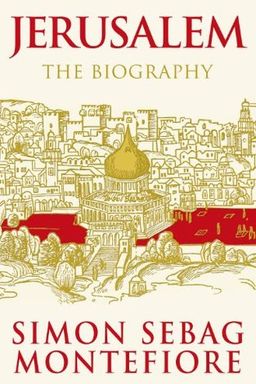
Why does one small city occupy such immense spiritual and political territory? In Simon Sebag Montefiore's Jerusalem: The Biography, you discover that the city's story is not linear but layered—an ever-renewed palimpsest of holiness and power. Montefiore argues that Jerusalem is both a physical city and a symbolic idea, a place where memory, conquest, and belief constantly rewrite one another. To grasp its history, you must read the stones and the stories together, understanding how each faith and empire claimed, reused, and reinterpreted its predecessors' sacred sites.
A City of Dual Identities
Jerusalem exists simultaneously as a terrestrial capital and as a celestial symbol. David’s capture of Zion gives the city a national and political center, while Solomon’s Temple consecrates it as a divine dwelling. When later empires—Babylonian, Roman, Byzantine, Islamic, Crusader, Ottoman, and British—occupy or rebuild it, they treat each stone as theological evidence. The Temple Mount becomes a geography of meaning: the site of Solomon’s Temple, Herod’s expansions, Rome’s Aelia Capitolina, Constantine’s Christian basilicas, and Abd al‑Malik’s Dome of the Rock. Each period leaves an imprint that future generations reinterpret.
The Logic of Holiness
Holiness, Montefiore shows, is not static—it accrues through repetition and reinterpretation. David’s royal decision makes Jerusalem politically central; the destruction of the First Temple turns it into a symbol of mourning; the Second Temple’s fall redefines Judaism around scripture and prayer. Christianity reads that fall as fulfilment, displacing the Temple with Christ; Islam later asserts continuity and supremacy by building the Dome over the same foundation stone. Each faith inherits earlier sanctity while claiming to complete it.
Palimpsest and Power
No conqueror entirely erases what came before. Herod builds on earlier foundations; Constantine builds churches near pagan sanctuaries; Abd al‑Malik builds upon Herod’s platform. The stones themselves become witnesses and instruments of appropriation. Political rulers rework architecture to claim divine favor—proof that sovereignty and sanctity are inseparable in this city. Archaeology, Montefiore reminds you, thus serves political narratives: every trench carries theological consequence.
Faith and Violence Entwined
Because sacred legitimacy confers political power, rulership in Jerusalem has always been contested. From Titus’s siege to Hadrian’s erasure of Judaea, from the Crusades to modern conflicts, religion and sovereignty reinforce each other. To burn or rebuild in Jerusalem is never just to wage war—it is to claim revelation. The city functions as both mirror and magnet: world empires see in it their own self-image and rewrite their theology in stone.
Core insight
To understand Jerusalem is to accept contradiction: its holiness grows because every conqueror reclaims and reinterprets it. Each ruin becomes foundation, each shrine a stage for new revelation. Montefiore’s core claim is that the city’s very fragility sustains its sanctity—what keeps drawing pilgrims and armies alike is not certainty but contention.
Across three millennia, Jerusalem’s biography mirrors global history: monarchy gives way to empire, empire yields to faith, faith transforms to ideology. In this interplay, Montefiore invites you to see not just a chronicle of wars and rulers but an anatomy of belief itself—how human longing for the divine repeatedly shapes, and is shaped by, the same haunted hill of stones.