
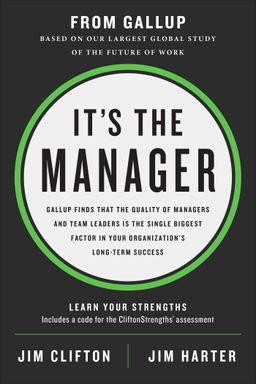
It''s the Manager cover

It''s the Manager

by Jim Clifton, Jim Harter

It''s the Manager reveals transformative strategies for modern leadership. Dive into Gallup''s research to discover how to align purpose with practice, engage a diverse workforce, and thrive in the evolving gig economy. Empower your team, redefine your brand, and foster a culture of inclusion and growth.

The Culture Shock Transforming Work and Life

Have you ever looked at your workday and wondered, “Does this really fit my life?” In Culture Shock, Jim Clifton and Jim Harter of Gallup tackle this question head-on, arguing that the pandemic didn’t just change where we work—it permanently changed what people want from work and life. According to their research, this global disruption has created a new “will of the worker” that demands freedom, meaning, and wellbeing. The old system—where employees were expected to live around their job—is giving way to one where work must fit life.

Gallup calls this global transformation a “culture shock.” Using a massive trove of data from more than 100,000 teams, the authors show that how leaders respond will determine whether productivity and customer loyalty soar—or collapse. The book’s core argument is simple but profound: organizational culture, employee engagement, and manager behavior now drive financial outcomes more directly than ever. In this new world, human nature—not spreadsheets—decides whether companies grow or decline.

From Pandemic Chaos to a Permanent Shift

Gallup traces how a sudden, global experiment in remote work doubled the number of people working from home overnight. What began as a temporary necessity became an awakening—workers realized that autonomy improves wellbeing, creativity, and focus. Once people experienced the freedom of choosing when and where they work, there was no going back. Clifton calls this the “New Freedom”: not a perk, but a new psychological contract. Employees are no longer asking for flexible hours—they’re demanding the ability to design their day around life, not around traffic lanes and office clocks.

But this evolution carries risks. Gallup’s surveys reveal steep declines in employee engagement and customer satisfaction since 2020. Disconnected cultures lead to lost loyalty, declining revenue, and eroding trust. The pandemic exposed how fragile workplace relationships were—and how little most leaders understood about the human side of performance.

Human Nature Meets Hard Economics

Gallup’s famous “Gallup Path” model connects managers and engagement directly to financial performance. It shows that great managers account for 70% of team engagement, and engaged employees create engaged customers—who, in turn, drive sustainable growth, earnings, and ultimately stock increases. When employees strongly agree (a “5” rating on Gallup’s scale) that someone at work encourages their development, turnover falls by 28% and productivity rises by 13%. The science is clear: feelings and relationships have measurable economic power.

Gallup’s Core Finding

Human behavior—not systems—is the primary engine of business performance. When leaders learn how to engage employees emotionally, they create a chain reaction that leads to customer loyalty, profitability, and shareholder value.

The Manager: Source of Economic Energy

The authors emphasize that the future of work depends on one habit: great managers holding one meaningful conversation per week with each employee. They argue this is the “most important habit of a great manager.” Such weekly conversations—focused on goals, strengths, recognition, and wellbeing—drive engagement more effectively than annual reviews ever could. Managers who master this rhythm create high-trust, high-performance teams even in hybrid environments.

Gallup’s data supports this claim across 5 million teams. When 50% of employees can give a “5” (strongly agree) to the statement “I received meaningful feedback in the past week,” customer retention and profitability rise dramatically. This conversational approach transforms management from command-and-control to coaching.

A Playbook for Future Culture

The book ends with Gallup’s CEO Playbook—a blueprint for leaders. Their advice includes committing to hybrid work, certifying managers as strengths-based coaches, and focusing relentlessly on customer retention. The authors warn that failing to adapt to the new culture could make employees behave more like gig workers—detached, transactional, and disengaged. The counterattack is clear: build trust, encourage wellbeing, and talk to people every week. Human connection becomes the new metric.

In short, Culture Shock shows that business transformation begins where it always should have—inside the human heart. Managers that align strengths to roles, foster autonomy, and coach with empathy will thrive. Those who cling to control and outdated systems will fade. The future of productivity belongs to organizations that understand human nature as deeply as Gallup’s research does.


The New Freedom Has No Commute

When the world shut down in 2020, something extraordinary happened: office workers discovered that “the commute” was optional. In Chapter 2, Clifton and Harter tell humorous yet revealing stories—like an analyst named Rajesh calling his boss from a lake house to say he has moved there permanently. The boss’s shock mirrors millions of leaders’ reactions around the world. The message was clear: people weren’t going home temporarily; they were reinventing work and life.

Freedom as the New Dream

Gallup found that 50% of U.S. employees want their work and life blended, and 90% of desk workers never want to return to pre-pandemic routines. This is now part of the “Great American Dream”—and increasingly, the Great Global Dream. Freedom has become a form of currency. People want to choose when, where, and how they work—complete autonomy over their rhythm. That autonomy improves wellbeing and productivity but disrupts traditional management, which was built on surveillance and control.

The data also reveal that this freedom isn’t just psychological—it’s economic. Among hybrid workers, engagement and performance peak when teams have clear autonomy and accountability. The authors urge leaders to stop fighting this shift and instead design cultures that work with human nature. The “new freedom” doesn’t mean chaos; it means choice coupled with clarity.

Breaking the Old Paradigm

Clifton compares the current moment to the move from farms to factories a century ago. The change is as irreversible and disruptive: cities shrank, office buildings emptied, and commuting lost its cultural meaning. Employees realized they could produce more without wasting hours in traffic. The authors cite Gallup studies showing that long commutes correlate with stress, high blood pressure, and lower wellbeing. Work-from-home freedom eliminated that chronic misery overnight.

The Endowment Effect

Clifton and Harter use a concept from behavioral economics—the “endowment effect”—to explain why workers refuse to give up remote work. Once people possess freedom, they value it far more than before. You can’t un-own autonomy.

Smart Autonomy and Team Trust

As the book later expands in Chapter 9, autonomy isn’t useful without trust and collaboration. Smart autonomy means managers help employees decide which tasks they can do best at home and which require being in person. Meetings and decisions should be collective, not dictated from above. When teams co-design their schedules, engagement and wellbeing rise. When employers mandate days in the office, engagement plummets.

This chapter sets the foundation for everything that follows: the new culture is not about managing attendance—it’s about managing outcomes. As the authors conclude, the commute is dead. Freedom is alive. And leaders who treat it as temporary will lose their best people forever.


Managers as Coaches, Not Bosses

Gallup’s workplace science places the manager at the center of organizational performance. In Chapter 5 and beyond, Clifton and Harter call managers “the very origin of new economic energy.” They argue that future success depends less on policies and more on human relationships—specifically, how managers coach. The single most powerful managerial habit? One meaningful conversation per week focused on goals and growth.

The Weekly Conversation Revolution

Gallup research across 5 million teams shows that weekly feedback drives engagement, customer retention, and wellbeing. Annual reviews fail because they disconnect feedback from real work. The right rhythm is weekly, brief (15–30 minutes), and meaningful. These conversations should cover five essentials: recognition, collaboration, goals, progress, and strengths. When done well, 80% of those employees become fully engaged regardless of where they work—remote, hybrid, or on-site.

Only 16% of workers say their last conversation with a manager was “extremely meaningful.” The authors highlight that this gap represents trillions in lost productivity. A great manager’s habit sounds simple but requires discipline. They aren’t administrators chasing spreadsheets—they’re coaches inspiring human potential.

Meaningful Feedback Metric

Clifton suggests adding a single question to every cultural dashboard: “I have received meaningful feedback in the past week.” When half of employees can strongly agree with that statement (a 5 score), customer retention and engagement surge.

Strengths-Based Coaching

Gallup’s CliftonStrengths assessment underpins the coaching model. The best managers build roles around each employee’s natural talents. Peter Drucker, whom the authors praise as a “strengths pioneer,” taught that effective leadership aligns strengths to roles so that weaknesses become irrelevant. When managers use strengths as the basis for feedback and goal setting, burnout declines, and creativity rises.

Managers must become “developers of energy,” not controllers of tasks. Gallup now trains leaders through its Boss-to-Coach program, which boosts team engagement by up to 18% and reduces turnover by nearly 25%. The message is simple: you don’t motivate people—you coach them through meaningful conversations about what they do best.

A New Dashboard for Modern Cultures

The authors propose upgrading Gallup’s famous Q12 engagement instrument to Q12+, which now includes items for Respect, Wellbeing, Coaching, and Customer focus. These additions reflect the new hybrid reality. Leaders must measure and manage coaching habits, diversity, and wellbeing with the same precision as profit margins.

In the end, the great manager isn’t a boss—it’s a builder of human capital. Coaching is now a business strategy, not a “soft skill.” As Clifton and Harter put it, “Only 5s matter.” When managers turn weekly feedback into meaningful development, they ignite the engagement that drives the modern economy.


Strengths to Role: The Science of Fit

One of Gallup’s most important discoveries, explored in Part 3, is that performance rises when strengths are perfectly matched to roles. Clifton called this “fitting strengths to role,” and it is the cornerstone of the Gallup Path. The authors illustrate this through vivid stories and decades of data, proving that human talent—not policy—determines organizational excellence.

Why Fit Matters

Gallup’s meta-analyses show that employees who “do what they do best every day” are five times more engaged. The proportion of time people spend using their strengths differentiates thriving from miserable workers: engaged employees spend five times more of their day using strengths, while disengaged ones split their time between strengths and weaknesses. When you misalign someone’s job with their talents, you invite burnout and mediocrity.

To illustrate, Clifton and Harter tell the story of Deepak and Jenny—two high-performing leaders suited for different challenges. Deepak is a fix-it leader with Restorative and Self-Assurance talents, ideal for solving hard problems. Jenny is a rainmaker, driven by Futuristic and Woo strengths—perfect for generating new business. When their company placed them in roles matching their profiles, customer retention and revenue soared. When in misaligned roles, both struggled. The right fit became a measurable competitive advantage.

The Psychology Behind Fit

This section bridges management theory and psychology. Abraham Maslow taught that people reach self-actualization only when they use their innate talents. Gallup’s evidence confirms his hypothesis quantitatively. Don Clifton operationalized this with the CliftonStrengths taxonomy—34 themes that form a shared language of talent. When organizations understand this language, they can create engaged, collaborative teams instead of homogenous ones.

Gallup’s Five Manager Traits

Gallup identifies five innate traits predicting managerial success: Motivation, Workstyle, Initiation, Collaboration, and Thought Process. The best leaders combine these to inspire, organize, influence, unite, and think strategically.

Creating Strengths-Based Cultures

Gallup urges organizations to measure everyone’s strengths, train managers as certified Strengths Coaches, and integrate those insights into hiring, learning, and performance systems. Companies like Accenture and Stryker have already done so—embedding strengths conversations into performance reviews and team building. The result: lower turnover, higher engagement, and faster innovation.

In short, this science turns human nature into a system of excellence. Drucker, Maslow, and Clifton all pointed to the same truth: people grow when they do what they do best. Gallup gives leaders the data and tools to make that truth operational.


HumanSigma: Linking People and Profits

Gallup’s concept of HumanSigma reveals how employee and customer engagement act together to boost financial performance. Borrowing the language of Six Sigma, it quantifies what happens when emotions and economics meet. Through more than 1,900 business units studied, Gallup found that the combined power of engaged employees (EE) and engaged customers (CE) delivers dramatic gains in revenue growth.

Employee-Customer Interaction

The HumanSigma meta-analysis shows that neither employee engagement nor customer engagement alone predicts maximum performance. It’s their product—EE × CE—that creates sustainable growth. In business units with both high EE and CE, revenue is 3–5 times higher than units with low scores. Engagement acts as a multiplier. Managers who cultivate both worlds—internal enthusiasm and external loyalty—see tangible results: fewer accidents, higher productivity, and stronger customer retention.

The Manager Cascade

Gallup discovered that engagement cascades through leadership hierarchies. Executive enthusiasm fuels manager commitment, which drives front-line engagement. Statistically, managers account for about 70% of engagement variance—a proxy for how much human energy flows through the company. When that energy connects with customers, financial performance skyrockets. Business units in the top quartile on HumanSigma measure outperform the bottom quartile by up to 420%.

Six Levels of HumanSigma

Gallup groups business units into six HumanSigma levels, with Level 6 units performing over five times better financially than Level 1. The higher the level, the stronger the people-analytics link between engagement and revenue.

Feelings Into Facts

HumanSigma turns the seemingly intangible—relationships, trust, and emotion—into hard data. EE and CE correlations with revenue (.13 and .35 respectively) show that behavioral economics are not soft science; they’re measurable assets. The lesson for leaders: stop viewing culture and customer satisfaction as separate. They’re the same system. When people believe in their organization’s purpose and customers feel valued, profitability follows as reliably as gravity.

Through HumanSigma, Gallup quantifies what visionary thinkers like Peter Drucker and Jeff Bezos intuited: the human encounter between employee and customer is the true growth engine of the modern economy.


Rehumanizing Productivity and Wellbeing

Gallup’s research reveals a paradox at the heart of modern work: employees are stressed and burned out, yet yearning for meaning. In Part 2, Clifton and Harter analyze how wellbeing, autonomy, and engagement intertwine—and why caring about people’s wellbeing is not just ethically right, but financially smart.

The Decline of Care

At the beginning of the pandemic, 49% of employees strongly agreed their organization cared about their wellbeing. By mid-2022, that number had collapsed to 21%. This decline coincides with drops in engagement, trust, and pride in company products. Gallup warns that when employees perceive indifference, they disengage, leading to higher turnover and lower customer satisfaction. Only one in five workers believe leadership makes decisions in customers’ best interests—a dangerous gap undermining loyalty and brand reputation.

Wellbeing Drives Engagement

Employees who feel their employer cares are 69% less likely to job hunt, 71% less likely to burn out, and five times more likely to advocate for their organization. These correlations demonstrate that wellbeing isn’t an HR metric—it’s a profitability metric. The best organizations institutionalize wellbeing through manager coaching, clear communication, and flexible systems that honor life outside of work.

Hybrid work contributes to this as well. By eliminating commutes and granting autonomy, it frees time for family, health, and meaning. Yet autonomy only improves wellbeing when coupled with clarity and purpose. Smart flexibility beats unchecked freedom.

Four-Day Week Debate

Gallup’s studies show that while a four-day workweek lowers burnout slightly, engagement and thriving wellbeing depend far more on the quality of the work experience than the number of hours worked. The right culture outweighs the calendar.

Rebuilding Trust Through Human Systems

The solution to declining care is rehumanizing management. Systems that ignore human nature—command-and-control performance reviews, obsession with weaknesses—destroy motivation. Strengths-based coaching flips this script by celebrating what’s right with people. As Maslow discovered, self-actualization through meaningful work transforms individuals and communities alike.

Clifton and Harter conclude that thriving employees create thriving organizations. Wellbeing is not a perk—it’s a business model. When people feel valued, they engage customers better, make fewer mistakes, and innovate more often. Caring is not sentimental—it’s strategic.

Dig Deeper

Get personalized prompts to apply these lessons to your life and deepen your understanding.

Go Deeper

Get the Full Experience

Download Insight Books for AI-powered reflections, quizzes, and more.