
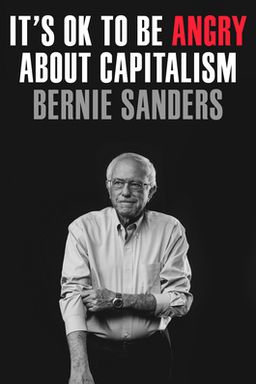
It’s OK to Be Angry About Capitalism cover

It’s OK to Be Angry About Capitalism

by Bernie Sanders

Bernie Sanders'' ''It’s OK to Be Angry About Capitalism'' challenges the current economic and political norms in America. He presents a compelling argument for democratic socialism, offering solutions like universal healthcare and fair taxation. Sanders'' insights aim to inspire citizens to envision and work towards a more equitable future.

Economic Freedom and Moral Democracy

How can you build a nation where democracy truly serves people rather than profit? In this book, Bernie Sanders argues that America’s crisis is not only political but moral: unrestrained capitalism—what he calls 'uber-capitalism'—has concentrated wealth and power so severely that political rights alone no longer guarantee freedom. He contends that real democracy requires economic democracy—systems where healthcare, education, and work are human rights, not commodities sold for profit.

Sanders traces how billionaire wealth, corporate lobbying, and concentrated media ownership turn citizens into spectators. The top one percent owns more wealth than the bottom ninety percent, and a handful of investment firms—BlackRock, Vanguard, and State Street—wield ownership over nearly every major corporation. These facts, Sanders argues, show why policy so often favors the rich. His moral frame echoes Franklin D. Roosevelt’s Second Bill of Rights and Martin Luther King Jr.’s call for economic justice as civil rights. Freedom cannot exist without security, and democracy cannot thrive when billionaires dictate policy.

The Moral Critique of 'Uber-Capitalism'

You learn that Sanders’s central argument is not merely economic but ethical. A system that rewards exploitation and turns basic needs into profitable markets corrodes both character and citizenship. When tens of millions struggle for healthcare while executives earn millions, when young people drown in debt while billionaires fly to space, the fabric of shared society frays. He insists that morality must re-enter policy debates—not as charity but as justice. (Note: This theme parallels the ethical economics of E.F. Schumacher and Amartya Sen.)

Toward Economic Rights and Collective Power

The book moves from diagnosis to prescription: Sanders proposes economic rights as public goods—guaranteed healthcare, tuition-free education, living wages, clean energy jobs, and fair taxation. These reforms require what he calls a 'political revolution,' not a violent one but a grassroots awakening that restores public control over the economy. You are invited to see democracy as something lived every day through labor rights, community ownership, and fair representation, not confined to voting every few years.

A Thread Through the Book

Across chapters, this argument unfolds through concrete sectors: the health system that prioritizes profit over care; billionaires whose influence bought tax cuts and deregulation; automation that threatens jobs unless planned for public benefit; media collapse that silences working-class voices; and political structures that defend the elite. Sanders shows how each domain reveals the same pattern—power concentrated at the top, decisions made for shareholders, and ordinary citizens left struggling. His narrative is less a memoir than a moral economic blueprint.

Core Insight

To defend democracy, you must democratize the economy itself. Political freedom without economic dignity produces despair, polarization, and authoritarian temptation.

What It Means for You

If you accept Sanders’s premise, your task becomes active citizenship: demand institutions that guarantee rights, challenge corporate capture of government, and join collective movements. From supporting union drives to advocating for public medicine, your engagement determines whether democracy survives. Sanders’s message—rooted in Roosevelt’s moral economy and King’s dream of shared prosperity—asks you not simply to care but to act. In this sense, the book is both warning and invitation: either capitalism remains our master, or democracy becomes our means to reclaim humanity.


The Grassroots Revolution

You see how the 'Not Me, Us' movement became proof that political power can grow from ordinary people acting collectively. Sanders’s campaign methods revealed how digital tools, small donations, and cross-community organizing can defeat the logic that only billionaires can finance national politics. His movement was a democratic experiment at scale—millions contributing modest sums and volunteering in neighborhoods from Nevada to Michigan.

Small-Dollar Fundraising and Digital Mobilization

More than two million donors made ten million contributions averaging $18.50, proving that moral integrity and financial independence can coexist. February 2020’s $45 million raised from small donors demonstrated that rejecting super PACs is a pragmatic path to accountability. Livestreams and social media created real-time dialogue: 85 million video views, 11.5 million Twitter followers, and direct message blasts built an alternative to corporate news filters.

Organizing and Inclusion

The book chronicles multilingual outreach and grassroots leadership—organizers like Supreet Kaur, Ruth Buffalo, and the Latino mobilization that achieved a 53 percent share in Nevada. The campaign’s multiracial, multigenerational unity embodied the movement’s purpose: replace isolated personal ambition with shared civic empowerment.

Human Trials and Resilience

Events such as Sanders’s recovery from his heart attack, Alexandria Ocasio-Cortez’s endorsement, and the 27,000-person rally in Queens marked emotional peaks. Viral moments—even the later 'mittens' meme—turned authenticity into solidarity. Through these episodes the book shows that vulnerability, openness, and humor can sustain collective hope even in loss.

For you, the lesson is simple yet profound: power does not begin with wealth—it begins when people believe their voices matter. Digital platforms can amplify, but organization on the ground and shared meaning across diversity are what make democracy tangible. 'Not Me, Us' is not a slogan—it is the practical architecture for rebuilding trust in collective action.


Wealth, Power, and the Billionaire Question

Sanders’s declaration that 'billionaires should not exist' crystallizes his critique of oligarchy. This is not envy—it is political realism. When 725 billionaires increased their wealth by over $2 trillion during a pandemic, while ordinary families faced eviction and illness, inequality ceased being an economic gap—it became a democratic emergency. The chapter lays out both the data and the remedies to dismantle billionaire influence.

The Machinery of Influence

Super PACs, campaign donations, and lobbying link money and law. Examples abound: Michael Bloomberg’s $900 million self-funded bid, Sheldon Adelson’s multimillion-dollar donations, and Peter Thiel’s ideological investments. After Citizens United, political spending detached representation from citizens. Sanders connects billionaire patronage to stalled reform—tax cuts, deregulation, and privatization reinforce plutocracy.

Policy to Restrain Wealth

Sanders’s proposals combine moral action with fiscal logic. The 'For the 99.5 Percent Act' hikes estate taxes on vast inheritances; the 'Corporate Tax Dodging Prevention Act' fights offshore profits; and the 'Make Billionaires Pay Act' sought to tax pandemic windfalls at 60 percent. Together they could fund childcare, climate programs, and universal health care. He cites Roosevelt-era taxation as precedent—proof that strong democracies once treated tax as duty, not punishment.

Moral Principle

Extreme wealth is not merely unfair—it is incompatible with democratic equality. Redistributing power is not revenge; it is restoration of public sovereignty.

For you, the chapter serves as both education and motivation. Understand how billionaire capital shapes elections, media, and regulation, then act through support for transparency laws, progressive taxation, and publicly funded campaigns. Fairness is not idealism—it is democratic survival.


Health Care and Human Dignity

Few issues reveal capitalism’s cruelty more clearly than health care. Sanders argues that America’s system profits from sickness: insurers collect premiums while families ration insulin or launch GoFundMe pages for surgeries. The U.S. spends over $12,000 per person annually—far more than other wealthy nations—yet yields worse outcomes and leaves more than 85 million uninsured or underinsured.

The Human Cost

Statistics meet stories: roughly 60,000 die each year for lack of timely care. Sanders recounts his Detroit-to-Windsor trip, where diabetics bought insulin at a tenth of U.S. prices, to symbolize a system engineered for profit, not patients. Polls show most adults struggle with medical bills; half of bankruptcies involve health costs. Behind these numbers are real lives trapped in indecent choices—medicine or rent.

Medicare for All Explained

The reform is straightforward: universal single-payer coverage eliminating premiums, deductibles, and copays; inclusion of dental, vision, and hearing; and public negotiation of drug prices. Analyses show billions saved from reduced administrative overhead and rationalized payments. Nurses’ unions and physician networks agree: it is humane, cost-effective, and long overdue. (Note: The argument resembles those of Atul Gawande and Elizabeth Rosenthal on health market failures.)

Pharma Accountability

Sanders exposes how public research funds private monopoly profits. Taxpayer-funded NIH discoveries turn into overpriced drugs under corporate patents. He calls for a 'reasonable pricing' rule, government procurement leverage, and compulsory licensing when companies abuse monopoly power. Senate hearings and drug-price negotiations illustrate how activism translates into policy leverage.

For you, the message is moral and practical: health should be treated as a right, not a market purchase. Support Medicare for All, demand transparency in drug pricing, and remember that every reform begins with moral clarity—the courage to declare that no one should die because they are poor.


Work, Unions, and Economic Democracy

Sanders insists that workers are the backbone of democracy. When unions are strong, wages rise, safety improves, and political representation broadens; when unions are crushed, inequality spreads and corporate power surges. Fewer than 11 percent of Americans today belong to unions—down from over 30 percent mid-century—and this decline mirrors wage stagnation and insecurity.

Organizing Under Siege

Employers spend billions on union-busting. Around 75 percent hire anti-union consultants; over half threaten layoffs or closure. Starbucks partners and Amazon warehouse workers illustrate both obstacles and resilience. Christian Smalls’s leadership at JFK8 proved that determined grassroots organizing can breach corporate fortresses. Sanders’s recounting of these battles makes one point clear: solidarity is hard work, but power concedes nothing without pressure.

Policy Steps for Worker Power

The book outlines reforms such as majority-signup union certification, repeal of anti-labor clauses in Taft–Hartley, first-contract requirements, and bans on 'right-to-work' laws. Federal procurement should reward union firms and penalize exploiters. Extending protections to farmworkers and domestic workers completes the democratic circle. Sanders reminds you that joining picket lines, lobbying legislators, and electing pro-labor candidates are civic acts, not fringe choices.

Moral Choice

You either side with those who create wealth or with those who extract it. Democracy depends on how that line is drawn in every workplace.

The takeaway is urgent: rebuild unions, legislate worker protections, and democratize the economy so workers share decision-making. Power at work equals power in society.


Jobs Guarantee and the Future of Work

To end involuntary unemployment, Sanders proposes a federal jobs guarantee—a public promise that anyone seeking decent work can have it. He traces this idea to Martin Luther King Jr. and A. Philip Randolph’s original demand for 'jobs and freedom.' In modern form, it becomes not charity but structural reform: government investment directed toward human needs.

Where the Jobs Belong

Health care, childcare, education, housing, and climate infrastructure are core targets. You imagine millions employed retrofitting buildings, caring for elderly or children, and advancing clean energy. These jobs serve moral and economic purposes—community renewal and environmental survival. Economists like Darrick Hamilton show that guaranteed work reduces crime, improves mental health, and stabilizes demand.

Funding and Feasibility

Sanders is direct: reallocate from bloated military budgets and billionaire tax cuts. Redirecting hundreds of billions can fund full employment sustainably. Historical New Deal public works serve as proof. When you compare this to infrastructure backlogs and caregiving shortages, the jobs guarantee looks less utopian than pragmatic.

Automation and Planning

This guarantee also stabilizes work amid automation. Supplemental planning agencies could anticipate transitions and retrain workers for emerging industries. If AI displaces jobs, tax systems must adapt—robot taxes and corporate responsibility for retraining ensure that productivity gains benefit societies, not just balance sheets.

For you, the policy means dignity: work becomes a right, not a privilege. Once society guarantees meaningful employment, the fear of job loss—used to intimidate workers—loses power. A democratic economy rests on shared labor, not structural scarcity.


Education and Media as Democratic Foundations

Sanders links education and journalism as twin pillars of democracy: both inform citizens and foster critical thought. When privatization and media consolidation erode them, the public loses its capacity to reason collectively. Education should create thinking citizens, not obedient workers; journalism must serve truth, not advertisers.

Educating Citizens, Not Robots

The proposed Thurgood Marshall Plan for Public Education sets national funding equity, bans for-profit charter expansion, fully funds special education, and ensures teacher salaries above $60,000. Free meals, broadband, and infrastructure rebuilds make schooling universal and humane. Lessons from Finland—professionalized teachers, minimal testing, universal meals—show how investing in equity yields excellence.

Media Reform: A New Deal for Journalism

Roughly 90 percent of U.S. media sits under six conglomerates, many owned by the same investment behemoths. Sixty million Americans live in news deserts, leaving power unchallenged locally. Sanders proposes a 'New Deal for Journalism'—billions in public funding for noncommercial, local, digital-first outlets insulated from political interference. Stronger antitrust rules and FCC action would restore diversity and independence.

If you value informed citizenship, you must demand public investment in truth-telling. Support local news, defend public schools, and resist privatizers who view education or journalism as markets. These are civic arteries: if they collapse, democracy starves of knowledge.


Winning Reforms and Defending Democracy

The book culminates in the political trenches: protecting democracy itself while fighting for reform. The post-2020 phases—Sanders endorsing Biden, crafting coalition policy, and sounding alarms about Trump’s threats—show pragmatic unity beneath ideological difference. Democracy’s defense required progressives and moderates to align against authoritarian erosion.

Coalition Politics and Policy Work

Sanders joined policy task forces with Biden allies like John Kerry and Eric Holder, shaping climate, education, and justice agendas. These efforts proved that persistent organizing can influence governance even outside presidential victory. His Budget Committee leadership passed the $1.9 trillion American Rescue Plan—a demonstration that systemic relief can uplift millions when public spending meets moral vision.

Failures and Lessons of Build Back Better

Senate obstruction and corporate lobbying gutted the broader Build Back Better bill. The minimum wage, childcare extensions, and climate funding were diluted. Sanders’s reflection: procedural rules and individual senators can block majority will unless citizens apply sustained pressure. You learn that reform is not just legislation—it is endurance.

Defending Democratic Norms

From warning about election threats to condemning the January 6 attack, Sanders’s response frames democracy as daily maintenance. Livestream rallies during pandemic lockdowns mobilized voters and modeled crisis adaptation. His September 2020 address declared, 'This election is between Donald Trump and democracy'—a summative moral stance.

For you, the final call is steady vigilance. Democracy survives when people organize beyond election cycles, pressure governments for reforms, and defend truth against manipulation. The struggle to build back better—economically and ethically—never ends, but every act of civic participation makes democracy real.

Dig Deeper

Get personalized prompts to apply these lessons to your life and deepen your understanding.

Go Deeper

Get the Full Experience

Download Insight Books for AI-powered reflections, quizzes, and more.