
Idea 1
Marketing Analytics: Turning Data into Decisions That Matter
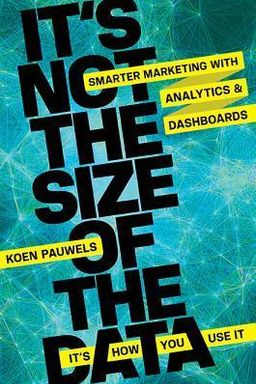
How can you turn the overwhelming flood of marketing data into insight that really changes how you work? In It's Not the Size of the Data — It's How You Use It, Koen Pauwels argues that the future of marketing depends not on amassing more data, but on mastering the tools, processes, and culture that translate data into action. He contends that marketing's credibility and success hinge on its ability to connect activities to measurable business results. In an era when chief marketing officers face relentless pressure for accountability, the book offers a playbook for building, using, and sustaining what's called a marketing analytics dashboard—a framework that integrates data, analytics, metrics, and decisions into one coherent system.
Pauwels draws on years of consulting and research with companies like SAP, Procter & Gamble, Unisys, and small firms like Inofec to reveal how dashboards empower teams to track, analyze, and improve performance. But the point is not the technology—it's the marriage of human judgment and hard analytics. The author warns that many organizations have gorgeous dashboards yet make poor decisions because they lack the strategy or discipline to interpret the numbers. The book is therefore both a practical manual and a cultural manifesto for marketers who want to transform data into strategic execution.
From Metrics to Meaning
At its core, Pauwels distinguishes between dashboards that simply report performance—what he calls pretty but passive—and analytics dashboards that diagnose and predict performance. A true dashboard is not just a snapshot of current metrics; it’s an interactive tool that connects marketing actions to outcomes like revenue, profit, and brand equity. Imagine driving a car: You see the speedometer, but you also feel how the vehicle responds to pressing the gas pedal. Marketing dashboards should do the same—they should reveal how strategy moves the business, not merely how fast it's going. In Pauwels’s definition, a marketing analytics dashboard is “a concise set of interconnected performance drivers viewed in common across the organization.” It connects teams, clarifies goals, and guides decision-making toward measurable impact.
Why Dashboards Transform Organizations
The book situates dashboard adoption within a larger revolution of accountability. Marketers today face four major challenges: fragmented data, managerial bias, lack of cross-department integration, and pressure to prove business impact. Dashboards address each one. They consolidate siloed systems, counteract human gut instincts with evidence, link marketing to finance, and make performance transparent across departments. When done well, dashboards become the hub for organizational learning—what strategic scholar Robert Kaplan might call the bridge between measurement and management. As a result, decisions stop being isolated or political and start being fact-based. Pauwels insists that this transparency not only builds profitability but also shifts corporate culture toward trust and shared understanding.
A Roadmap for the Dashboard Journey
The book unfolds as a step-by-step roadmap for organizations at any scale. Early chapters help you compare dashboards to other management systems like the Balanced Scorecard (which measures strategic outcomes but lacks real-time flexibility). Later chapters explore how to build databases, assemble teams, gain executive and IT support, choose key metrics, and design visual layouts that make insights intuitive. The second half dives into advanced analytics—distinguishing key leading performance indicators (KLPIs) from simple KPIs, incorporating online and social media metrics, and adapting dashboards for emerging markets. The final sections tackle implementation, renewal, and the cultural shifts required to sustain accountability.
Dashboards, Pauwels explains, are living systems. They evolve as strategies change, markets mature, and new technologies emerge. The most successful companies treat them not as rigid scorecards but as dynamic learning instruments. In this sense, the dashboard is less about software than about mindset. It teaches marketers to ask: What happened? Why did it happen? What will happen if? And what should happen now?
Data and Judgment—Not Data Versus Judgment
Across all chapters, Pauwels emphasizes that analytics should complement—not replace—human judgment. Even the best metrics cannot predict the future without managerial interpretation. He cites Jonathan Becher of SAP, who reminds us that “we can’t let metrics completely displace experience.” Dashboards provide evidence, but leadership provides meaning. This balance of science and art defines modern marketing: “Science enriches the art, and art accelerates the science.” The book’s stories—from Inofec’s fourteenfold profit increase to Discover Financial Services’ empowerment of middle managers—show how numbers drive creativity when teams use dashboards to test, learn, and act.
Ultimately, It’s Not the Size of the Data is a call to action for any marketer frustrated by ad hoc reporting or intuition-based decision making. Pauwels argues that when you measure what truly drives results—and make those metrics visible and actionable—you create a culture where every employee can see how their work contributes to growth. The payoff isn’t just smarter marketing; it’s smarter management overall. In a business world drowning in data, the author offers a lifeline: Don’t just swim in the numbers—navigate with them.