
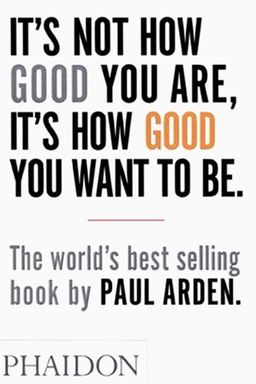
It’s Not How Good You Are, It’s How Good You Want to Be cover

It’s Not How Good You Are, It’s How Good You Want to Be

by Paul Arden

Dive into the mind of legendary ad man Paul Arden as he reveals the secrets to turning ambitious dreams into reality. Learn how to think big, break away from mediocrity, and pitch ideas effectively in the competitive world of advertising.

How to Truly Be Rich: What Wealth Really Means

What does it really mean to be rich? Is it having millions in the bank, a luxury car, or the freedom to buy whatever you want? Andy Stanley’s How to Be Rich challenges that entire mindset. Instead of teaching you how to acquire more wealth, he reveals how to handle what you already have — because if you live in the modern Western world, odds are, you’re already rich. The problem, Stanley argues, is that most people simply don’t know it. And because they don’t know it, they’re not very good at being rich.

Rethinking Riches

Stanley begins with the startling truth that most of us are among the wealthiest people in history — and yet we rarely feel rich. In Chapter 1, he shows that “rich” is a moving target. Everyone defines it as having double what they currently possess, meaning no one is rich, but everyone knows someone who is. This endless chase mirrors other cultural illusions, like anorexia, where people think they’re never thin enough despite already being far beyond healthy. We are, he says, in a constant state of financial dysmorphia.

The average Western earner often ranks in the top 1–4% globally, yet feels anxious, stretched, and unsatisfied. Stanley insists that this isn’t a problem of wealth; it’s a problem of awareness and mindset. The goal isn’t guilt over being rich but gratitude for the blessings you already enjoy. Without that gratitude, wealth becomes spiritually toxic — producing arrogance, misplaced hope, and greed.

From Having to Being

Stanley’s big idea is simple but revolutionary: being rich is not about how much you have, but about what you do with what you have. He interprets 1 Timothy 6:17–19, where the apostle Paul instructs the rich “not to be arrogant nor to put their hope in wealth” but to “do good, to be rich in good deeds, and to be generous and willing to share.” Stanley unpacks this passage across seven chapters, describing how wealth subtly distorts your worldview, why generosity counteracts its effects, and how planning ahead for generosity creates long-term spiritual health.

He explains that money does things to people. It makes us feel smarter, more capable, even better looking, leading us to confuse net worth with self-worth. Over time, hope “migrates” from God to riches. The paradox, Stanley insists, is that the wealthier you become, the more you tend to depend on money for security — and the more anxious you grow about losing it.

The Antidote to Affluenza

Just as Edward Jenner invented the vaccine to protect against smallpox, Stanley uses this metaphor to describe generosity as the vaccine against “affluenza” — the spiritual illness that wealth can cause. Without conscious practices of giving, serving, and sharing, we become consumed by what Stanley calls “the consumption assumption”: the belief that everything we have is meant for our own use. Over time, that belief makes us spiritually sick — self-centered, fearful, and detached from purpose.

Generosity, then, isn’t just a virtue; it’s a form of financial health care. By giving strategically and sacrificially, we neutralize arrogance and realign hope toward God. Planning generosity, as Stanley recommends through his “three Ps” framework — priority, percentage, and progressive giving — keeps us spiritually immune to the disease of self-sufficiency.

From Ownership to Stewardship

One of Stanley’s most powerful reframes occurs in his chapter on the “ownership myth.” He reminds us, through King David’s prayer in 1 Chronicles 29, that everything ultimately belongs to God. David gives billions toward constructing the temple and prays, “Everything comes from you, and we have given you only what comes from your hand.” This radically redefines wealth: if everything is God’s, you’re a manager, not an owner. Managers don’t feel guilty for what they possess — they feel responsible for how they use it.

From this perspective, generosity isn’t a burden but a privilege. It’s how we honor God with all we’ve been entrusted with. Stanley connects this mindset to eternity — the idea that “there’s more to life than this life.” When you view your money through the lens of eternity, your grip on it loosens, and its grip on you weakens.

Rediscovering Early Christian Generosity

The book closes with a return to history. In the early centuries, Christianity spread not through doctrine or force, but through generosity. Stanley recounts how first-century believers shocked the Roman world by caring for strangers and enemies, nursing the sick during plague outbreaks, and helping pagans who couldn't repay them. Emperor Julian, unable to revive paganism, lamented that Christians “support not only their own poor but ours as well.” Their “inexplicable compassion,” Stanley notes, was the most powerful argument for their faith.

Stanley’s hope is that such radical, contagious generosity can happen again today — that the church could once again be known for love expressed through sacrificial giving and service. You don’t become rich by acquiring more, he concludes; you become rich by using what you have to bless others and honor God. That transformation begins by realizing you’re already rich — and choosing, today, to be good at it.


Learning to Be Good at Being Rich

Stanley insists that wealth doesn’t come with instructions. Being good at being rich is an acquired skill — one that requires learning, practice, and discipline. In Chapter 2, "Learning Curve," he compares wealth management to parenting: having a child doesn’t make you good at raising one, and having money doesn’t make you wise with it.

Wealth Distorts Our Sense of Balance

Money, Stanley warns, has a dizzying effect on its owners — like a figure skater spinning at high speed. Without learning to stay balanced, you lose perspective. He borrows from Paul’s instructions in 1 Timothy 6:17, noting that riches naturally pull their possessors toward arrogance and self-sufficiency. Wealth creates a gravitational field that bends your sense of reality.

For example, Stanley recounts meeting billionaires who worried about having “enough,” proving that fear and insecurity don’t vanish with fortune. He tells the story of Ella, a church secretary whose hope migrated from God to her husband’s pension plan. When the company laid him off just before retirement, her spirit collapsed. She didn’t lose her faith, but she lost her hope. Stanley’s point: hope tends to migrate toward money — and when it does, even strong believers become spiritually unstable.

The Side Effects of Wealth

Stanley lists two main side effects: arrogance and misplaced hope. Arrogance inflates self-worth, confusing identity with possessions. Misplaced hope turns money into a substitute for God. Together, these side effects form what he calls a spiritual illness. If wealth came with warning labels, it would read: May cause arrogance. May impair perception. May result in hope migration.

The Cure: Redirecting Hope

So what’s the cure? Paul’s solution is to direct your hope “in God, who richly provides.” Stanley turns this into a mantra: “I will not trust in riches, but in him who richly provides.” Repeating this simple truth, he says, reshapes your inner posture toward money. Trusting in God protects you from arrogance by producing gratitude, and it stops your hope from migrating toward your bank account.

Ultimately, Stanley explains, learning to be good at being rich means retraining your heart. It’s not about earning more or budgeting smarter; it’s about keeping your spiritual balance in a culture that constantly spins you toward self-reliance. Wealth can distort you — unless you learn to spot the signs and deliberately anchor your hope in God.


Breaking the Consumption Assumption

In Chapter 3, Stanley turns to what Jesus calls greed: the assumption that everything placed in your hands is intended for your consumption. He calls this mindset the "Consumption Assumption", and it’s the root of most financial anxiety and spiritual discontent.

McClellan’s Mistake

He illustrates this with the story of General George McClellan during the Civil War. Though McClellan commanded one of the largest armies in history, he refused to engage, hoarding resources and waiting for “just a little more.” President Lincoln visited and observed that McClellan wasn’t fighting the war — he was guarding his own fortune. “This is not my army’s mission,” Lincoln realized. “This is McClellan’s bodyguard.” Stanley uses this metaphor to show how people with plenty often act like stewards of their own possessions rather than servants of a larger mission.

Jesus’ Warning

Stanley revisits Luke 12, where Jesus tells the story of a rich man whose land yields an abundant harvest. Instead of sharing it, he tears down his barns to build bigger ones and tells himself, “Take life easy.” Jesus calls him a fool because his life would end that night and his riches would serve only himself. Stanley highlights the moral: the problem isn’t saving or planning, but assuming all surplus is for personal use. The solution — being "rich toward God" — means directing excess not into storage, but into stewardship.

What You Need Versus What You’re Given

Everyone has seasons of abundance. The key, Stanley says, is to ask different questions about your surplus: not "What can I buy?" but "Why do I have this extra?" If your mindset shifts from ownership to opportunity, generosity becomes natural. Paul’s command “to be generous and willing to share” isn’t moral pressure; it’s spiritual protection. Hoarding wealth locks you in a false sense of security. Giving unlocks joy and purpose.

Breaking the consumption assumption requires a conscious shift from accumulation to contribution. Stanley’s practical advice — planning generosity in advance — ensures that money flows through you rather than sticking to you. It’s the difference between being rich and being good at being rich.


The Vaccine Against Affluenza: Generosity

In Chapter 4, Stanley introduces the concept of Affluenza — a spiritual illness caused by wealth. Just as Edward Jenner’s vaccine inoculated people against smallpox, generosity immunizes us against the toxic effects of affluence. But generosity, Stanley insists, has to be planned and intentional, not spontaneous or guilt-driven.

The Three Ps

Stanley’s framework for "vaccinating" your heart consists of three Ps: Priority giving, Percentage giving, and Progressive giving.

  • Priority giving means giving first, before spending or saving. By making generosity the first check you write, you symbolically declare where your hope lies.
  • Percentage giving means choosing a consistent share of your income to give. The amount matters less than the proportion because percentages reveal your heart’s true allegiance.
  • Progressive giving means raising your giving over time. As your wealth grows, your percentage should too, keeping generosity as the antidote to complacency and arrogance.

Vaccinating Before the Outbreak

Stanley compares those early generosity steps to Jenner’s patients willingly exposing themselves to illness for long-term health. Giving when it feels least comfortable reorients your values ahead of temptation. Waiting until you “have enough” to give ensures you’ll never start — because wealth never feels sufficient. Like a vaccine, generosity strengthens your system against the disease of selfishness before it strikes.

Spontaneous vs. Strategic Giving

Stanley warns that most people give in three S’s: spontaneously, sporadically, and sparingly. That kind of generosity is emotion-driven and temporary. Strategic giving, by contrast, becomes a lifestyle — one that produces sustained joy. The goal isn’t merely “giving to charity” but building generosity into the rhythm of your life. (Dave Ramsey and John Maxwell, whom Stanley cites, echo this mindset: giving strategically keeps money from owning you.)

To be good at being rich, you must immunize yourself regularly. The three Ps act as booster shots that maintain gratitude, humility, and perspective — qualities that vanish when money dictates your sense of identity.


Cultivating Contentment and Awareness

In Chapter 5, Stanley explores a hidden enemy of generosity: discontentment. Rich people, he says, don’t like being told “no” — even when telling themselves “no” is the only way to stay free from greed. The appetite for more is insatiable; it always says one word: “More.”

Contentment as the Real Gain

Quoting Paul, Stanley states, “Godliness with contentment is great gain” (1 Timothy 6:6). Choosing contentment over consumption doesn’t mean denying desire — it means mastering appetite. He explains that appetites never diminish by feeding; they grow stronger. To shrink them, you have to starve them, which is why contentment is both radical and liberating. In his church small group, Stanley observed that couples were most content when they had less money. Their joy during lean years surpassed their satisfaction during wealthy ones.

Awareness Management

To control discontentment, you must manage awareness — the information and images you allow to influence you. Advertising fuels dissatisfaction by raising brand awareness and lowering gratitude. Awareness, Stanley says, can work both ways: it can incite envy, or inspire generosity. His vivid example of his wife Sandra resisting a $3,000 outfit because she envisioned how that money could feed orphans in Rwanda captures this power perfectly. Awareness of need made desire fade instantly.

Using Awareness for Good

Stanley recommends two practical steps: increase awareness of others’ needs by volunteering and stories; and decrease awareness of what you don’t have by minimizing exposure to advertising and comparison. Stay out of malls, unsubscribe from catalogs, and instead immerse yourself in service. Awareness of what matters restores balance. “You miss money you waste,” Stanley writes, “but you never miss money given to meet a need.”

Contentment and awareness together disable the appetite for more. They allow you to enjoy abundance without letting abundance define you. When practiced, these disciplines transform giving from mere charity into genuine joy — and that joy is the hallmark of being rich God’s way.


The Ownership Myth: Managing What Belongs to God

Chapter 6 introduces the most transformative principle of Stanley’s framework: you don’t own anything — you manage everything. He calls this the Ownership Myth. Wealth tempts us to see ourselves as owners, but Scripture defines us as stewards. Stanley illustrates this through King David’s prayer when dedicating resources for the Temple (1 Chronicles 29:11–14). David’s words — “Everything comes from you, and we have given you only what comes from your hand” — make ownership vanish. We give to God what was already his.

Honor God with All You Possess

Stanley simplifies this principle into a single goal: Honor God. Honoring God means managing your money, possessions, reputation, and opportunities in ways that reflect his ownership. He likens it to a museum curating art “on loan.” The Louvre still owns every piece, but the High Museum must preserve and display them faithfully. Misusing sacred assets would ruin the partnership — and your credibility.

Beyond the Ten Percent

Stanley challenges traditional tithing that stops at 10%. Even faithful givers can still fall into the Ownership Myth by assuming the remaining 90% is theirs to use however they wish. True stewardship considers everything, not just a percentage. Whether saving, spending, or investing, each act should aim to honor God’s purposes — including caring for people, investing in values that matter, and rejecting fear-based hoarding.

Viewing Wealth Through Eternity

Finally, Stanley connects stewardship to eternity. Quoting Paul again, he notes that this life is the “present age,” but another age — the eternal one — follows. Generosity here echoes forever. Jesus’ warning that gaining the world but losing your soul (Mark 8:36) reminds us to view our possessions through eternity’s lens. When you do, you loosen your grip on your wealth, and wealth loosens its grip on you. This doesn’t mean poverty; it means peace.

The Ownership Myth dismantles fear and pride. You can be rich without arrogance, and generous without guilt, because your job isn’t to give away everything — it’s to manage everything well. “God doesn’t want to take your money,” Stanley writes. “He just doesn’t want your money to take you.”


Generosity That Changed the World

In Chapter 7, Stanley zooms out to the grand narrative of history. The early Christian movement, he says, survived against impossible odds — not because of power or wealth, but because of generosity. When the Roman world operated by liberalitas (give in order to receive), Christians introduced a shocking alternative: giving with no expectation of return.

From Liberalitas to Kindness Economy

Roman emperors tossed coins to citizens to cultivate loyalty. Every gift was transactional. But Jesus flipped the script. His teachings — love your enemies, lend without expecting repayment, and do good anonymously — established an entirely new economy: the kindness economy. Acts of compassion became the currency of influence. This ethos produced communities that cared for widows, orphans, and even pagan neighbors abandoned during plagues.

Stories of Inexplicable Compassion

Stanley recounts San Pachomius, a young pagan drafted into the Roman army. During a famine, a band of Christians risked their lives to feed prisoners through the bars of his cell. Their selfless act converted him — and he later became a saint and leader in the early church. Emperor Julian, trying to revive paganism, complained that Christians “support not only their own poor but ours as well.” The generosity of believers was so radical that it reshaped the moral consciousness of the empire.

It Can Happen Again

Stanley closes with a challenge: radical generosity once transformed the world, and it can do so again. His own church’s “Be Rich” campaign mirrors this vision by surprising charities with large donations and volunteer hours without asking for anything in return. These modern acts echo the ancient church’s spirit — restoring the reputation of faith through compassion.

The conclusion urges readers to give like rich people, plan generosity, and live for eternal impact. You can take hold of life “as it was meant to be lived,” Stanley writes, when your faith migrates away from fortune and toward the One who richly provides. That is how you truly be rich — and how generosity changes the world one humble act at a time.

Dig Deeper

Get personalized prompts to apply these lessons to your life and deepen your understanding.

Go Deeper

Get the Full Experience

Download Insight Books for AI-powered reflections, quizzes, and more.